

 Back to other articles


 Last updated: September 18, 2026



 Interviews
 Investment banker
 Analytical thinking, Statistics and probability
 Deeply researched
Investment banking brainteasers are one of the trickiest parts of the interview process to prepare for. Many are created on the spot by interviewers, which means you can’t simply memorize answers beforehand.
That’s EXACTLY why top firms use them. Brainteasers test how well you structure your thinking, stay composed under pressure, and make logical assumptions in ambiguous situations, all of which are essential skills in a field as demanding as investment banking.
It can feel intimidating, which is why we’ve put together this guide. Here, we share how IB brainteasers work, the different types you might encounter, sample questions, a framework for solving them, plus a fully worked answer and expert tips to help you prepare with confidence.
- What are investment banking brainteasers?
- Different types of IB brainteaser questions (with examples)
- How to answer IB brainteasers (framework + sample answer)
- Tips for answering brainteasers in investment banking interviews
- How to prepare for IB brainteasers
Click here to practice 1-on-1 with investment banking ex-interviewers
Let’s get started.
1. What are brainteasers in investment banking interviews? ↑
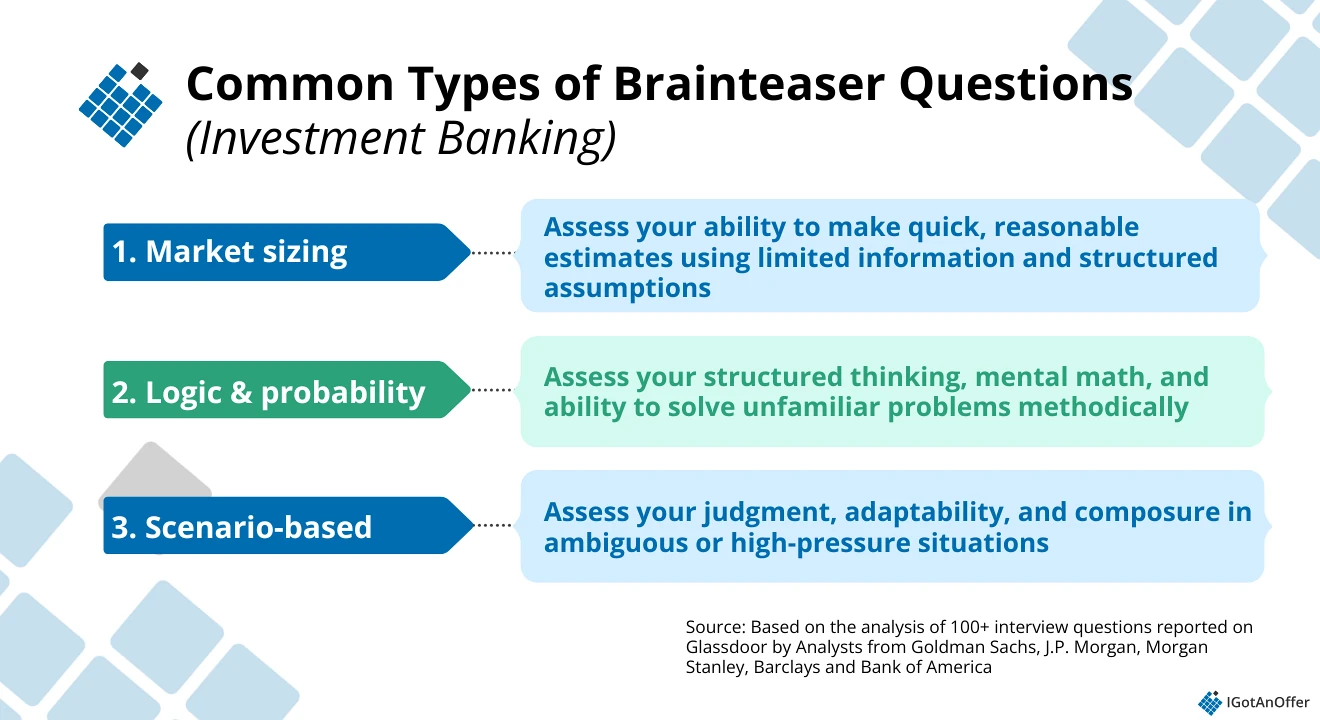
Some firms, especially Goldman Sachs, include brainteasers to test candidates’ logical thinking and problem-solving skills. These curveball questions often take the form of market sizing, logical and probability questions, as well as scenario-based questions (more on this in Section 2).
According to Justin (ex-Goldman Sachs investment banker), there is no one “correct” answer to these problems. Rather, interviewers want to see whether you can “break ambiguous problems into logical components, make reasonable assumptions, and communicate clearly while thinking in real time.”
These questions are designed to simulate the kind of ambiguity investment banking analysts deal with on the job, where decisions often need to be made quickly with incomplete information and under significant pressure.
1.1 What skills do investment banking brainteasers test?
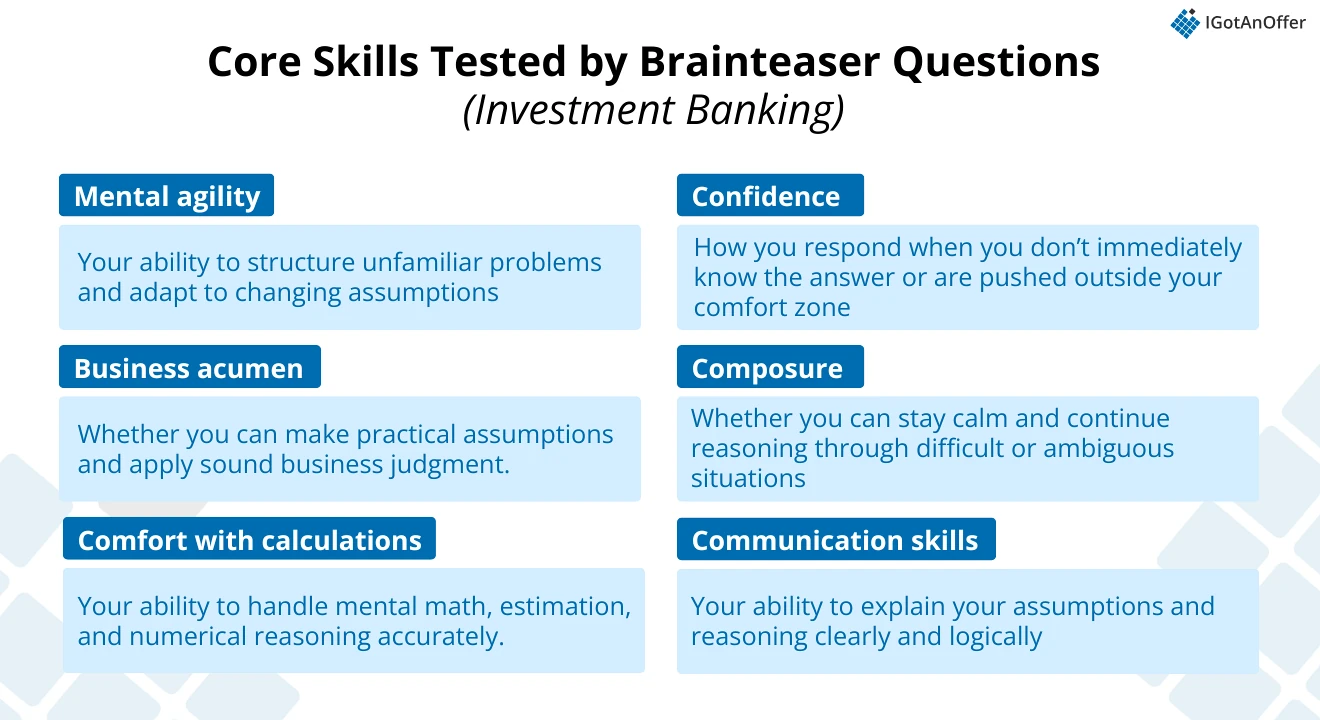
According to Tymo (ex-investment banker and interviewer), IB brainteasers are designed to evaluate candidates on the following core competencies:
- Mental agility: Your ability to adapt quickly and structure your thinking when faced with unfamiliar problems, changing assumptions, or incomplete information
- Business acumen: Whether you can make practical assumptions and approach problems with sound business judgment (e.g. estimating product demand, evaluating trade-offs, or deciding how to allocate capital)
- Comfort in performing calculations: Your ability to handle mental math, estimation, and numerical reasoning confidently and accurately
- Confidence: How you react when you do not immediately know the answer or are pushed outside your comfort zone. Interviewers want to see whether you can stay composed and continue reasoning through the problem.
- Comfort in facing challenges: Whether you can stay composed and continue reasoning through difficult or ambiguous situations
- Communication skills: Your ability to explain your assumptions and reasoning clearly and logically
Coaches who contributed to this guide













2. Different types of brainteasers asked in IB interviews (with examples) ↑
Now that you have an idea of how IB brainteaser questions work and what they test, let’s dive into the three most common types you’ll encounter, according to investment banking experts Nikita (Evercore Analyst) and Justin (ex-Goldman Sachs Investment Banker).
Feel free to skip to a specific type of question:
For each category, we’ve included real sample questions sourced from Glassdoor for the IB analyst role at top firms, including Goldman Sachs, J.P. Morgan, Morgan Stanley, Barclays, and Bank of America.
Right, let’s get into each.
2.1 Market sizing questions ↑
These are the most common types of investment banking brainteasers. As an IB analyst, you’ll often need to make quick estimates around market demand, company value, deal size, or revenue potential during live deals and client discussions.
According to Nikita, candidates should at least have a few key anchor figures (e.g., population size, rough GDP, demographic splits, average household size) memorized to help make reasonable estimates and support their assumptions.
Let’s look at some sample questions below.
Example of IB brainteasers: market sizing questions
- How many tennis balls can fit inside a Tesla? (Goldman Sachs)
- T-Mobile is planning on placing orders for the new iPhone. How would you estimate how many phones they should order? (Goldman Sachs)
- Estimate the annual revenue of a coffee shop. (Goldman Sachs)
- Estimate how many Uber rides occur in NYC each day. (Goldman Sachs)
- Approximate the Total Addressable Market (TAM) for a niche software product. (Goldman Sachs)
- How many cigarettes are sold in the US each year? (J.P. Morgan)
- How many coins would fit in this room? (J.P. Morgan)
- Market sizing the gum industry in America (J.P. Morgan)
- How many people do you think speak Bengali in Japan? (J.P. Morgan)
- How many light bulbs are there in New York? (Barclays)
- How many balls could you fit into this room? (Bank of America)
- How would you value an apple tree? (Goldman Sachs / Barclays)
To answer market sizing brainteasers, we always recommend using this 4-step framework. Here’s an overview:
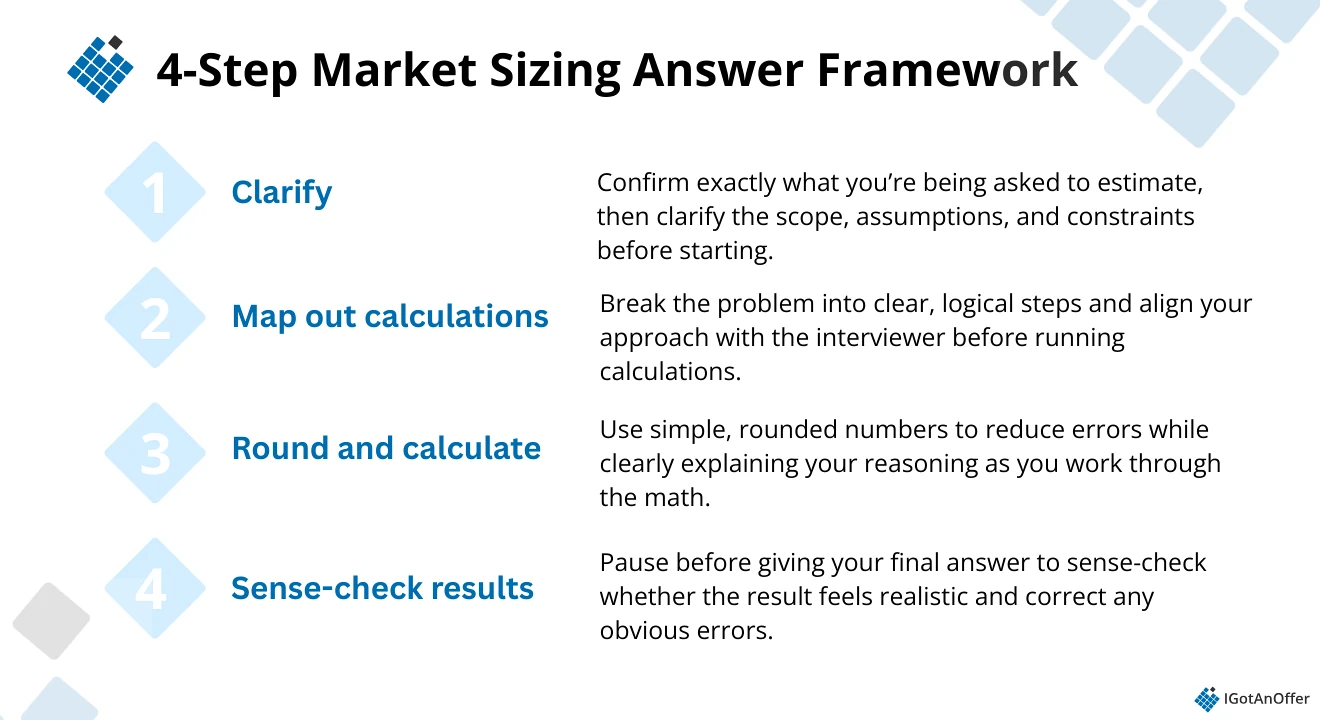
This framework helps you structure unfamiliar problems, make reasonable assumptions, and communicate your reasoning clearly during interviews.
To strengthen your estimates, see our market sizing cheat sheet for commonly used figures such as U.S. population, GDP, and average household size.
Then, check out our ultimate guide to market sizing questions for a deeper deep dive into the topic, additional examples, and fully worked sample answers.
2.2 Logic and probability questions ↑
Logic and probability questions are more structured than market sizing questions and often involve numbers, patterns, sequencing, or logical reasoning.
Banks use these questions because IB analysts regularly work through detailed financial problems, test assumptions, and explain complex analyses to senior bankers and clients. Interviewers want to assess whether candidates can think methodically, perform calculations accurately, and avoid careless errors when solving unfamiliar problems.
Example of IB brainteasers: logic and probability questions
- Which number is closest to 27 squared: 600, 700, or 800? (Goldman Sachs)
- If there is a piggy bank that will deposit $100 per year, how much would you buy that piggy bank? (J.P. Morgan)
- If you look at a clock and the time is 9:45, what is the angle between the hour and minute hands? (Goldman Sachs)
- What is the angle between the hands at 3:15? (Barclays)
- Calculate the derivative of a complex logarithmic function. (Goldman Sachs)
2.3 Scenario-based questions ↑
Scenario-based questions place you in a hypothetical situation and ask how you would respond. You’ll usually be given a role, a set of constraints, and a conflict to resolve.
Justin says many of these questions are intentionally vague or unusual because interviewers want to evaluate your composure and adaptability. This reflects the reality of investment banking, where analysts regularly weigh trade-offs, assess risks, and respond to changing priorities during live deals.
Example of IB brainteasers: scenario-based questions
- If your sister’s wedding were tomorrow and a live deal was closing tomorrow, which event would you prioritize? (Morgan Stanley)
- What would you do with 10 million dollars? (Bank of America)
- If you could be any animal, what would it be? (Morgan Stanley)
3. How to answer IB brainteaser questions (framework, sample answer) ↑
As mentioned earlier, most of the brainteaser questions you’ll encounter in investment banking interviews are created on the spot. Meaning, there’s no way for you to memorize answers.
A great workaround for this, according to Justin (ex-Goldman Sachs Investment Banker), is to learn a repeatable framework for structuring your answers.
Here’s one that he recommends to candidates:
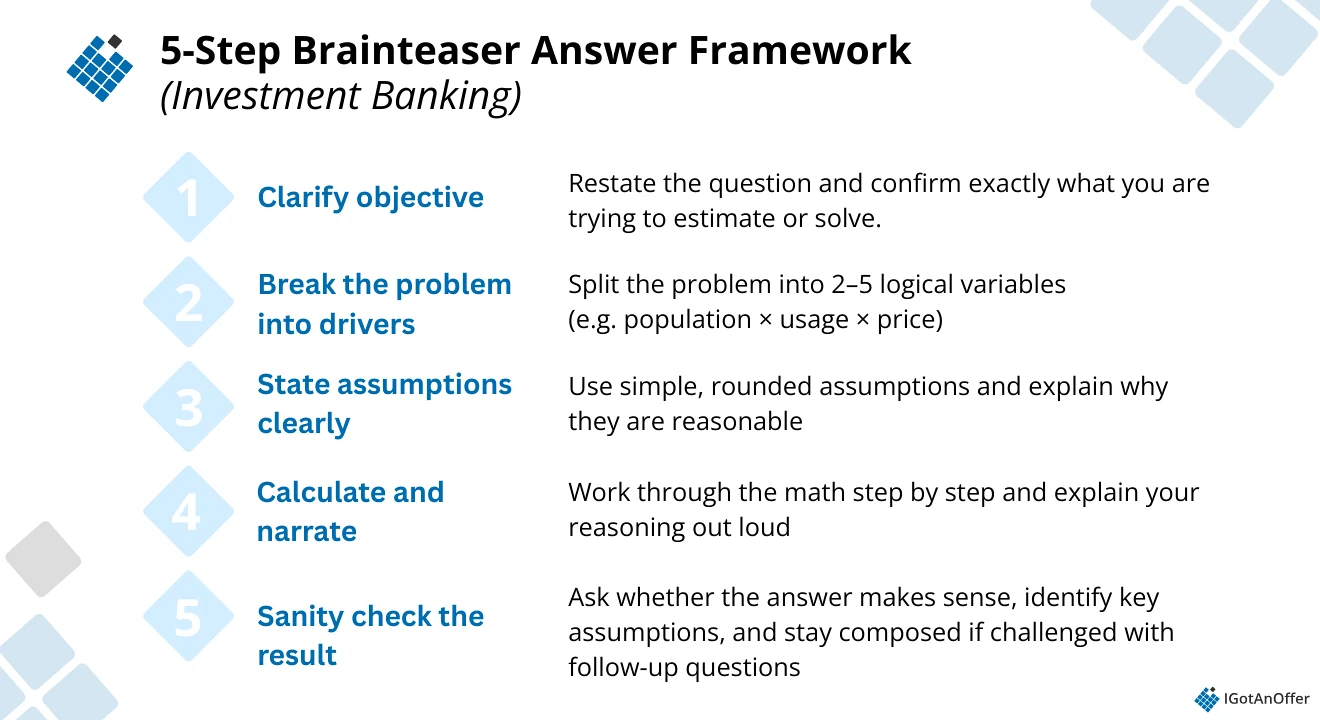
For a more detailed overview:
5-step framework for answering IB brainteasers
Step 1: Clarify the objective
Restate the question and confirm exactly what you are trying to estimate or solve. Ask clarifying questions if the prompt is vague or missing important details.
Step 2: Break the problem into drivers
Break the problem into 2 to 5 logical variables or inputs. For example, a market sizing question might be broken down into: population × penetration rate × usage frequency × price.
Step 3: State assumptions clearly
Use simple, rounded assumptions and explain why they are reasonable. Interviewers care more about the quality of your assumptions and reasoning than about giving perfectly precise answers.
Step 4: Calculate cleanly and narrate your thinking
Work through the calculation step by step, keeping your units consistent and explaining your logic out loud so the interviewer can follow your reasoning and guide you if needed.
Step 5: Sanity check the result
Before giving your final answer, ask whether the result makes sense in the real world. Identify which assumptions have the biggest impact on the estimate and explain how changing them would affect the answer.
Be prepared for follow-up questions where the interviewer changes a constraint or challenges one of your assumptions. Stay composed, adapt your reasoning, and continue working through the problem logically.
Now, let’s look at a sample answer to a classic market sizing brainteaser question using the framework above.
Sample IB brainteaser question:
How many tennis balls fit in a Tesla?
Step 1: Clarify the Objective
“First, I want to make sure I’m defining the scope correctly. We are estimating how many standard tennis balls can fit inside a standard Tesla sedan (like a Model 3), assuming the car is empty (no passengers) but the interior fixtures (seats, steering wheel, console) remain intact.
Are we including the trunk and the "frunk" (front trunk), or just the main passenger cabin? For this calculation, I will assume we are filling the entire available cargo and cabin space to maximize the count.”
Step 2: Break the Problem into Drivers
“To solve this, we need to determine the total available volume of the Tesla and divide it by the effective volume of a single tennis ball.
The core equation is:
Number of Tennis Balls = Total Interior Volume of Tesla / Effective Volume of a Tennis Ball
To get there, we need to look at total cargo and cabin capacity, the dimensions of a single ball, and a packing factor to account for the empty air gaps between spheres.”
Step 3: State Assumptions Clearly
“Let's establish some clean, round numbers for our variables:
- Tesla Volume: A mid-size sedan has a total interior and cargo volume of roughly 3 cubic meters. Since 1 meter is 100 cm, 1 cubic meter equals 1,000,000 cubic centimeters. That gives us a total volume of 3,000,000 cubic centimeters.
- Tennis Ball Dimensions: A standard tennis ball has a diameter of roughly 7 cm.
- Packing Efficiency Shortcut: Instead of calculating the volume of a sphere and applying a 64% packing density, I’m going to assume each ball occupies the space of a cube with 7 cm sides. Treating the spheres as cubes inherently bakes in the empty space between them.
- Effective Ball Volume: 7 x 7 x 7 equals 343 cubic centimeters. Let’s round this to 350 cubic centimeters to keep the upcoming division clean.”
Step 4: Calculate Cleanly and Narrate
“Now, dividing the total volume of the car by the effective volume of one ball: 3,000,000 cubic centimeters divided by 350 cubic centimeters per ball.
To simplify this in my head, I’ll drop a zero from both sides, which gives me 300,000 divided by 35.
- I know 35 x 2 = 70.
- 70 x 4 = 280 (so 35 x 8 = 280).
- Therefore, 35 x 8,000 = 280,000.
- That leaves us with 20,000 remaining. 35 goes into 200 just under 6 times, so 35 goes into 20,000 roughly 570 times.
Adding those together gives us approximately 8,570 balls. I will round this to a baseline of 8,500 to 9,000 tennis balls.”
Step 5: Sanity Check the Result
“Let's sanity check this. A standard case contains 24 cans of 3, which equals 72 balls. 9,000 balls divided by 72 is roughly 125 cases of tennis balls. Visualizing a Tesla with the seats down, stacking 125 medium-sized cardboard shipping boxes into the cabin and trunks feels tight, but entirely plausible.
The most sensitive variable here is the Tesla's volume. If we were to remove the rear and passenger seats entirely, we could likely increase the available volume by 25% to 30%, pushing our estimate past 11,000. Given that variability, I would provide a final reasonable range of 9,000 to 12,000 tennis balls.”
4. Tips for acing brainteasers in investment banking interviews ↑
For this section, we’ve gathered tips from two investment banking experts, Nikita (Evercore Analyst) and Justin (ex-Goldman Sachs Investment Banker). Together, they’ve interviewed and coached dozens of candidates for investment banking roles at top firms across the industry.
Here are their tips for answering IB brainteasers, based on what they’ve seen on the ground:
4.1 Take a moment before responding
Don’t rush into your answer. It’s completely fine to ask the interviewer for a few moments to think or to repeat the question if needed.
Use that time to clarify what they’re asking, identify the information you need, and decide what steps you’ll take to solve the problem. This helps you avoid jumping into the wrong approach too quickly.
4.2 Be prepared to talk about the economy and financial markets
Some brainteasers, especially market sizing and scenario-based questions, require a solid understanding of business and financial markets. Interviewers may ask you to make assumptions about consumer demand, industry trends, or market conditions while working through a problem.
Be prepared to discuss:
- Macroeconomic trends (e.g. how inflation affects consumer spending)
- Interest rates and central bank policy
- Industry or sector trends
- Recent market events or transactions
4.3 Be comfortable performing quick mental math
Calculators are not usually allowed in investment banking interviews. While you won’t be expected to perform complex modeling, many brainteasers involve quick estimation, percentages, ratios, or rough calculations.
If you’re out of practice, regularly exercise your mental math muscle to become as fast and accurate as possible. Khan Academy has several helpful resources for refreshing your arithmetic skills. Here are a few we recommend:
Once you're feeling comfortable with the basics, you'll need to regularly exercise your mental math muscle to become as fast and accurate as possible.
You might want to use some of the following resources. We haven't tested all of them, but some of the candidates we work with have used them in the past and found them helpful.
- Preplounge's math tool. This web tool is very helpful to practice additions, subtractions, multiplications, divisions, and percentages. You can both sharpen your precise and estimation math with it.
- Mental math cards challenge app (iOS). This mobile app lets you work on your mental math easily on your phone. Don't let the old-school graphics deter you from using it. The app itself is actually very good.
- Mental math games (Android). If you're an Android user, this one is a good substitute for the mental math cards challenge one on iOS.
4.4 Practice estimating everyday situations
One surprisingly effective preparation method is practicing estimation on everyday situations, says Nikita (Evercore Analyst).
For example, try estimating the annual revenue of your local coffee shop, the number of rideshare trips in your city each day, or the number of customers a restaurant serves in a week.
This helps you build the habit of breaking large problems into smaller assumptions and performing rough calculations quickly, which is exactly what interviewers look for in market sizing brainteasers.
4.5 Learn a consistent framework
Candidates who rely too heavily on memorized examples often struggle when interviewers slightly change the prompt or introduce new constraints, says Justin (ex-Goldman Sachs Investment Banker).
Instead, use a consistent framework that you can apply across different types of brainteasers. For example, for market sizing questions, you can use the simple 4-step approach we shared in Section 2.1: Clarify the problem -> map out your calculations -> use rounded assumptions -> sense-check your final estimation.
This helps you stay organized, adapt to new information, and communicate your reasoning more clearly during the interview.
4.6 State your assumptions
Refusing to make assumptions is one common mistake Justin sees in candidates during brainteaser interviews.
Interviewers usually won’t give you all the information needed to solve the problem. You’ll have to make reasonable assumptions to narrow down the question and work toward an answer.
State your assumptions clearly so the interviewer can either accept them or guide you in a different direction.
4.7 Catch the hints
Most interviewers have good intentions and may give subtle hints about how to approach a brainteaser.
If an interviewer questions one of your assumptions or pushes back on your reasoning, pay attention. They are often trying to steer you toward a more logical approach. Candidates sometimes get flustered and miss these cues, but picking up on hints shows adaptability and coachability.
4.8 Perform a sanity check
It’s easy to get caught up in calculations or assumptions during brainteasers. Before giving your final answer, take a moment to step back and ask whether your estimate or reasoning actually makes sense.
For example, if your market sizing estimate suggests an unrealistically large market or an impossible level of demand, you should be able to identify and correct it. Catching your own mistakes demonstrates good judgment and attention to detail.
4.9 Communicate clearly
Communicate your thought process out loud so that the interviewer can follow along. Interviewers are usually more interested in your reasoning than your final answer.
As you work through the problem, explain your assumptions, calculations, and logic step by step instead of jumping straight to a conclusion. This also makes it easier for interviewers to guide you if needed.
4.10 Stay composed when challenged
Many candidates become visibly flustered when they don’t immediately know the “right” answer or when interviewers challenge their assumptions. But most brainteasers do not have a single correct answer.
Interviewers are usually evaluating how you react under uncertainty. Stay calm, think through the problem step by step, and be willing to adjust your approach if new information or constraints are introduced.
5. How to prepare for IB brainteasers ↑
Brainteaser questions are unpredictable. You’ll need to structure unfamiliar problems, make reasonable assumptions, and explain your logic clearly under pressure. However, they’re manageable with the right preparation.
Use every resource available to you. This could include your network, upperclassmen, alumni, school clubs, mentors, or peers.
For example, you can speak with someone who has interviewed at your target firm, practice market sizing or logic questions with classmates, or ask a mentor to challenge your assumptions and reasoning during mock interviews.
In addition to that, we’d also like to share some resources to help you prepare.
5.1 Research the company you’re applying to
In many cases, investment banking brainteaser questions will reflect the firm’s industry focus, interview style, and the types of commercial problems their bankers typically work on. If you’re applying to a specific team, study their recent transactions, industry coverage, and priorities.
Take the time to understand which types of clients or projects you’d most likely be working on based on the job description, and research them thoroughly. Look up relevant deal announcements, investor presentations, and press releases so you can speak confidently about the company’s recent activities and how you would contribute to similar transactions.
If you want to learn more about your target firm, check out the resources below. We’ve included useful links for the top 8 firms commonly regarded as “bulge bracket” banks, known for their large-scale deals and rigorous hiring processes:
Goldman Sachs
- Goldman Sachs’ purpose and values (By Goldman Sachs)
- Goldman Sachs Briefings newsletter (By Goldman Sachs)
- Goldman Sachs strategy teardown (by CB Insights)
J.P. Morgan
- Who we are (By JP Morgan)
- JP Morgan weekly brief (By JP Morgan)
- JP Morgan strategy teardown (by CB Insights)
Morgan Stanley
- A culture-driven strategy (by Morgan Stanley)
- Insights (by Morgan Stanley)
- Comparison Morgan Stanley vs Goldman Sachs (by Investopedia)
Bank of America
- Bank of America core values (by Bank of America)
- BofA Insights (by Bank of America)
- BoFa strategy teardown (by Rancord Society)
Citigroup
- About Citi
- Insights (by Citi)
- Citi’s plan to transform its wealth business (by Euromoney)
Barclays Capital
- About Barclays
- Barclays’ three-year plan (by Barclays)
- Barclays’ official interview prep guide (by Barclays)
UBS Investment Bank
- About UBS
- UBS sustainability and impact strategy (by UBS)
- UBS checklist for interview prep (by UBS)
Deutsche Bank
- About Deutsche Bank
- Deutsche Bank strategy (by Deutsche Bank)
- Deutsche Bank interview prep guide (by Deutsche Bank)
5.2 Practice by yourself
Acing brainteaser questions in IB interviews is harder than it looks. You’ll stand out if you put in the required work to craft concise and direct answers.
We recommend starting with our guides below to prepare for your brainteaser questions. You’ll also find a few additional articles that can help you understand the full IB interview process:
Brainteasers
General
- Investment banking interview prep guide
- Investment banking interview process
- Investment banking interview questions guide
- 15 investment banking interview tips
- Investment banking interview cheat sheet
- How to answer “Why X company” question
- Investment banking technical questions guide
- Investment banking behavioral & fit questions guide
- Investment banking interview accounting questions guide
- Investment banking HireVue interview guide
- Investment banking Superday interview guide
- How to network your way into investment banking (by ex-Merrill Lynch director Mike)
- How to make your LinkedIn profile more visible to IB recruiters (by ex-Merrill Lynch director Mike)
- Investment Banking Fit Questions Masterclass (by ex-Blackstone MD Kent)
Goldman Sachs
- Goldman Sachs interview prep guide
- Goldman Sachs behavioral interview guide
- Goldman Sachs HireVue interview guide
J.P. Morgan
- JP Morgan interview prep guide
- JP Morgan behavioral interview guide
- JP Morgan HireVue interview guide
Morgan Stanley
- Morgan Stanley interview prep guide
- Morgan Stanley behavioral interview prep guide
- Morgan Stanley HireVue interview guide
5.3 Practice with peers
If you have friends or peers who can do mock interviews with you, that's an option worth trying. It’s free, but be warned, you may come up against the following problems:
- It’s hard to know if the feedback you get is accurate
- They’re unlikely to have insider knowledge of interviews at your target company
- On peer platforms, people often waste your time by not showing up
For those reasons, many candidates skip peer mock interviews and go straight to mock interviews with an expert.
5.4 Practice with ex-investment banking interviewers
In our experience, practicing real interviews with experts who can give you company-specific feedback makes a huge difference.
If you know someone who runs interviews at an investment bank, then that’s amazing! They'll be a great person to practice interviews with.
But most of us don’t, and it can be REALLY tough to make a new connection with an investment banker. And even if you do have a good connection already, it might also be difficult to practice multiple hours with that person unless you know them extremely well.
That’s where mock interviews come in.
Find an investment banking interview coach so you can:
- Test yourself under real interview conditions
- Get accurate feedback from a real expert
- Build your confidence
- Get company-specific insights
- Save time by focusing your preparation
Click here to book investment banking mock interviews with experienced finance interviewers.