

 Back to other articles
 Last updated: September 18, 2026
 Interviews
 Investment banker
 Deeply researched
If you have received an invite to an investment banking Superday interview, congratulations! You have successfully progressed past a significant number of applicants.
At this stage, banks are confident that you possess the technical skills needed for the job. The real question is how you compare to the other candidates with similar credentials.
It may feel high stakes, but we’ll walk you through everything you know to secure an offer. Below, you’ll find a detailed breakdown of IB Superday interviews, real questions reported by candidates on Glassdoor, expert tips, and a preparation plan to ace your interviews.
- What to expect in IB Superday interviews
- Types of questions asked in IB Superday interviews
- Tips for acing IB superday interviews
- How to prepare
Click here to practice 1-on-1 with investment banking ex-interviewers
Let’s get started.
1. Overview: Investment banking Superday interviews
Before we go through the types of questions asked in IB Superday interviews, let’s first take a look at what these interviews are and how they work.
1.1 What are IB Superday interviews?↑
Superday interviews (or “Assessment Centre” in the UK) are the final round of interviews in the investment banking hiring process. These typically consist of 3-6 back-to-back interviews, each lasting around 30-45 minutes. Interviews may be conducted 1-on-1 or 2-on-1 (two interviewers in a single session).
Depending on the bank, superdays may be held virtually via Zoom or Microsoft Teams, or candidates may be invited to attend in person.
In some cases, the Superday may include more unique interview formats. For example, Morgan Stanley uses a group exercise and sometimes an individual presentation to evaluate candidates.
In addition to the formal interviews, you may also participate in networking events, coffee chats, or informal meals with bankers and staff. According to Amir (ex-Morgan Stanley), it’s important to “stick to protocol” and treat these interactions as part of the evaluation process.
This is because recruiting teams often collect feedback from everyone involved, including assistants, receptionists, and lunch hosts. They use these in-between moments to assess your social skills, professionalism, and overall fit with the firm.
If you pass, you can expect to hear back within 24 to 48 hours. Other candidates may be placed on hold or waitlisted while final decisions are made.
1.2 How do Superday interviews work?↑
Different companies may have slightly different formats for Superday interviews. Below, we break down how the process works at major banks, such as Goldman Sachs, J.P. Morgan, and Morgan Stanley.
1.2.1 Goldman Sachs Superday interviews
Goldman Sachs conducts its Superday interviews back-to-back, either in-person or via Zoom. The process typically includes 3 to 5 rounds, each lasting about 30 minutes.
Here’s an overview:
Process
- 3-5 back-to-back interviews (~30 minutes each)
- Interviewers typically include associates and VPs, occasionally an MD
- Usually bankers from the division you applied to
Types of Questions
- Deep technical questions (e.g., discounted cash flow analysis, comparable company analysis, accounting walk-throughs, and basic leveraged buyout logic)
- Behavioral and cultural fit questions
- Brainteasers
You generally won’t encounter group exercises or formal case studies in Goldman Sachs Superdays. However, interviewers may ask you to discuss past deals or hypothetical scenarios to test your analytical thinking (e.g., “Walk me through how you would value Company X”).
1.2.2 J.P. Morgan Superday interviews
The format for J.P. Morgan Superdays is quite similar to Goldman Sachs'. You can expect 3 to 5 back-to-back interviews at J.P. Morgan's offices, although you may still get the occasional virtual interview.
Here’s an overview:
Process
- 3-5 back-to-back interviews (30-45 min each)
- Often conducted in a 2-on-1 format
- Interviewers range from associates to MDs
- Usually held in person, occasionally virtual
Types of Questions
- Behavioral and competency-based questions (e.g., "Tell me about a time you handled a conflict with a team member" or "Describe a situation where you had to act with integrity")
- Technical questions (e.g., 3-statement flows, DCF analysis, enterprise value concepts, and accretion/dilution math)
- Economic / market awareness questions (e.g., "Pitch me a stock you like," "Where do you think the S&P 500 will be in 12 months?" or "How do interest rates affect M&A activity?")
- Brainteasers (e.g., "What is the angle between the hour and minute hand at 3:15?" or "How many ping pong balls fit in a Boeing 747?")
Some candidates also report receiving a brief execution-based case study where you are asked to walk through a slide deck or a set of financial statements and provide a recommendation to a hypothetical client.
1.2.3 Morgan Stanley Superday interviews
Morgan Stanley Superdays are quite unique from Goldman Sachs’ and JPM’s. Instead of just the typical series of interviews, Morgan Stanley superdays are broken down into three parts:
- 2-5 interviews (~30min each)
- A group exercise
- An individual presentation (some roles)
Let’s go through what to expect in each one.
- Interviews: You will likely face at least two people in each interview, and they’ll be of varying levels of seniority across the division you’re applying to (associate, VP, MD, and executive director). Be prepared to answer behavioral/fit (e.g., questions around Morgan Stanley’s 5 core values) and technical questions (e.g., DCF, LBO, three financial statements).
- Group exercise: This allows Morgan Stanley to observe your teamwork and leadership skills. A common setup involves candidates discussing budget allocation at an imaginary firm, where one is appointed head of department, and others propose projects for funding.
- Individual presentation: This is more for people in roles where presentations are part of the job (like Sales), but we have seen reports of banking analysts doing them too. If you’re asked to do a presentation, you’ll be given a short time to research a question before having to present your findings.
1.3 What skills are being tested in Superday↑
According to Amir (ex-Morgan Stanley), IB candidates are typically assessed in the following competencies:
- Technical acumen tests your quantitative ability and whether you have the hard skills to perform the job. Interviewers need to know you can be trusted with complex financial modeling and data analysis without constant supervision.
- Business acumen tests your ability to think like an investor rather than just a calculator. It separates candidates who have merely memorized technical guides from those who actually understand how businesses operate and how markets move.
- Culture fit is often the deciding factor in a Superday. Since investment banking requires long hours and high-pressure teamwork, this assesses your resilience, maturity, and social skills.
1.4 Who can expect Superday interviews?
Superdays are most common for junior roles such as full-time IB analysts and summer analysts, but depending on the bank, they may also be used for associate hiring.
Lateral hires or candidates joining from another bank or a related finance role may also go through a Superday, particularly if they are entering at the analyst or associate level.
If you’re a more experienced hire, you probably won’t be invited to a Super Day. Instead, your final-round interview will consist of at least 3 consecutive interviews with team members of varying seniority, each lasting around 30 minutes.
How hard is it to get a Superday?
Getting an invite to a Superday is incredibly tough because you’re competing against a massive pool of ambitious, high-quality candidates.
To give you a sense of the odds, Goldman Sachs reported over 360,000 applicants for its 2025 internship program, yet only about 2,500 were selected. That’s an acceptance rate of roughly 0.7%.
If you want to improve those odds, networking, such as coffee chats with bankers and securing referrals, could help get your foot in the door. While it’s not a guarantee, the more people who know your name and can vouch for you, the better your chances of getting that Superday invite.
For more tips, see ex-Merill Lynch Director Mike's videos on how to network your way into investment banking and how to make your LinkedIn profile more visible to IB recruiters.
For more insider insights, we also recommend scheduling a coaching session with an investment banking expert who has firsthand experience with the Superday process.
Coaches who contributed to this guide





2. Types of questions asked in IB Superday interviews ↑
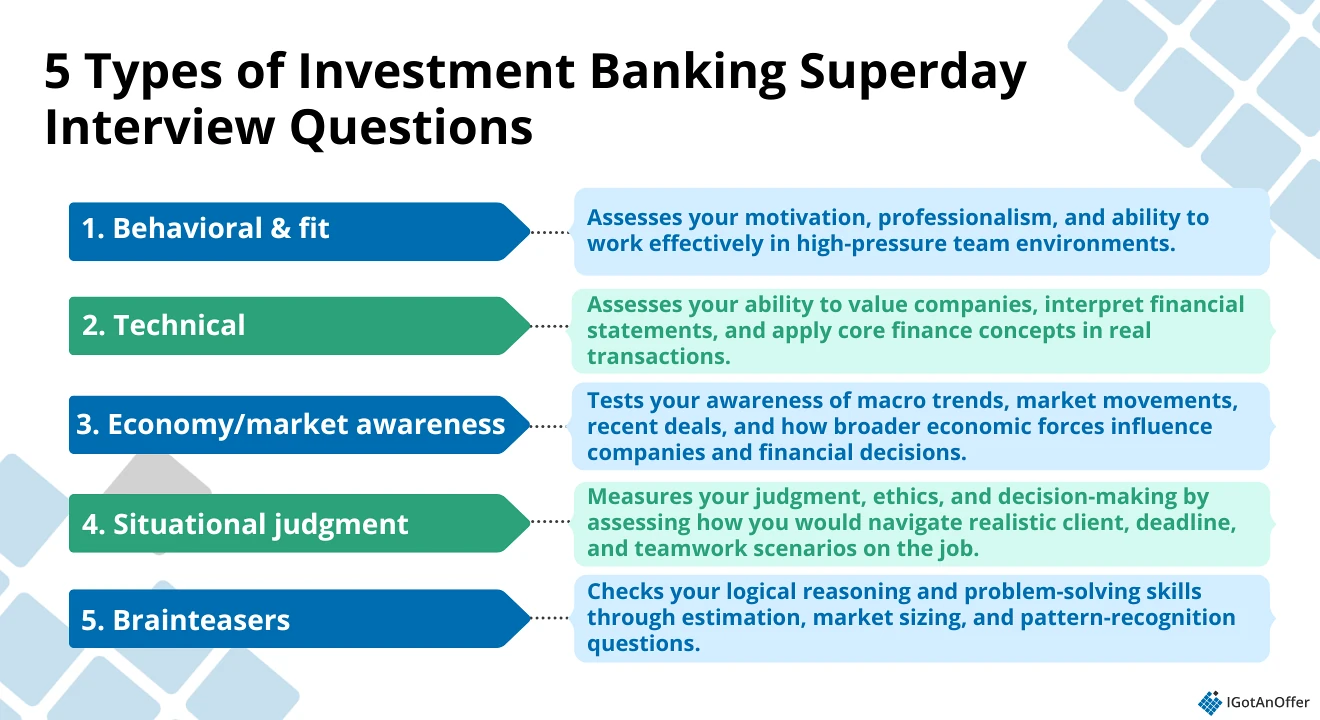
Now that you have an idea of what to expect in IB superday interviews, let’s dive into the five types of interview questions you can expect.
We have included real example questions reported by IB analysts on Glassdoor from Goldman Sachs, J.P. Morgan, and Morgan Stanley, along with links to sample answers for some of them.
Note that the types of questions you’ll get depend on the specific group you’re applying to (e.g., M&A, TMT, Healthcare). Behavioral questions and prompts like “Why X company?” tend to be similar across groups, while technical questions can vary significantly.
- Behavioral and fit questions
- Economic / market awareness questions
- Technical questions
- Situational judgement questions
- Brainteasers
Let’s get into the details.
1. Behavioral and fit questions ↑
Behavioral questions are by far the most common type of question you’ll face in your superday interviews.
Interviewers ask these questions to understand whether you have the motivation, temperament, and interpersonal skills needed to handle the demands of investment banking. And, if you would fit within their team and culture.
Behavioral and fit questions are based on the idea that past behavior is one of the strongest predictors of future performance. They prompt you to share real stories about your experiences, so interviewers can evaluate soft skills, such as problem-solving, leadership, communication, and handling conflict.
Be ready to link your answers to firm-specific values. For instance, Morgan Stanley interviewers often ask how you align with their "5 Core Values," Goldman Sachs probes for their "14 Business Principles," and J.P. Morgan focuses on their specific "Business Principles."
You can expect these questions fall under two formats:
- General questions, such as “why investment banking?” or “why should we hire you?”, which require individualized responses. These should sound natural and not overly scripted.
- Scenario questions that typically begin with “Tell me about a time…”, which can be answered using a repeatable framework, such as the traditional STAR method (Situation, Task, Action, Result) or, even better, IGotAnOffer’s SPSIL method (Situation, Problem, Solution, Impact, Lessons). These frameworks make it easier to present your experience clearly and highlight your impact.
If you want a deeper explanation, read our guide on why IGotAnOffer's SPSIL method can be more effective than STAR.
In the meantime, here are some practice questions sourced from real candidates on Glassdoor, plus links to useful resources.
Example behavioral & fit questions asked at IB Superday interviews
- Why Firm X? (i.e., Why Goldman Sachs?)
- Why investment banking?
- Tell me about a time you worked in a team
- Walk me through your resume
- Tell me about yourself
- Why should we hire you?
- Why this job?
- What are your strengths and weaknesses?
- Tell us about a time you had a problem and how you solved it
- What was your greatest challenge?
- Why did you choose your major?
- What are your career goals?
- What is your understanding of the role you will be doing?
- Tell me something about yourself that is not on your résumé.
- What would your co-workers say about you?
- How would your friends and family describe you?
- What do you do for fun outside of work?
- Why wouldn’t I hire you?
- How would you describe yourself in a single word?
- Tell us one thing about yourself that we should not know.
- What is the hardest thing you have experienced, and how did you overcome it?
- Tell me about a difficult time you worked in a team.
- Tell me about a time when a team member wasn’t pulling their weight. What did you do?
- Tell me about a time your team encountered an issue and how you handled it.
- Tell me about a time you had to work under pressure.
- Tell me about a time you had a leadership role. What challenges did you face?
- Tell me about a time you were persuasive.
- Tell me about a time you showed resilience.
- Tell me about a time you showed independent thinking.
- Tell me about a time you had to make a quick decision. What was your thought process?
- Tell me about a time you had to work outside of your normal schedule.
- Tell me about a time you had a positive impact on a project and how you measured success.
- Tell me about a time you dealt with a difficult client and how you handled it.
- Tell me about a time you used data to make a recommendation.
- Tell me about a time you had to present detailed or complex information. How did you ensure your message was clear?
- Tell me about a time you made a significant mistake and how you addressed it.
- Tell me about a time you experienced failure and how you recovered.
- Tell me about a time you had a conflict with someone and how you resolved it.
- Tell me about an ethical or moral dilemma you faced and what you did.
- Provide an example of a time you sought out relevant information and used it to form a plan of action.
- Tell me about a time you worked with someone you disliked. How did you manage the relationship?
For a complete list of practice questions, including sample answers and an answer framework, take a look at our guide to investment banking behavioral and fit interview questions.
For more tips on how to structure strong vs. weak responses, see ex-Blackstone Managing Director Kent's video on "Investment Banking Fit Questions Masterclass: Weak vs. Strong Answers."
2.2 Economic / market awareness questions ↑
Economic / market awareness questions in IB interviews assess your understanding of the market, deals, and the fundamental logic behind finance. As an IB analyst, you’re expected to understand how macro events affect valuations, capital markets activity, and client decisions.
You can expect these questions most commonly at J.P. Morgan, but you should be prepared for them when interviewing at any bulge-bracket or boutique firm.
To help you prepare effectively, we’ve grouped them into four sub-categories:
- Economy questions test your knowledge of current events, major market trends, and how these developments impact companies, valuations, and financial markets
- Deals questions assess whether you understand the industry and the key factors to consider when analyzing real M&A or capital markets transactions
- Industry questions evaluate your understanding of the investment banking landscape, what IB teams do, and how your target firm is positioned relative to competitors
- Investing questions gauge your ability to think like an investor by forming a clear thesis, evaluating a company, or explaining where you’d allocate capital
Below, we’ve listed REAL questions that past candidates have reported on Glassdoor and Reddit.
Example economic / market awareness questions asked at IB Superday interviews
Economy
- What is a recent headline you read in the news? (Goldman Sachs)
- Can you talk about one piece of economic news and its impact on the market? (Goldman Sachs)
- Tell me about a current event that will impact the financial markets. (JPMorgan)
- What is a recent market event that interested you? (Morgan Stanley)
- How will recent tariffs on China impact trade deals? (JPMorgan)
- Where do you see the S&P 500 going over the next 12 months? (Morgan Stanley)
Deals
- What is a recent IB deal you've seen, and what fascinates you about it? (Goldman Sachs)
- Tell me about a deal you’ve been following. (Goldman Sachs)
- Share an M&A deal that interests you. (Morgan Stanley)
- What is a recent transaction that interested you? (Morgan Stanley)
- Walk me through a recent Morgan Stanley deal. (Morgan Stanley)
Industry
- What is something that you recently heard about our company? And why is it important?
- What is investment banking?
- How can an investment bank add value?
- What technology will be trendy in the next 6–12 months? (Goldman Sachs)
Investing
- Pitch a stock. (Goldman Sachs / Morgan Stanley)
- Describe [X company’s] business model (Goldman Sachs)
- Discuss a stock you’ve been following. (Morgan Stanley)
- Pitch me a stock where you would invest $1,000,000. (Morgan Stanley)
- What are the requirements for making a good investment?
2.3 Technical questions ↑
Technical questions can feel intimidating, especially if you’re unsure where to begin. In investment banking interviews, “technical” is an umbrella term that typically refers to valuation, accounting, and a few other (less common) question sub-types.
- Valuation questions test your ability to determine the value of a business
- Accounting questions assess your understanding of financial statements and core accounting principles
- Other technical questions touch on topics such as leverage ratios, beta, interest rate impacts, or other finance concepts that don’t neatly fall under valuation or accounting
You can expect technical questions during the Superday to be significantly more rigorous than those in your HireVue interview. HireVue questions typically ask you to define concepts (e.g., "Walk me through a DCF"), whereas Superday interviewers will ask you to apply those concepts, sometimes in the form of a brief case study (e.g., “A client is considering acquiring Company X. How would you think about valuing the target?”).
You should also expect follow-up questions (e.g., “How does that change if the tax rate increases?”) that test whether you have not simply memorized the answers.
If you don’t know where to start, we created an investment banking interview cheat sheet that highlights the most common technical topics you’ll need to know.
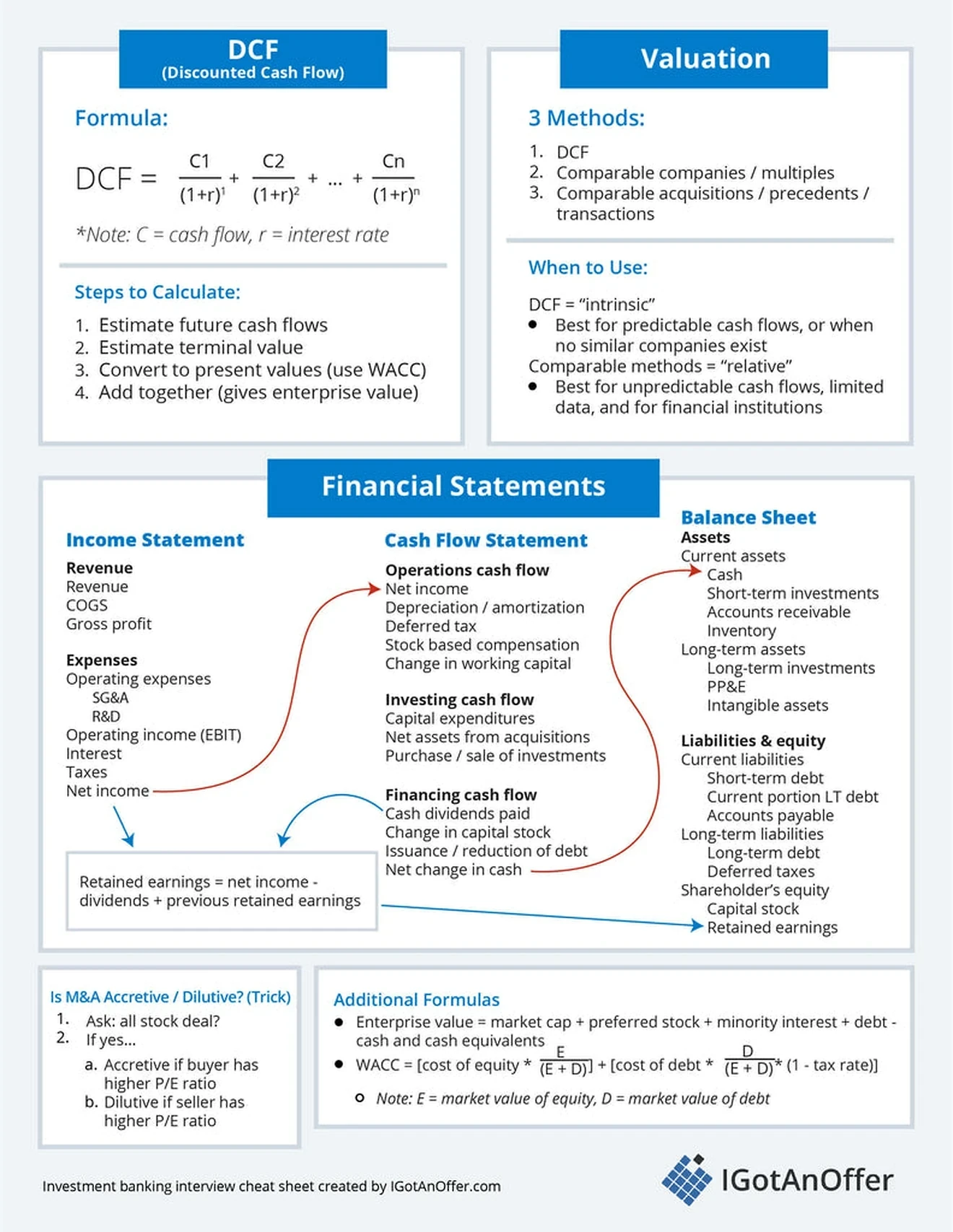
Click here to download the investment banking cheat sheet
Example technical questions asked at IB Superday interviews
Valuation
- Walk me through a discounted cash flow (DCF) analysis.
- What are the main methods of valuing a company?
- How would you value a company?
- How do you value a company with no revenue or profit?
- How would you value an apple tree?
- When would you not use a DCF to value a company?
- Give me a scenario where a DCF provides more insight than a multiples-based valuation.
- How would a DCF analysis differ for a biotechnology company?
- How would an increase in the corporate tax rate affect a DCF valuation?
- What is your view on price-to-earnings (P/E) versus enterprise value to earnings before interest, taxes, depreciation, and amortization (EV/EBITDA)?
- What happens to the value of a company if its cost of equity increases?
- What is the difference between enterprise value and market capitalization?
- How do you calculate the market capitalization of a company?
- Walk me from equity value to enterprise value.
- Why do we use earnings before interest, taxes, depreciation, and amortization (EBITDA)?
- What is the effect of a stock split on a company’s price-to-earnings (P/E) ratio?
- How do leasing rules under International Financial Reporting Standard 16 (IFRS 16) affect a DCF?
Accounting
- What are the three financial statements?
- How do the three financial statements link together?
- Walk me through the impact of a $10 increase in depreciation across all three statements.
- What is the effect on all three statements after a non-recurring impairment charge?
- How does goodwill impairment impact the financial statements?
- How do you go from earnings before interest, taxes, depreciation, and amortization (EBITDA) to free cash flow (FCF)?
- How do you calculate levered/unlevered free cash flow?
- Walk me through how purchasing $100 of assets affects the financial statements by the end of the year.
- What is the impact of an increase in accounts payable (AP) on cash flow?
- Walk me through a profit and loss (P&L) statement.
- Walk me through a balance sheet.
- Explain minority interest in simple terms.
- Explain the treasury stock method.
- Walk me through a $10 increase in depreciation and amortization (D&A).
- Explain the post-merger impact on the financial statements of two companies.
- What leverage ratios would you use to evaluate the risk on a company’s balance sheet?
- How do changes in interest rates affect corporate balance sheets?
Others (LBOs, M&As, etc.)
- Walk me through a leveraged buyout (LBO).
- What are the key drivers of an LBO model?
- What is the typical financing structure of an LBO?
- What is the typical timeline for an LBO?
- Would a financial sponsor and a strategic buyer pay the same price for a company if synergies were removed?
- If a buyer trading at 25x price-to-earnings (P/E) acquires a seller trading at 20x P/E, is the transaction accretive or dilutive?
- How do you calculate beta?
- What metrics would you examine to determine whether a company can repay a new loan?
- How are interest rates correlated with real estate investment trusts (REITs)?
- How would you build a sum-of-the-parts (SOTP) valuation for a drug launch?
- What does it mean for cash to have a price-to-earnings (P/E) ratio?
You can learn more about each type of question above and get an overview of how to solve them in our separate investment banking technical questions interview guide.
For more practice questions, refer to our guides on investment banking accounting questions and investment banking valuation questions.
2.4 Situational / judgment questions ↑
In addition to behavioral questions, you may also be asked situational judgment questions.
Instead of asking about past experiences, as behavioral questions do, you’ll be given a hypothetical scenario involving clients, deadlines, or teamwork. You’ll then be asked to explain how you would approach the situation. Expect to be evaluated based on your judgment, ethics, communication style, and ability to handle pressure.
Situational judgment questions help interviewers understand how you respond to the unexpected. They want to see whether you can adapt to evolving challenges and unfamiliar problems that may arise in the role you’re applying for, as well as in future positions.
Let’s look at some examples.
Example situational judgment questions asked at IB Superday interviews
- The person sitting in front of you during a test begins cheating. How would you handle the situation, and would you respond immediately or wait until afterward?
- You have a deliverable due tomorrow, but are missing a critical component, and your team is asleep. What do you do?
- You are working on a major client deal, and the client makes a request that violates firm policy. What would you do, and who would you escalate it to?
- What would you do if a major client’s request were illegal?
- If you had several urgent tasks to complete but not enough time, how would you prioritize them?
- You gave your manager a piece of work and later realized you made a mistake. What would you do?
- Your previous manager asks you for confidential information about a project you’re working on, claiming it’s needed for an important decision. How do you respond?
- Your team is facing activist pressure because one business segment is underperforming. How would you approach this challenge?
- If part of a company is facing severe headwinds, what steps would you take as an advisor?
- A client or teammate is struggling to understand complex information you need to present. How would you prepare, and how would you communicate it effectively?
- You are asked to support a live deal on the same day as an important personal commitment (e.g., a family event). What do you prioritize, and why?
For a simple framework on how to answer situational judgment questions, check out Section 1.4 of our IB behavioral & fit interview questions guide.
2.5 Brainteasers ↑
Finally, some firms, especially Goldman Sachs and J.P. Morgan, like to throw in a few brainteasers to measure your logical thinking and problem-solving skills. These curveball questions often come in the form of estimation or market sizing questions.
Let’s look at a few sample questions.
Example brainteaser questions asked at IB superday interviews
Market sizing
- Size the market of the gum industry in the United States.
- How many people do you think speak Bengali in Japan?
- How many cigarettes are sold in the United States each year?
- How would you estimate how many iPhones T-Mobile should order for the next release?
Estimation
- How many tennis balls can you fit into a Tesla?
- How many coins would fit in this room?
- How many light bulbs are there in New York?
Others
- Which number is closest to 272: 600, 700, or 800?
- If you look at a clock and the time is 9:45, what is the angle between the hour and minute hands?
- What is the angle between the hands at 3:15?
- If a piggy bank deposits $100 per year, how much would you pay for it?
For more information, check out our guide on IB brainteaser interview questions. It covers more example questions and insights relevant to this category.
Click here to download IGotAnOffer’s complete list of 150+ IB interview questions
3. Tips for acing IB Superday interviews ↑
Superdays are the final decision point in the recruiting process. By this stage, banks already know you meet the technical bar. The real question is how you differentiate yourself from the rest of the equally qualified candidates.
Here are eight tips to help you stand out and perform at your best on Superday.
3.1 Know your resume inside and out
Working on your resume doesn’t end at the application stage. Questions like “Walk me through your resume” and “Tell me about yourself” were among the most common behavioral questions reported by candidates across Goldman Sachs, J.P. Morgan, Morgan Stanley, Barclays, and Bank of America.
Your response to these questions will set the tone for the interview, and interviewers will often follow up by digging into your past experiences. Everything on your resume is fair game, so come prepared to talk about it in detail.
If you need help crafting your resume, check out our IB resume guide for tips and sample resumes from successful candidates.
3.2 Have a solid ‘about me’ introduction ready
Ice-breaker questions like “Why this firm?” or “Why investment banking?” almost always appear at the start of an interview. Unlike resume questions, these prompts test your motivation and whether you’ve done the research needed to show genuine interest in the role/company.
Think of these questions as an opportunity to give your elevator pitch: to tell your story and why this is a good fit for you in one to two minutes.
We’ve written in-depth guides on how to answer the most common ice-breaker and behavioral questions at Goldman Sachs, J.P. Morgan, and Morgan Stanley, but if you’re short on time, here are the most frequent questions we found in our research:
- Why this firm?
- Why investment banking?
- Tell me about yourself.
- Walk me through your resume.
- What are your strengths and weaknesses?
3.3 Center on the company’s culture and values
You should always align each story to a key competency and tailor your answers to the firm by referencing recent initiatives or cultural values.
Familiarize yourself with the firm’s core values and weave them naturally into your answers. In investment banking, interviewers often look for qualities such as teamwork, client focus, attention to detail, and integrity.
Keep in mind that your cultural alignment will be assessed throughout the entire interview process, not just during behavioral rounds.
For instance, at Goldman Sachs, you could demonstrate their focus on client service by sharing an example of how you supported a project under tight deadlines while ensuring that the quality of your work met client expectations.
3.4 Be prepared to talk about the economy and financial markets
Understanding the broader economy is essential for investment bankers. This is because market conditions directly affect a company’s financial performance and, by extension, how its financial statements are interpreted.
You should be ready to explain how changes in global and regional markets might affect a company’s revenue, expenses, financing costs, valuation, etc.
Be ready to give your views on:
- Macroeconomic trends (e.g., inflation, GDP growth, employment data)
- Central bank policy (e.g., rate hikes, quantitative easing, or tightening)
- Market movements (e.g., stock indexes, bond yields, or sector performance)
- Recent transactions that reflect how market shifts are influencing valuations or deal structure
To stay current, you can review market updates and analysis from reliable sources such as The Financial Times, The Wall Street Journal, Bloomberg, Reuters, and CNBC.
3.5 Mix and match
A common mistake candidates make when answering behavioral/fit questions is that they come up with only one story for each question.
However, you’ll probably have a lot of overlap with your stories. A story you use to answer a leadership question could easily work for a question on conflict, people management, or handling pressure.
If you practice adapting stories so they can answer various questions, 10-15 strong stories should be enough to get you through even the toughest interview.
3.6 Network, network, network
Talk to as many people from your target firm as possible before interviewing. It’s a great way to learn more about the firm from insiders’ perspectives.
You can also give yourself an advantage by name-dropping the people from the firm with whom you’ve made connections during the interviews. This shows the interviewers that you’ve gone the extra mile to get to know the firm and that you already have connections with your future teammates.
If you don’t already know anybody at your target firm, you can use LinkedIn to reach out to current employees. Search for people with a connection to you: alumni of your university or high school, people from the same hometown, a mutual connection, etc.
This will help you find a common ground to start the conversation and get to know each other with less of the awkwardness of a cold email.
To learn more, see ex-Merrill Lynch director Mike's videos on how to make your LinkedIn profile more visible to IB recruiters and how to network your way into investment banking.
3.7 Set up your environment and look the part
How you present yourself matters, whether you’re interviewing virtually or in-office.
If you’re interviewing virtually, choose a quiet, well-lit space where you won’t be interrupted. Keep your background clean, position your camera at eye level, and test your audio and internet connection beforehand.
If your Superday is in the office, arrive early and plan your route in advance to avoid unnecessary stress or delays.
Most importantly, dress professionally, regardless of where you’re interviewing. Amir (ex-Morgan Stanley) recommends wearing a proper business suit and tie, as appearance is critical in establishing immediate trust and credibility with senior bankers and high-net-worth clients.
3.8 Treat every interaction as an evaluation
Approach each interaction with the same level of professionalism you bring to your interviews. This includes coffee chats with bankers, conversations at networking events, and lunches during the Superday. As mentioned earlier, recruiting teams gather feedback from everyone involved in the process, non-interviewers included.
According to Amir, it’s also best practice to send thoughtful thank-you emails or notes to everyone you spoke with. This helps keep you top of mind and reinforces your interest in the role.
For more tips on how to set yourself apart in an investment banking interview, take a look at our list of 15 essential IB interviewing tips.
4. How to prepare for IB Superday interviews ↑
Superdays are competitive, but they’re manageable if you prepare properly.
Use every resource available to you. This could include your network, upperclassmen, alumni, school clubs, mentors, or peers.
For example, you can speak with someone who has gone through a Superday at your target firm, run mock interviews with classmates, or ask a mentor for feedback.
In addition to that, we’d also like to offer some resources to help you prepare.
4.1 Learn about the company’s culture
Most candidates skip this step. But before investing tens of hours preparing for interviews at top firms, take a moment to make sure it’s actually the right fit for you. This is important for two reasons.
First, most of these firms are prestigious, and it’s easy to assume you should apply without thinking it through. But prestige alone won’t guarantee satisfaction in your day-to-day work. What matters more is the kind of work you’ll be doing and the people you’ll be working with.
Second, having a clear understanding of a specific company's culture will give you an edge in your interviews, because it will help you frame your skills and experiences to align with what the company values.
If you know anyone currently at a firm or who has worked there before, reach out to learn about their experience and the team culture. In addition, we would recommend reading the following:
Goldman Sachs
- Goldman Sachs’ purpose and values (By Goldman Sachs)
- Goldman Sachs Briefings newsletter (By Goldman Sachs)
- Goldman Sachs strategy teardown (by CB Insights)
J.P. Morgan
- Who we are (By JP Morgan)
- JP Morgan weekly brief (By JP Morgan)
- JP Morgan strategy teardown (by CB Insights)
Morgan Stanley
- A culture-driven strategy (by Morgan Stanley)
- Insights (by Morgan Stanley)
- Comparison Morgan Stanley vs Goldman Sachs (by Investopedia)
Bank of America
- Bank of America core values (by Bank of America)
- BofA Insights (by Bank of America)
- BoFa strategy teardown (by Rancord Society)
Citigroup
- About Citi
- Insights (by Citi)
- Citi’s plan to transform its wealth business (by Euromoney)
Barclays Capital
- About Barclays
- Barclays’ three-year plan (by Barclays)
- Barclays’ official interview prep guide (by Barclays)
UBS Investment Bank
- About UBS
- UBS sustainability and impact strategy (by UBS)
- UBS checklist for interview prep (by UBS)
Deutsche Bank
- About Deutsche Bank
- Deutsche Bank strategy (by Deutsche Bank)
- Deutsche Bank interview prep guide (by Deutsche Bank)
4.2 Practice by yourself
Acing IB Superday questions is harder than it looks. You’ll stand out if you put in the required work to craft concise and direct answers.
We recommend starting with our guides below to prepare for your Superday interviews. You’ll also find a few additional articles that can help you understand the full IB interview process:
General
- Investment banking interview prep guide
- Investment banking interview process
- Investment banking interview questions guide
- 15 investment banking interview tips
- Investment banking interview cheat sheet
- How to answer “Why X company” question
- Investment banking interview accounting questions guide
- Investment banking valuation interview questions guide
- Investment banking HireVue interview guide
- Investment banking technical interview questions
- Investment banking behavioral & fit interview questions
- Investment banking brainteasers guide
- How to network your way into investment banking (by ex-Merrill Lynch Director Mike)
- How to make your LinkedIn profile more visible to IB recruiters (by ex-Merrill Lynch director Mike)
- Investment Banking Fit Questions Masterclass (by ex-Blackstone MD Kent)
Goldman Sachs
- Goldman Sachs interview prep guide
- Goldman Sachs behavioral interview guide
- Goldman Sachs HireVue interview guide
J.P. Morgan
- J.P. Morgan interview prep guide
- J.P. Morgan behavioral interview guide
- J.P. Morgan HireVue interview guide
Morgan Stanley
- Morgan Stanley interview prep guide
- Morgan Stanley behavioral interview prep guide
- Morgan Stanley HireVue interview guide
4.3 Practice with peers
If you have friends or peers who can do mock interviews with you, that's an option worth trying. It’s free, but be warned, you may come up against the following problems:
- It’s hard to know if the feedback you get is accurate
- They’re unlikely to have insider knowledge of interviews at your target company
- On peer platforms, people often waste your time by not showing up
For those reasons, many candidates skip peer mock interviews and go straight to mock interviews with an expert.
4.4 Practice with ex-investment banking interviewers
In our experience, practicing real interviews with experts who can give you company-specific feedback makes a huge difference.
If you know someone who runs interviews at an investment bank, then that’s amazing! They'll be a great person to practice interviews with.
But most of us don’t, and it can be REALLY tough to make a new connection with an investment banker. And even if you do have a good connection already, it might also be difficult to practice multiple hours with that person unless you know them extremely well.
That’s where mock interviews come in.
Find an investment banking interview coach so you can:
- Test yourself under real interview conditions
- Get accurate feedback from a real expert
- Build your confidence
- Get company-specific insights
- Save time by focusing your preparation
Click here to book investment banking mock interviews with experienced finance interviewers.









 Analytical thinking, Statistics and probability