

 Back to other articles






 Last updated: October 06, 2026
 Investment banker
 Case
Case Deeply researched
The first step to acing your investment banking interview is to familiarize yourself with the interview process. But if you’re interviewing at several banks, keeping track of every process might be overwhelming.
That’s why we’ve written this guide. We’ve done the research for you, so you can focus on your interview prep.
We’ve found that many banks, including Goldman Sachs, J.P. Morgan, and Morgan Stanley, follow a similar investment banking interview process. However, the exact steps can differ for summer analysts, full-time analysts, and associates, as well as by office.
We’ll walk you through each step and give you pointers on how you can go through each round with confidence to help you get an offer.
Here's what we'll cover:
- Role and salary overview
- Investment banking interview process
- Types of investment banking interview questions
- Investment banking interview tips
- How to prepare for investment banking interviews
Practice one-on-one with an investment banking interview coach
1. Investment banker role and salary overview ↑
Before we get into the investment banking interview process, let's first take a quick look at the role itself.
1.1 What does an investment banker do?
Investment bankers advise clients on major financial transactions, such as raising capital and buying, selling, or merging businesses. They work with clients in industries such as technology, healthcare, and energy.
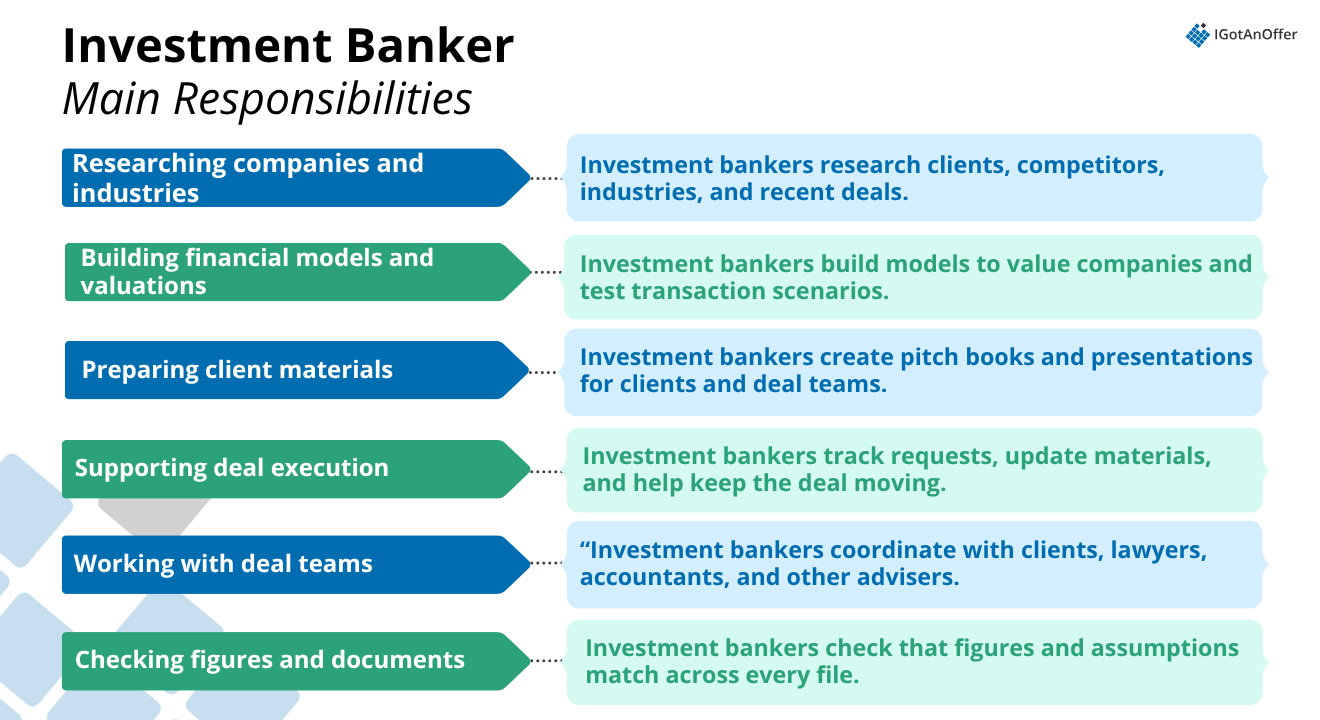
Your exact responsibilities will depend on your level, but common tasks include:Your exact responsibilities will depend on your level, but common tasks include:
Your level of responsibility will depend on where you are in your investment banking career. Here’s what you can expect as a summer analyst, full-time analyst, or associate:
- Full-time analysts usually join after university. They research companies, build models, and prepare client presentations.
- Summer analysts are interns, often working during the summer before their final year at university. They support deal teams while learning the job.
- Associates are a level above analysts. You can get there through promotion, join with relevant finance experience, or apply after an MBA. Associates check analysts’ work and help them with their tasks.
As an investment banker, your exact responsibilities will depend on your level, but common tasks include:
- Researching companies and industries. Bankers research companies, industries, market trends, and recent deals. They use what they find to recommend ways for clients to raise money or buy or sell a business.
- Building financial models and valuations. Bankers build and update models to value a company based on its financial results and expected future cash flows.
- Preparing client materials. Bankers are responsible for preparing pitch books and presentations for client meetings.
- Supporting deal execution. Bankers support the process from initial research to due diligence through to preparing financial transaction documents
- Working with deal teams. Bankers coordinate with clients, lawyers, accountants, and other advisers to move deals forward.
- Checking figures and documents. Bankers check figures, assumptions, and other details across financial models, presentations, and deal documents for accuracy and consistency.
1.2 Investment banker core competencies
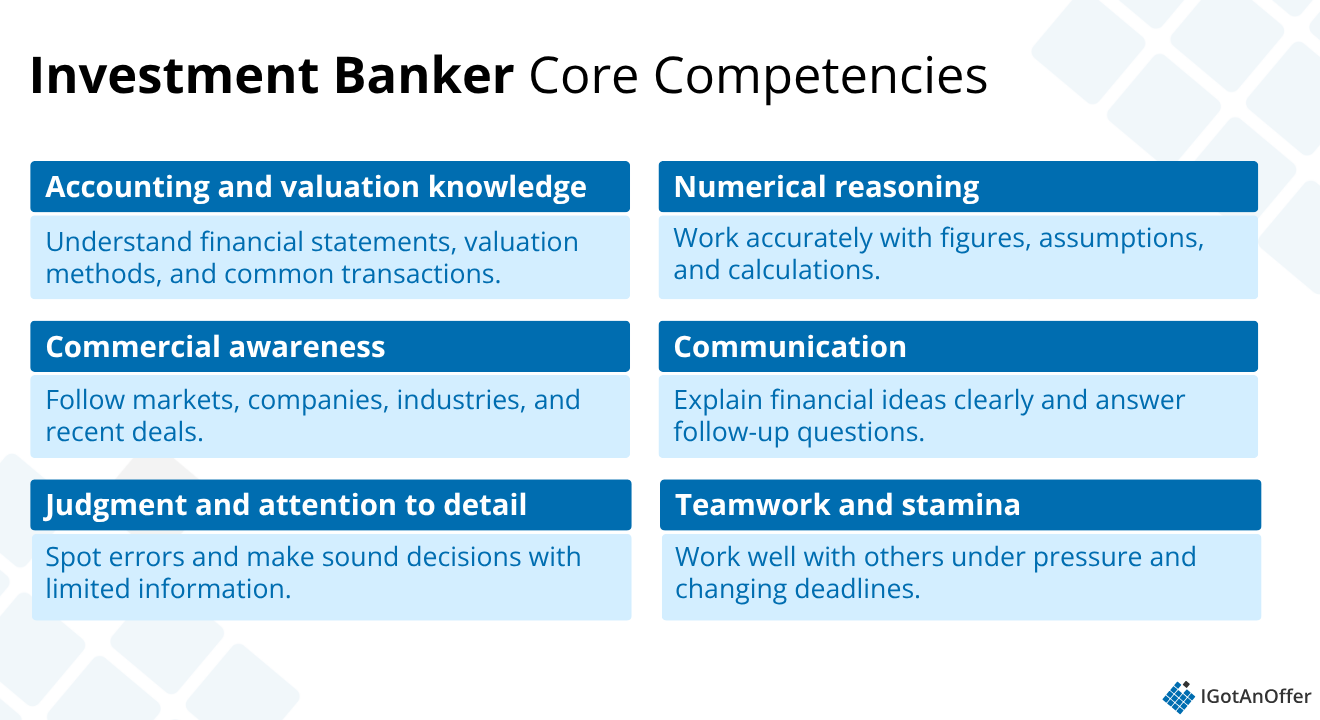
Different banks will more or less assess you on the same skills and foundational knowledge. According to IB experts Hashim (ex-Lazard and J.P. Morgan analyst), Susan (ex-Goldman Sachs IB associate), and Geert (ex-Deutsche Bank valuation specialist), here are six core competencies you should prepare for:
- Accounting and valuation knowledge. Good understanding of financial statements, methods for valuing a company, and how deals affect its finances.
- Numerical reasoning. How you work with figures, i.e., how you make estimates, calculate ratios, and check your answers.
- Commercial awareness. An interest in business news and an understanding of what it means for clients, whether they’re raising money, buying a company, or selling one.
- Communication skills. How well you explain your analysis to someone without finance knowledge and respond to their questions.
- Judgment and attention to detail. Accurate calculations and careful checks of client documents. You also need to recognize when you’re missing information and ask for help.
- Teamwork and stamina. How you work with colleagues when a deal gets busy, including disagreements, feedback, and last-minute requests.
You’ll find some differences in how banks test these skills. For example, in HireVue interviews, Goldman Sachs and J.P. Morgan may place more emphasis on market awareness, while Morgan Stanley may give more equal weight to behavioral, market, and basic technical skills.
1.3 How much does an investment banker earn?
According to Levels.fyi, average yearly total pay for full-time IB analysts, associates, and vice presidents at the three banks below ranges from $130K to $384K in the US. Total pay includes base salary, bonuses, and any reported stock payments.
Here is a quick summary of the average pay for IB analysts, associates, and vice presidents at Goldman Sachs, JPMorgan Chase, and Morgan Stanley in the US, based on Levels.fyi compensation data as of September 2026.
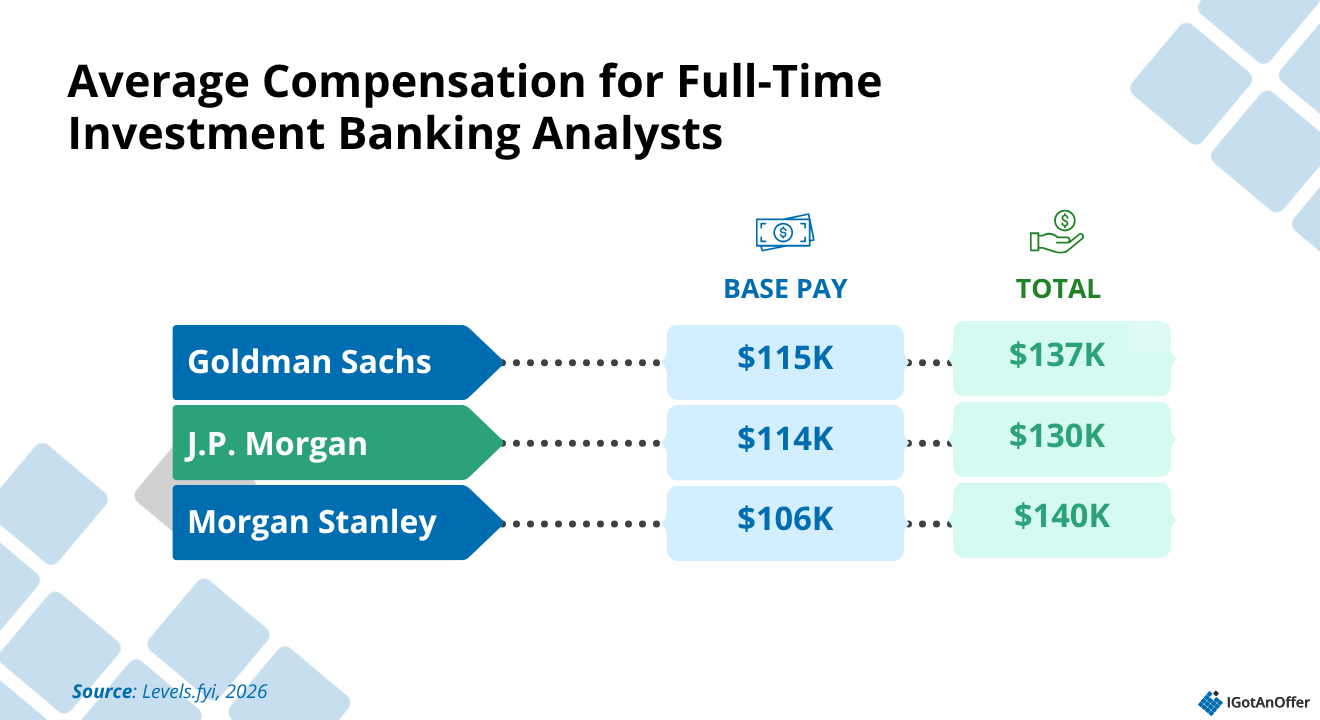
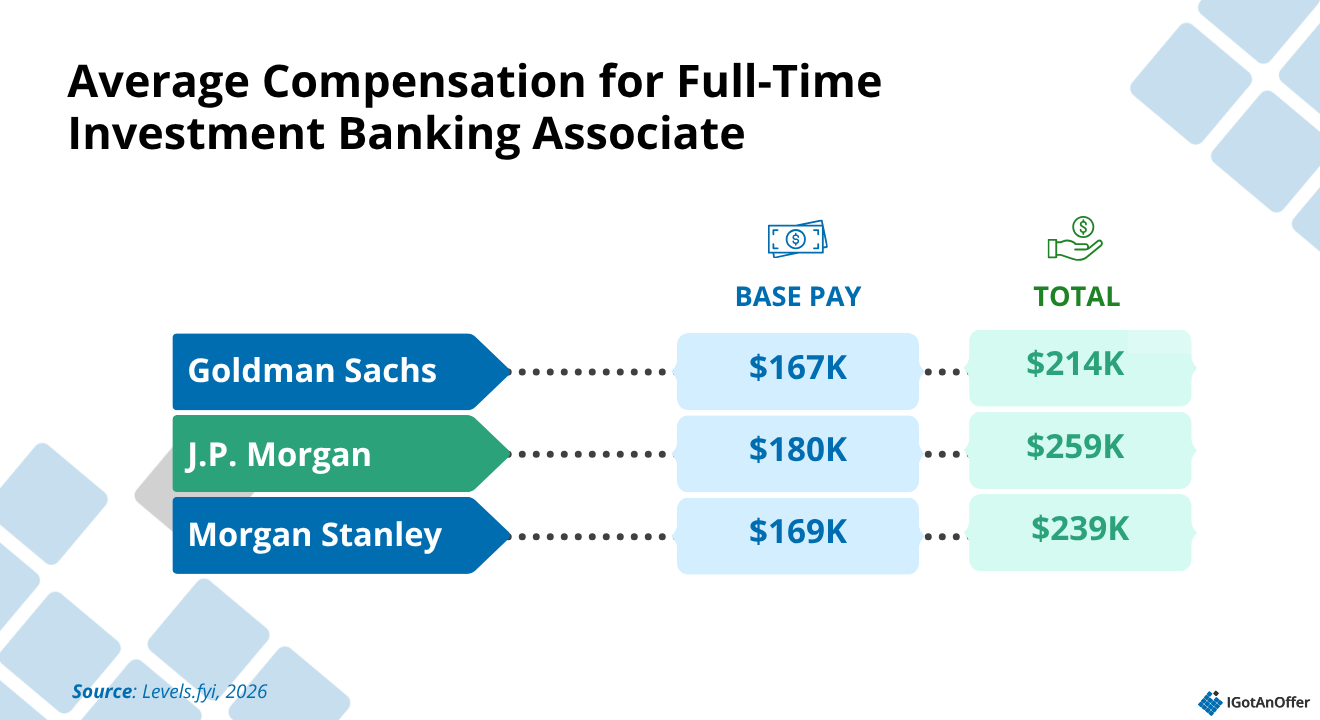
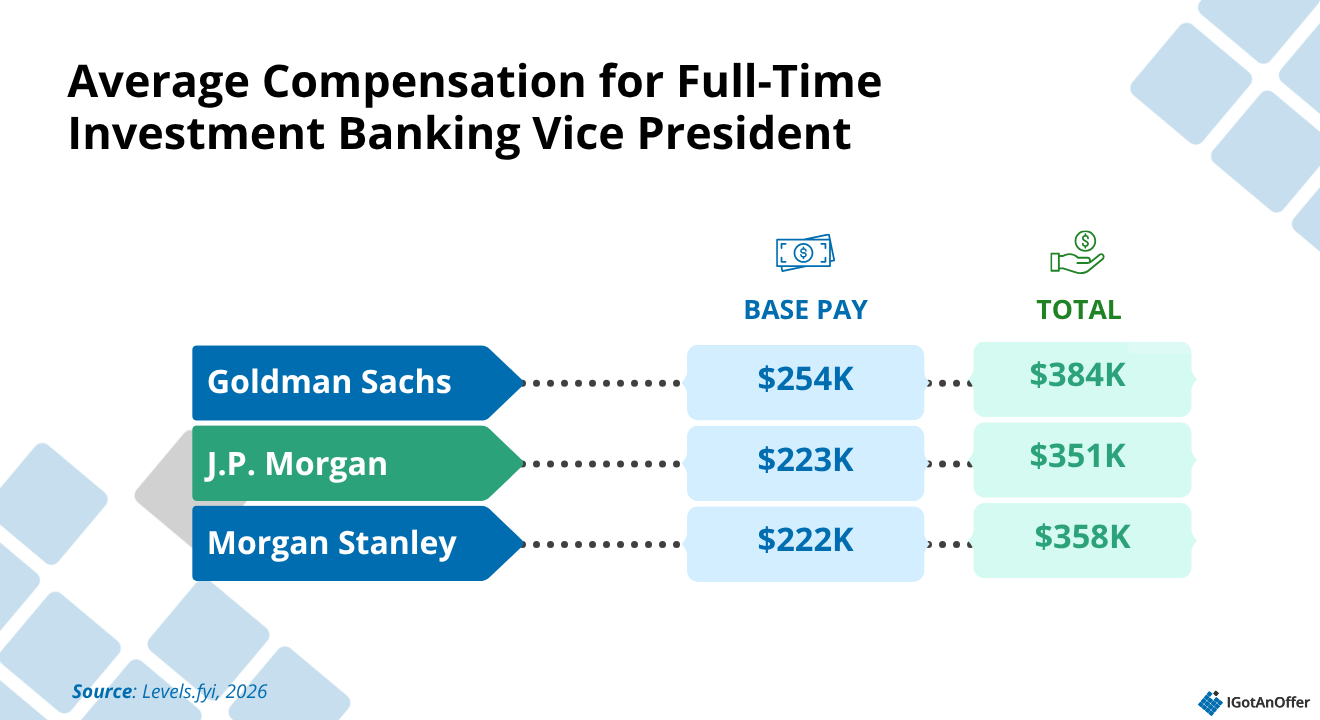
Your experience and the role you apply for will affect your offer. Working with an investment banking interview coach can help you prepare for the interviews at that level.
And remember, parts of your pay package may be negotiable. So if you do get an offer, don't be afraid to ask for more.
Before you negotiate, check the base salary, expected bonus, and signing bonus. Then, consider booking a salary negotiation coaching session with one of our experts to practice what you've learned.
Coaches who contributed to this guide
























2. Investment banking interview process ↑
The stages below reflect the process we've found at Goldman Sachs, J.P. Morgan, and Morgan Stanley, mainly for full-time and summer analyst roles. Other large investment banks may use different steps. The order, number of interviews, and questions also depend on the office and role.
Here are the six stages we'll cover. You may not go through all of them, as HireVue can replace the first-round interview:
- Application and resume screen
- Aptitude test
- First-round interviews
- HireVue or recorded video interview
- Superday or assessment centre
- Offer
2.1 Resume screen ↑
First, recruiters will look at your resume and assess if your experience matches the open position.
Focus on relevant experience, such as a finance internship or a project where you analyzed a company. Explain what you did, rather than only naming the team or course.
You can use our investment banking resume guide to see examples of successful investment banking resumes and tips to help tailor your resume to the role you’re targeting.
For expert feedback, get input from an investment banking resume reviewer, who will cover what achievements to focus on (or ignore), how to fine-tune your bullet points, and more.
2.2 Aptitude test ↑
Some banks give online assessments as part of their investment banking interview process. For example:
- Morgan Stanley: Candidates may take numerical, verbal, logical, or error-checking tests, depending on the role.
- J.P. Morgan: According to J.P. Morgan, some roles require assessments, which may include Pymetrics, a series of digital games that assess cognitive and behavioral traits. Your invitation will confirm which assessment applies to you.
Generally speaking, the best way to prepare for aptitude tests is to practice with similar questions. You can do that using online test providers, like this one. You could also practice with sample GMAT questions, since aptitude tests often have some similarities with GMAT-style questions.
2.3 First-round interviews ↑
Your first live interview may take place by phone or video, with a recruiter or a banker. Expect to talk about your experience and why you applied. You may also get basic accounting or valuation questions.
You should expect typical behavioral and resume questions like, “Tell me about yourself,” “Why this bank?” or “Tell me about a deal you worked on.”
First-round interviews often last around 30 minutes, though the length and question mix depend on the role.
According to Jonathan (ex-Wells Fargo managing director, ex-Morgan Stanley), the HireVue can also replace the first round of interviews.
2.4 HireVue or recorded video interview ↑
In a HireVue interview, you record your answers to questions on screen. You won't be speaking to a live interviewer. Geert (ex-Deutsche Bank valuation specialist) says the bank assesses your “delivery, clarity, and alignment to the role.”
A typical HireVue interview includes three to six questions. For each question, you’ll get time to prepare, then a limited time to record your response. Here’s a summary of the formats reported at each bank:
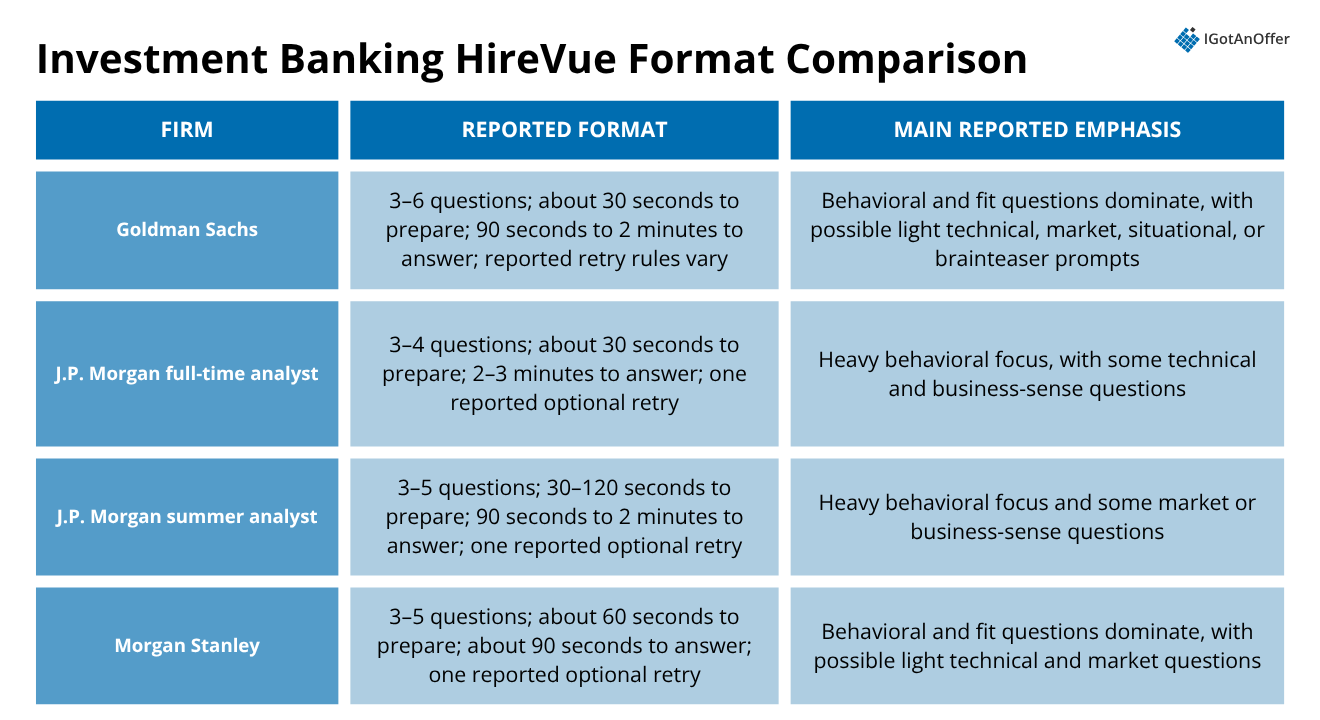
The HireVue interview mostly contains common behavioral questions like “Why investment banking?” and “Tell me about a time…” questions. You’ll also get market awareness questions like “Tell us about a recent M&A deal.” Geert says some firms include questions about the role or market, and occasionally an unexpected question to test how you think.
The time allowed and number of retries can vary, so check the instructions sent by your recruiter before you start.
For more information, check out our general IB HireVue guide. If you’re preparing for a particular bank, see our Goldman Sachs, J.P. Morgan, or Morgan Stanley HireVue guide.
2.5 Superday or assessment centre ↑
If you do well enough in the previous steps, you’ll be invited to the final round of interviews. For entry-level positions, such as internships and graduate jobs, this may take the form of a Superday. You’ll spend the day meeting several interviewers. In the UK, an assessment centre may also include a group exercise or presentation.
In these interviews, you’ll answer technical questions as well as questions about your experience and the markets. At Goldman Sachs, campus Superdays typically include two to five interviews, depending on the division. Other banks may arrange the day differently.
For more on this round, read our investment banking Superday guide.
2.6 Offer and follow-up ↑
Finally, once you’ve successfully passed each stage of the interview process, you’ll receive your offer package from the bank.
Most candidates hear back within 24 hours to 2 weeks after their final-round interview or Superday, depending on the firm’s hiring cycle and the number of candidates being reviewed.
At this point, all that’s left is to negotiate your offer. Your recruiter will typically reach out with the details and may schedule a call to walk you through the terms and answer questions. If they don’t schedule a call, you should feel free to request one.
Salary discussions can feel uncomfortable, especially if you’re new to them. Consider booking one of our salary negotiation coaches to get expert advice.
Before you accept, check the pay, start date, and which team and office you’ll join. Ask the recruiter about anything you don’t understand. Also check how long you have to decide.
3. Types of investment banking interview questions ↑
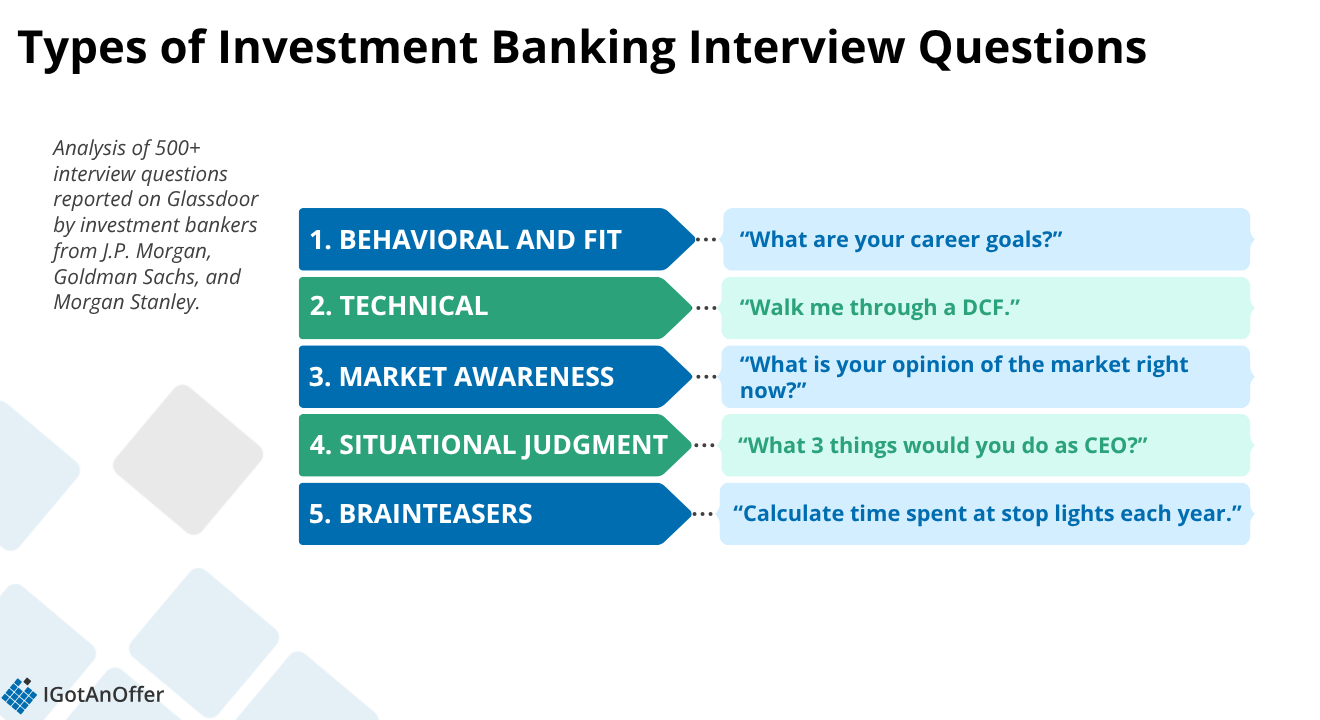
Investment banking interviews are tough because they cover a wide range of question types. To make prep easier, we’ve broken them down into five categories.
3.1 Behavioral and fit questions
Banks use behavioral interviews to assess job candidates based on their past experiences. These questions typically start with “Tell me about a time you…” and focus on skills such as leadership, communication, teamwork, problem-solving, etc.
You'll also get questions about your background, motivation, and fit for the role. Below, we’ve grouped these questions into two categories:
- General questions: These cover your background, reasons for applying, and motivation for investment banking and the bank.
- Scenario-based questions: These typically start with “Tell me about a time…” and ask you to discuss a specific situation or experience from your past.
Examples of IB behavioral and fit interview questions
General
- What are your strengths and weaknesses?
- What are your career goals?
- What would your co-workers or manager say about you?
Scenario-based
- Tell me about a time you handled team conflict. How did you solve it?
- Tell me about a time you demonstrated leadership
- Tell me about a time you failed and how you handled it
- Tell me about a time you faced a challenge / complex problem and how you solved it
- Tell me about a time you faced an ethical dilemma
- Tell me about a time you used data / analysis to make a recommendation
- Tell me about a time you had to work under pressure
For a longer list of behavioral interview questions, including sample answers, check out our investment banking behavioral & fit interview questions guide.
Then, see former Blackstone managing director Kent’s video, Investment Banking Fit Questions Masterclass: Weak vs. Strong Answers, for tips on structuring your answers and common mistakes to avoid.
3.2 Technical questions
In investment banking interviews, “technical” is an umbrella term that typically refers to valuation, accounting, and a few other (less common) question sub-types.
- Valuation questions: These test your ability to determine the value of a business.
- Accounting questions: These assess your understanding of financial statements and core accounting principles.
- Other technical questions: These cover topics such as debt ratios, beta, and interest rates that don’t fit neatly under valuation or accounting.
Examples of IB technical interview questions
Valuation questions
- What are the main methods of valuing a company?
- What is enterprise value?
- Walk me through a DCF
- How do you calculate WACC?
- When would you use (or not use) DCF instead of other valuation methods?
- How do you calculate cost of debt and cost of equity? How do they impact a company’s value?
- Determine if an acquisition is accretive or dilutive.
- How would you value an apple tree?
- Give me a scenario where a DCF provides more insight than a multiples-based valuation.
- How would a DCF analysis differ for a biotechnology company?
- How would an increase in the corporate tax rate affect a DCF valuation?
- What is your view on price-to-earnings (P/E) versus enterprise value to earnings before interest, taxes, depreciation, and amortization (EV/EBITDA)?
- What happens to the value of a company if its cost of equity increases?
- What is the difference between enterprise value and market capitalization?
- How do you calculate the market capitalization of a company?
- Walk me from equity value to enterprise value.
- Why do we use earnings before interest, taxes, depreciation, and amortization (EBITDA)?
- What is the effect of a stock split on a company’s price-to-earnings (P/E) ratio?
- How do leasing rules under International Financial Reporting Standard 16 (IFRS 16) affect a DCF?
Accounting questions
- Walk me through the financial statements.
- How does goodwill impairment impact the financial statements?
- How do you go from earnings before interest, taxes, depreciation, and amortization (EBITDA) to free cash flow (FCF)?
- How do you calculate levered/unlevered free cash flow?
- Walk me through how purchasing $100 of assets affects the financial statements by the end of the year.
- What is the impact of an increase in accounts payable (AP) on cash flow?
- Walk me through a profit and loss (P&L) statement.
- Walk me through a balance sheet.
- Explain minority interest in simple terms.
- Explain the treasury stock method.
- Walk me through a $10 increase in depreciation and amortization (D&A).
- Explain the post-merger impact on the financial statements of two companies.
- What leverage ratios would you use to evaluate the risk on a company’s balance sheet?
- How do changes in interest rates affect corporate balance sheets?
Other technical questions
- What is an LBO, and what are its value drivers?
- Build an LBO model.
- Would a financial sponsor and a strategic buyer pay the same price for a company if synergies were removed?
- If a buyer trading at 25x price-to-earnings (P/E) acquires a seller trading at 20x P/E, is the transaction accretive or dilutive?
- How do you calculate beta?
- What metrics would you examine to determine whether a company can repay a new loan?
- How are interest rates correlated with real estate investment trusts (REITs)?
- How would you build a sum-of-the-parts (SOTP) valuation for a drug launch?
- What does it mean for cash to have a price-to-earnings (P/E) ratio?
Check out our technical questions guide for sample answers to the most common technical questions. For a closer look at each topic, see our accounting questions guide and valuation questions guide.
3.3 Economy / market awareness questions
Investment bankers need to understand the market to advise clients on raising money or buying and selling businesses. Interviewers ask market awareness questions to see whether you can connect the news to those decisions. You could get any of the following question types:
- Economy: Questions about economic events and their effect on companies and financial markets.
- Deals: Questions about recent transactions, the companies involved, and the reasons behind the deal.
- Industry: Questions about investment banking, your target bank, and its competitors.
- Investing: Questions about choosing investments and explaining their possible returns and risks.
Examples of IB market awareness interview questions
Economy
- Name one story in the news and describe why it’s important to you.
- What is happening in the current market that has caught your interest, and why?
- What is your opinion of the market right now?
- What do you think is the biggest challenge facing the financial market in the next 5 years?
- Describe how a world event can impact markets.
- What are three key themes that UK markets will be focused on over the coming year?
- How would you explain the local economy in layman’s terms?
- How do you expect current trade policy and Federal Reserve policy to impact markets over the next 12 months?
- How will the bond market react to the interest rate drop?
- What do you think the Federal Reserve will do with interest rates?
- What is the difference between monetary and fiscal policy?
- What do you think of quantitative easing?
- What is the trend of the Asia equity market in the last two years?
- Name a major current event happening in the world right now, and explain how it affects the markets relevant to this business.
Deals
- Tell us about a recent private equity deal.
- Tell me about a recent deal you’ve been paying attention to.
- Tell me about a recent deal that the company worked on and what you know about it.
- Tell me about one of the deals on your résumé.
Industry
- What is something you recently heard about our company, and why is it important?
- What makes our bank different from other banks?
- What is investment banking?
- What technology will be trendy in the next 6–12 months?
- How can an investment bank add value?
Investing
- What are the requirements for a good investment?
- Pitch a stock.
- Discuss a stock you’ve been following.
- Pitch me a stock where you would invest $1,000,000.
- What stock would you long and which would you hedge?
Check out our investment banking interview questions guide for more market awareness questions with sample answers.
3.4 Situational judgment questions
Situational judgment questions present a hypothetical problem and ask what you would do. Unlike the scenario-based questions in Section 3.1, you don't need to talk about a past experience. The bank wants to understand your judgment, including how you would handle pressure or an ethical problem.
Examples of IB situational judgment interview questions
- The person sitting in front of you during a test begins cheating. How would you handle the situation, and would you respond immediately or wait until afterward?
- You have a deliverable due tomorrow, but are missing a critical component, and your team is asleep. What do you do?
- You are working on a major client deal, and the client makes a request that violates firm policy. What would you do, and who would you escalate it to?
- What would you do if a major client’s request were illegal?
- If you had several urgent tasks to complete but not enough time, how would you prioritize them?
- You gave your manager a piece of work and later realized you made a mistake. What would you do?
- Your previous manager asks you for confidential information about a project you’re working on, claiming it’s needed for an important decision. How do you respond?
- Your team is facing activist pressure because one business segment is underperforming. How would you approach this challenge?
- You need to explain a difficult topic to a client or colleague. How would you prepare, and what would you do to help them understand?
- You’re asked to work on a deal on the same day as a family event you’ve committed to attending. What would you do, and why?
For more on this question type, see Section 1.4 of our IB behavioral and fit guide.
3.5 Brainteasers
Brainteasers test your logic and problem-solving skills. These curveball questions often take the form of market sizing, logical and probability questions, as well as scenario-based questions.
According to Justin (ex-Goldman Sachs investment banker), there is no one “correct” answer to these problems. Rather, interviewers want to see whether you can “break ambiguous problems into logical components, make reasonable assumptions, and communicate clearly while thinking in real time.”
Example IB brainteaser interview questions
Market sizing / estimation
- Size the market of the gum industry in the United States.
- How many people do you think speak Bengali in Japan?
- How many cigarettes are sold in the United States each year?
- How would you estimate how many iPhones T-Mobile should order for the next release?
- How many light bulbs are there in New York?
Others
- Which number is closest to 27 squared: 600, 700, or 800?
- If you look at a clock and the time is 9:45, what is the angle between the hour and minute hands?
- What is the angle between the hands at 3:15?
- If a piggy bank deposits $100 per year, how much would you pay for it?
Check out our investment banking brainteasers guide for more examples and insights relevant to this question category.
4. Investment banking interviewing tips ↑
You might be strong at finance, but unfortunately, that’s not necessarily enough to ace your interviews at investment banks. Interviewing is a skill in itself that you need to learn.
Here are some tips from investment banking coaches to help you prepare.
4.1 Get used to setting up the situation in 30 seconds or less
For behavioral questions, start with a brief description of the situation. Explain where you were working, who was involved, and what was happening. Spending too much time on this background is a common mistake. Use a timer while you practice to keep it to 30 seconds or less.
4.2 Have a solid ‘about me’ introduction ready
Prepare a strong answer for your “about me” introduction, or the classic “Tell me about yourself” question. This is often the first question in an investment banking interview and sets the tone for the rest of the conversation.
Your introduction should briefly summarize your background and experience while highlighting what makes you unique as a candidate.
4.3 Be concise and data-driven
Interviewers hear a lot of behavioral stories in a day, so avoid unnecessary details that could lose their attention and try to keep your answer to around two minutes.
According to Kent (ex-Blackstone managing director), you should keep your answers between 60 and 90 seconds. This is enough time to articulate your answers well while leaving a lasting impression in your interview.
Then, back up your claims with specific metrics or quantifiable data to make your answer more concrete. For example, instead of saying “I helped the team with a project,” say “I built a three-statement model that improved our pitch turnaround time by 25%.”
It helps to share your stories with a few different people beforehand, as they can give feedback on which details to keep and which to cut.
4.4 Center on the company’s culture and values
According to Geert (ex-Deutsche Bank valuation specialist), you should always align each story to a key competency.
Familiarize yourself with the firm’s core values and weave them naturally into your answers. In investment banking, interviewers often look for qualities such as teamwork, client focus, attention to detail, and integrity.
Also, keep in mind that your cultural alignment will be assessed throughout the entire interview process, not just during behavioral rounds.
For instance, at Goldman Sachs, you could demonstrate their focus on client service by sharing an example of how you supported a project under tight deadlines while ensuring that the quality of your work met client expectations.
4.5 Familiarize yourself with deals related to the company
Real-world deals come up frequently in investment banking interviews, as interviewers want to see if candidates really understand the industry and the important things to consider when looking at a deal.
Prepare to discuss a couple of recent IB transactions in depth, particularly in relation to their accounting implications. Be ready to give your opinion on whether the deal was a good (or bad) move, and memorize some key numbers to back up your analysis.
If you’re applying for a particular group within your target firm, make sure you prepare to discuss deals that are relevant to that group.
You can find information about recent deals by reading the Investment Banking section of the Financial Times, which frequently covers stories involving leading firms.
4.6 Be proud and talk about YOU
Not talking about YOU enough is another common mistake we see with a lot of candidates. This is not the time to be shy about your accomplishments. Concentrate on your impact, not what “the team” did.
4.7 Be honest and authentic
Interviewers can tell if your answer sounds memorized, says Kent (ex-Blackstone managing director). Be genuine in the way you talk about your experiences. If you’ve faced challenges or setbacks, discuss how you improved and learned from them.
Kent also encourages candidates to think carefully about what they actually want in their next job and what drives their happiness (both at work and outside of work).
When you’ve done that reflection, it comes through in your answers, and interviewers get a clearer sense of who you are and what motivates you.
4.8 Mix and match
A common mistake Raul (ex-BNP Paribas investment banker) observes in candidates is that they come up with only one story for each question.
However, you’ll probably have a lot of overlap with your stories. A story you use to answer a leadership question could easily work for a question on conflict, people management, or handling pressure.
If you practice adapting stories so they can answer various questions, 10-15 strong stories should be enough to get you through even the toughest interview.
4.9 Practice with real financial statements
As we’ve established, a great percentage of your IB accounting interview questions will be about the financial statements. Hence, it only makes sense to get hands-on experience by reviewing real company filings.
For example, you can examine Microsoft's financials for free and see how the different statements flow together. This is important for a couple of reasons:
First, the financial statement examples provided in interview prep guides are often simplified for illustration. As a result, you’ll be missing key details unless you also study the details of real-world statements.
Second, by looking at real statements for large publicly traded companies, you can get a better sense of the underlying financials for the kinds of clients you’d be working with at big-name firms like Goldman Sachs.
You can also practice building spreadsheets with the company’s data and manipulating the information yourself. Doing so will help you internalize how accounting movements flow through each statement.
4.10 Be ready to go off script
You should know your stories extremely well by interview time. But don't feel that you have to stick rigidly to a script. The interview should feel like a conversation, so if the interviewer takes you down an unexpected direction, go with it.
“Delivering memorized answers instead of having a natural conversation can make you come across as rigid and less engaging,” says Kent.
4.11 Avoid these common IB behavioral & fit interview mistakes
During IB behavioral and fit interviews, interviewers are on the lookout for red flags. These are some of the most common mistakes Kent has seen, even among top candidates:
- Starting answers with filler words: Opening with phrases like “um” or “so yeah,” which weakens your first impression
- Answering the surface question only: Giving shallow responses without connecting them to your experience or the role, which shows limited depth in how you approach problems
- Using vague language: Relying on generic phrases like “It was a great learning experience” instead of specific examples, which makes your answers less credible
- Lacking energy and presence: Showing low energy or weak body language, which hurts both your first and last impression
- Not knowing the firm / group well enough: Failing to reference specific deals or focus areas can signal a lack of preparation
- Mentioning exit opportunities: Talking about MBAs, private equity, or other next steps, which raises concerns about your long-term commitment
- Not asking thoughtful questions: Missing the opportunity to engage meaningfully with the interviewer
- Closing the interview weakly: Failing to leave a strong final impression, instead of using the last few minutes to ask thoughtful questions and end on a memorable note
5. How to prepare for investment banking interviews ↑
Now that you know what questions to expect, let's focus on preparation.
Below, you’ll find links to free resources and four introductory steps to help you prepare for your investment banking interviews.
5.1 Learn about the bank and role
As you've probably figured out from the example questions listed above, you’d need to be familiar with your target bank and its work. You'll therefore need to do some homework before your interviews.
Below are useful links to help you learn about eight major investment banks:
Goldman Sachs
- Goldman Sachs’ purpose and values (By Goldman Sachs)
- Goldman Sachs Briefings newsletter (By Goldman Sachs)
- Goldman Sachs strategy teardown (by CB Insights)
J.P. Morgan
- Who we are (By JP Morgan)
- JP Morgan weekly brief (By JP Morgan)
- JP Morgan strategy teardown (by CB Insights)
Morgan Stanley
- A culture-driven strategy (by Morgan Stanley)
- Insights (by Morgan Stanley)
- Comparison Morgan Stanley vs Goldman Sachs (by Investopedia)
Bank of America
- Bank of America core values (by Bank of America)
- BofA Global Research (by Bank of America)
- Bank of America strategy (by Bank of America)
- BofA official interviewing guide (by Bank of America)
Citigroup
- About Citi
- Insights (by Citi)
- Citi’s plan to transform its wealth business (by Euromoney)
Barclays Capital
- About Barclays
- Barclays’ three-year plan (by Barclays)
- Barclays’ official interview prep guide (by Barclays)
- Virtual interview practice tool (by Barclays)
UBS Investment Bank
Deutsche Bank
- About Deutsche Bank
- Deutsche Bank strategy (by Deutsche Bank)
- Deutsche Bank interview prep guide (by Deutsche Bank)
5.2 Learn a consistent method for answering IB questions
As we mentioned previously, interviewers will ask you questions from several categories. Using a method that fits each question type will help you build strong interview habits.
Then, when it comes time for your interviews, these habits will reduce your stress and help you to make a great impression.
If you’re just looking for a place to start, you can start learning about the different question types you’ll need to master in the following investment banking interview guides. We’ve also included a few additional resources to help you understand the overall interview process and how to prepare.
General
- Investment banking interview prep guide
- Investment banking interview questions guide
- 15 investment banking interview tips
- Investment banking interview cheat sheet
- How to answer “Why X company” question
- Investment banking interview accounting questions guide
- Investment banking valuation interview questions
- Investment banking behavioral & fit interview questions guide
- IB technical interview questions guide
- IB brainteaser questions guide
- Investment banking HireVue interviews
- Investment banking Superday interviews
Goldman Sachs
- Goldman Sachs interview prep guide
- Goldman Sachs behavioral interview guide
- Goldman Sachs HireVue interview guide
J.P. Morgan
- JP Morgan interview prep guide
- JP Morgan behavioral interview guide
- JP Morgan HireVue interview guide
Morgan Stanley
- Morgan Stanley interview prep guide
- Morgan Stanley behavioral interview prep guide
- Morgan Stanley HireVue interview guide
You can also watch mock interviews and advice videos on the IGotAnOffer Finance YouTube channel. Here are three great videos to start with:
- How to network your way into investment banking, with Mike, a former Merrill Lynch director.
- How to make your LinkedIn profile more visible to IB recruiters, also with Mike.
- Investment Banking Fit Questions Masterclass: Weak vs. Strong Answers, with Kent, a former Blackstone managing director.
Once you’re familiar with the different topics relevant to your target role, you’ll want to practice answering questions.
But by yourself, you can’t simulate answering without preparation or the pressure of performing in front of a stranger. Plus, there are no unexpected follow-up questions and no feedback.
That’s why many candidates try to practice with friends or peers.
5.3 Practice with peers
If you have friends or peers who can do mock interviews with you, that's an option worth trying. It’s free, but be warned, you may come up against the following problems:
- It's hard to know if the feedback you get is accurate
- They're unlikely to have insider knowledge of interviews at your target bank
- On peer platforms, people often waste your time by not showing up
For those reasons, many candidates skip peer mock interviews and go straight to mock interviews with an expert.
5.4 Practice with experienced interviewers
In our experience, practicing real interviews with experts who can give you company-specific feedback makes a huge difference.
Find an investment banking interview coach so you can:
- Test yourself under real interview conditions
- Get accurate feedback from a real expert
- Build your confidence
- Get company-specific insights
- Learn how to tell the right stories, better.
- Save time by focusing your preparation
Landing a job at a big tech company often results in a $50,000 per year or more increase in total compensation. In our experience, three or four coaching sessions worth ~$500 make a significant difference in your ability to land the job. That’s an ROI of 100x!
Book investment banking mock interviews with experienced interviewers.

 Interviews