

 Back to other articles
 Last updated: July 27, 2026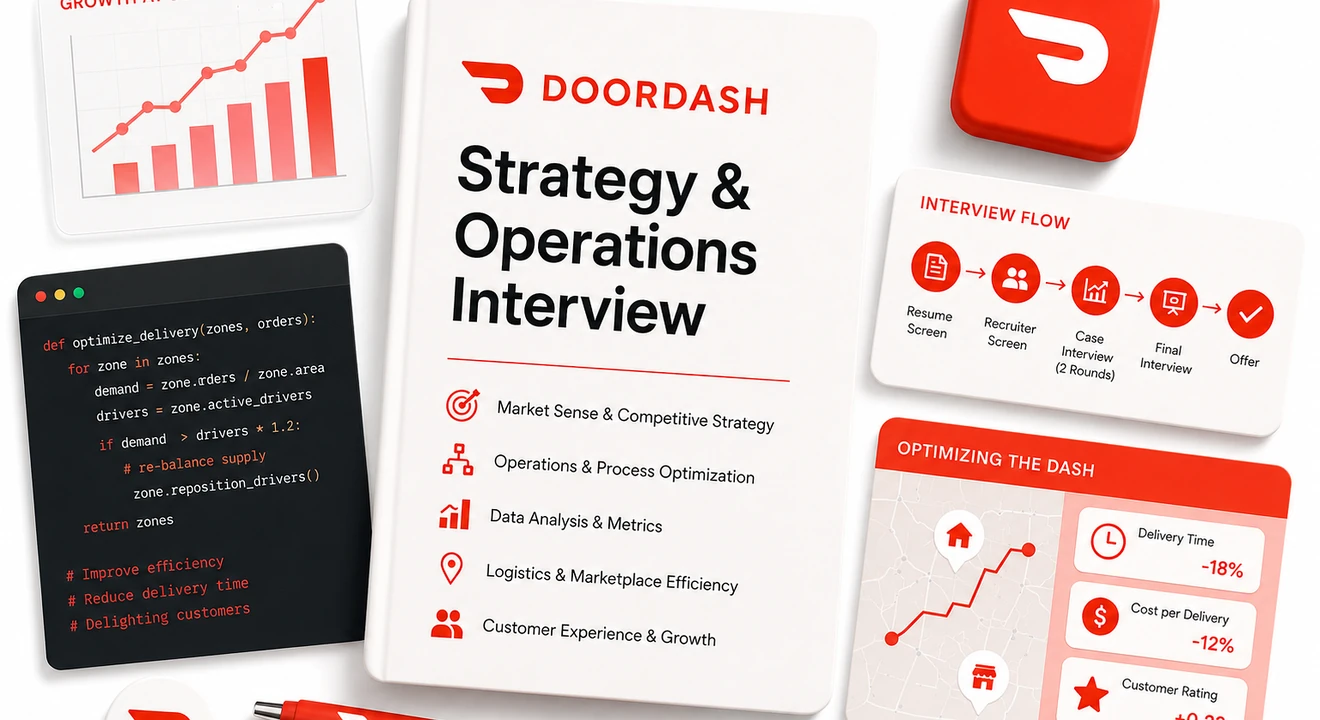

 Interviews
 Strategy and operations manager
 Deeply researched
DoorDash strategy and operations (S&O) interviews are hard to prepare for. Good S&O-specific resources are thin, since most published guides for the company focus on software engineering or product roles.
What we do know based on candidate reports we've seen online, DoorDash S&O interview questions are wide-ranging, data-heavy, and tied closely to how the company's marketplace works.
The take-home case alone can run past 10 hours, so plan your week around it rather than squeezing it into a spare evening.
This guide covers the role, the interview process, example questions, plus how to prepare for each stage.
We've based it on DoorDash's own careers page and dozens of recent Glassdoor reports from Associate and Manager candidates.
Here's an overview of what we'll cover:
Click here to practice with an expert strategy and operations interview coach
1. DoorDash strategy and operations role and salary ↑
1.1 What does a strategy and operations associate/manager do at DoorDash?
DoorDash's Strategy & Operations (S&O) team builds the initial hypothesis for a piece of the business, then owns it through implementation and optimization. You'll find S&O associates and managers behind new market launches, product expansion, and the ongoing tuning of DoorDash's marketplace.
The team describes itself as operators first. In practice, that means getting to the lowest level of detail rather than stopping at a strategy deck, pulling your own data, building your own models, and staying accountable for the result after a plan goes live.
Titles vary by team and level. You'll see Strategy and Operations Associate, Strategy and Operations Manager, and Senior Associate or Senior Manager variants, along with team-specific labels like New Verticals or DashMart Strategy and Operations.
1.2 What is it like to work in strategy and operations at DoorDash?
Ex-DoorDash coach Aamna describes the environment as "fast-paced and dynamic, with a huge emphasis on execution and navigating a complex three-sided marketplace where margins are tight."
S&O has to weigh customers, merchants, and dashers against each other in every decision.
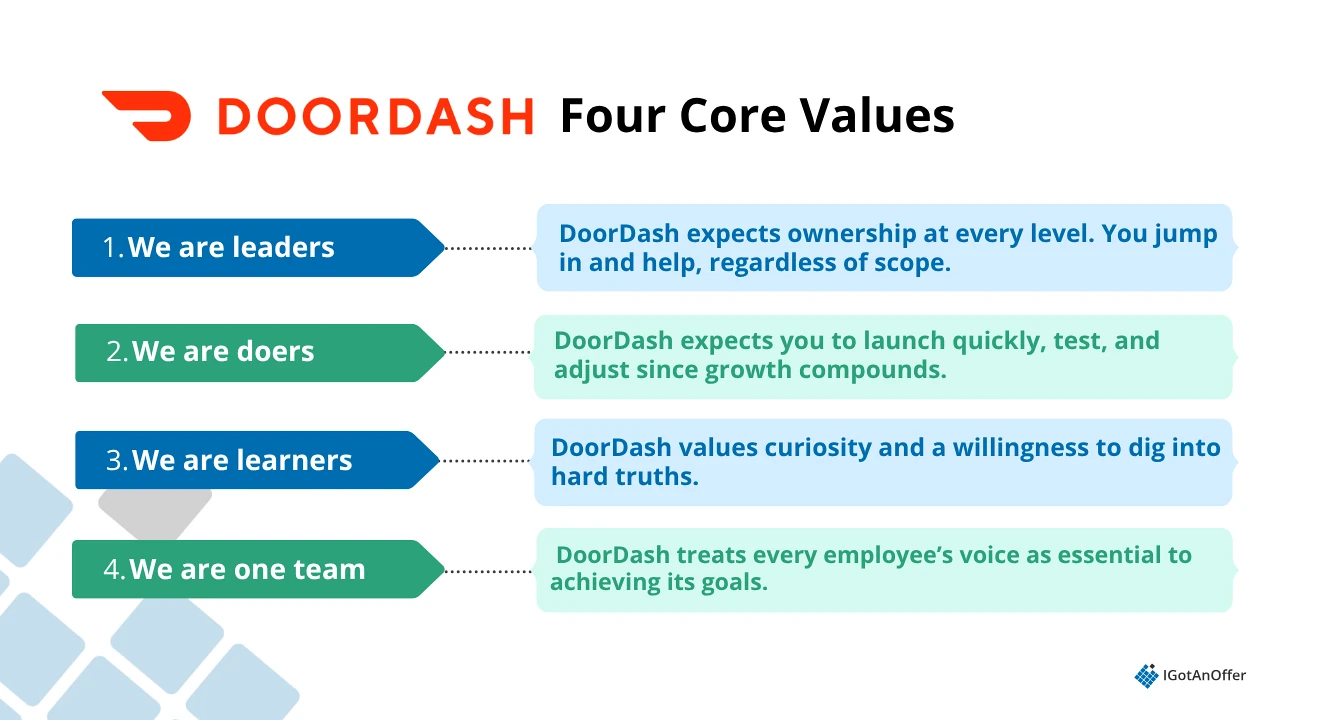
DoorDash's four core values (leaders, doers, learners, one team) show up in daily S&O work: owning a problem, testing small ideas before scaling, and digging into an inconvenient number instead of smoothing it over.
1.3 How much does DoorDash pay for strategy and operations roles?
The figures below come from Levels.fyi for DoorDash's Business Operations Manager role, the closest reported match for strategy and operations positions at the company.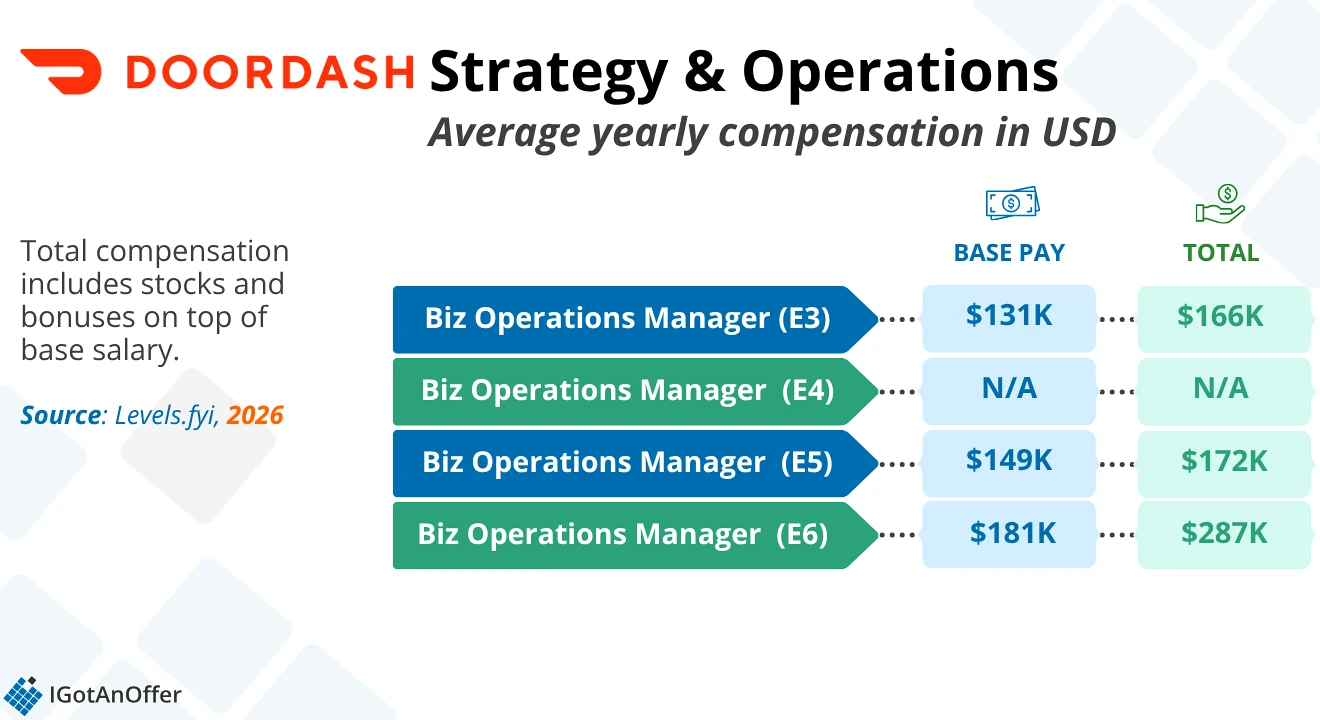
Ultimately, how you perform in your interviews will help determine what you're offered. That's why hiring one of our ex-DoorDash interview coaches can provide such a significant return on investment.
Compensation packages are always negotiable, even at DoorDash. If you do get an offer, don't be afraid to ask for more. For expert support, consider booking one of our salary negotiation coaches.
1.4 What does DoorDash look for in strategy and operations candidates?
DoorDash doesn't filter heavily based on pedigree. The company cares more about whether you can take an idea from analysis to a launched, measurable change, and iterate once the data comes in.
DoorDash's own S&O job postings consistently ask for a consulting, banking, analytics, or operations background, plus comfort pulling your own data in SQL and modeling in Excel rather than waiting on an analyst.
Expect Excel and SQL (Structured Query Language) work to come up directly in the interviews themselves, rather than only appearing as a line in the job posting.
Because the process leans heavily on take-home case work, DoorDash also looks for candidates who can make defensible assumptions from messy data and communicate a clear recommendation, rather than presenting analysis with no decision attached.
Coaches who contributed to this guide




2. DoorDash strategy and operations interview process and timeline ↑
The full DoorDash interview process typically takes four to eight weeks from application to offer.
The number of rounds varies quite a bit within that window. Some S&O candidates finish in as few as four, others describe six or seven rounds with a case in nearly every one. Below are the steps you can expect.
2.1 Resume screen
This is the most competitive part of your DoorDash application process. You'll have to make sure your resume matches the exact position you're applying for.
At this stage, recruiters are mostly filtering on the signals covered in Section 1.4: consulting, banking, analytics, or operations experience. They're also looking for any hint you've personally tracked a metric from the data pull through to the final recommendation, rather than only reporting a number someone else calculated.
If you haven't yet got an interview at DoorDash, you'll want to get your resume up to scratch.
To help you put together a targeted resume that stands out from the crowd, follow the tips below.
Tips for crafting a resume
- Simplify. Avoid using overly creative resume layouts. A simple resume layout accomplishes two things: it helps your resume pass through the applicant tracking system (ATS) and makes it easy to read for recruiters and hiring managers.
- Verbalize. Start each bullet point under your previous roles with an action word.
- Quantify. Add numbers to illustrate your impact in each role. If you were in a leadership role, how many people were on your team? If you've successfully launched a project, what metrics did you use to measure its success?
- Summarize. Make your resume ATS-friendly by having a skills section. Insert keywords from the job requirements that are relevant to your professional experience.
The tips above are a starting point. For detailed steps and examples you can follow, see our tech resume guide.
If you're looking for expert feedback, you can also get help on your resume from one of our resume coaches, who will cover what achievements to focus on (or ignore), how to fine-tune your bullet points, and more.
2.2 Recruiter phone screen
This call covers your background, communication style, and general fit questions. Its main job is to confirm you're worth moving into the case work that follows.
Recruiter calls typically run 30 to 45 minutes. However, some Associate candidates describe a brief hiring manager call around 15 minutes, in one case followed by a separate HR round and a short "would-be-manager" round rather than a single combined screen.
2.3 Take-home case (and SQL exercise for some roles)
You'll receive a case and a data packet, with 48 hours to turn it around. For Associate roles, this often comes paired with a short SQL exercise on the same deadline.
Manager-level cases tend to run longer and lean on large datasets under time pressure. One candidate reported 10 or more hours of work; another mentioned a skills assessment with more than 60,000 records. Budget real time for this rather than treating it as a quick exercise.
A few candidates describe the case being built around a problem DoorDash has actually faced, rather than a generic hypothetical. Grounding your recommendation in how DoorDash's marketplace really works tends to land better than a textbook framework.
2.4 Case debrief and panel interviews
Most candidates move through a mix of rounds at this stage:
- A debrief of your take-home case
- One or two behavioral interviews
- In some reports, a market-assessment case done live rather than asynchronously
One Associate candidate reported an outlier version instead: a recruiter screen, an analytical exercise, then two back-to-back interviews, one behavioral and one a real-time Excel assessment, with two different strategy managers.
You should expect interviewers to probe specific assumptions in your take-home recommendation and ask you to justify them during the debrief round.
Cultural fit isn't confined to a single dedicated session. One candidate described DoorDash as focusing a lot on its values throughout the panel, rather than only in a standalone behavioral interview.
2.5 Final round and hiring decision
Some processes include a final round with a director or the hiring manager directly, often shorter than the earlier rounds. In one report, this director conversation follows the presentation of the take-home analysis.
From there, DoorDash's hiring team reviews feedback across all interviewers before extending an offer. Based on DoorDash's general process, expect roughly one to two weeks between your last interview and a decision.
3. Example DoorDash strategy and operations interview questions ↑
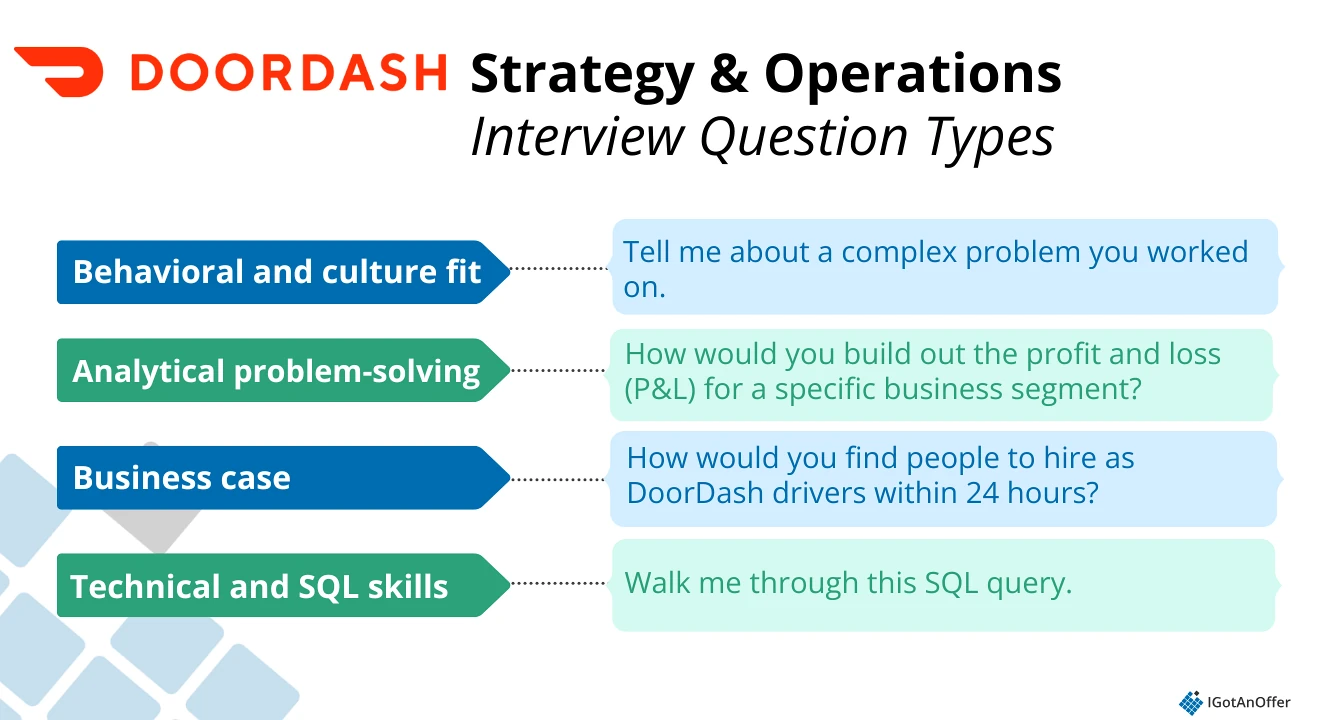
We've grouped the questions below into four categories based on our review of recent Glassdoor Associate and Manager reports. We also considered DoorDash's own description of its S&O interview format.
You'll meet all four at different points across the process covered in Section 2, often more than once.
3.1 Behavioral and cultural fit ↑
Behavioral questions run throughout the process, and DoorDash uses them to check alignment with its four core values: leaders, doers, learners, and one team.
We've grouped the questions below into three types: motivation and fit, problem-solving with data, and leadership and collaboration. When you prepare a story, think about which of DoorDash's values it demonstrates rather than only the outcome.
Tie your story back to DoorDash's own language: owning a problem, testing a small idea before scaling it, or digging into an inconvenient number rather than smoothing it over. Interviewers care about both what happened and how you tell it.
3.1.1 Motivation and fit
Example DoorDash strategy and operations interview questions: Motivation and fit
- Tell me about yourself.
- Why do you want to work at DoorDash? (Sample answer)
- What attracts you to this role?
- What are you looking to get out of the role?
- Why is this the next step in your career path?
- Why are you looking for a new job?
- Walk me through your resume.
- Can you confirm which role you applied for?
- Do you have consultancy experience?
- What is your billion-dollar idea?
- What is your view on DEI?
3.1.2 Problem-solving with data
Example DoorDash strategy and operations interview questions: Problem-solving with data
- Tell me about a complex problem you worked on. How did you handle it? What was the outcome?
- Have you ever had to solve a critical problem with an out-of-the-box solution?
- What's something you saw a problem with and changed?
- Tell me about a time something didn't go according to plan.
- Tell me about a time you had to navigate complexity.
- Provide an example of a time you used data to solve a problem.
- Talk about a time you used data to improve a process.
- Tell me about a time you had to own metrics.
3.1.3 Leadership and collaboration
Example DoorDash strategy and operations interview questions: Leadership and collaboration
- How did you engage teams cross-functionally?
- How would you handle working with cross-functional partners?
- Tell me about a time you had to work with a difficult colleague/stakeholder.
- Mention a time you had to be scrappy.
- Define an ambiguous situation you encountered in a previous role.
- Tell me about a time you demonstrated leadership.
- Tell us about a time you led a product from concept to launch.
- What project or achievement are you most proud of?
- What is the most valuable thing you've learned in the past 12 months at your current role?
- How do you stay organized?
- Tell me about a time you made a decision too quickly.
To prepare, work through our guide to behavioral interview questions to learn a repeatable method for structuring your answers.
3.2 Analytical problem-solving ↑
These questions test whether you can define and reason about a metric on the spot, separate from a full business case scenario.
DoorDash's own process bundles this together with case interviews under one label, but based on candidate reports, it can come up as a distinct question type.
To create a strong answer, start by defining the metric precisely before reasoning about it. Interviewers are testing whether you reach for the right measure under time pressure, not whether you can recite a long list of possible KPIs.
Example DoorDash strategy and operations interview questions: Analytical problem-solving
- Give an example of a metric you created in a piece of analysis.
- How would you build out the profit and loss (P&L) for a specific business segment?
- What variables would you look at to determine the success of a test launch for new features?
- You need 1,000 conversions by next week. What do you do?
Check our guide for cracking product metrics questions. It was written for PMs, but you the same approach can apply to S&O interviews too.
3.3 Business case ↑
Business case questions cover both the take-home case you'll be asked to defend afterward and the live case discussions in onsite rounds.
Expect to receive case packets that run large and messy, with tons of gaps in the data. That means part of the test is whether you can make defensible assumptions and still land on a recommendation.
A few of these cases involve live math or a quick estimate, so practice working through numbers out loud rather than silently.
Example DoorDash strategy and operations interview questions: Business case
- How would you choose what market to launch in?
- How would you find people to hire as DoorDash drivers within 24 hours?
- How would you get more drivers to use the red food bag DoorDash provides, over a single weekend?
- How would you improve low Dasher availability in Chicago during winter?
- How would you improve the business?
- How would you start DoorDash 11 years ago?
- Map out the end-to-end order journey with KPIs and measures to improve it.
- What is the most important spoke of the flywheel?
- Create a presentation from data they provide. Extract the analytics and interpret the data.
- Present your recommendations from a large dataset.
- Walk me through your case.
- You're given an Excel sheet of transaction data. Build a client-ready deck of slides with insights and recommendations.
For frameworks and practice, see our guides to case interview frameworks, case interview math, and market sizing.
For a step-by-step walkthrough of a real strategy and operations case, see our BizOps interview guide and our operations case interview guide.
3.4 Technical and SQL skills ↑
DoorDash S&O roles expect you to pull and interpret your own data rather than depend on an analyst, so a short technical check often shows up alongside the case rounds.
The goal isn't a perfect query on the first try. Interviewers care more about whether you can walk through your logic clearly, catch your own mistake, and explain what you'd check next.
Example DoorDash strategy and operations interview questions: Technical and SQL skills
- Walk me through this SQL query.
- What data tools have you used before?
- What experience do you have with SQL?
4. Interview tips ↑
4.1 Treat the take-home case as your first impression
Because DoorDash's process leans so heavily on the take-home case, your slide deck often carries as much weight as the live rounds that follow. Interviewers read it before they ever speak with you, so structure and clarity matter as much as the underlying math.
Turn the data into a concrete recommendation instead of a plain summary. State that recommendation clearly on an early slide, then use the rest of the deck to support it, since judgment is what you'll get graded on.
4.2 Say your assumptions out loud
As described in most reports, DoorDash likes to send packets with messy or incomplete data. Interviewers want to see how you fill those gaps, so if you make an assumption while filling them, say so clearly when presenting.
A good habit is writing your assumptions as a short list on an early slide, then referencing them again wherever they shape a number downstream. That way an interviewer can challenge one specific assumption instead of your whole analysis.
4.3 Practice mental math and live spreadsheet work
The panel round in Section 2.4 can ask you to build formulas or pull numbers on the spot. Practice working through calculations out loud beforehand so the format itself doesn't throw you off.
Focus on the kind of math that actually shows up in the question bank: building out a P&L, hitting a conversion target, and the KPI trade-offs behind the case questions.
Get comfortable making quick estimates under time pressure, but keep narrating your logic clearly as you go.
4.4 Prepare to defend your take-home case in the debrief round
The case debrief round exists specifically to pressure-test your recommendation. Don't stop at revisiting your assumptions when you submit the case. Look at them again before this round too.
Expect follow-up questions that push on the weakest part of your logic rather than the strongest. Preparing a rebuttal for your own biggest assumption ahead of time tends to pay off here.
4.5 Map your stories to DoorDash's four values
DoorDash evaluates behavioral answers against its four core values: leaders, doers, learners, and one team. Prepare two or three stories and know which value each one demonstrates before the interview.
A story that shows you owning a messy problem end to end can cover doers and leaders at once, which is more efficient than preparing four separate stories for four separate values.
4.6 Ask about level early
Interview expectations vary by level even for the same title. Confirm which level you're being considered for during the recruiter call so you can calibrate your prep accordingly.
An Associate case and a Manager case draw on different depth, and the salary table in Section 1.3 shows how much the level itself can move your eventual offer.
5. How to prepare ↑
5.1 Learn how DoorDash's business works
The example questions above make it clear you need to understand DoorDash's marketplace and economics in detail. Here are some resources to start with:
- DoorDash's strategy and operations careers page
- DoorDash's four core values
- DoorDash investor relations and quarterly reports
- DoorDash's newsroom
Use the DoorDash app before your interview so you can speak about the product from direct experience.
5.2 Learn a consistent method for each question type
DoorDash's questions fall into the four categories covered in Section 3. Approaching each with a repeatable method builds habits that reduce stress on the day.
- Behavioral interview questions
- Case interview frameworks
- Case interview math
- Market sizing guide
- Operations case interview guide
- General BizOps interview questions and prep
- Products metrics questions
Once you're in command of the subject matter, you'll want to practice answering questions under pressure.
On your own, you can't simulate thinking on your feet in front of a stranger, and there's no one to throw an unexpected follow-up at you or tell you where the answer fell short.
5.3 Practice with peers
If you have friends or peers who can run mock interviews with you, it's worth trying, and it costs nothing. The drawbacks:
- It's hard to know if the feedback you get is accurate
- Peers rarely have insider knowledge of DoorDash's interview process
- On peer platforms, people often waste your time by not showing up
For those reasons, many candidates go straight to mock interviews with an expert.
5.4 Practice with experienced interviewers
In our experience, practicing with experts who can give company-specific feedback makes a measurable difference to how you perform on the day.
Find a DoorDash strategy and operations interview coach so you can:
- Test yourself under real interview conditions
- Get accurate feedback from an expert
- Build your confidence
- Learn company-specific insights
- Practice telling the right stories
- Focus your preparation where it counts
Landing an offer at a company like DoorDash often comes with a meaningful jump in total compensation compared to your current role. Set against that, a handful of coaching sessions is a small cost, and many candidates find it pays for itself many times over.
Book strategy and operations mock interviews with experienced interviewers.