


 Back to other articles

 Last updated: August 27, 2026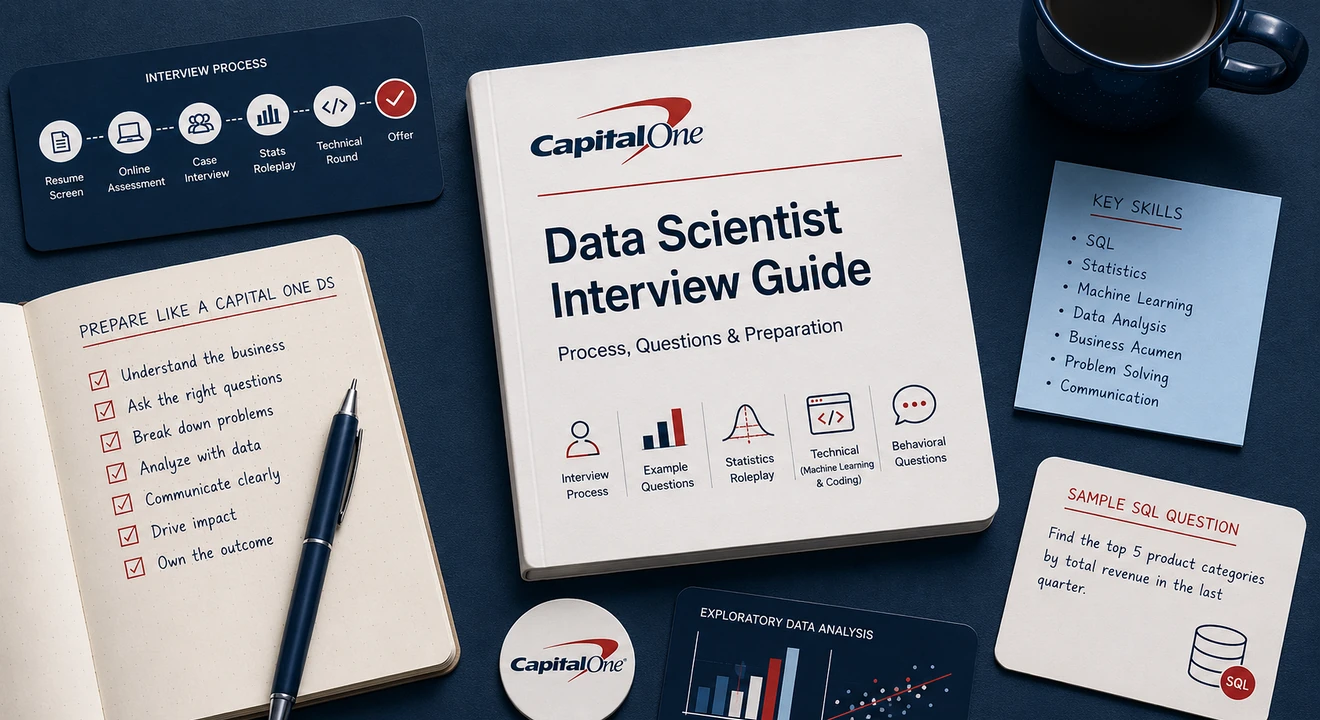

 Interviews
 Data scientist
 Deeply researched
Capital One data scientist interviews focus on applying data to real business problems, more than testing textbook algorithms. That aligns with how Capital One describes itself: "changing how millions bank and live" and pursuing "breakthroughs" rather than playing it safe, powered by data and analytics.
Expect a case interview, statistics round, a technical round covering machine learning and coding, and behavioral questions.
Below, we break down the full process, share example questions sourced from recent candidate reports, and give you tips and a prep plan to help you walk in ready.
Here's an overview of what we'll cover:
Find a Capital One data scientist interview coach
1. Capital One data scientist role and salary ↑
1.1 What does a Capital One data scientist do?
According to Capital One's careers page on the role, data scientists "collaborate with partners across the company to build models and implement data in innovative ways" in "applied scientist roles."
The role varies significantly by team. Capital One's data science job listings span teams like US Card Fraud Prevention, Cash Flow Underwriting, Card Intelligence, Operational Risk Management, and People Strategy & Analytics.
Therefore, as a Capital One data scientist, you could be working on fraud and risk detection, marketing, and product personalization across the company’s bank, card, commercial, and auto finance businesses, apart from building models for credit decisions
You'll typically work alongside data engineers, analysts, and product or risk stakeholders rather than in an isolated research function. The job includes translating models into decisions the business can act on, beyond just building them.
1.2 How much does a Capital One data scientist make?
According to Glassdoor, the median total pay for a Capital One data scientist is $164K/year, based on 251 salaries submitted as of early 2026.
Below, you can see average compensation by level at Capital One US, based on Levels.fyi data as of August 2026.
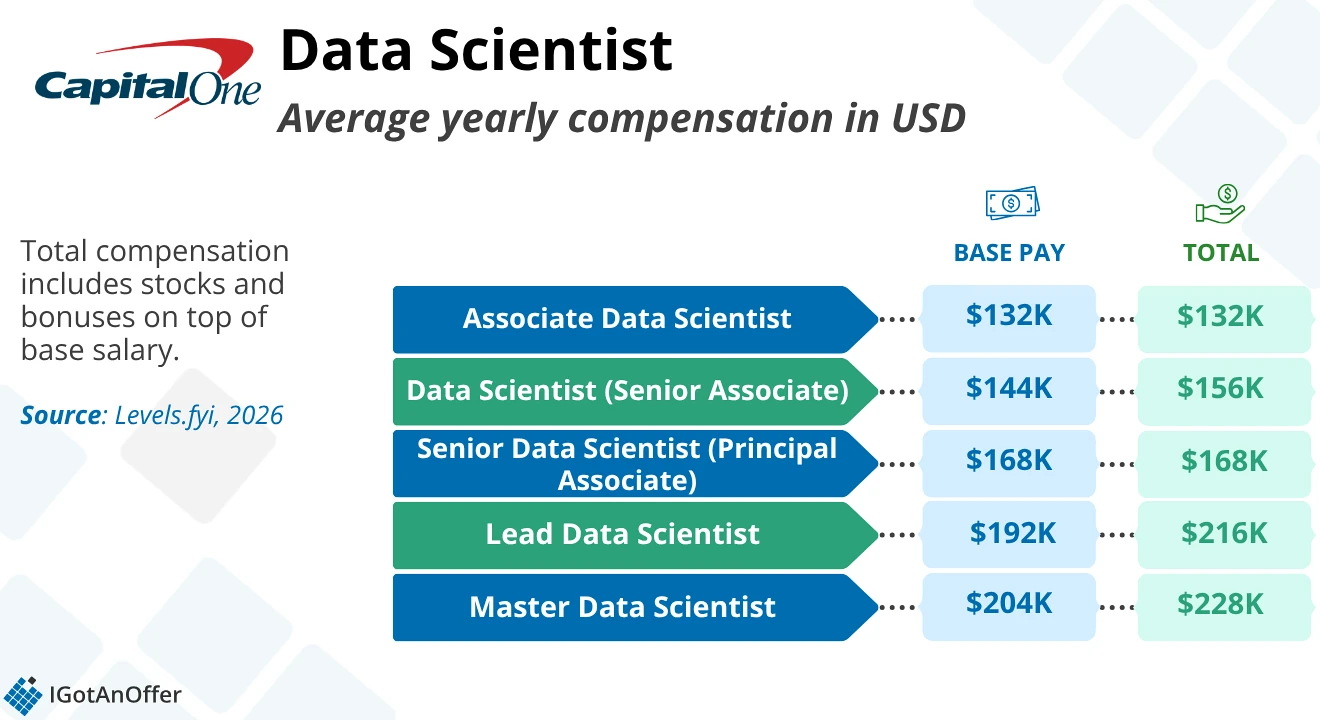
We presume you already know which level you're applying for, but it's worth double-checking with your recruiter, who can confirm exactly which level you're being evaluated for.
Ultimately, how you do in your interviews will help determine your offer, which is why hiring one of our ex-Capital One interview coaches can provide such a significant return on investment.
Remember, compensation packages are always negotiable, even at Capital One. So, if you do get an offer, don't be afraid to ask for more. Consider booking one of our Capital One salary negotiation coaches to get expert advice.
Coaches who contributed to this guide










2. Capital One data scientist interview process and timeline ↑
This section mainly discusses the interview process for the Capital One data scientist role, but it also applies if you're going for a Capital One data science internship or an associate data scientist position.
The interview process for Capital One data scientists generally takes four to eight weeks to complete. Let’s go over the steps you may face along the way.
2.1 Resume and referrals
Before getting an interview, you'll need a quality resume tailored to both data scientist positions and Capital One.
Once you find a role you're interested in and have determined that you meet all Basic Qualifications (BQs), you'll start your application by submitting some basic information. You'll then be prompted to complete your full application in Workday, according to Capital One's career FAQs.
As with most companies, getting an employee or contact at Capital One to refer you to the recruiting team could help. In our experience, the easiest way to do this is to directly contact Capital One employees you share connections with on LinkedIn.
To help you put together a resume that stands out, follow the tips below.
- Simplify. Avoid overly creative layouts. A simple resume passes through applicant tracking systems and reads quickly for recruiters and hiring managers.
- Verbalize. Start each bullet point under your previous roles with an action word.
- Quantify. Add numbers wherever you can: model performance gains, scale of experiments, or adoption of a technique you developed.
- Summarize. Include a skills section with keywords pulled directly from the job posting.
For real examples and a step-by-step writing guide, see our data science resume examples guide.
If you're looking for expert feedback, you can also get input from our team of resume coaches. They will guide you on what achievements to focus on (or ignore), how to get more impact from your bullet points, and more.
2.2 Automated assessment
The first step of Capital One's interview process is the automated assessment. This step aims to filter the initial pool of applicants. At this stage, Capital One evaluates basic competencies relevant to the role, including communication, leadership, problem-solving, and customer focus.
On average, the online assessment tests take 20 to 45 minutes to complete.
It's unclear whether every applicant receives this assessment. It may depend on the exact role, but it's worth preparing for in case it comes up.
If you pass this round, a Capital One recruiter will contact you to review your assessment and discuss the next steps.
2.3 Recruiter screen
The next step is the recruiter screen. This will typically be a brief 30-to-45-minute call during which your recruiter will discuss further details about the company and role. The purpose of this interview is to assess your fit. You’ll be asked behavioral questions during this stage.
This list of common interview questions by Capital One is a good resource to review more example questions for practice.
If you pass this step, you will then move on to the more in-depth portion of the process, which includes longer interviews and, for data science roles, a take-home challenge.
If you're unsure about what steps are ahead in the interview process, take this opportunity to ask your recruiter. They will be your point of contact for the rest of the interviews.
2.4 Virtual test (Virtual Job Tryout)
Depending on your specific data scientist role, you may be asked to complete an hour-long virtual job tryout. This is not a video interview. It's a written, scenario-based assessment covering the following sections:
- Manage relationships: Make decisions and respond to scenarios you'll commonly encounter in the role.
- Work your business case: Review and integrate information from multiple sources about a fictitious business and offer solutions to help it succeed.
- Tell us your story: Talk about your work experiences and background that have helped shape who you are.
- Describe your approach: Talk about your preferred style and approach to work.
The virtual test may look like a personality quiz, but it can determine whether you advance to the next interview rounds.
For a detailed breakdown and prep tips, see our Capital One virtual job tryout guide.
2.5 Hiring manager pre-screen (behavioral / case-style question)
The next step is usually a 30-minute call with the hiring manager or a senior data scientist. Expect more behavioral questions and further probing into your analytical background than during the recruiter call.
Some people also report a light case question here. It won't be a full Power Day case, but a quick gut-check on your business reasoning before you're invited to the final round.
2.6 Take-home data science challenge
This stage is specific to data scientists, as reported by candidates. You’ll be given a take-home that aims to evaluate your skills in data and engineering analytics, written communication, and predictive modeling. Our data science case interview guide and data science interview guide cover the underlying concepts in more depth.
Candidate reports describe a few different formats this challenge can take:
- Data cleaning and modeling. Cleaning and wrangling a dataset before building a model.
- Fraud detection classification. For example, a credit card fraud detection (classification) challenge, addressing class imbalance, handling missing values, choosing evaluation metrics suited to the business problem, and predicting the probability of fraud.
- SQL and Python screening. Some candidates call this "Technical Assessment" or "Code Screening" likely because it touches on SQL and Python, including basic pandas and numpy work on a dataframe. One report calls it "not as extensive as a typical data science code screening process," though it's unclear whether it's completed live or take-home.
2.7 Power Day interviews (3-5 interviews)
Power Day is typically the final step in the data scientist hiring process. In this stage, expect three to five back-to-back virtual interviews. Each round can run up to an hour, with a one-hour break built into the day.
For data scientist roles, Glassdoor candidate reports describe four distinct interview types: Job Fit, Case interview, Statistics roleplay, and Technical.
We cover each of these rounds, with example questions, in Section 3 below.
2.8 Offer and salary negotiation
If you pass the Power Day, you'll receive your job offer from Capital One. Your recruiter will get in touch with the details, likely scheduling one final call to clarify and discuss the terms. If they haven't scheduled a call, you can ask for one.
We understand that salary discussions can be a bit uncomfortable, especially if you're not used to having them. So here are some tips to help you through salary negotiations.
Salary negotiation tips
- Be polite. Remember that the person you're negotiating with is just doing their job. You'll get much farther in your negotiations if you approach the conversation with grace.
- Don't give a number right away. Whenever possible, it's better to wait until you receive an offer to start negotiating. This reduces the risk of giving a number that is lower than what Capital One otherwise would have paid.
- Do your research. Have a number in mind before the conversation begins, and back it up with data. Research your position and level on Levels.fyi, ask around on professional networking sites like Blind, and factor in the cost of living where you are.
- Start high. Name a compensation number that is higher than your goal. Your Capital One recruiter will likely negotiate it down to something closer to what you actually want.
- Negotiate everything. Your offer includes more than a base salary. You also have bonuses, vacation days, location, and remote work arrangements to consider. If the salary won't budge, there may be wiggle room elsewhere.
Book a session with our salary negotiation coaches to practice what you've learned and maximize your compensation.
3. Capital One data scientist example questions ↑
Here are the kinds of questions you can expect for each type of interview, based on the process above.
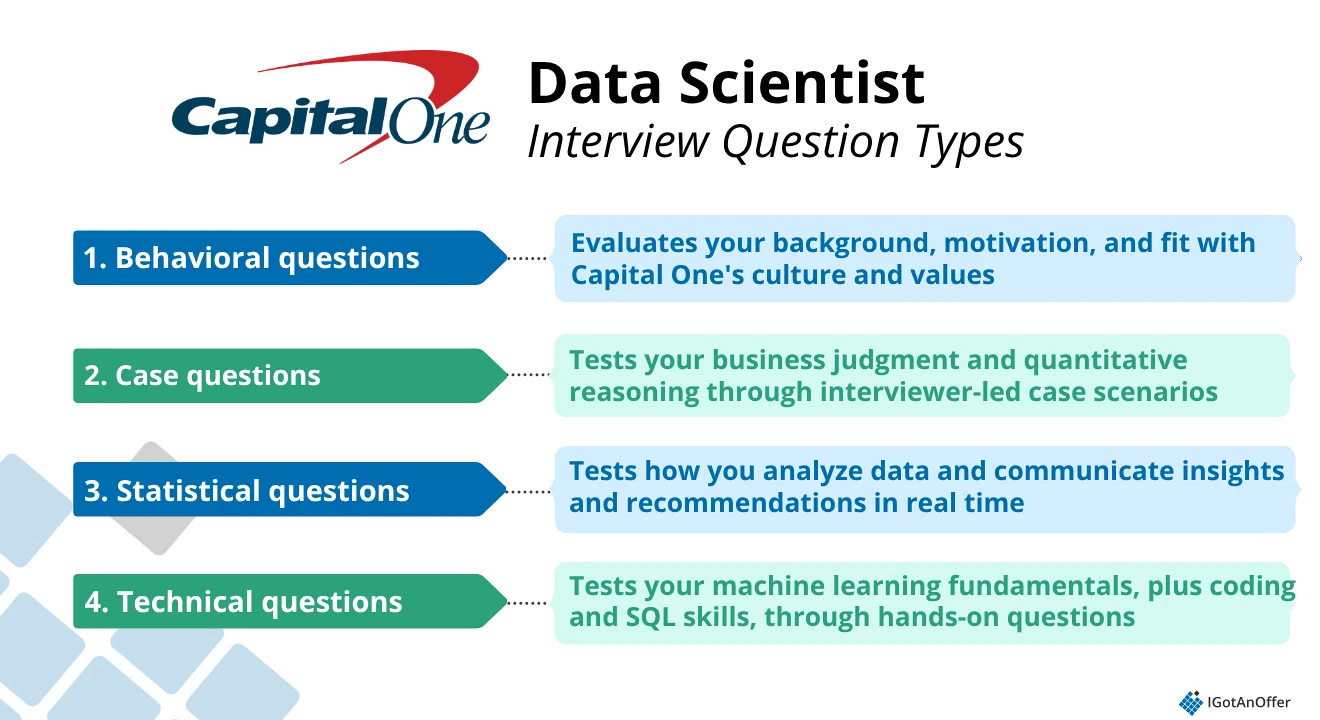
Capital One data scientist interviews cover four main areas:
- Behavioral
- Case interview
- Statistics roleplay
- Technical
We've gathered actual Capital One data scientist interview questions from candidate reports on Glassdoor (2022 through mid-2026), cross-checked against Blind discussions.
We've divided them based on the four round types data science candidates report during Power Day, covered in Section 2.7 above. Many of the questions below are asked in the form of case studies.
Where Capital One-specific reporting was thin on a topic, we've borrowed a question from another company's guide and labeled the source company directly.
3.1 Behavioral
You can expect behavioral questions throughout the Capital One data scientist process, particularly during the recruiter screen, hiring manager pre-screen, and the Job Fit round of Power Day.
Behavioral questions help interviewers understand how you think and whether your approach aligns with Capital One's culture and values. They focus on past experiences, how you respond to challenges, and how you collaborate with others.
To keep your answers clear and concise, use a repeatable framework for structuring your answers.
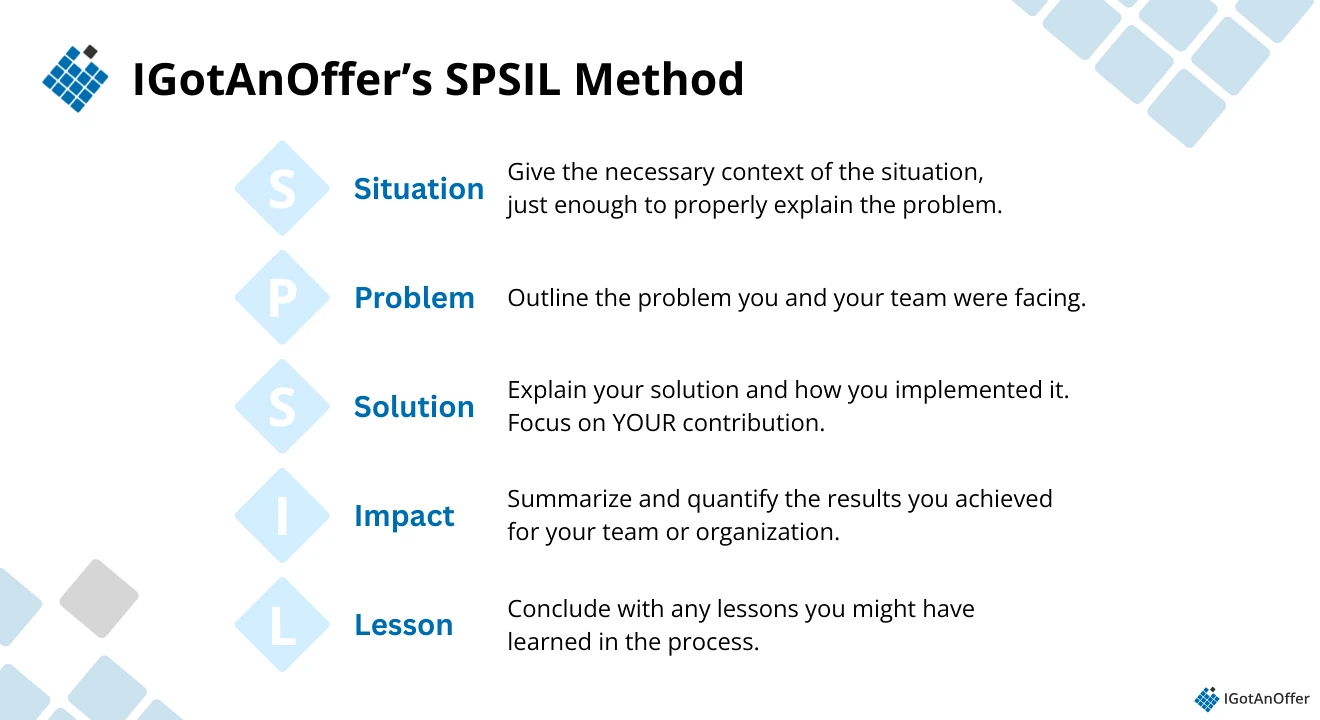
The STAR method (Situation, Task, Action, Result) is the most common, but we recommend IGotAnOffer's SPSIL method (Situation, Problem, Solution, Impact, Lessons) instead. It's easier to use because there's no overlap between steps, and it prompts you to include lessons learned.
Example Capital One data scientist interview questions: Behavioral
- Walk me through your resume.
- Tell me about yourself, based on your resume.
- Tell me about your past project experience with machine learning, and how many lines of code you contributed in your last job.
- Tell me about your past projects and relevant experience.
- What is your motivation in life?
- How do you ensure compliance with legal or regulatory requirements regarding data quality? (TikTok)
- Why Capital One?
- What are your strengths and weaknesses?
- Tell me about a time you had to resolve a difficult situation or conflict.
For a full breakdown of how to answer each of these, including example answers, see our Capital One Behavioral Interview guide.
3.2 Case interview
Case questions give you a business problem and ask you to work through it. The goal is to show your thinking and decision-making process, rather than arrive at one correct answer.
These questions call for a structured framework and clear analytical reasoning. A number alone isn't the answer. You need to explain what it means and what the business should do about it.
Example Capital One data scientist interview questions: Case interview
- You're given a mini-case about airline or airport scheduling. Walk through how you'd approach it.
- You're given an airplane-themed case study, plus a coding test involving writing or reviewing a script.
- You're given a case study that applies statistical methods to a business project. Walk through your approach.
- A company is facing high employee turnover. What metrics would you look at to help solve the problem?
- Walk through a breakeven analysis for a given business scenario.
- Walk through how you'd model a business problem: what data would you collect, what model would you use, and how would you evaluate it?
- Theme park case: given usage and revenue data, calculate a weighted average and a cost/revenue breakdown, then recommend next steps.
For more on cracking Capital One's case format specifically, see our Capital One case interview guide or our data science case interview guide.
3.3 Statistics roleplay
Candidates on Glassdoor, Blind, and Reddit refer to this round as a "statistics roleplay" or "stats role play," though Capital One doesn't use that exact term on its careers site. Treat the details below as a handful of firsthand accounts rather than a documented process.
Reports describe the round taking a couple of different forms:
- Client scenario. You’re handed a short slide deck to review for about 15 minutes. You’ll then walk the interviewer through your insights, recommendation, and what you’d do differently, out loud and in real time.
- Straightforward stats Q&A. A more conventional "stats round" of direct questions rather than a slide walkthrough. For example, you could get a single question on how to perform an A/B test properly.
Worth confirming the format with your recruiter or a coach who's interviewed for the role recently.
Example Capital One data scientist interview questions: Statistics roleplay
Statistics roleplay
- You're given a slide of business data or charts. Explain your insights, your recommendation, and what you'd do differently.
- Statistics roleplay built around an airline-delay business problem: given a sample analysis, explain it to the interviewer.
- Explain what a dataset means in business terms, rather than in technical ones.
General statistics
For sample answers to statistics questions like these, see our data science interview prep guide.
3.4 Technical
This round, per candidate reports, covers both machine learning and coding/SQL (Structured Query Language), sometimes in the same session and sometimes split across two back-to-back interviews.
Live coding here skews practical and scenario-driven rather than LeetCode-style algorithm puzzles. Expect a code review of a Python package or a question about a shell script, where interpreting the output and explaining your reasoning matter as much as landing on the right answer.
The machine learning side spans classical methods, like comparing logistic regression against random forest for a classification problem, through newer generative AI topics.
One mid-2026 report includes a question on how RAG (retrieval-augmented generation) works in an LLM context, suggesting the round has kept pace with recent industry shifts.
We've grouped machine learning and coding/SQL questions together below since public reporting doesn't consistently separate them into distinct rounds.
Example Capital One data scientist interview questions: Technical
Machine learning
- Compare logistic regression and random forest models in Python for a classification problem. (Solution)
- How does RAG (retrieval-augmented generation) work in an LLM (large language model) context? (Solution)
- Design an ML system, at a high level, for a given product scenario.
- Walk through your understanding of the machine learning project workflow, plus a couple of fundamental statistics questions.
- You're shown a sample dataset and an ML model. Is this the correct model to use here? Are there better options? (Solution)
- Discuss the entire ML lifecycle end to end. (Reported independently by two separate candidates.) (Solution)
- What evaluation metrics would you use for a classification model? (Solution)
- Describe an ML project you've worked on. (Expect follow-up questions from the hiring manager.)
- How do you handle missing values? How does credit card fraud detection typically work? What evaluation metrics would you use for classification versus regression?
- Walk through your approach to data processing, model building, and deploying a model to production.
Coding & SQL
- How would you find the top 5 highest-selling items from a list of order histories? (Google) (Solution)
- Provided a table with user_id and the dates they visited the platform, find the top 100 users with the longest continuous streak. (Meta) (Solution)
- Review and critique a given Python package's code, and answer a question about a shell script.
- How do you use version control (e.g. Git) in your day-to-day work? (Solution)
- How do you maintain code quality within a data science team? (Solution)
- What are SQL joins, and how would you use Spark for similar data tasks? (SQL joins solution | Spark joins solution)
- Write Python code to check whether two strings are anagrams of each other. (Amazon) (Solution)
- Write a query to find active users from a user activity table. (TikTok) (Solution)
Check out our coding interview questions list (with samples for Python, Java, C++, SQL, and more) and our data science interview prep guide to learn more.
4. Capital One data scientist interviewing tips ↑
You might be a fantastic data scientist, but unfortunately, that won't necessarily be enough to ace your interviews at Capital One. Interviewing is a skill in itself that you need to learn.
Let's look at some key tips to make sure you approach your interviews in the right way.
4.1 Ask clarifying questions
Case and technical prompts are often intentionally ambiguous. Ask questions that narrow the problem down before you start solving it, and be upfront if you hit a topic you have limited experience with rather than trying to bluff through it.
Capital One cares as much about how you work through something unfamiliar as it does about your technical skills.
4.2 Treat the interview like a conversation
Approach the interview like a conversation rather than a test. You're assessed on how clearly you communicate more than on reaching the right answer, especially in case and statistics rounds, where you're walking someone through your thinking as you go.
Practice explaining your reasoning in a way that's clear to someone without a technical background.
4.3 Think out loud, especially in case and statistics rounds
Walk your interviewer through your thought process as you work instead of solving silently and presenting a final answer. Capital One's case and statistics interviews are interviewer-led.
As James T. (Capital One case interview coach) puts it: "Interviewers will push you to commit (launch or do not launch, price A or price B) and then stress-test your logic."
Narrating your thinking as you go, even when it feels awkward, gives the interviewer something to react to. If you're off track, they'll nudge you, so listen for those cues and adjust accordingly.
4.4 State and check your assumptions
Say your assumptions out loud, explain why you're making them, and check with your interviewer that they're reasonable before you build on them.
Interviewer-led formats like Capital One's don't give you the same runway to explore on your own that a candidate-led case would.
It's fine to make assumptions since you won't have full context or data in an interview setting. Just be clear that on the job, you'd go find that data before committing to a decision.
4.5 Present multiple possible solutions
Where you can, present more than one possible approach, then explain your reasoning for choosing one over the others. This shows your interviewer how you think, which matters more than the solution you land on.
4.6 Practice with "ugly" numbers
Capital One's cases tend to use messy, realistic inputs (think 17.5% of 2,340, not 20% of 2,000) rather than the clean, round figures common in consulting-style cases. James T. advises building your mental math on exactly this kind of "ugly numbers and messy inputs."
Practice your mental math on numbers like these, and bring a calculator or use a spreadsheet during the interview instead of trying to do everything in your head.
4.7 Know how to pivot when you're stuck
"When stuck, summarize your position, then pivot to another angle to avoid silence or filler language," Brittany G (case interview coach) says.
Interviewers can tell the difference between a deliberate pause and actually being stuck.
4.8 Center your stories on data-driven decisions
Capital One was built on using data and analytics to make better business decisions, and that shows up in what interviewers listen for in behavioral answers. When you can, anchor your stories in a decision you made or influenced using data, rather than a technical build.
4.9 Center on Capital One's culture
Familiarize yourself with Capital One's culture and values and align your responses with them. Capital One highlights excellence, doing the right thing, growth and mobility, innovation, belonging, collaboration, and well-being as what it looks for in its people.
4.10 Keep your code organized
Keep your code readable and easy to follow so your interviewer isn't working to parse what you wrote while also evaluating it. That applies as much to the technical round's ML and SQL questions as it does to the take-home challenge.
4.11 Brute force, then iterate
Don't hold out for the perfect solution on your first pass. Get something working, then iterate to refine it. Interviewers care more about seeing your process than about a polished final answer.
5. Preparation plan ↑
Now that you know what to expect, here's how to prepare.
5.1 Learn about Capital One's culture
Most candidates skip this step, but before investing hours preparing for Capital One specifically, make sure it's the right fit for you.
Capital One's culture differs from a traditional bank's and also from a typical Big Tech company's, so it's worth understanding what you're signing up for.
Here are some resources to help you get started:
- Capital One Careers: Culture page
- Capital One Careers: How we work
- Capital One Careers Blog
- Capital One About page
- Capital One culture video (YouTube)
- Capital One Careers FAQ
5.2 Practice by yourself
As covered above, you'll encounter four main round types at Capital One: Behavioral, Case interview, Statistics roleplay, and Technical (machine learning and coding/SQL).
For behavioral prep:
- Capital One behavioral interview guide
- 16 most-asked behavioral interview questions
- 50 case studies exploring data governance and management (relevant background for data quality and compliance-related questions)
For case prep:
- Capital One case interview guide
- How to crack data science case studies
- Frameworks for answering business case questions
For statistics roleplay prep:
- Khan Academy Statistics & Probability course
- StackExchange Stats (for statistics, machine learning, and data analysis Q&A)
- Brilliant.org's online courses on statistical probability
- Reddit's statistics and machine learning threads to discuss questions with peers
- Ultimate A/B Testing Guide
- How Experimentation Informs Product Development (LinkedIn)
For technical (machine learning and coding/SQL) prep:
- Data science interview prep guide
- How to get better at coding interviews
- Practice for 3 types of SQL interviews
- SQL Course
- Mode Analytics SQL tutorials
- Programmer Interview SQL Practice Database
- Python | SQL comparison guide
A great way to practice all of these different types of questions is to interview yourself out loud. This may sound strange, but it helps you communicate more clearly once you're in the actual interview.
Play the role of both the candidate and the interviewer, asking questions and answering them, just like two people would in an interview.
If you're also interviewing at other companies, our other data scientist guides may help too:
- Google data scientist interview guide
- Meta data scientist interview guide
- Amazon data scientist interview guide
- TikTok data scientist interview guide
- Amazon applied scientist interview guide
- Uber data scientist interview guide
- OpenAI data scientist interview guide
5.3 Practice with peers
If you have friends or peers who can do mock interviews with you, that's an option worth trying. It's free, but be warned, you may come up against the following problems:
- It's hard to know if the feedback you get is accurate
- They're unlikely to have insider knowledge of interviews at your target company
- On peer platforms, people often waste your time by not showing up
For those reasons, many candidates skip peer mock interviews and go straight to mock interviews with an expert.
5.4 Practice with ex-interviewers
You should try to practice Capital One data scientist mock interviews with expert ex-interviewers, as they'll be able to give you much more accurate feedback than friends and peers.
In our experience, practicing real interviews with experts who can give you company-specific feedback makes a huge difference.
Find a Capital One data scientist interview coach so you can:
- Test yourself under real interview conditions
- Get accurate feedback from a real expert
- Build your confidence
- Get company-specific insights
- Learn how to tell the right stories, better.
- Save time by focusing your preparation
Landing a job at a big tech company often results in a $50,000 per year or more increase in total compensation. In our experience, three or four coaching sessions worth ~$500 will make a significant difference in your ability to land the job. That's an ROI of 100x!
Book Capital One data scientist mock interviews with experienced interviewers.












 Coding