

 Back to other articles
 Last updated: October 15, 2026

 Interviews
 Data scientist
 Data modelling
 Deeply researched
Netflix data scientist interviews can be daunting. You need to show that you can use data to solve product problems, communicate your thinking clearly, and work effectively with people in a way that aligns with Netflix’s culture.
You’ll be tested on coding, statistics, experimentation, and product analysis. Behavioral questions will explore your experience and how you work with others.
In this guide, you'll learn what to expect in Netflix's data scientist interviews, based on candidate reports from Glassdoor and discussions on Reddit and Blind. We've also included sample questions, practical interview tips, and a preparation plan to help you get ready.
Here's an overview of what we'll cover:
Practice 1-on-1 with data scientist interview coaches
1. Netflix data scientist role and salary ↑
Before we cover your Netflix data scientist interviews, let’s first look at the role itself.
1.1 What does a Netflix data scientist do?
As a data scientist at Netflix, your ultimate goal is to provide data-driven insights that will help improve user experience across Netflix’s products. For example, the Interactive Discovery team works on Continue Watching, My List, and Remind Me. Its data scientists help evaluate changes to these features through experimentation and causal inference.
You’ll work with the product team to design experiments and recommend changes based on the results. That work includes maintaining the code and datasets used in your analyses.
Netflix’s work-life philosophy describes flexible working hours, but where you work depends on the role. For example, Interactive Discovery lists a remote data scientist position within the United States, while the Senior Data Scientist, LATAM Content role is on-site in Mexico City. Check the location and work arrangement in your job posting before applying.
1.2 How much does a Netflix data scientist make?
According to Levels.fyi, $500K is the median annual total compensation for Netflix data scientists reported in the United States. The figures below show its reported level breakdown, rounded to the nearest thousand dollars.
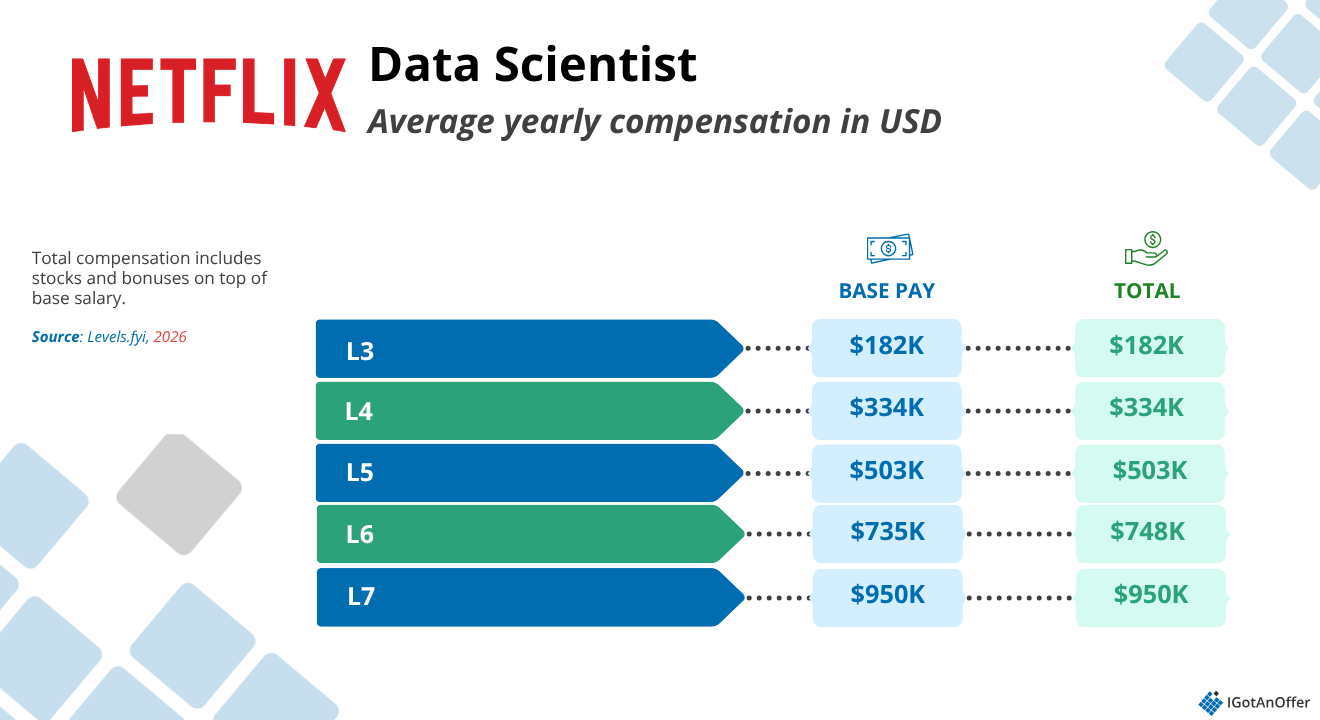
We presume you already know which level you're applying for, but it's worth double-checking with your recruiter, who can confirm which level you're being evaluated for.
It’s worth noting that Netflix’s stock option program lets you decide how to split your eligible compensation between salary and options. You can choose all cash, all options, or any mix that suits you. The options vest immediately, have a ten-year term, and stay with you if you leave Netflix.
Ultimately, how you do in your interviews will help determine whether you get an offer, which is why hiring one of our Netflix interview coaches can provide a significant return on investment.
If you do get an offer, ask your recruiter whether any part of the package is open to discussion. Consider booking one of our salary negotiation coaches to get expert advice.
Coaches who contributed to this guide




2. Netflix data scientist interview process ↑
The Netflix interview process typically takes 2–5 months, but it can be as short as 6–8 weeks. The timing depends on team urgency, interviewer availability, and the number of candidates being evaluated. This is the company-wide timeline from our Netflix interview process guide; ask your recruiter about the timeline for your data science team.
Here’s an overview of each step of the Netflix interview process:
- Resume screen
- Recruiter call
- Hiring manager screen
- Technical screen
- On-site interviews
- Hiring committee
- Salary negotiation
2.1 Resume screen ↑
The first step of Netflix's interview process is the resume screen. After you've submitted your application through the Netflix jobs portal or been contacted directly via email or LinkedIn, recruiters will evaluate your resume to see if your experience aligns with the open position.
This is a highly competitive step. To help you put together a targeted resume that stands out, follow the tips below:
Tips on crafting a resume
- Simplify. Avoid overly creative layouts. A simple resume passes through applicant tracking systems and reads quickly for recruiters and hiring managers.
- Verbalize. Start each bullet point under your previous roles with an action word.
- Quantify. Add numbers wherever you can: model performance gains, scale of experiments, or adoption of a technique you developed.
- Summarize. Include a skills section with keywords pulled directly from the job posting.
For more guidance on how to craft your resume, check out our data science resume guide. We recommend booking a resume review session to get expert personalized advice on how to improve your CV.
2.2 Recruiter call ↑
If your resume passes the screen, a Netflix recruiter will reach out to schedule an initial call. This typically lasts 30 minutes.
The recruiter will send you Netflix's culture memo before your conversation. Read it carefully because this call focuses heavily on assessing cultural fit. Take note that Netflix is big on culture, and the recruiter call is where that evaluation begins.
The recruiter will also ask you for any follow-up questions. Avoid generic questions that can be easily researched online, like "What's the interview process like?" or "Is this position remote?"
Instead, ask questions like "What does success look like in the first 6-12 months for this role?" or “What's the biggest challenge the team is facing right now?" These questions show your strategic thinking and genuine interest in the role.
If you do well here, the recruiter will move you to the next stage: the hiring manager screen.
For an insider look into how Netflix culture works and how to crack Netflix culture interviews, check out this video with ex-Netflix Lead PM and coach, Michael P. After seeing the video, check out our Netflix culture interview guide to prepare stories for each value in the culture memo.
2.3 Hiring manager screen ↑
After the recruiter call, you'll have one or more screening interviews with a hiring manager or future peers. This typically consists of one 45-60 minute interview, though some roles may have two separate screens.
Your interviewer’s goal here is twofold: to assess how you think and how you work, in the context of the role you’re applying for. The manager could explore your technical background, decision-making process, and how you approach complex or ambiguous challenges.
Specifically for a data scientist role, managers would cover technical discussion of data pipelines you've built, SQL/data modeling questions, and how you communicate insights to non-technical stakeholders.
2.4 Technical screen ↑
Here, your technical skills and fit for the role are assessed.
Note that Netflix is moving away from algorithmic LeetCode-style questions. They instead focus on real-world, practical problems that reflect actual challenges the team faces. These challenges may include content delivery, recommendations, and infrastructure.
To ace this stage, practice with real-world problems relevant to Netflix. Understand the platform’s architecture, content delivery challenges, and how recommendation systems work.
Also, be prepared to communicate your thinking clearly and discuss trade-offs in your approach.
This stage varies based on the role you’re interviewing for. Here's what you can expect, depending on the role: SQL queries and data modeling challenges, designing pipelines for high-volume streaming data, discussing ETL processes and scalability at Netflix's scale.
2.5 On-site interviews ↑
The on-site interview loop is the most extensive stage of the Netflix process. This typically consists of approximately 8 interviews conducted either in Netflix's physical offices or via video call over two rounds:
- Round 1: Deep-dive into skills and collaboration
- Round 2: Leadership, influence & organizational fit
For data scientist roles, prepare for questions in these five areas:
- Coding and data preparation
- Statistics and probability
- Experimentation and causal inference
- Product metrics and business analysis
- Behavioral, culture, and experience
These are question categories, not five separate interview rounds.
Given how taxing these interviews are, your Netflix recruiter may offer to split your on-site over two days. We recommend taking this option if offered, or requesting it if not.
Check out our Netflix interview process to find out more about these two rounds.
2.6 Hiring committee ↑
A hiring committee reviews all interview feedback and makes the final decision on your candidacy. This is a collective judgment process based on your interview feedback, alignment with culture, and how you stack up against other finalists.
While Netflix doesn’t publicly share how its committees work, we’ve had reports from candidates that reveal a consistent pattern.
Netflix recruiters typically inform you that “the team is debriefing” or “finalizing feedback.” This phase can last a few days to several weeks, depending on how many candidates are still in process.
The recruiters generally maintain strong communication throughout, providing updates and, when possible, sharing snippets of feedback. However, some candidates report receiving concise rejections after weeks of waiting, with little explanation.
If you haven’t heard back after a couple of weeks, it’s perfectly fine to follow up with your recruiter for an update. Response times can vary depending on team schedules, so try to stay patient and use the waiting period to prepare for potential next steps.
2.7 Salary negotiation ↑
If you pass the final round, your recruiter will contact you with an offer. Take some time to review it before you respond, especially if you plan to negotiate.
Salary negotiation tips
- Be polite. Remember that the person you're negotiating with is just doing their job. You'll get much farther in your negotiations if you approach the conversation with grace.
- Don't give a number right away. Whenever possible, it's better to wait until you receive an offer to start negotiating. This reduces the risk of giving a number that is lower than what Netflix otherwise would have paid.
- Do your research. Have a number in mind before the conversation begins, and back it up with data. Research your position and level on Levels.fyi, ask around on professional networking sites like Blind, and factor in the cost of living where you are.
- Start high. Name a compensation number that is higher than your goal. Your Netflix recruiter will likely negotiate it down to something closer to what you actually want.
- Negotiate everything. Your offer includes more than a base salary. You also have the salary-versus-stock-options mix, location, and work arrangements to consider. If the salary won't budge, ask which other parts of the package are open for discussion.
If you'd like help reviewing your offer and planning your negotiation, you can book a session with one of our salary negotiation coaches.
3. Netflix data scientist example interview questions ↑
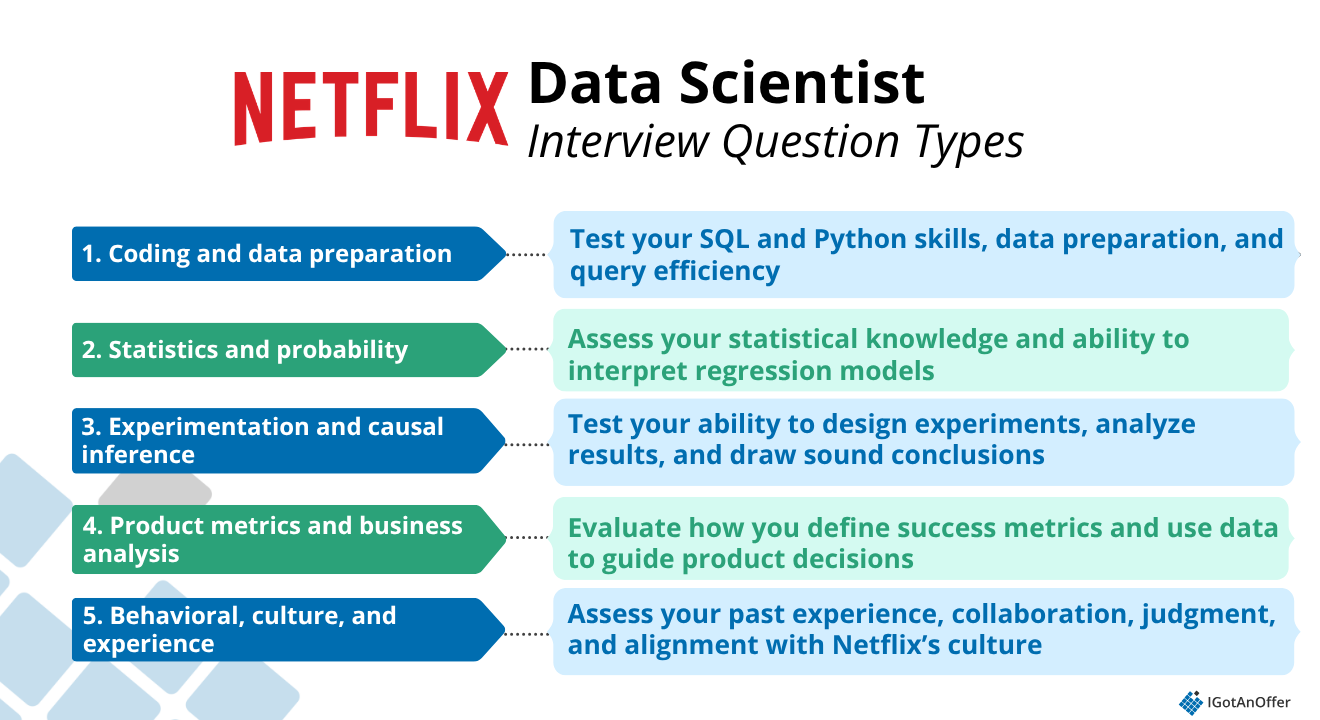
We’ve collected Netflix data scientist questions from Glassdoor, along with practice questions from other Netflix roles and other FAANG+ companies’ data scientist guides. The additional questions are labeled by source. We’ve grouped the questions into five categories:
- Coding and data preparation
- Statistics and probability
- Experimentation and causal inference
- Product metrics and business analysis
- Behavioral, culture, and experience
3.1 Coding and data preparation
Netflix’s coding questions include SQL and Python. For SQL, review joins, window functions, and common table expressions (CTEs). Be prepared to use them across several tables in the same problem.
For Python, practice preparing data with pandas: filter rows, combine datasets, calculate grouped summaries, and handle missing values. Try solving the same data problem in SQL and Python so you can explain how your approaches differ.
What you’ll be tested on is your ability to structure, articulate, and code an executable solution to the problem you’ll be given.
The SQL screen may also cover code efficiency and edge cases, such as how your query handles null values.
Example Netflix data scientist interview questions: Coding and data preparation
- Write a SQL query to find the top ten titles that drove the highest new-signup completion rate over the last quarter, restricted to first-time viewers.
- Write SQL code to calculate the month-to-month user retention rate. (Sample solution) (Amazon)
- Describe different JOINs in SQL. (Amazon)
- Write a SQL query to calculate video watch time. (TikTok)
- Write a function to generate N samples from a normal distribution and plot the histogram. (Sample solution) (Google)
- How would you optimize a database query? (Google)
- How do you ensure dataset integrity before analysis? (Uber)
- How do you inspect missing data and when are they important? (Sample solution) (Amazon)
For more practice, see our coding interview examples, which include mock interview videos in Python and SQL. Use them to practice explaining your approach as you work through a problem.
3.2 Statistics and probability
Netflix’s statistics questions test both your theoretical knowledge and how you apply it. Topics include regression, hypothesis testing, and uncertainty in your results. In one reported interview, the candidate had to interpret a supplied regression model, including its coefficients and R².
To prepare, review concepts such as p-values, confidence intervals, and Type I and Type II errors. Then work through regression output: explain what each coefficient means, check the model’s assumptions, and discuss what the results do and don’t tell you.
Example Netflix data scientist interview questions: Statistics and probability
- How do you interpret R² in a regression model?
- Explain the coefficient in the linear regression model provided. (Sample solution)
- Explain Type I and Type II errors.
- What is the false discovery rate (FDR), and how do you calculate it? (Sample solution)
- Explain p-value to a non-technical person. (Uber)
- What are the assumptions of linear regression? (Uber)
- Explain confidence intervals. (Amazon)
- What happens to regression coefficients if you have omitted variable bias? (Google)
To brush up on your fundamentals,For a broader review, we recommend Khan Academy’s Statistics and Probability course. It includes lessons and practice exercises on probability, confidence intervals, hypothesis testing, and regression.
3.3 Experimentation and causal inference
Some Netflix data science case interviews require you to design a complete experiment and explain your choices to the interviewer.
You may need to choose metrics, explain how you would analyze the results, and recommend whether to launch the change, revise it, or test further. Your recommendation should account for what the experiment can tell you. For example, a short test might show that viewers watch more, but you may need to follow them for longer to find out whether the change improves retention.
If you have experience conducting A/B tests, we'd recommend preparing a specific example in advance. Explain the hypothesis, how you assigned participants to groups, and why you chose your primary metric and sample size. Walk through the results and any limitations, then explain how they informed the team’s decision.
For “multi-class” questions, clarify the groups and comparisons with your interviewer before choosing a test.
Example Netflix data scientist interview questions: Experimentation and causal inference
- Design an A/B test to evaluate a new personalized row-ordering model on the logged-in homepage, where different rows may surface many of the same titles and retention is a long-term outcome.
- What is a common pitfall in multi-class A/B testing?
- What are the assumptions of A/B testing? (Uber)
- How do you determine the sample size for an experiment? (Uber)
- Walk through a causal inference problem from your experience. (Uber)
- With multiple experiments running at the same time, how do you tell if the result comes from a specific experiment? (TikTok)
- An A/B test shows a 0.2% drop in click-through rate (CTR) but an increase in session length. How would you interpret these results, and what would you do next? (Meta)
3.4 Product metrics and business analysis
Product metrics questions test whether you can identify measures that reflect a product’s goals and use data to guide decisions. You may be asked to define success for a feature or investigate a change in an existing metric.
For a success-metrics question, first agree on the user and business goals, then explain which metrics would show progress and what they might miss. If a metric has dropped, clarify its definition, the affected users, and the time period before investigating possible causes.
Take the “Because you watched” question below. If the goal is to help viewers find something to watch, you could measure the percentage of people who see the row and start one of its recommended titles. That gives you an early measure of whether the recommendations attract viewers, but it doesn’t tell you whether they’ll keep using Netflix. Explain that limitation before treating more play starts as evidence of better retention.
Example Netflix data scientist interview questions: Product metrics and business analysis
- How would you define and measure the success of a change to the 'Because you watched' recommendation row, and what proxy metrics would you use in the short term?
- Given that no metrics are being tracked for a Netflix product feature, a product manager asks you for the top five metrics you would implement. What would you choose? (Google)
- How would you investigate a drop in a key performance indicator (KPI)? (TikTok)
For frameworks and worked examples covering both types, see our product metrics interview guide. It’s written for product managers, but the steps for defining metrics and investigating changes apply to data science cases too.
3.5 Behavioral, culture, and experience
Behavioral questions help interviewers understand how you think and whether your approach aligns with Netflix's culture and values. They focus on past experiences, how you respond to challenges, and how you collaborate with others.
In our Netflix culture and behavioral interview guide, Michael (ex-Netflix lead PM) explains that interviewers connect your examples to the culture memo: “They're literally taking notes against these words.” Make that connection clear by showing how you put a value into practice in your own work.
To keep those stories easy to follow, we recommend using an answer framework. You may already know STAR (Situation, Task, Action, Result). Our preferred IGotAnOffer SPSIL method uses Situation, Problem, Solution, Impact, Lessons. The final step reminds you to explain what you learned, which is particularly helpful when discussing feedback or failure.
Let’s look at some example questions.
Example Netflix data scientist interview questions: Behavioral, culture, and experience
- Introduce your research.
- Tell me about a time you had to make a decision with incomplete information.
- Describe difficult feedback you received and the changes you made afterward.
- Describe a failure and the lesson you applied afterward.
- Tell me about a time you influenced a decision without having formal authority.
- Why Netflix?
- Which Netflix values would you embrace, and which would be challenging for you?
For more help structuring your responses, see our Netflix culture and behavioral interview guide. The linked questions above also have relevant sample answers or answering guidance, although some examples come from other roles. Use them to understand how to develop an answer, then build your own response around your experience.
4. Netflix data scientist interviewing tips ↑
You might be a fantastic data scientist, but unfortunately, that won’t necessarily be enough to ace your interviews at Netflix. Interviewing is a skill in itself that you need to learn.
Let’s look at some key tips to make sure you approach your interviews in the right way.
4.1 Ask clarifying questions
Often, the questions you’ll get will be quite ambiguous. Make sure you ask questions that can help you clarify and understand the problem.
Be upfront if you encounter topics you have little experience with, but don’t give up on tackling them. Netflix isn’t just testing your technical skills but your ability to deal with problems you’re not familiar with.
4.2 Treat the interview like a conversation
Netflix wants to know if you have excellent communication skills. So make sure you approach the interview like a conversation.
Netflix will also be testing you on your ability to tell a clear and concise story through data, especially to stakeholders who may or may not have a technical background.
Be sure to practice communicating data in a way that’s clear and easy for everyone to understand.
4.3 Think out loud
You need to walk your interviewer through your thought process before you actually start coding. Keep talking while coding so your interviewer can understand how you think.
Your interviewer may also give you hints about whether you’re on the right track or not. Be alert for these, and be ready to pivot once you’ve gotten the prompt. This shows you’re eager to learn and listen well to feedback.
4.4 State and check assumptions
You need to state assumptions explicitly, explain why you’re making them, and check with your interviewer to see if those assumptions are reasonable.
4.5 Present multiple possible solutions
Present multiple possible solutions if you can. Netflix wants to know your reasoning for choosing a certain solution.
When dealing with complicated or ambiguous questions, show your ability to deconstruct such problems into groups and demonstrate how you can combine these groups for your proposed solution.
4.6 Center on Netflix’s culture
Familiarize yourself with Netflix’s culture memo and align your responses with it.
For the data scientist role in particular, prepare examples that demonstrate independent judgment, comfort with ambiguity, and collaboration.
Note that your culture alignment will be assessed during the entire interview process and not just in your behavioral interview. For example, if your interviewer adds a constraint that changes your experiment design, explain which assumption no longer holds and revise your approach. This shows you can adapt your thinking when new information becomes available.
5. How to prepare for Netflix data scientist interviews ↑
Now that you know what questions to expect, let's focus on how to prepare. Below is our four-step prep plan for Netflix.
If you're preparing for other companies as well, then check out our general data science interview preparation guide.
5.1 Learn about Netflix's culture
Most candidates fail to do this. But before investing a ton of time preparing for an interview at Netflix, you should make sure it's actually the right company for you.
Netflix is prestigious, and so it's tempting to assume that you should apply without considering things more carefully. But it's important to remember that the prestige of a job by itself won't make you happy in your day-to-day work. It's the type of work and the people you work with that will.
If you know anyone who works at Netflix (or used to), it's a good idea to talk to them to understand what the culture is like.
We recommend checking out these resources to help you learn more about the company:
- Netflix’s culture memo
- Netflix’s work-life philosophy
- Sharing Our Latest Culture Memo (by Netflix)
- Netflix tech blog
In addition, we recommend reading the following:
- Netflix annual reports and proxies (by Netflix)
- Netflix interview process
- Netflix culture and behavioral interview questions
- Common Netflix interview questions and sample answers
5.2 Practice by yourself
As covered above, you'll encounter five main question types at Netflix: Coding and data preparation; Statistics and probability; Experimentation and causal inference; Product metrics and business analysis; and Behavioral, culture, and experience.
To help you with your self-practice, we recommend the following resources below:
For coding and data preparation prep:
- Data science interview prep guide
- How to get better at coding interviews
- Practice for 3 types of SQL interviews
- SQL Course
- ThoughtSpot SQL tutorial
- Programmer Interview SQL Practice Database
- Python | SQL comparison guide
For statistics and probability prep:
- Khan Academy Statistics & Probability course
- StackExchange Stats (for statistics, machine learning, and data analysis Q&A)
- Brilliant.org's online courses on statistical probability
- Reddit's statistics and machine learning threads to discuss questions with peers
For experimentation and causal inference prep:
For product metrics and business analysis prep:
For behavioral, culture, and experience prep:
A great way to practice all of these different types of questions is to interview yourself out loud. This may sound strange, but it helps you communicate more clearly once you're in the actual interview.
Play the role of both the candidate and the interviewer, asking questions and answering them, just like two people would in an interview.
If you're also interviewing at other companies, our other data scientist guides may help too:
- Google data scientist interview guide
- Meta data scientist interview guide
- Amazon data scientist interview guide
- TikTok data scientist interview guide
- Amazon applied scientist interview guide
- Uber data scientist interview guide
- OpenAI data scientist interview guide
- Microsoft data scientist interview guide
- Capital One data scientist interview guide
- Data science interview prep
5.3 Practice with peers
Practicing by yourself will only take you so far. One of the main challenges of data scientist interviews at Netflix is communicating your different answers in a way that's easy to understand.
As a result, we strongly recommend practicing with a peer or a friend. Even better if you can find someone with the same background or who has interviewing experience.
However, be warned, as you may come up against the following problems:
- It’s hard to know if the feedback you get is accurate.
- They’re unlikely to have insider knowledge of interviews at your target company.
- On peer platforms, people often waste your time by not showing up.
For these reasons, many candidates skip peer mock interviews and go straight to mock interviews with an expert.
5.4 Practice with experienced interviewers
You should try to practice data science mock interviews with expert ex-interviewers, as they’ll be able to give you much more accurate feedback than friends and peers.
In our experience, practicing real interviews with experts who can give you company-specific feedback makes a huge difference.
Find a Netflix data scientist interview coach so you can:
- Test yourself under real interview conditions
- Get accurate feedback from a real expert
- Build your confidence
- Get company-specific insights
- Learn how to tell the right stories, better
- Save time by focusing your preparation
Landing a job at a big tech company often results in a $50,000 per year or more increase in total compensation. In our experience, three or four coaching sessions worth ~$500 make a significant difference in your ability to land the job. That’s an ROI of 100x!