

 Back to other articles
 Last updated: September 03, 2026

 Interviews
 Data scientist
 Coding
 Deeply researched
Microsoft data scientist interviews reflect the major role data science plays in building, measuring, and improving the company’s products. Depending on the team, you could measure product changes, build machine learning systems, or turn user and business data into decisions across cloud, productivity, search, gaming, and AI.
Your interview may therefore include coding and SQL, statistics and experimentation, machine learning and AI, case or system-design problems, and behavioral questions.
Below, we break down the full hiring process, share example questions from recent firsthand accounts, and give you tips and a preparation plan to help you get ready.
Here's an overview of what we'll cover:
Click here to practice 1-on-1 with experienced data scientist interviewers
1. Microsoft data scientist role and salary ↑
Before we cover the Microsoft data scientist interview process, let's look at the role itself and what it pays.
1.1 What does a Microsoft data scientist do?
Microsoft data scientists fall under the research, applied, and data sciences profession. They use data, statistical methods, and machine learning to help teams answer business and product questions.
The role varies by team. Depending on the position you get, you may work on experimentation, product analytics, machine learning, recommendation systems, forecasting, or AI.
1.2 How much does a Microsoft data scientist make?
According to Glassdoor, the median total pay for a Microsoft data scientist in the US is $204K/year, based on 603 salaries submitted.
Meanwhile, Levels.fyi lists a median total compensation of about $244K/year for Microsoft data scientists in the US, with packages ranging from about $158K at level 59 to $559K at level 67. These figures are based on data available as of September 2026.
Below, you can see compensation for some Microsoft data scientist levels in the US.
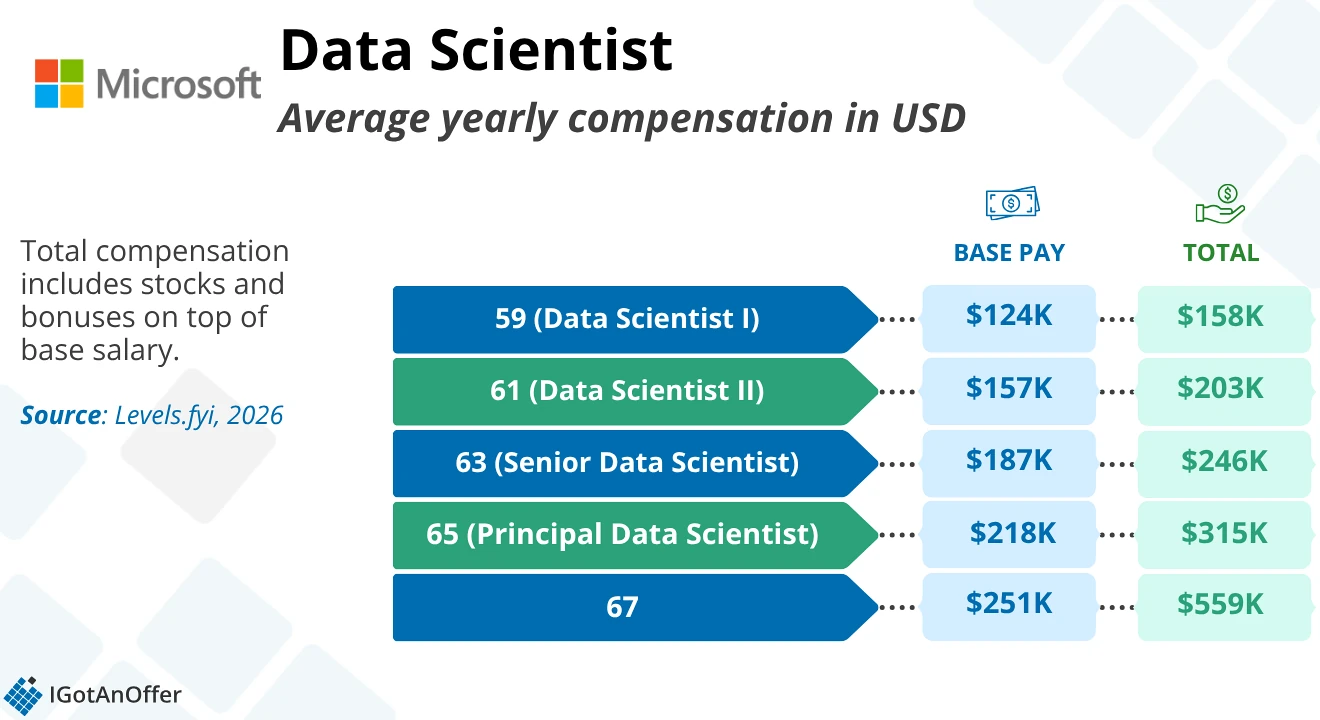 We presume you already know which level you're applying for, but it's worth double-checking with your recruiter, who can confirm which level you're being evaluated for.
Ultimately, how you do in your interviews will help determine your offer, which is why hiring one of our Microsoft data scientist interview coaches can provide such a significant return on investment.
Compensation packages are negotiable. If you do get an offer, don't be afraid to ask for more. Consider booking one of our salary negotiation coaches to get expert advice.
Coaches who contributed to this guide





2. Microsoft data scientist interview process and timeline ↑
Microsoft's full interview process typically takes three to eight weeks. The exact steps depend on the role and team, and data science hiring can follow different paths within that range.
2.1 Resume screen
To score an interview, you'll need a quality resume tailored to the data scientist role at Microsoft.
The resume screen is where recruiters compare your background with the requirements of the open position. Doing so helps them decide whether your experience is a strong enough match to move forward.
Once you find a suitable role, apply through Microsoft Careers. If you know someone at Microsoft, a referral may also help your application get noticed. In our experience, the simplest approach is to contact employees you already share a connection with on LinkedIn.
To help you put together a resume that stands out, follow the tips below:
Resume writing tips
- Simplify. Avoid overly creative layouts. A simple resume passes through applicant tracking systems and reads quickly for recruiters and hiring managers.
- Verbalize. Start each bullet point under your previous roles with an action word.
- Quantify. Add numbers wherever you can: model performance gains, scale of experiments, or adoption of a technique you developed.
- Summarize. Include a skills section with keywords pulled directly from the job posting.
For more detailed guidance, read our data science resume guide. You can also get feedback from our Microsoft resume coaches.
2.2 Recruiter call
If your resume passes the initial screen, a Microsoft recruiter will reach out to schedule a call. This typically lasts 30 to 45 minutes.
The call is primarily a background and fit conversation. The recruiter is assessing whether your experience broadly matches the position and how clearly you communicate. Expect questions like:
- "Tell me about yourself"
- "Why Microsoft?"
- "Walk me through your resume"
Your recruiter will also walk you through how the overall interview process will work. Use this call to ask about the timeline, team, job description, and the level you're being considered for. If all goes well, you’ll get a schedule for an online assessment, a first-round interview, or both.
2.3 Online assessment
Not every Microsoft data scientist role includes an online assessment. Non-engineering positions may get a different test or skip this stage. When an assessment is required, it usually runs for around 90 minutes.
For data science roles, the format can differ. One Data Scientist II applicant encountered three problems covering DSA, SQL, and machine learning, including an ordinary least squares coding task. A separate PhD internship account also mentions an online assessment before the final interviews.
Your recruiter should clarify whether you have an assessment, how long it will take, and what it will cover.
2.4 First-round interviews
After the recruiter call and online assessment (if you undergo the latter), you’ll move into one or two first-round interviews. Microsoft usually holds them over video, and each lasts 45 to 60 minutes.
You'll usually speak with a peer or hiring manager and get a mix of technical and behavioral questions. Recent Microsoft data scientist interviews have included coding, SQL, machine learning, statistics, resume questions, and sometimes case or system-design problems.
If these interviews go well, you'll get an invite to the full interview loop.
2.5 Interview loop
The interview loop is the main stage of the Microsoft interview process. You can expect four to six interviews of about 45 to 60 minutes each, though firsthand data science accounts range from three to six final rounds.
Our review of Microsoft data scientist interviews found four main question categories:
The mix depends on the team you will be joining. A product-focused role may emphasize SQL, experiments, and business questions, while an ML-heavy role may focus more on modeling, coding, and ML system design.
Some Microsoft loops also include an “as appropriate” (AA) interview with a senior executive, usually the hiring manager's manager or a VP-level leader. The AA interview may probe an area where the panel still needs evidence, or, if your interviews have gone well, spend part of the time selling you on the team and role.
After the loop, each interviewer submits feedback and a hiring recommendation. Your recruiter will usually give you a timeline for the decision. If you haven't heard back within a week, it's reasonable to follow up.
2.6 Offer and salary negotiation
If you pass the interview loop, your recruiter will present an offer package. Microsoft offers typically include base salary, an annual bonus, and restricted stock units (RSUs).
Microsoft recruiters expect you to negotiate, so you don't have to accept the first offer.
Here are some salary negotiation tips.
Salary negotiation tips
- Be polite. Remember that the person you're negotiating with is just doing their job. You'll get much farther in your negotiations if you approach the conversation with grace.
- Don't give a number right away. Whenever possible, it's better to wait until you receive an offer to start negotiating. This reduces the risk of giving a number that is lower than what Microsoft otherwise would have paid.
- Do your research. Have a number in mind before the conversation begins, and back it up with data. Research your position and level on Levels.fyi, ask around on professional networking sites like Blind, and factor in the cost of living where you are.
- Start high. Name a compensation number that is higher than your goal. Your Microsoft recruiter will likely negotiate it down to something closer to what you actually want.
- Negotiate everything. Your offer includes more than a base salary. You also have bonuses, vacation days, location, and remote work arrangements to consider. If the salary won't budge, there may be wiggle room elsewhere.
Once you're ready to practice, you can book a session with our salary negotiation coaches.
3. Microsoft data scientist example interview questions ↑
Now that we've covered the process, let's get into the kinds of questions you can expect for each type of interview.
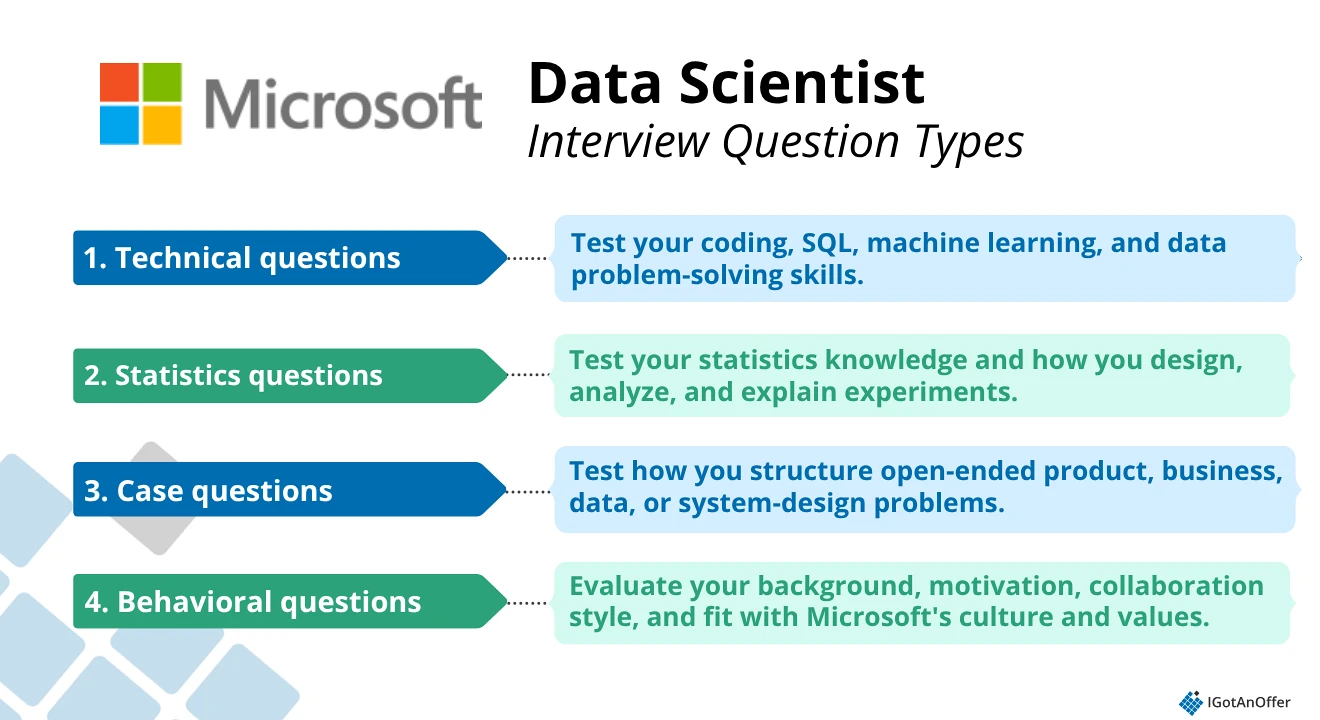
We've gathered real example questions from recent Microsoft data scientist interview reports on Glassdoor and discussions on Reddit. Based on our analysis, these questions typically fall into four main categories:
Let's get into the example questions.
3.1 Technical questions ↑
Microsoft data scientist technical interviews cover both coding/SQL and machine learning. You may encounter both types of questions in the same interview or in separate parts of the loop.
Coding questions can range from SQL, Python, pandas, NumPy, and PySpark to data structures and algorithms (DSA), including trees, linked lists, shortest paths, dynamic programming, and matrices.
For machine learning, questions may cover classical methods such as logistic regression, SVMs, bias-variance, and evaluation metrics, as well as recommendation systems, deep learning, Transformers, LLMs, and ML system design.
Let’s look at a few example questions.
Example Microsoft data scientist interview questions: Technical
Coding & SQL
- Write code to reverse a binary tree. (Solution)
- Solve one greedy algorithm problem and one shortest-path problem. (Greedy practice) (Shortest-path practice)
- Solve a probability and prefix-sums problem. (Solution)
- Determine whether a linked list is a palindrome. (Solution)
- Think of an algorithm for efficient hashing.
- Compute Fibonacci numbers first with recursion and then with dynamic programming. (Solution)
- Solve general array or hash-table problems. (Solution)
- Solve a Spiral Matrix problem. (Solution)
- How would you write a streaming function with PySpark? (Solution)
- Calculate the standard deviation of tabular data using a predefined formula in NumPy/Python. (Solution)
- Code a simple optimization problem, such as fitting points to a line.
- Answer SQL questions about table indexes. (Solution)
- Solve SQL and Python problems, including follow-up questions.
- Solve easy LeetCode-style Python, SQL, and pandas questions. (Solution)
- Solve SQL queries and LeetCode-style DSA questions.
Machine learning
- How do you perform logistic regression? (Solution)
- Explain the machine learning lifecycle in broad strokes. (Solution)
- Design a machine learning recommendation system.
- How would you track a person in a video?
- Build a predictive model for spatio-temporal power-station failure.
- Explain the bias-variance trade-off in machine learning. (Solution)
- How can we design a multimodal recommender system for a website, and how would we measure its performance?
- What is cross-entropy?
- Which is better, SVM or logistic regression, and when would you choose each?
- When would you use precision, recall, and F1 score? (Solution)
- Explain ARIMA for time-series analysis.
- Design a machine learning system for hospitals using MRI scans.
- Provide the formula for the output shape of a CNN layer. (Solution)
- Explain the attention mechanism, BatchNorm and LayerNorm, and encoder-decoder architecture in Transformers. (Solution)
- Explain a neural network to a young child.
- What different kinds of models and algorithms would you consider, and why? (Solution)
- Design an algorithm that determines whether a post is fake using features from its comments. How would you handle missing features and array-valued features?
- Build the best-performing machine learning model you can for an imbalanced-class problem. (Solution)
- How would you improve model performance in one of your resume projects?
- Build a machine learning model from scratch for a case study.
- How would you evaluate classification models? (Solution)
- You deployed a model to production. How would you check whether it is performing well in real time? (Solution)
- Explain boosting and bagging. (Solution)
- Explain LLMs briefly. (Solution)
For more coding questions, check out our coding interview questions list, with examples in Python, Java, C++, SQL, and more.
For machine learning, see our ML system design interview guide and ML questions in our data science interview prep guide.
3.2 Statistics questions ↑
Microsoft data scientists use statistics to understand patterns and quantify uncertainty in data. They also use experimentation to measure whether product or model changes work. Because both are central to the role, you can expect to be tested on them during the interview.
Statistics questions can cover probability, regression, hypothesis testing, p-values, and cross-validation. You may get a direct concept check or a quantitative problem.
Experimentation questions are more applied and often focus on A/B testing. You may need to choose metrics, explain how you would analyze the result, discuss factors that could affect your conclusion, and recommend whether to ship, iterate, or run further experiments.
Example Microsoft data scientist interview questions: Statistics
Statistics
- Why is cross-validation needed? What is overfitting? (Resource)
- What are four assumptions of linear regression?
- Define a p-value. Define Type I and Type II errors. (Resource)
- Explain confidence values and p-values. (Resource)
- Explain hypothesis testing. (Resource)
- Given 20 bus stops, 10 seats, and a 50% chance that a person gets on at each stop, what is the expected number of people who get on?
- Find the mean and standard deviation of the sum of Gaussian random variables when they are independent versus dependent.
- If you draw a random variable uniformly from 1 to 10, what is its expected value? If you draw two numbers with replacement, what is the expected sum?
- What are ways to minimize residuals in different statistical models?
Experimentation
For more statistics questions like these, see our data science interview prep guide.
3.3 Case questions ↑
Microsoft data scientists often tackle open-ended product, business, data, and system problems.
You may be asked to work through a business case, find useful patterns in a large dataset, design a data pipeline, or discuss how you would structure a system. Some interviews also include case studies where you analyze data and present your findings.
There could be different approaches to the same case, so there usually isn’t one correct answer. Interviewers are more interested in how you frame the problem, work through the trade-offs, and justify your approach.
Start by clarifying the goal and constraints, then state your assumptions and explain what data you would need. Next, compare possible approaches and explain how you would measure whether your recommendation or system works.
Example Microsoft data scientist interview questions: Case studies
- Given a user calling another user on a video-call platform, how would you account for cases where user 1 missed user 2's call and vice versa?
- Given a large database with no predefined target question, what anomalies or useful patterns can you find?
- How would you compose a pipeline for obtaining VM data?
- Work through a data science case study and present your findings.
- Work through data science case studies and related questions.
For more practice with open-ended data science problems, see our data science case interview guide.
3.4 Behavioral questions ↑
As we mentioned earlier, behavioral questions appear throughout the interview process, including the recruiter call, first-round interviews, and final loop.
These questions assess your motivation, past experience, communication, and how well your approach aligns with Microsoft's culture. The company's interview guidance emphasizes collaboration, adaptability, judgment, influence, customer focus, and a growth mindset. Before the interview, prepare a few stories tied to these qualities so you can show how you've demonstrated them in practice.
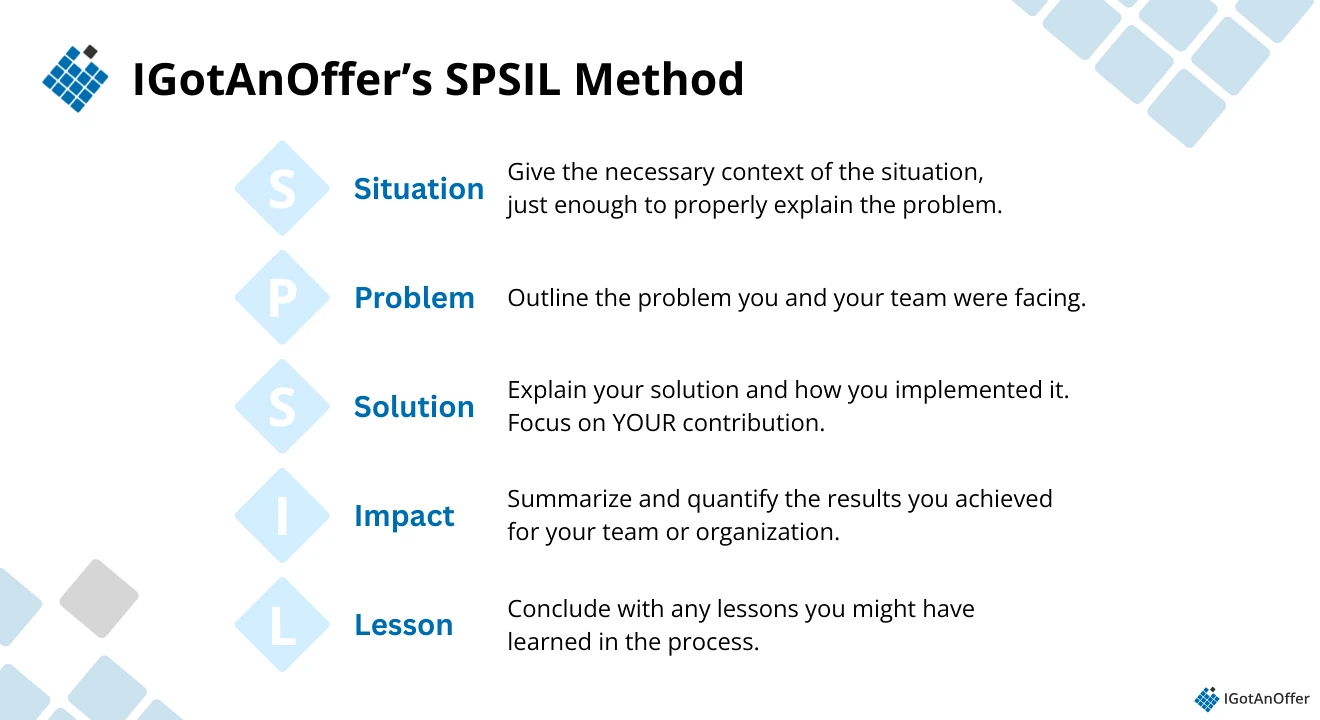
The STAR method (Situation, Task, Action, Result) is a common way to structure behavioral answers. However, we’ve found that IGotAnOffer's SPSIL method (Situation, Problem, Solution, Impact, Lessons) can be more effective because it separates the problem from your solution and gives you space to explain what you learned.
Let's look at some example questions.
Example Microsoft data scientist interview questions: Behavioral
- What is your interest in this role?
- Tell me about yourself.
- Describe your current role.
- Tell me about a time you disagreed with management but were able to convince them.
- Talk about a situation when the outcome of an experiment surprised you.
- Tell me about a time a project missed its deadline. How did you respond?
- Tell me about a case when you had an issue with a stakeholder.
- Have you ever worked in a multicultural environment dealing with global clients?
- Tell me about a time you led a team on your own.
- How do you deal with conflicts with your manager?
- How do Microsoft values align with your personal development plan?
- Tell me about a time you worked on a project with a team.
- Describe an ML capstone project you worked on.
- Describe the problem you worked on, which evaluation metrics you used and why, and which ML models you used.
- Tell me about one machine learning project. Explain the loss function and feature engineering you used.
- How do you keep yourself up to date on the latest technologies in data science?
For a full breakdown of how to answer behavioral questions, including example answers, see our behavioral interview questions guide.
4. Microsoft data scientist interviewing tips ↑
You might be a fantastic data scientist, but unfortunately, that won't necessarily be enough to ace your interviews at Microsoft. Interviewing is a skill in itself that you need to learn.
Here are a few tips and best practices to help you ace your Microsoft interviews.
4.1 Ask clarifying questions
Some of the prompts you'll get will be quite ambiguous, so ask clarifying questions before you start working through the problem. This will help you better understand what the interviewer is asking and avoid making incorrect assumptions.
If you encounter a topic you’re unfamiliar with, be upfront about it but still try to work through the problem. Microsoft isn't only assessing your technical skills, but also your ability to deal with unfamiliar problems.
4.2 Treat the interview like a conversation
Microsoft values strong communication skills. One way to demonstrate this is by treating your interview like a conversation. Explain your thought process clearly and engage with your interviewer as you work through each question.
You should also be able to tell a clear, concise story with data and explain your findings to stakeholders who may not have a technical background.
4.3 Think out loud
Walk your interviewer through your thought process before you start coding. Microsoft recommends talking as you work because interviewers want to understand how you think. As you explain your approach, state your assumptions and check that the interviewer agrees with them.
According to Hanif, (ex-Amazon and Meta Senior Data Science Manager), coding rounds are often about “‘interrogating’ the data.” You should talk through how you explore the data, ask questions, and test your approach so the interviewer can follow your reasoning.
Your interviewer may also give you hints about whether you're on the right track. Be prepared to adjust your approach based on their feedback. This shows you're eager to learn and can adapt when needed.
4.4 Present multiple possible solutions
Present more than one possible solution if you can. Microsoft wants to understand why you favor one approach over the others. When dealing with complicated or ambiguous questions, break the problem into smaller parts, and work through each one before arriving at your solution.
4.5 Center on Microsoft's culture
Familiarize yourself with Microsoft's four core cultural attributes: growth mindset, customer obsession, diversity and inclusion, and One Microsoft.
Think about how your past experiences demonstrate these attributes and align your responses with them.
You’ll see Microsoft's culture and competencies assessed most clearly in behavioral questions during the first-round and final-loop interviews. But they can also come through in technical rounds, where qualities such as collaboration and adaptability may be assessed alongside your technical skills.
5. How to prepare for Microsoft data scientist interviews ↑
Now that you know what questions to expect, let's focus on how to prepare. Below is a four-step prep plan for Microsoft.
If you're preparing for other companies as well, check out our general data science interview preparation guide.
5.1 Learn about Microsoft's culture
Most candidates skip this step. But before investing a lot of time preparing for Microsoft, make sure you understand the company, its products, and the team you're applying to.
If you know someone who works at Microsoft, talking to them can help you understand how the culture and day-to-day work differ by team.
Here are some official Microsoft resources to start with:
- Microsoft Careers: Culture
- Microsoft Careers: Interview tips
- Microsoft Careers: How we hire
- Microsoft Careers: Professions
- Microsoft News
- Microsoft annual report
For more background on Microsoft's culture and how it changed under Satya Nadella, Microsoft's chairman and CEO, you can also read:
- Inc.com: Satya Nadella Transformed Microsoft’s Culture
- Forbes: Leadership During Microsoft's Turnaround
5.2 Practice by yourself
As covered above, you'll encounter four main question types at Microsoft: technical, statistics, case, and behavioral questions.
For technical prep:
- Data science interview prep guide
- Machine learning system design interview guide
- How to get better at coding interviews
- Practice for 3 types of SQL interviews
- SQL Course
- Mode Analytics SQL tutorials
- Programmer Interview SQL Practice Database
- Python | SQL comparison guide
For statistics prep:
- Khan Academy Statistics & Probability course
- StackExchange Stats (for statistics, machine learning, and data analysis Q&A)
- Brilliant.org's online courses on statistical probability
- Reddit's statistics and machine learning threads to discuss questions with peers
- Ultimate A/B Testing Guide
- How Experimentation Informs Product Development (LinkedIn)
For case prep:
- 47 case interview examples
- How to crack data science case studies
- Frameworks for answering business case questions
For behavioral prep:
You may also find these IGAO Microsoft guides useful:
- Microsoft interview process
- Microsoft software engineer interview guide
- Microsoft program manager interview guide
- Microsoft engineering manager interview guide
A great way to practice all of these different types of questions is to interview yourself out loud. This may sound strange, but it helps you communicate more clearly once you're in the actual interview.
Play the role of both the candidate and the interviewer, asking questions and answering them, just like two people would in an interview.
If you're also interviewing at other companies, our other data scientist guides may help too:
- Google data scientist interview guide
- Meta data scientist interview guide
- Amazon data scientist interview guide
- TikTok data scientist interview guide
- Amazon applied scientist interview guide
- Uber data scientist interview guide
- OpenAI data scientist interview guide
- Capital One data scientist interview guide
5.3 Practice with peers
If you have friends or peers who can do mock interviews with you, that's an option worth trying. It's free, but be warned, you may come up against the following problems:
- It's hard to know if the feedback you get is accurate
- They're unlikely to have insider knowledge of interviews at your target company
- On peer platforms, people often waste your time by not showing up
For those reasons, many candidates skip peer mock interviews and go straight to mock interviews with an expert.
5.4 Practice with experienced interviewers
In our experience, practicing real interviews with experts who can give you company-specific feedback makes a huge difference.
Find a Microsoft data scientist interview coach so you can:
- Test yourself under real interview conditions
- Get accurate feedback from a real expert
- Build your confidence
- Get company-specific insights
- Learn how to tell the right stories, better.
- Save time by focusing your preparation
Landing a job at a big tech company often results in a $50,000 per year or more increase in total compensation. In our experience, three or four coaching sessions worth ~$500 will make a significant difference in your ability to land the job. That's an ROI of 100x!
Book Microsoft data scientist mock interviews with experienced interviewers.