

 Back to other articles

 Last updated: June 01, 2026

 Interviews
 Machine learning engineer
 Deeply researched
Machine learning engineer interviews at TikTok are really challenging. The questions are difficult, specific to TikTok, and cover a wide range of topics.
You’ll need to demonstrate strong coding skills, machine learning system design expertise, and a clear understanding of TikTok’s products and culture.
The good news is that the right preparation can make a big difference and help you land an ML job at TikTok. We have put together the ultimate guide below to help you maximize your chances of success.
Here's an overview of what we'll cover:
Click here to practice 1-on-1 with ML ex-interviewers
If you're interviewing for MLE roles at other companies, see our guides to the Apple MLE interview, the Meta MLE interview, the Amazon MLE interview, and the Google MLE interview. If you're targeting an AI/ML engineer role, take a look at our guide to AI engineer interview questions.
1. TikTok machine learning engineer role and salary
Before getting into the interview process and questions, it's worth understanding what the role involves and what TikTok pays for it.
1.1 What does a TikTok machine learning engineer do?
As a TikTok MLE, you own machine learning models end-to-end on one of the most consequential consumer ML stacks in the industry. Your work directly shapes what more than a billion users see, watch, and buy every day.
Most MLE roles sit on a specific surface, with the core systems being:
- For You Page (FYP) recommendations: ranking the next video served to each user
- Ad ranking and ad relevance: predicting click-through and conversion rates on in-feed ads
- Search ranking: matching queries to videos, creators, sounds, and products
- TikTok Shop and Live commerce: ranking commodity recommendations and live-stream feeds
- Trust and safety: detecting policy-violating videos, fraud, and integrity threats
- Generative effects and CapCut: powering filters, multimodal models, and creator tools
Day-to-day, you'll spend most of your time on the ML lifecycle for your team's models. That means building real-time data pipelines, engineering features from user behavior and content metadata, watching online metrics through A/B tests, etc.
The pace at TikTok is different. You'll launch dozens of model variants per quarter, watch them succeed or regress on live traffic, and iterate fast. Your process will be collaboration-heavy, too. You’ll work with:
- Data scientists for offline experiments
- Software engineers for production integration
- Product managers for metric definitions
- Infra teams for serving and feature stores.
The role is more applied than research-based. If you enjoy fast iteration cycles, end-to-end ownership, and watching your models get used at a billion-user scale, you'll feel at home.
What skills are required for a TikTok machine learning engineer?
Every machine learning engineer job on TikTok will have different requirements. Minimum requirements typically include 3 to 5 years of non-internship software development and system design experience, programming experience in at least one language, and a bachelor’s degree in computer science or any related field.
Some jobs will require experience in training and deploying ML/AI models or an advanced degree in machine learning. That said, applied ML experience isn't mandatory for every MLE role at TikTok, according to interview coach Sandeep (Sr. MLE at Amazon). Strong software fundamentals plus the ability to learn ML in the role can be enough for certain teams. As always, it's best to look carefully at each job post to determine which ones match your level of expertise and interest.
For specific verticals, additional skills come into play. Recommendation teams, for example, expect familiarity with two-tower models, ANN search, and gradient-boosted ranking. Trust and safety teams expect experience in computer vision and NLP.
1.2 How much does a TikTok machine learning engineer make?
TikTok pays competitively, especially for ML roles. Based on Levels.fyi data for ByteDance (TikTok’s parent company), the median total compensation for an MLE is approximately $358K per year, with packages ranging from around $180K at level 1-2 to over $927K at level 3-2.
Location is an important factor when it comes to salary. To compare, based on Levels.fyi data:
- TikTok Singapore ML engineer: est. average total pay is $143K
- TikTok US ML engineer: est. average total pay is $358K
Here's an approximate breakdown of how compensation maps to TikTok/ByteDance levels (based on Levels.fyi data, with MLE typically in line with software engineer ranges):
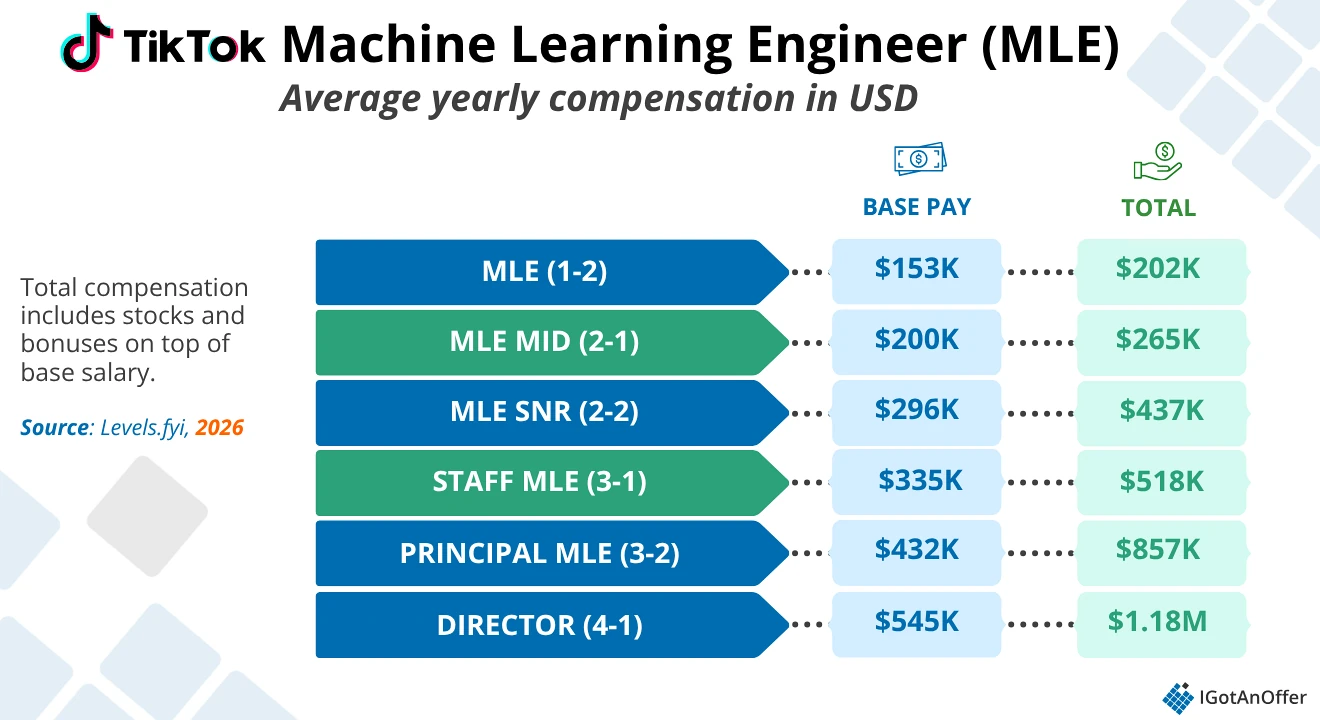
Ultimately, how you do in your interviews will help determine what you’ll be offered. That’s why hiring one of our ex-TikTok interview coaches can provide such a significant return on investment.
And remember, compensation packages are always negotiable, even at TikTok. So if you do get an offer, don’t be afraid to ask for more. If you need help negotiating, consider booking one of our salary negotiation coaches to get expert advice.
Coaches who contributed to this guide








2. TikTok machine learning engineer interview process and timeline
TikTok's interview process is fast-moving and follows a fairly consistent structure across teams. But, like ByteDance overall, each team has some flexibility to shape its own loop. The full process typically takes 4 to 6 weeks and is conducted fully virtually.
2.1 What interviews to expect
Here's an overview of the stages in the TikTok MLE interview process:
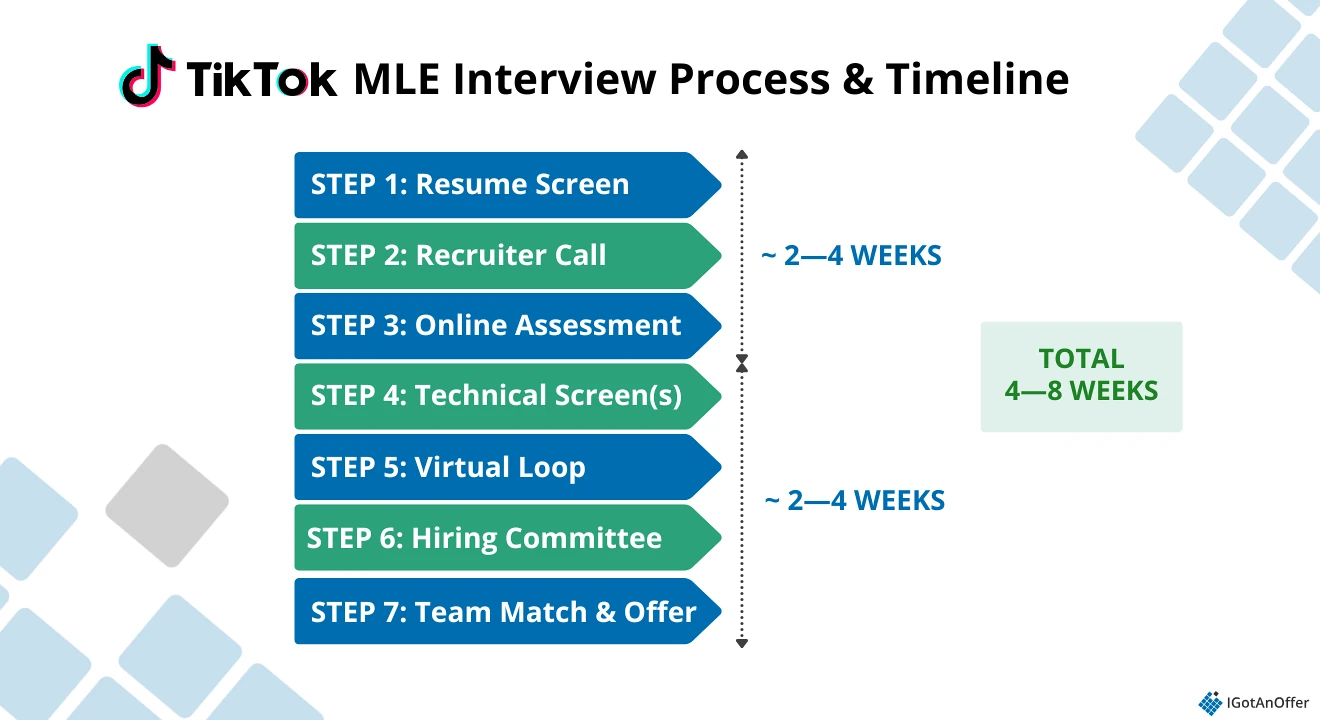
- Resume screen
- Recruiter call
- Online assessment
- Technical phone screens (1 to 2 rounds)
- Virtual interview rounds (3 to 5 rounds)
- Hiring committee review
- Team match and offer
Below is a deep dive into each step, so you know exactly what to expect and how to prepare.
2.1.1 Resume screen
First, recruiters review your resume to assess if your experience matches the open position. This is the most competitive step in the process, as TikTok receives a high volume of applications. Take extra care to tailor your resume to the specific position you're applying to.
Check out our free machine learning engineer resume guide with examples to help you write yours. If you're looking for expert feedback, get input from our team of ex-FAANG recruiters who will cover what achievements to focus on (or ignore), how to fine-tune your bullet points, and more.
2.1.2 Recruiter call
Once you're invited to interview, you'll first speak with a recruiter on a 30-minute call. The recruiter will discuss your background, domain fit (recommendations vs. ads vs. search), location preferences, and salary expectations.
You should expect questions like:
Also, be prepared to provide a clear, professional summary, as TikTok recruiters tend to schedule loops aggressively and may not always review resumes in detail beforehand. Don't hesitate to ask questions about the process ahead, especially if the recruiter doesn't immediately provide you with the information you need to prepare.
Don't reveal your salary expectations at this stage. If pressed, say you're looking for a competitive offer and would like to learn more about the full compensation package later. See some of our salary negotiation guides for specific phrasing.
2.1.3 Online assessment
For some candidates, particularly those with under 5 years of experience, TikTok uses a 60 to 90-minute online assessment, often delivered through HackerRank. The OA usually includes:
- 2 to 3 medium-to-hard coding problems
- 5 to 10 multiple-choice questions covering CS fundamentals (databases, networking, OS, data structures), and sometimes ML basics
Coding problems lean toward classic LeetCode patterns: dynamic programming, graphs, binary search, and sorting. When prepping, set a timer to solve medium and hard questions in 15 minutes or less, and practice talking through your process out loud.
Note that some assessments are proctored with video and microphone enabled. Also, the OA is async and auto-graded, which makes it the main filter before TikTok sets you up with a live interviewer.
2.1.4 Technical phone screens
After the OA, there are one or two technical phone screens, typically 60 minutes each. These usually combine three components in a 20-20-20 split:
- Resume deep-dive, where the interviewer drills into specific projects
- ML knowledge check, covering theory, model choices, and applied ML concepts
- Coding, usually a LeetCode medium
Unlike the OA, these are live sessions with a TikTok interviewer. Most are video calls, though some interviewers run them audio-only. In rare cases, you may be invited for in-person interviews.
2.1.5 Virtual interview rounds
Past the phone screens comes the full loop, also virtual. Most TikTok MLE loops run 3 to 5 rounds, each lasting 45 to 60 minutes. The exact mix depends on the team and seniority, but a typical breakdown looks like this:
- Coding (1 to 2 rounds): Algorithm and data structure problems, usually medium-to-hard LeetCode difficulty. Some rounds blend DSA with ML-specific coding.
- ML fundamentals (1 round): Deeper theoretical discussion of ML and deep learning concepts. Topics include loss functions, regularization, transformer architecture, and increasingly LLM-specific topics like quantization.
- ML system design (1 round): End-to-end design of a production ML system, almost always with a recommendation, ranking, or content moderation context.
- Behavioral / ByteStyle (1 round): Past-experience questions probing ownership, ambiguity, conflict, and alignment with TikTok's ByteStyle values.
- Hiring manager (1 round): Resume deep-dive, project ownership, and team fit. Often includes additional ML or system design probing.
These interviews don't all happen in one day. TikTok conducts these sequentially over 4-6 weeks. You complete one interview, wait for feedback (typically 2-3 business days), and only advance to the next interview if you pass.
Note that each round is eliminatory. If you don't pass, the process stops. There's no opportunity to compensate for a weaker performance in one round with a strong showing in another.
2.2 What happens after the loop
After the loop, interviewers submit written feedback through TikTok's internal system. The feedback is consolidated and presented to a cross-functional hiring committee, which makes the final hire/no-hire decision. A response typically arrives within one to two weeks.
If a team decides to move forward with you, the recruiter will extend a verbal offer, at which point your negotiation window opens. For candidates who interviewed without a specific team in mind, the recruiter may run a separate team match before the offer is finalized.
Once you've completed this step and accepted your offer: congratulations! It's time to start your career at TikTok.
3. TikTok machine learning engineer example questions
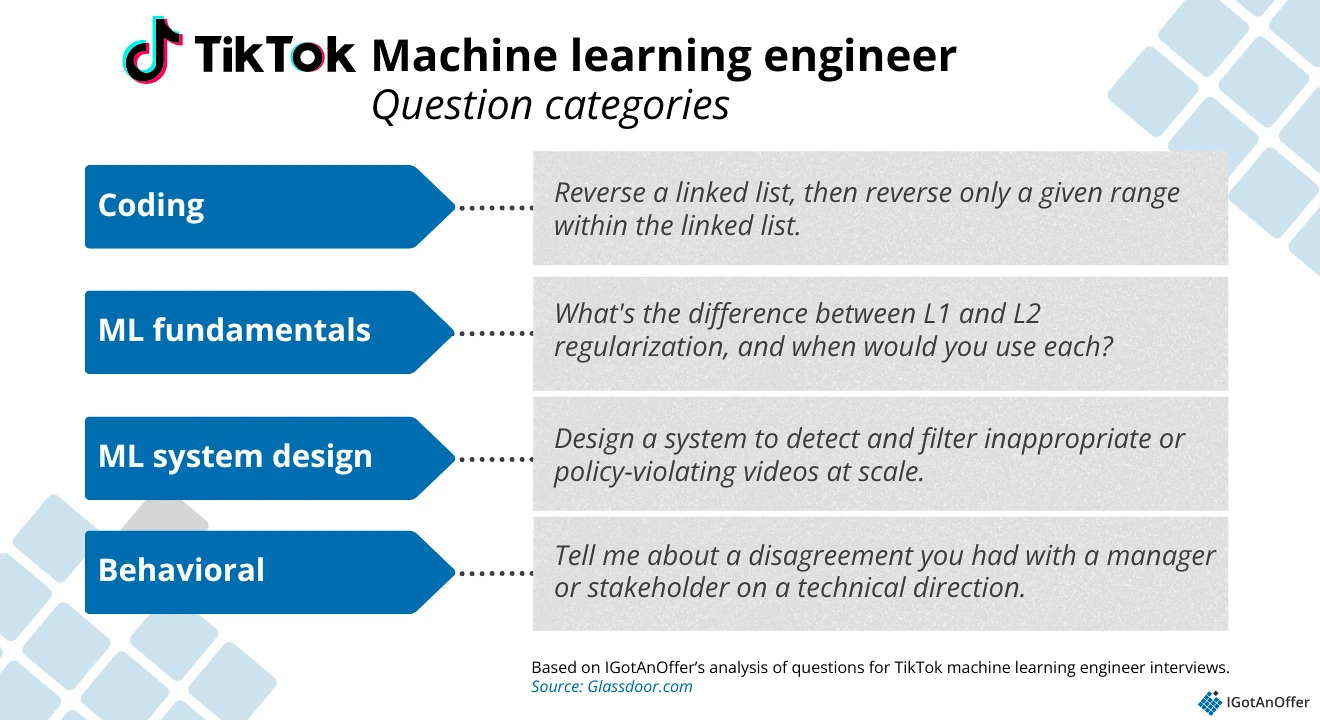
TikTok MLE interviews cover four main areas:
- Coding
- ML fundamentals
- ML system design
- Behavioral
Below, we've put together a summarized list of example questions for each of these interview types, along with notes to help you understand what to expect.
Most questions are drawn from firsthand TikTok candidate accounts on Glassdoor and Blind. Where we've supplemented with questions from our other MLE interview guides (to give you a fuller picture of the topic areas covered), we've indicated the source company in brackets at the end of the question.
3.1 Coding interview questions
TikTok’s machine learning software engineers solve some of the company's most difficult problems with code. It's therefore essential that you have strong problem-solving skills to stand out as a candidate.
This is the part of the interview where you want to show that you think in a structured way and write code that's accurate, bug-free, and fast. You can expect to have 2 to 3 coding interviews.
Below, we've listed common examples used during TikTok MLE interviews. To make these questions easier to study, we've modified the phrasing to match the closest problem on LeetCode or another resource, and we've linked to a free solution.
Example TikTok machine learning engineer interview questions: Coding
- Reverse a linked list, then reverse only a given range within the linked list. (Solution)
- Implement layer normalization from scratch using NumPy. (Solution)
- Implement single-head and multi-head attention in PyTorch, then apply masking to mask out later tokens. (Solution)
- Implement KL divergence in Python. (Solution)
- Given an array nums of n integers, are there elements a, b, c in nums such that a + b + c = 0? Find all unique triplets in the array that give a sum of zero. (Solution)
- Solve the sieve of Eratosthenes problem. (Solution)
- In a row of dominoes, A[i] and B[i] represent the top and bottom halves of the i-th domino. (A domino is a tile with two numbers from 1 to 6 - one on each half of the tile.) We may rotate the i-th domino, so that A[i] and B[i] swap values. Return the minimum number of rotations so that all the values in A are the same, or all the values in B are the same. If it cannot be done, return -1. (Solution) (Google)
- Given a matrix and a target, return the number of non-empty submatrices that sum to target. (Solution) (Google)
- Given a linked list, reverse the nodes of a linked list k at a time and return its modified list. k is a positive integer and is less than or equal to the length of the linked list. If the number of nodes is not a multiple of k then left-out nodes in the end should remain as it is. (Solution) (Amazon)
We recommend reading our guide on how to answer coding interview questions for a broader coding preparation framework. You can also practice with this list of coding interview examples in addition to those listed above.
3.2 ML fundamentals interview questions
The ML fundamentals round tests how well you understand the theory underlying the models you've worked with. TikTok interviewers favor depth over breadth, so be ready to defend the specific architectures, loss functions, and evaluation metrics you've used in past projects.
ML knowledge questions cluster around four topics:
- Classical ML theory: loss functions, regularization, bias-variance tradeoff, feature engineering, and evaluation metrics
- Deep learning: transformer architecture, attention mechanisms, backpropagation, optimization, and model debugging
- Recommendation systems: candidate generation, two-tower models, ranking, embeddings, and cold-start handling
- LLMs and quantization: fine-tuning, RAG, inference optimization, INT8/FP16 trade-offs, and latency reduction
Be prepared to whiteboard mathematical derivations, especially around loss functions and gradient updates.
Below are some example machine learning domain questions we’ve gathered from TikTok candidates, along with a few more from other machine learning engineer interviews reported on Glassdoor and Blind.
Example TikTok machine learning engineer interview questions: ML fundamentals
- Tell me about transformer architecture in detail.
- How do you choose between cross-entropy loss and MSE? When does each apply?
- Explain how diffusion models work, and where they'd apply at TikTok.
- What's the difference between L1 and L2 regularization, and when would you use each?
- Explain the difference between collaborative filtering and content-based filtering.
- How would you reduce inference latency for a large model? Why might you use INT8 quantization over FP16?
- How would you build a recommender system from scratch for a new product surface? (Amazon)
- How do you deal with misrepresentative training data (imbalanced dataset, overfitting)? (Amazon)
- How do you deal with a large dataset where only a few examples are labeled (semi-supervised learning)? (Amazon)
- Walk through how convolution works and where you'd apply it in a model architecture. (Apple)
- When do you stop training a model? (Apple)
- How do you deal with a large dataset where only a small fraction of examples are labeled? (Apple)
3.3 ML system design interview questions
TikTok has huge datasets and billions of users across its platform. The magnitude and complexity of these systems present opportunities to apply machine learning to real-world problems.
The questions you'll be asked are similar to system design questions, in that you'll need to outline a high-level approach for a system or problem. The primary difference is that you'll be expected to design a machine learning solution specifically.
ML Solutions Architect expert, Oussama, breaks down what interviewers actually score you on:
- Your ability to connect ML models with scalable production systems
- Understanding of trade-offs between accuracy, latency, cost, interpretability, and user experience
- Knowledge of the ML breadth/lifecycle, including data collection, feature pipelines, model training, deployment, and monitoring
- Ability to communicate clearly by asking the right questions and stating assumptions
- Ability to apply structured thinking and prioritization when making design choices
Example TikTok machine learning engineer interview questions: ML system design
- Design TikTok's For You Page recommendation system.
- Design a real-time content ranking system that balances freshness, relevance, and latency.
- Design a system to detect and filter inappropriate or policy-violating videos at scale.
- Design an ad ranking system for TikTok's in-feed ads.
- Design a search ranking system for TikTok's search bar.
- How would you design a system that recommends in-flight movies from a database, such that the total time matches the flight time? (Amazon)
- Design a personalized news ranking system. (Meta)
- Design YouTube's recommendation system. (Google)
- Design autocomplete for a mobile search bar. (Google)
- Design an evaluation framework for ad ranking. (Meta)
For a full framework on how to approach these questions, see our machine learning system design interview guide and generative AI system design interview guide.
3.4 Behavioral and ByteStyle interview questions
TikTok's behavioral interview focuses on alignment with ByteStyle, the core values inherited from parent company ByteDance. The five core ByteStyles are:
- Always Day 1 (entrepreneurial mindset, agility)
- Be Grounded and Courageous (independent thinking, calculated risks)
- Be Open and Humble (assume good intent, value diverse perspectives)
- Be Candid and Clear (direct communication, fact-based reasoning)
- Aim for the Highest (mission alignment, resilience)
To ace your TikTok behavioral interviews, make sure to demonstrate how you take ownership of outcomes, work collaboratively across teams with differing constraints, and can navigate ambiguity without being paralyzed by it.
Also, prepare your story bank carefully and use IGotAnOffer's SPSIL framework (Situation, Problem, Solution, Impact, Lessons) to structure your answers. Here's an overview of each step:
- Situation: Set the scene in one or two sentences. Who, what, when, where.
- Problem: Name the specific challenge or constraint you faced.
- Solution: Walk through what you did, not what the team did. Focus on your decisions and trade-offs.
- Impact: Quantify the outcome wherever possible (metrics, business results, time saved).
- Lessons: Close with what you learned and how you'd apply it differently next time.
Below, we've listed several example behavioral questions that were asked in TikTok machine learning interviews.
Example TikTok machine learning engineer interview questions: Behavioral and ByteStyle
- Why TikTok? (sample answer from Amazon interviews).
- Tell me about yourself / your past experience.
- Tell me about a time you shipped an ML model under a tight deadline. What tradeoffs did you make?
- Tell me about a disagreement you had with a manager or stakeholder on a technical direction.
- Describe a project where you owned an ML system end-to-end, from data collection to deployment.
- Tell me about a time you had to decide with incomplete information.
- Walk me through a time you challenged an existing approach and proposed a new one.
- Walk me through a financial model you built. (Amazon)
- Tell me about a time you managed a technical program from end to end. (Google)
Behavioral alignment is one of the most common reasons for rejection at TikTok, even for technically strong candidates, so don't underprepare for this round. Read up on the ByteStyle values before the interview and prepare at least one story per value.
For more on behavioral interview prep, check out our guides to behavioral interview questions and IGotAnOffer's SPSIL framework.
4. TikTok machine learning engineer interviewing tips
You might be a fantastic ML engineer, but unfortunately, that won't necessarily be enough to ace your interviews at TikTok. Interviewing is a skill in itself that you need to learn.
For this section, we've gathered tips from three of our expert coaches: Ashish, Oussama, and Marvin. Collectively, they've conducted many interviews, both actual and mock, at top tech companies including Google, Meta, and Amazon.
Here are their tips, based on what they've seen on the ground.
4.1 Ask clarifying questions
The questions you'll be asked are often deliberately ambiguous. That's by design. Interviewers want to see how you handle uncertainty, and as Marvin (ex-FAANG system design expert) advises, "asking clarifying questions and articulating trade-offs go a long way."
4.2 Be concise but detailed
When answering behavioral questions, start with a brief description of the situation you want to cite, and be prepared to provide more detail if asked.
Always use specific information and never generalize. The best way to do this is to prepare a single, specific example from your past to illustrate your answer to a question.
4.3 Think out loud
You need to walk your interviewer through your thought process before you actually start coding or designing a machine learning system. TikTok also recommends talking even while coding, as they want to know how you think. Your interviewer may also give you hints about whether you’re on the right track.
4.4 State and check assumptions
In your machine learning system design interview, you need to explicitly state assumptions and check with your interviewer to see if those assumptions are reasonable.
That’s the easy part. The harder part is showing the interviewer how you got there, especially when you decide against a path.
Oussama (ML Solutions Architect expert) says: "Feel free to make assumptions as long as you communicate them clearly. Share your thought process, including both the choices you make and the ones you discard."
4.5 Present multiple possible solutions
When you code, present multiple possible solutions whenever possible. TikTok wants to know your reasoning for choosing a certain solution.
4.6 Strike a balance between your ambitious and collaborative nature
The ideal TikTok candidate is ambitious and driven, but your interviewer will also want to see evidence of how well you collaborate with others.
So in your behavioral answers, be sure to get the right balance between ‘we’ and ‘I’. Acknowledge team effort by talking about what 'we' did as a team, and use 'I' to clearly demonstrate your own actions and elaborate on the impact YOU had.
4.7 Center your prep on the ByteStyle values
Go deep on TikTok's ByteStyle values. They carry real weight in the loop, and weak alignment here can sink a technically strong candidate. Prepare for them as seriously as you prepare for coding or system design.
Have at least one story ready for each of the five ByteStyles:
- Always Day 1
- Be Grounded and Courageous
- Be Open and Humble
- Be Candid and Clear
- Aim for the Highest
To work more efficiently, adapt your stories so that a single project can answer multiple values. Use the SPSIL framework to structure each one.
4.8 Make your code organized and production-ready
Keep your code organized so your interviewer won’t have a hard time understanding it. TikTok wants to see that your code captures the correct logical structure.
While your code won’t be tested, you’ll be more impressive if you write testable code. Prepare to explain the Time/Space Complexity of your solutions, and how to better optimize it further.
Also, don’t use random/variable function names. Be sure to write descriptive, meaningful ones.
4.9 Get comfortable with coding on various media
TikTok advises MLE candidates to be ready to write code in real-time on an online editor. If the interview is in person, you might be asked to code on paper or a whiteboard. You can check with your recruiter which one it will be if you’re not sure which medium to use.
4.10 Use a structured framework for ML system design answers
Ashish (ex-software engineer, AI/ML-focused) recommends a 4-step framework that candidates can use to keep their ML system design answers organized under time pressure:
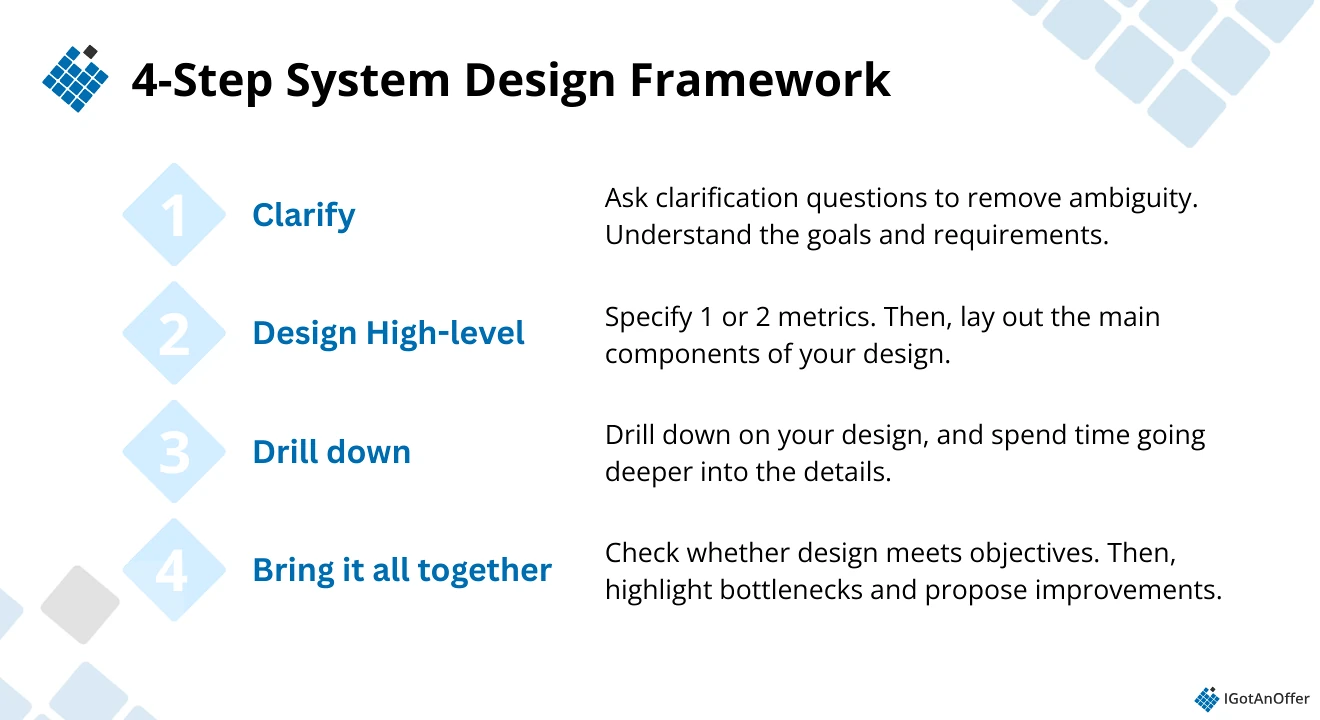
- Ask clarifying questions: Make sure you clearly understand the goals and requirements of the system
- Design high-level: Specify 1 or 2 metrics, map out the functional system components, and design DB design
- Drill down on your design: Spend time drilling down into more detailed aspects of the system
- Bring it all together: Reexamine whether design meets objectives, highlight bottlenecks, and how to improve
For a full walkthrough of this framework with a sample answer, see our ML system design interview guide.
5. How to prepare for TikTok MLE interviews
Now that you know what questions to expect, let's focus on how to prepare. After all, the right preparation will make the difference between failing your TikTok interviews and getting an offer.
Here are the four most important things you can do to prepare for TikTok's machine learning engineer interviews.
5.1 Deep dive into the product and organization
Start by learning as much as you can about TikTok and the team you're applying to. ML system design and behavioral questions at TikTok lean heavily on company-specific context, so candidates who can speak fluently about the product and the role land much stronger answers.
TikTok is prestigious, so it's tempting to assume you should apply without considering it more carefully. But it's important to remember that the prestige of a job (by itself) won't make you happy in your day-to-day work. It's the type of work and the people you work with that will.
If you know engineers who work at TikTok or used to work there, it's a good idea to talk to them to understand the culture. In addition, we would recommend checking out the following resources:
- TikTok’s mission statement (by TikTok)
- TikTok’s culture (by TikTok)
- TikTok’s newsroom (by TikTok)
- TikTok’s official blog (by TikTok)
- TikTok’s growing impact on culture and music (by TikTok)
- TikTok’s revenue and usage statistics (by Business of Apps)
- TikTok’s business model (by Business Model Toolbox)
- TikTok stats (by Viralyft)
- ByteDance's engineering blog
If you're applying to a specific team (recommendations, ads, search, integrity, Live), research that team's product area in depth. The more precise you can be about which ML system you'd own, the stronger your behavioral and system design answers will be.
Once you’re comfortable with the culture and team operations, the next step is practice.
5.2 Practice by yourself
Once you understand the role and what TikTok is looking for, start working through the question types systematically using the resources below. The goal here is to get fluent in the technical fundamentals before you start practicing with someone else.
Coding
- Coding interview prep guide
- Array interview questions
- String interview questions
- Linked list interview questions
- Tree interview questions
- Dynamic programming interview questions
Focus on LeetCode medium and hard problems covering trees and graphs, arrays and strings, dynamic programming, and linked lists. Also, practice narrating your thinking out loud. TikTok interviewers pay close attention to how you reason through a problem.
ML fundamentals
- Machine learning system design interview guide
- Generative AI system design interview guide
- Deep Learning Specialization (covers bias-variance tradeoff, CNNs, RNNs, and transformers)
- PyTorch tutorials (for practicing forward/backward pass implementations)
Go deeper than definitions. TikTok interviewers probe whether you can apply concepts like regularization, loss functions, and transformer architecture to real constraints. For every system design, build privacy and on-device constraints from the start rather than tacking them on at the end.
Behavioral
Prepare answers to the questions listed in section 3.4. If you have more time, build out a broader story bank covering ownership, cross-functional influence, and navigating ambiguity.
Other useful guides
If you're preparing for MLE roles across multiple companies, you may also find these guides useful:
- Meta machine learning engineer interview
- Amazon machine learning engineer interview
- Google machine learning engineer interview
- OpenAI interview process
- Anthropic interview process
- NVIDIA interview process
Once you’re in command of the relevant subject matters, you’ll want to practice answering questions. But by yourself, you can’t simulate thinking on your feet or the pressure of performing in front of a stranger. Plus, there are no unexpected follow-up questions and no feedback.
That’s why many candidates try to practice with friends or peers.
5.3 Practice with peers
If you have friends or peers who can do mock interviews with you, that's an option worth trying. It's free, but be warned, you may come up against the following problems:
- It's hard to know if the feedback you get is accurate
- They're unlikely to have insider knowledge of interviews at your target company
- On peer platforms, people often waste your time by not showing up
For those reasons, many candidates skip peer mock interviews and go straight to mock interviews with an expert.
5.4 Practice with experienced ML interviewers
In our experience, practicing real interviews with experts who can give you company-specific feedback makes a huge difference.
Find a TikTok machine learning engineer interview coach so you can:
- Test yourself under real interview conditions
- Get accurate feedback from a real expert
- Build your confidence
- Get company-specific insights
- Learn how to tell the right stories, better
- Save time by focusing your preparation
Landing a job at a big tech company often results in a $50,000 per year or more increase in total compensation. In our experience, three or four coaching sessions worth ~$500 make a significant difference in your ability to land the job. That's an ROI of 100x!
Click here to book mock interviews with ex-TiktTok interviewers







 ML system design