

 Back to other articles
 Last updated: March 17, 2026
 Interviews
 Software engineer
 Coding
 Deeply researched
When your interview is days away and you feel underprepared, most last-minute coding interview prep advice will tell you to open LeetCode and grind through as many problems as possible. It feels like the right thing to do.
But grinding through problems in the final few days without a plan rarely moves the needle, and often leaves candidates more anxious going in than if they'd been more selective.
In this guide, we cover how you can better use the time you have left, which topics are worth focusing on and which to leave, and what to do in the last 24 hours before your interview.
Here’s an overview of everything we cover:
- Before you start your last-minute coding interview prep
- Why patterns matter more than problems
- What coding interview topics to prioritize
- A coding interview answer framework
- Time-segmented action plans
Still got weeks or months ahead of you to prep? Start with our full coding interview prep guide instead.
Click here to practice coding interviews with experts.
1. Before you start your last-minute coding interview prep ↑
Before you open a practice platform or sketch out a study plan, there are two things worth settling first: whether you should be doing this interview at all right now, and where you actually stand in your preparation.
Getting both right is what makes the rest of your time count.
1.1 Should you even do the coding interview now?
Most candidates treat the interview date as fixed when it usually isn't. Before anything else, ask yourself whether now is actually the right time.
Google, Meta, Amazon, and most other large tech companies will accommodate a reschedule request of two to four weeks if you ask early and frame it well. Recruiters generally prefer that over sending through a candidate who isn't ready.
You can simply tell your recruiter that you want to give the opportunity your best shot and ask whether there's any flexibility on timing.
If you haven't touched data structures and algorithms in months and have fewer than five days before the interview, pushing back is almost always the right call. A week of focused preparation is substantially more useful than two panicked days.
That said, if you've been preparing consistently and you're looking to sharpen things up in the time remaining, the rest of this guide is for you.
1.2 Know where you stand
Before you plan anything, spend 15 minutes working out where you genuinely are. The right approach for the next few days depends entirely on your starting point.
- You've been preparing for weeks or months. The foundation is there, and this is the final push. Focus on mock interviews, light revision of weaker areas, and logistics rather than picking up new material.
- You've been preparing, but unevenly. Maybe you went deep on graphs but barely touched dynamic programming, or you've been grinding problems without practicing communicating your reasoning out loud. Identify the gaps worth addressing to give your prep some focus.
- You haven't really started. A week is unlikely to be enough to get genuinely ready for a FAANG-level interview from scratch. Have the reschedule conversation first, and if that's off the table, focus on the highest-value topics in section 3.
With that picture in mind, here's how to spend the time you have left.
2. Why patterns matter more than problems during last-minute coding interview prep ↑
A coding pattern is a reusable problem-solving approach that applies across a whole category of questions. Two pointers, for example, show up in problems about pairs in sorted arrays, removing duplicates, and reversing linked lists. BFS shows up any time you need to find the shortest path. The specific problem changes, but the underlying structure doesn't.
This is what makes pattern-based prep so effective last-minute. Instead of trying to memorize 100 solutions before your interview, build the ability to look at a new problem and recognize which category it belongs to. Once you've identified the pattern, you already know roughly how to approach it.
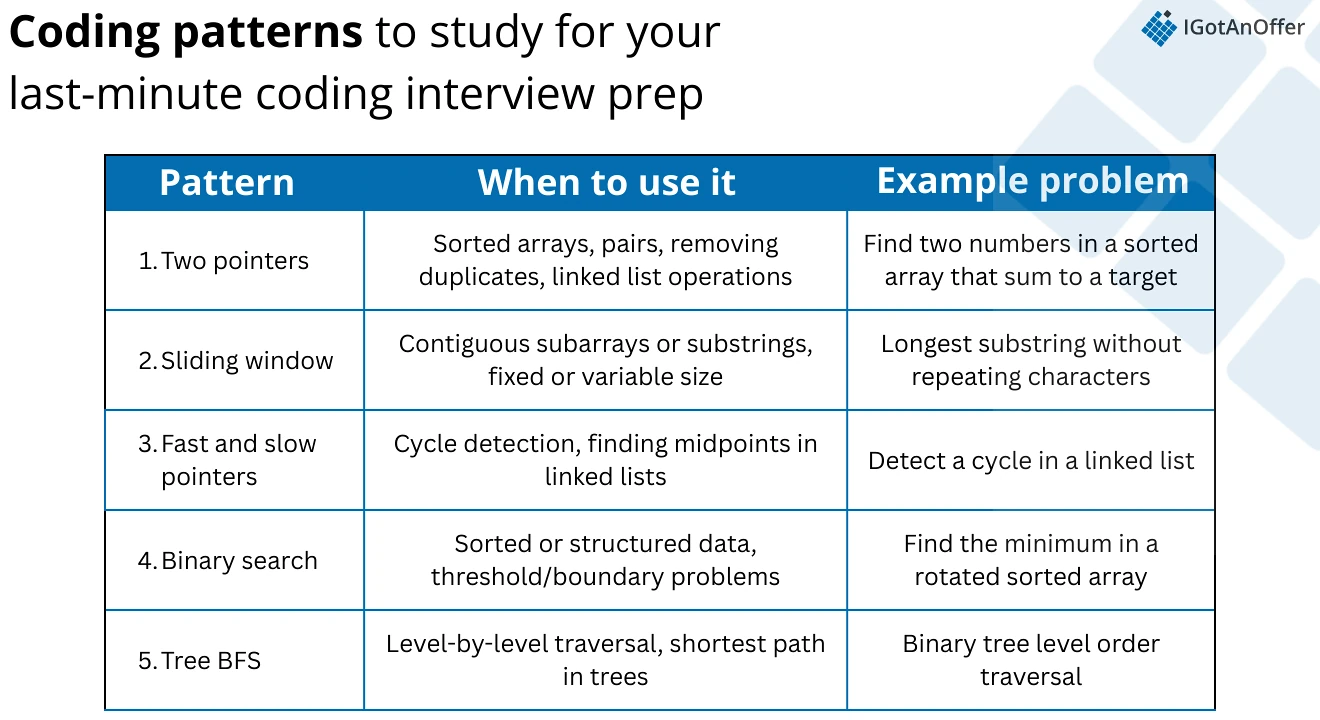
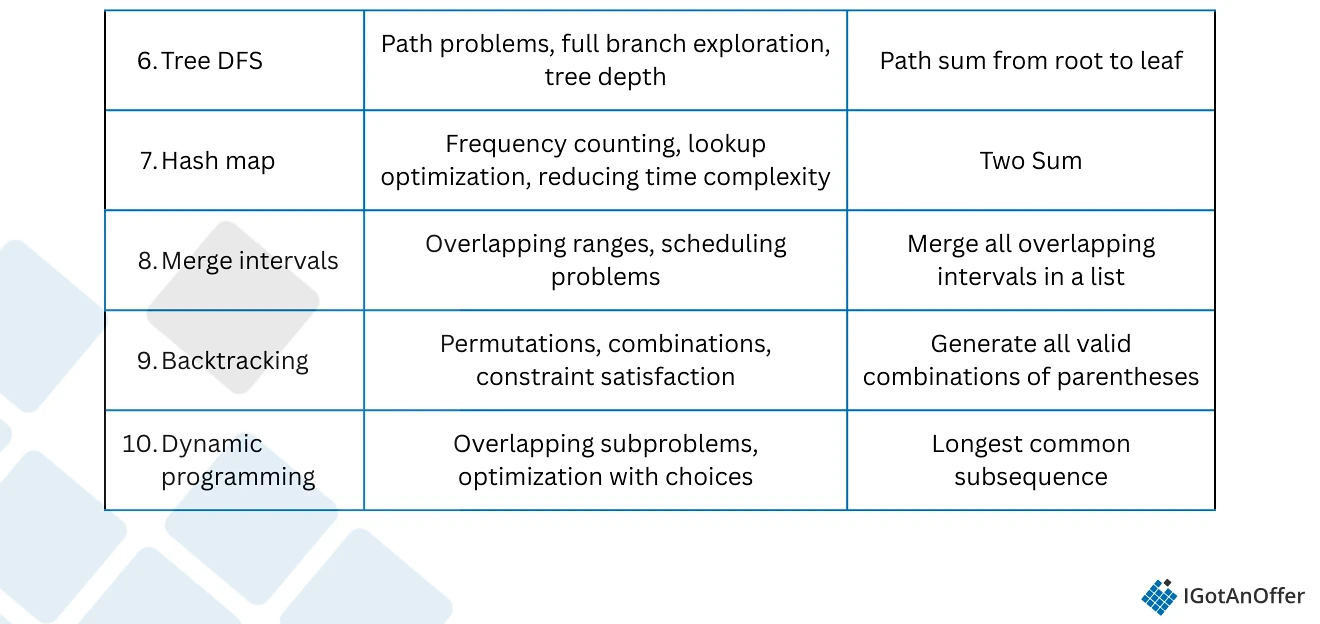
A few of these, DP and backtracking in particular, take real time to internalize and aren't worth attempting last-minute if you haven't used them before.
The top half of the table (1-7) is where most of your prep time should go. These patterns are high-frequency, relatively quick to learn, and appear across a wide range of difficulty levels.
Once you recognize the pattern a question belongs to, the solution approach becomes much easier to reason through under time pressure.
Coaches who contributed to this guide


3. Coding interview topics to prioritize ↑
With limited time, what you focus on matters as much as how much work you put in. The right topics depend partly on the role you're interviewing for, so it's worth starting there before getting into the specifics.
3.1 What coding interviews look like by role
Here's what to expect during coding interviews, depending on the position you're going for:
- Software engineers typically have the most coding-intensive process. Expect multiple rounds testing data structures and algorithms, with questions that increase in complexity at senior levels (i.e., arrays, trees, graphs, and dynamic programming). See our software engineer interview guides for company-specific breakdowns.
- Data scientists typically face one coding round. Questions tend to be more practical and less algorithmically complex than SWE rounds, usually covering array manipulation, string problems, and hash maps. See our data scientist interview guides.
- Engineering managers get one coding round or a code review. The bar here is more about writing clean, well-structured code and being able to explain your decisions clearly. See our engineering manager interview guides.
- Machine learning engineers see a blend of standard DSA questions and ML-specific implementation problems, such as coding a loss function or implementing a basic algorithm from scratch. See our machine learning engineer interview guides.
3.2 Topics worth reinforcing in last-minute coding prep
Regardless of role, these topics come up across a disproportionate share of coding interviews.
A few focused hours on any of these can make a tangible difference.
3.2.1 Arrays and strings
Arrays and strings form the foundation of most coding problems. Even candidates who know their algorithms well lose points here, usually on edge cases like empty inputs, single-element arrays, or strings with special characters. When you practice, always test these explicitly rather than just the happy path.
Common array and string questions you may encounter in a coding interview:
- Given a sorted array, return the index of a given value, or -1 if the element cannot be found
- Given an array with all integers between 1 and 100 except for one, find the missing number
- If you have two sorted arrays, how do you merge them and keep the result sorted?
- Given a string containing parentheses, determine whether all parentheses are matched correctly
- Find the longest common prefix of two given strings
See our full guides on array interview questions and string interview questions for more practice problems and solutions.
3.2.2 Hash maps
Hash maps are the most versatile data structure in coding interviews. They store key-value pairs and allow you to look up any value in O(1) time, which is what makes them so useful. In practice, they let you trade a small amount of memory for a significant improvement in speed, often turning an O(n²) brute-force solution into an O(n) one.
The Two Sum problem in section 5 is a good example of this in action. If you can only reinforce one topic, make it this.
3.2.3 Trees
A large share of medium-difficulty interview questions involves trees. There are two traversal methods worth knowing well.
- BFS (breadth-first search) processes nodes level by level, moving across the tree horizontally before going deeper. It's the right approach when the answer lives near the root, such as finding the shortest path between two nodes.
- DFS (depth-first search) explores one branch all the way down before backtracking to the next. It works better when you need to examine full paths, such as checking whether a path from root to leaf sums to a target value.
Common tree questions you may encounter in a coding interview:
- Given the root of a binary tree, return its maximum depth
- Given the root of a binary tree, invert the tree and return its root
- Given the root of a binary tree and a target sum, return true if a root-to-leaf path exists that adds up to that sum
- Given the root of a binary tree, return the pre-order traversal of its node values
- Given the roots of two binary trees, return true if one is a subtree of the other
See our full guide on tree interview questions for more practice problems and solutions.
3.2.4 Two pointers
The two pointers technique places two indices at different positions in an array or string and moves them toward each other or in the same direction, depending on the problem.
The benefit is that it lets you scan a data structure in a single pass rather than using nested loops, bringing many problems down from O(n²) to O(n). It comes up regularly in questions involving pairs, sorted arrays, and linked lists.
3.2.5 Sliding window
Sliding window is a variation of two pointers that maintains a moving range, or window, within an array or string. Rather than recomputing from scratch each time, you expand or shrink the window by one element at a time, keeping a running result as you go.
It's particularly common in problems that ask about contiguous subarrays or substrings, such as finding the longest substring without repeating characters or the maximum sum of a subarray of size k.
3.2.6 Binary search
Most candidates know binary search for finding a value in a sorted array, but its application in interviews goes beyond that. Any time a problem involves searching for a threshold, a boundary condition, or the minimum or maximum value that satisfies a constraint, binary search often applies. The key skill is learning to recognize when the problem has that structure.
Common binary search questions you may encounter in a coding interview:
- Given a sorted array and a target, return the index of the target or -1 if it doesn't exist
- Given a sorted rotated array, return the minimum element in O(log n) time
- Given a sorted array and a target, return the index where the target would be inserted if not found
- Given a sorted array, search for a target in a rotated version of that array
See our full guide on binary search interview questions for more practice problems and solutions.
4. How to answer coding interviews (framework + answer sample) ↑
This section is a memory cue for the framework covered in our full coding interview prep guide. Read through it now, and again in 30 minutes before your interview.
4.1 Coding interview answer framework
The five steps are: clarify, brute force, optimize, code, and test.
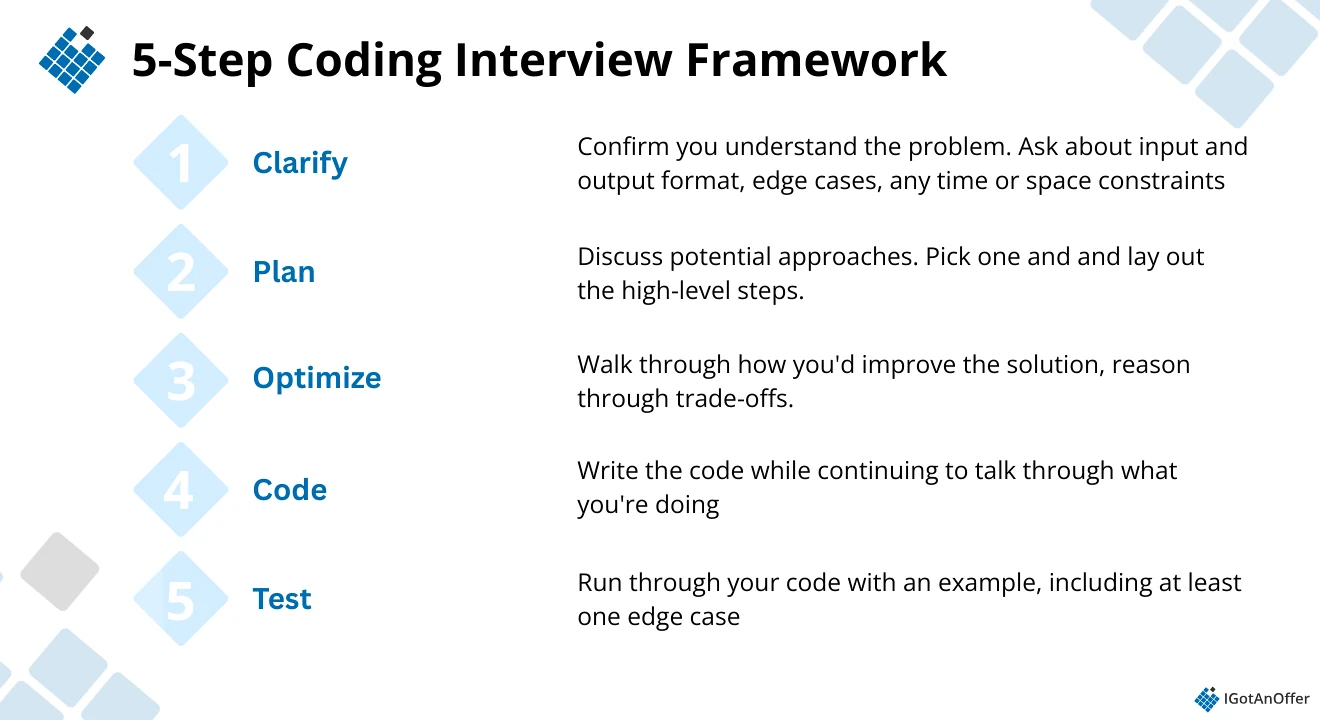
1. Clarify. Before writing any code, confirm you understand the problem. Ask about input and output format, edge cases, and any constraints on time or space. Most candidates skip straight to coding and discover halfway through that they've been solving the wrong version of the problem.
2. Brute force. Describe a simple, naive solution before optimizing. This gives the interviewer visibility into your reasoning and gives you a starting point. A brute-force solution communicated clearly is much better than silence while you try to find the optimal one.
3. Optimize. Walk through how you'd improve the solution. Interviewers care less about whether you land on the optimal answer and more about how you reason through the tradeoffs. Talk through your thinking rather than just announcing conclusions.
4. Code. Write the code while continuing to talk through what you're doing. Don't go quiet.
5. Test. Once you're done, run through your code with an example, including at least one edge case. Catching your own bug is far better than having the interviewer point it out.
The step candidates most often skip is the first one. Jumping into code without clarifying the problem is one of the things interviewers flag most consistently. Even when the question seems straightforward, taking a moment to ask one or two questions signals that you work carefully and collaboratively.
4.2 Sample answer
Let's look at how you can put this framework into practice. Say you're given this question:
"Given an array of integers and a target value, return the indices of the two numbers that add up to the target."
Sample Answer
Clarify: "Just to confirm, can I assume there's always exactly one valid pair? And can I use the same element twice?" The interviewer confirms: yes, and no.
Brute force: "The simplest approach is to check every pair. That's two nested loops, O(n²) time. For each element, I scan the rest of the array looking for the complement."
Optimize: "We can do better with a hash map. As we iterate through the array, we store each number and its index. For each new element, we check whether its complement already exists in the map. That gets us down to O(n) time and O(n) space."
Code: You write the solution, talking through each step.
def two_sum(nums, target):
seen = {}
for i, num in enumerate(nums):
complement = target - num
if complement in seen:
return [seen[complement], i]
seen[num] = i
Test: "If nums is [2, 7, 11, 15] and target is 9, we look for 7 when we hit 2 — it's not in the map yet, so we store 2. When we hit 7, we look for 2 and find it at index 0. So we return [0, 1]. Let me also check an edge case: if the two numbers are adjacent and the array only has two elements, it still works."
This is what a strong response looks like. Notice that none of it required finding a clever insight on the spot. The framework carries you through.
5. Time-segmented action plans for your last-minute coding interview prep ↑
The right prep strategy in the final stretch depends on how much time you have left. Here's what to do at each stage leading up to your interview:
5.1 What to do 1 week before a coding interview ↑
A week is enough time to make a real difference if you're deliberate about it. The most important thing to resist is trying to pick up new algorithms from scratch.
Shoring up topics you already know something about will take you much further than trying to cram unfamiliar material that might crumble under follow-up questions.
Here's how to spend the week:
5.1.1 Triage your weak spots with the Blind 75
Start by running a pass through the Blind 75. It’s a widely used list of the most commonly asked LeetCode-style problems.
Sort them into what you're confident on, what you're shaky on, and what you'd draw a blank on. That gives you a map for the week, rather than leaving you to guess what to work on each day.
Focus your sessions on the problems you have some familiarity with but couldn't solve cleanly under pressure. These tend to be the highest-value targets at this stage.
5.1.2 Book a mock interview early
Book a mock interview this week rather than saving it for the end. Most candidates wait until they feel ready, but an early mock practice interview is often what exposes their weak spots and accelerates their preparation.
Our coding mock interviews pair you with former FAANG interviewers who have sat on the other side of the table at the companies you're targeting. In a single session, they can identify exactly where you're losing points (whether that's in how you approach problems, how you communicate under pressure, or specific technical gaps) faster than any study plan can.
5.1.3 Do your company-specific research
Spend an hour looking into what the coding rounds look like at the company you're interviewing with (Google, Meta, etc.). Recent interview reports on Glassdoor and Blind are great sources for this. Candidates regularly share which topics came up, how the sessions were structured, and what caught them off guard.
It's also worth checking whether there are any format specifics to prepare for. Meta's coding rounds, for example, now include an AI-assisted session alongside the traditional round, which changes how candidates should think about their preparation.
5.2 What to do 3 days before a coding interview ↑
With three days to go, pick three or four topics you know reasonably well and go deeper on those rather than spreading attention across everything. The goal is to get from "I sort of know this" to "I can work through this cleanly under pressure."
Practice in 45-minute timed sessions. That's roughly how long a real coding interview runs, and many candidates who haven't coded against the clock discover they move more slowly under time pressure than they expected.
Get your technical environment sorted now rather than the evening before. Find out which tool the company uses for coding. CoderPad is common at many companies, Google uses Google Docs, Amazon uses LiveCode. Spend some time in the actual platform before interview day, so the interface isn't a surprise.
5.3 What to do 24 hours before a coding interview ↑
Stop trying to learn new things. The day before, the value of adding more material is very low, and the cost in terms of anxiety and fatigue is real.
Revisit one familiar problem, something you've solved before and feel good about, just to stay warm. After that, read through the answer framework in section 4 so it's fresh.
Check your logistics. Then wind down and sleep. A well-rested brain performs meaningfully better in an interview than one running on five hours and a caffeine spike.
Logistics to sort the day before
A surprising number of candidates leave these things until the last minute. Work through this list the evening before your interview rather than the morning of.
- Your coding language. If you haven't decided, do it now. Python is a common choice because it's concise and has useful built-in data structures, but the right answer is whichever language you write most fluently under pressure. Once you've decided, don't revisit it on the day.
- Your coding environment. Double-check which tool the company uses and confirm you're set up in it. If you haven't spent time on the platform yet, do that now.
- Time zone. If you're interviewing across time zones or the calendar invite is ambiguous, verify the exact start time. It's an easy thing to get wrong and a painful one.
- Remote setup. Test your camera and microphone. Check your background and lighting, and confirm you have the right video platform installed and working.
- Notes policy. Some companies allow candidates to keep notes or reference materials in certain rounds. If you're not sure whether yours does, ask your recruiter before the day.
- Getting there. For an onsite interview, know your route and how long it takes. Aim to arrive 10 to 15 minutes early. For remote, be set up and ready five to ten minutes before the start time.
5.4 The morning of your coding interview ↑
Give yourself time for a proper morning.
Solve one easy problem you've done before to get warmed up. Then take five minutes to review your answer framework and remind yourself of the two or three patterns you feel strongest on. After that, leave the prep alone.
5.5 What to do after your coding interview is over ↑
After a difficult interview, the immediate impulse is to replay it in detail and focus on everything that felt off. It's worth resisting this for at least an hour or two. Candidates consistently misjudge how their interviews went in both directions, and the post-interview spiral rarely produces useful insight.
When you're in a better headspace, write down the topics that came up and felt weak, any questions you weren't sure how to approach, and anything you'd handle differently. If there are further rounds ahead, these notes will be useful. If there aren't, they'll feed into your preparation next time.
Either way, you've done what you could with the time you had.
Click here for more coding interview tips, written in collaboration with our coding interview experts.
6. Are you ready for your coding interview?
One of the main challenges of coding interviews is that you have to communicate what you are doing as you are solving a problem. Having to think, code, and communicate your thoughts to the interviewer all at the same time is not easy.
Here are some other methods to try with the time you have left:
6.1 Practice by yourself
Review your fundamentals and practice solving coding questions, using the resources we’ve provided as well as any your recruiter may have provided.
As you begin your prep, we highly recommend self-tracking your progress. Here’s a checklist to assess your own coding preparedness, by our coding interview coach, Himanshi.
#Coding interview checklist
- I’ve revised and coded the foundational algorithms — sorting, searching, recursion, greedy, dynamic programming.
- I’ve internalized key data structures, including implementation, complexity, and core operations like traversal and memory handling.
- I’ve built a mind map that links common problem cues to patterns and structures.
- I can consistently go from brute force to optimal for a medium-hard problem in ~15 minutes.
- I can consistently code the solution in ~15 minutes with clean logic and basic test cases.
- I can consistently explain my thought process, solution, and code clearly under time constraints.
- I have taken at least 2-3 mock interviews to practice communication and clarity.
Click here for a copy of the checklist as a Google doc or a PDF.
6.2 Practice with peers
Practicing on your own is helpful, but it can only take you so far.
To get used to thinking on your feet and answering follow-up questions, we recommend doing a few mock sessions with peers, ideally those in the same field or who have technical knowledge. They’ll be able to help identify your blind spots, poke holes in your reasoning, etc.
However, their feedback won’t always be reliable. If you’re going on peer websites, they might not even show up.
For those reasons, many candidates skip peer mock interviews and go straight to mock interviews with an expert.
6.3 Practice with experienced coding interviewers
In our experience, practicing real coding interviews with experts who can give you company-specific feedback makes a huge difference.
Find a coding interview coach so you can:
- Test yourself under real interview conditions
- Get accurate feedback from a real expert
- Build your confidence
- Get company-specific insights
- Save time by focusing your preparation
Landing a job at a big tech company often results in a $50,000 per year or more increase in total compensation. In our experience, three or four coaching sessions worth ~$500 make a significant difference in your ability to land the job. That’s an ROI of 100x!
Click here to book a coding mock interview with an experienced interviewer.