


 Back to other articles

 Last updated: October 19, 2026
 Interviews
 Deeply researched
Netflix culture and behavioral questions run through the whole hiring process, from the recruiter call to the final onsite interviews.
The company is upfront about this. Your recruiter sends you the Netflix culture memo before your first conversation and expects you to have read it closely.
This guide explains how Netflix runs these interviews, with example questions, tips, and a prep plan. Throughout, you'll find insights from Michael, a former lead product manager at Netflix, who has coached 100+ candidates throughout his career and has helped candidates land roles at FAANG.
Here's an overview of what we'll cover:
- How does Netflix test culture fit?
- Netflix culture and behavioral interview questions
- Example Netflix culture and behavioral interview questions (by role)
- Tips for answering Netflix culture and behavioral interview questions
- How to prepare for Netflix culture and behavioral interviews
Click here to practice one-on-one with a Netflix interview coach
1. How does Netflix test culture fit? ↑
Netflix assesses culture fit through questions based on its culture memo, along with general behavioral and fit questions. You might be asked about situations you’ve faced at work, why you want to join Netflix, or why you’ve changed roles. Your answers help interviewers assess how well your approach aligns with Netflix’s values.
Here's where these questions typically come up:
- Recruiter call: The recruiter sends you the culture memo beforehand and asks what you think of it, what resonates, and what concerns you
- Hiring manager screen: In addition to the role discussion, you'll be asked behavioral questions about autonomy and decision-making
- Onsite round 1: You’ll be asked behavioral questions about how you work with others, handle setbacks, and give or receive feedback
- Onsite round 2: Expect questions from senior leaders and partners from other teams about your leadership, influence, and organizational fit
For most roles, culture isn't tested in a single Netflix interview. Instead, it’s assessed throughout the interview process, from your first call to the final onsite round, and Michael says interviewers are told to map your answers to specific values in the memo.
The exception is product management. Product manager candidates typically have a final culture interview with the recruiter after the onsite loop, which goes deeper into the memo.
2. Netflix culture and behavioral interview questions ↑
From our analysis of candidate reports on Glassdoor and Blind, along with Michael's experience working at Netflix, you can expect two main types of questions in these rounds:
- General behavioral and fit questions: Questions about why you want to join Netflix and how you've made past career decisions
- Culture memo questions: Questions built around a specific value in the memo, where you share a past example of that value in action
We'll cover each type in turn, starting with the general questions.
2.1 General behavioral and fit questions ↑
General behavioral and fit questions come up on the recruiter call and the hiring manager screen. The two you're most likely to get are "Why Netflix?" and why you're changing roles.
With "Why Netflix?", the recruiter wants to know whether you understand where the company is heading and why it's the right next step for you. Talking about how much you enjoy watching Netflix won't show them that.
Michael's example of a weak answer is saying you love Stranger Things or Single's Inferno. He calls this "pure fan service," and says it signals you haven't researched where the company is today.
Instead, pick one or two initiatives that interest you, such as ads, live events, or gaming, and explain how your experience maps to them. For example, if you've worked on video delivery, you could talk about Netflix's push into live events and the challenge of streaming to millions of viewers at the same moment.
When you're asked why you're changing roles, Netflix wants to know whether your career moves reflect deliberate judgment or were a reaction to circumstances like layoffs, boredom, or conflict.
Michael suggests presenting each move as a bet you made with clear intent, whether or not it paid off. It's fine to open with a practical reason like a salary increase. "I wanted more scope" may be true too, but pair it with a view on where the industry or product was heading.
Example Netflix general behavioral and fit questions
- Why Netflix?
- Why did you move from one role or company to another?
- Tell me about your main achievements in your current role.
- Tell me about the area where you have the most to learn.
Coaches who contributed to this guide









2.2 Culture memo questions ↑
Culture memo questions ask you to describe a time you acted on one of the memo's values. Interviewers want evidence from past experiences, so you don't need to recite the principles or explain what they mean.
You aren't expected to agree with everything in the memo either. Netflix encourages candidates to challenge its thinking, and always giving the agreeable answer can count against you. We cover how to handle this in section 4.1.
Whichever value a question targets, make sure your story connects back to it. "They're literally taking notes against these words," says Michael. If that connection isn’t clear, your answer won’t tell the interviewer much about your fit.
Netflix organizes its memo, "The Best Work of Our Lives," around four principles:
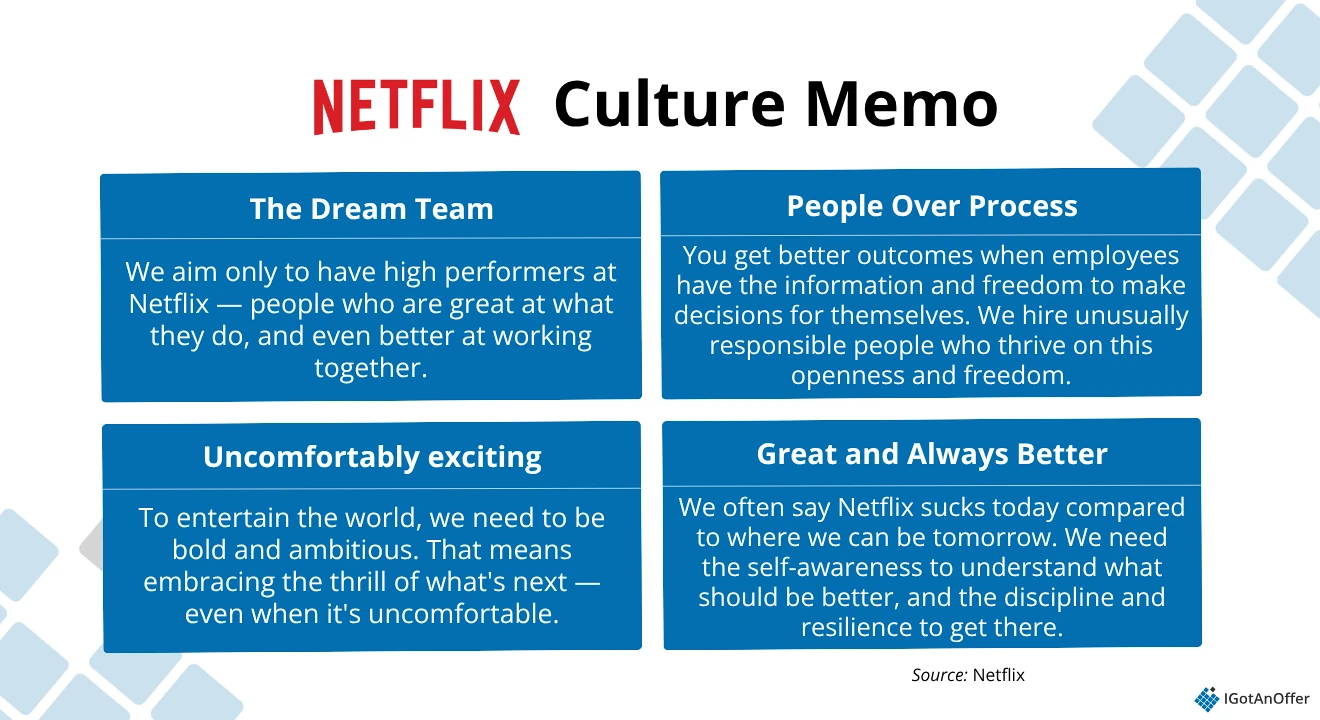
We'll go through each one below, with example questions.
2.2.1 The Dream Team ↑
"We aim only to have high performers at Netflix — people who are great at what they do, and even better at working together."
Netflix compares its workforce to a professional sports team, with every position filled by someone who is exceptional at what they do. The idea is to build a high-performing team where people are judged primarily on their contribution and performance rather than seniority or tenure.
Despite the company's cutthroat reputation, Michael says most of the colleagues he worked with at Netflix were “some of the nicest people of his career”, and some of the hardest working. He sees this as the reason Netflix puts so much weight on culture fit.
To maintain this standard, Netflix uses the "keeper test." Managers ask themselves whether they would fight to keep an employee who wanted to leave, and whether they would hire that person again knowing what they know today. If the answer is no, Netflix may part ways with the employee.
Michael says Netflix applies the keeper test on an ongoing basis to "determine whether or not you are still meeting expectations and performing at your highest caliber."
Under the Dream Team principle, Netflix has eight values it looks for in employees and candidates. You’ll be assessed against these values throughout the interview process. We'll go through each one below.
a. Selflessness
“You are humble when searching for the best ideas; you seek what’s best for Netflix, not yourself or your team; you take time to help others succeed.”
Selflessness at Netflix means putting the company and the wider team ahead of your own interests. Employees are expected to share information and help colleagues, even when it does nothing for their own goals or team.
In your interview, be prepared to share an example that demonstrates this. A strong story might involve a situation where you gave up something meaningful, such as credit, resources, or a win for your own team, because it was the right decision for the business.
Example Netflix culture interview questions: Selflessness
- Tell me about a time you took ownership of something outside your role.
- Tell me about a time you helped a colleague at a cost to your own goals.
- Tell me about a time you put the company's interests ahead of your team's.
b. Judgment
“You look beyond short-term fixes in favor of long-term solutions; you make wise decisions despite ambiguity; you use data to inform your intuition.”
Netflix has little formal process, so employees make many decisions on their own. That's why judgment comes up so often in interviews.
Your interviewer wants to see how you think when there's no obvious answer. Walk them through the information you had, the options you considered, and why you made the call you did.
Avoid building your story around how you got leadership to approve your decision. Michael says this is a common trap, since Netflix "doesn't necessarily want this buy-in culture." Employees are expected to make the call and own it.
Instead, he suggests framing your answer the way you'd present a decision on the job: "I'm going to make the call. I want to be transparent about my reasoning. I understand the risks."
Example Netflix culture interview questions: Judgment questions
- Tell me about a time you had to make a decision with incomplete information.
- Tell me about a time you had to make a difficult prioritization call.
- What does good judgment look like in your work?
- Describe a technically complex project you worked on. What trade-offs did you make?
- How do you balance creative freedom with accountability?
c. Candor
“You willingly receive and give feedback; you are open about what’s working and what needs to improve; you admit mistakes openly and share learnings widely.”
These questions assess whether you can give and receive direct feedback. Honest, sometimes uncomfortable conversations are part of working at Netflix, and your interviewer will be listening for whether you've had them.
Michael recommends using specific examples of how you’ve handled conflict in the past. For example, you could discuss a time when you gave someone difficult feedback, disagreed with a colleague, or addressed an issue directly rather than escalating it.
Example Netflix culture interview questions: Candor
- Tell me about a time you experienced a difficult coworker and how you handled it.
- What's the hardest conversation you've had with one of your direct reports?
- Tell me about a time you received difficult feedback. What did you do with it?
- Tell me about a time you admitted a mistake to your team.
If conflict stories are a weak spot for you, our guide to answering conflict questions walks through a full sample answer.
d. Creativity
“You welcome new ideas; you are passionate and persistent in pursuit of more innovative solutions; you value artistic expression.”
Netflix has reinvented its business several times, most famously the jump from mailing DVDs to streaming and making its own shows. The company looks for some of that inventiveness in every hire.
Think of a time you solved a problem with no obvious approach, maybe because you were on a tight budget, short on resources, or working with no precedent to follow. Then explain how you came up with your solution and what made your approach different from the obvious or conventional choice.
Example Netflix culture interview questions: Creativity
- Tell me about the most creative solution you've found to a hard problem.
- Tell me about a time you had to make something out of nothing.
- Tell me about a time you had to deliver with far fewer resources than you needed.
e. Courage
“You are vulnerable in search for the truth; you are willing to risk failure, or challenge the status quo, in the pursuit of excellence.”
Courage at Netflix means being willing to speak up, make difficult decisions, and take smart risks, even when doing so may be uncomfortable.
When preparing your examples, think of a time you challenged a decision or raised concerns with someone who had more authority than you, such as a senior leader or partner outside of your team. Michael recommends using data to support your concerns and clearly explain your reasoning.
Example Netflix culture interview questions: Courage
- Tell me about a time you influenced a decision without having formal authority.
- Tell me about a time you disagreed with a decision you ultimately had to support.
- Tell me about a time you had to push back on a product requirement.
- How have you resolved conflicting priorities between teams?
f. Inclusion
“You recognize your biases and work to counteract them; you work to ensure everyone at Netflix can do their best work, whatever their culture, identity, or background.”
Inclusion at Netflix means noticing where your own assumptions might be skewing your judgment, and correcting for them. It also means making sure the people around you can contribute fully, whoever they are and wherever they're from.
This ties into how Netflix makes decisions. The memo expects whoever owns a decision to seek out different opinions and listen to people at every level, a practice it calls "farming for dissent."
Michael points out that this only works when people feel safe speaking up in a room full of senior colleagues. Interviewers want to know that you'd help create an environment where others feel comfortable sharing their opinions.
Example Netflix culture interview questions: Inclusion
- Tell me about a time you worked closely with someone very different from you.
- Tell me about a time someone's perspective changed your approach.
- Tell me about a time you made sure a quieter voice on your team was heard.
g. Curiosity
“You learn rapidly and eagerly; you are as interested in other people’s ideas as your own; you’re humble about what you don’t yet know.”
Curiosity at Netflix covers how quickly you learn, how honest you are about what you don't know yet, and how open you are to other people's ideas.
You can show the first two in the same story. Start with a gap you'd rather not admit, such as moving into a role that relied on data analysis without knowing SQL. Keep that part short. The interviewer cares more about how quickly you closed the gap and what you were able to do once you had.
Being open to other people's ideas requires a slightly different kind of example. Netflix believes that the best ideas can come from anywhere. It's harder to show in a story, since it's tempting to pick one where your own idea won.
So choose one where it didn't. For example, you might describe a time a junior engineer suggested a simpler design than yours, and you went with it. Explain why you took their idea seriously instead of defending your own.
Example Netflix culture interview questions: Curiosity
- Tell me about a time you were wrong about something important.
- What's something you've changed your mind about recently?
- Tell me about the last thing you taught yourself.
h. Resilience
“You quickly adapt to changing circumstances; you make tough decisions without agonizing or long delay; you embrace a hard challenge.”
Netflix moves fast, and priorities can shift. As a team member, you should be able to adapt quickly to changes and continue making progress when things don’t go according to plan.
To demonstrate resilience, interviewers will want to understand how you responded when things changed or became difficult. You might talk about a project that didn’t go as planned, a sudden change in priorities, or a difficult decision you had to make under pressure. Focus on what you did to handle the situation and what came of it.
Example Netflix culture interview questions: Resilience
- Tell me about a significant challenge you faced on a project and how you overcame it.
- Tell me about a time you pushed through a failing project.
- Tell me about a time your priorities changed suddenly. How did you handle it?
2.2.2 People over process ↑
"You get better outcomes when employees have the information and freedom to make decisions for themselves. We hire unusually responsible people who thrive on this openness and freedom."
At Netflix, Michael says, employees have the freedom to use their own judgment without unnecessary process or bureaucracy slowing them down. This gives people more autonomy and lets good decisions move fast. It also means you’re accountable for the decisions you make, with no approval process to hide behind.
Product managers are a good example. Michael says you don't have standard PRD templates or mandatory roadmap reviews. Instead, you’re expected to drive the conversation, make a documented recommendation to leadership, and defend it live.
If you make the call on a launch and it fails, there's no decision review or approval process to share the blame. The call was yours, so you're accountable for the outcome. "It's essentially your judgment that gets reviewed," Michael says.
He notes this can take some adjusting to, especially for PMs used to leaning on structure. So your stories should show that you can make progress without set templates or review steps, and that you own the results.
Think of a time you took on a problem nobody had asked you to solve, or set your own priorities with little direction. Then explain how you handled the outcome, including if it went badly.
Example Netflix culture interview questions: People over process
- Tell me about a decision you made without your manager's approval.
- Tell me about a time you spearheaded a task and it succeeded. Now tell me about a time one failed.
- Tell me about a time you set your own priorities without direction.
2.2.3 Uncomfortably exciting ↑
"To entertain the world, we need to be bold and ambitious. That means embracing the thrill of what's next — even when it's uncomfortable."
At Netflix, Michael says, employees are expected to be ambitious and push for what's next, even when the way forward isn't clear. Leadership sets a strategic direction but rarely tells people exactly what to build, so it's up to you to turn a broad goal into a bold plan.
For example, a product manager might be told to invest in a more robust AI platform that supports customers globally and cuts costs by next quarter. From there, they're expected to define an ambitious roadmap themselves and adapt it quickly as priorities change.
"It may not be very comfortable, but you need to be able to embrace these quick changes," says Michael.
To demonstrate this, think of a time when you were given a broad goal with no clear plan, or took on an ambitious project without knowing whether it would work. Explain how you turned it into a plan by setting your own goals and success metrics, and how you adjusted as things changed.
Example Netflix culture interview questions: Uncomfortably exciting
- Tell me about the most ambiguous project you've led.
- How do you decide what to do when the goal itself is unclear?
- Tell me about a time you had to adapt to a major change at work.
2.2.4 Great and always better ↑
"We often say Netflix sucks today compared to where we can be tomorrow. We need the self-awareness to understand what should be better, and the discipline and resilience to get there."
Great and always better is about never being satisfied with where things are. The memo says Netflix is still far from where it wants to be, and it expects everyone to feel responsible for making the company better, from the product to the culture itself.
Michael describes the principle as "the awareness of where we're at today, knowing that all is not perfect and identifying ways that we can improve tomorrow." The memo pairs that awareness with the discipline to see improvements through.
In your interview, share a story where you saw that something could be better and followed through on improving it. It could be your own work, a team process, or a product. Stories where the thing was already working well are especially useful, because they show you don't wait for something to break before improving it.
Example Netflix culture interview questions: Great and always better
- Tell me about a time you failed. What did you learn?
- What would your last team say you most need to improve?
- Tell me about a skill you deliberately built because you were weak at it.
For more questions, along with technical questions for your other rounds, see our full Netflix interview questions guide.
3. Example Netflix culture and behavioral interview questions (by role) ↑
Culture and behavioral questions appear in every Netflix loop, but the emphasis shifts by role. To help you focus your preparation, here are the most frequent questions for three of the top roles at Netflix.
Example Netflix culture and behavioral questions: software engineer
- Tell me about a time you had to make a decision with incomplete information.
- Describe a technically complex project you worked on. What trade-offs did you make?
- Tell me about a time you had to push back on a product requirement.
- How do you decide when code is "good enough" to ship?
Example Netflix culture and behavioral questions: engineering manager
- What do you think about the Netflix culture memo?
- What's the hardest conversation you've had with one of your direct reports?
- How do you manage engineers who are more technically skilled than you in certain areas?
- Tell me about a time you influenced a decision without formal authority.
Example Netflix culture and behavioral questions: product manager
- What do you like best about the culture memo, and what resonates less?
- Tell me about your main achievements in your current role.
- Tell me about the area where you have the most to learn.
- Tell me about a time you experienced a difficult coworker and how you handled it.
To see how these fit into the wider loop for each role, check out our Netflix engineering manager interview guide and Netflix product manager interview guide.
4. Tips for answering Netflix culture and behavioral interview questions ↑
Finally, before we move on to some interview prep resources, we'd like to give you six helpful tips to keep in mind.
4.1 Find one thing you love in the memo, and one thing you'd challenge
Netflix encourages candidates to challenge its thinking. According to Valarie Toda, the company’s vice president of talent acquisition, you should “come with questions, challenge our thinking.”
Michael says one of the best ways to do this is to identify one principle in the culture memo you genuinely admire and one you would challenge. For each, think about why you feel that way and be ready to support your opinion with examples.
“If every answer you give is agreeable and safe, then ultimately you're not going to pass, even if your STAR stories are perfect,” says Michael.
4.2 Mix and match
Your stories will overlap. The one you use for a leadership question can often answer a question on conflict or people management too.
Practice adapting each story to different questions, and 10 to 15 of them should get you through even the toughest interview.
4.3 Learn a framework for answering questions
A framework gives your answer a clear structure, so you stay on point and finish within the time you have. The most common one is the STAR method (Situation, Task, Action, Result). It's popular because it's easy to remember when your mind goes blank, but it has two weak spots.
The first is that the task and action steps blur together. You describe what you were supposed to do, then describe doing it, and the interviewer hears the same thing twice. The second is that STAR ends at the result, so nothing prompts you to say the lessons you took away.
To fix those pitfalls, we developed the IGotAnOffer SPSIL framework (Situation, Problem, Solution, Impact, Lessons).
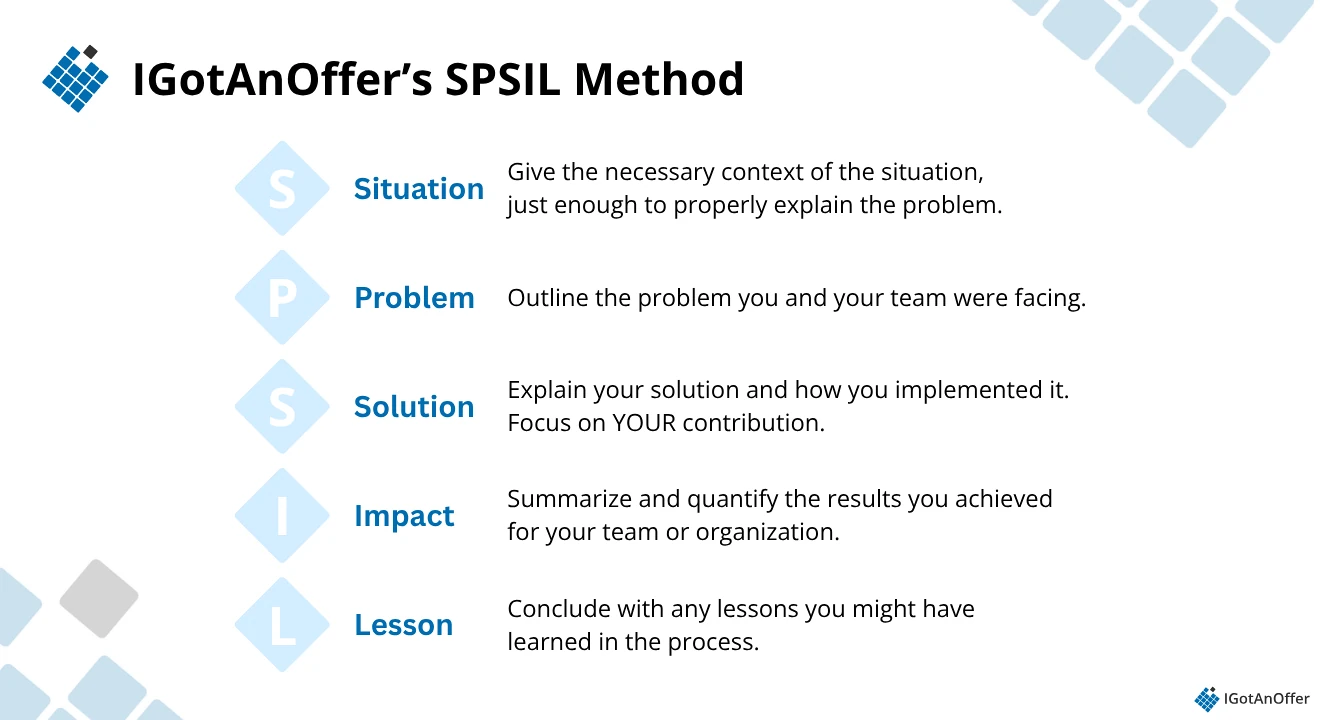
The IGotAnOffer SPSIL Method
- Situation: Start by giving the necessary context of the situation you were in. Describe your role, the team, the organization, the market, etc. You should only give the minimum context needed to understand the problem and the solution in your story. Nothing more.
- Problem: Outline the problem you and your team were facing.
- Solution: Explain the solution you came up with to solve the problem. Step through how you went about implementing your solution, and focus on your contribution over what the team / larger organization did.
- Impact: Summarize the positive results you achieved for your team, department, and organization. As much as possible, quantify the impact.
- Lessons: Conclude with any lessons you might have learned in the process.
To see the framework in action, watch this video, where Damien (ex-Meta PM) uses it to answer behavioral questions in a mock interview. The same structure works for Netflix's culture questions.
4.4 Keep your situation setup short
Candidates often spend too much time setting up their story. Give the interviewer enough context to understand the problem, then get into what you did.
As a rule of thumb, keep your story setup to 30 seconds or less. That leaves you enough time to talk about your decisions, actions, and results.
4.5 Show a coachable mindset
Be honest about gaps in your knowledge instead of trying to bluff through them. Michael describes this as intellectual honesty and recommends staying curious in areas where you’re uncertain. He says that this is “the kind of growth mindset that interviewers want to see from candidates.”
4.6 Listen for what the follow-up question is testing
Don’t be alarmed if your interviewer asks follow-up questions. This is perfectly normal and usually means they want to hear more about a particular part of your answer.
Pay attention to how they phrase the question, as it can give you a clue about what they want you to expand on. For example, if they ask how your team reacted, that’s a sign to talk more about how you worked with others.
You don’t need to read too much into every question. Just listen carefully and let the interviewer’s follow-ups guide where you take your answer next.
5. How to prepare for Netflix culture and behavioral interviews ↑
We've coached thousands of candidates through tech interviews, including many for Netflix roles. Below are the four most effective things you can do to prepare.
5.1 Learn about Netflix
Before investing hours in interview prep, make sure Netflix is the right company for you. The memo is explicit that the culture isn't for everyone, and the interviews are designed to filter for genuine fit.
If you know people who work at Netflix or used to, talk to them about what the culture is like day to day.
We'd also recommend the following resources:
- Netflix culture memo (by Netflix)
- Netflix's work-life philosophy (by Netflix)
- Sharing Our Latest Culture Memo, Netflix's post on how the current memo was written
- Netflix tech blog, useful context for engineering candidates
- No Rules Rules, by Netflix co-founder Reed Hastings and Erin Meyer, on how the culture works in practice
- Powerful, by former Netflix Chief Talent Officer Patty McCord, on building the culture from the inside
5.2 Practice by yourself
Culture and behavioral questions are only part of the Netflix loop. To prepare effectively, learn the full Netflix process and the other question types using these guides:
- Netflix interview process
- 30+ common Netflix interview questions and how to answer them
- Behavioral interview questions guide
Applying for a specific role at Netflix? Take a deeper dive with these guides:
- Netflix software engineer questions (in our questions guide)
- Netflix engineering manager interview guide
- Netflix product manager interview guide
- Netflix data scientist interview guide
Once you have a strong foundation, the next step is practicing under real conditions. By yourself, you can't simulate thinking on your feet, unexpected probing questions, or the pressure of performing in front of a stranger.
That's why many candidates practice with friends or peers.
5.3 Practice with peers
If you have friends or peers who can do mock interviews with you, that's an option worth trying. It's free, but be warned, you may come up against the following problems:
- It's hard to know if the feedback you get is accurate
- They're unlikely to have insider knowledge of Netflix's culture bar
- On peer platforms, people often waste your time by not showing up
For those reasons, many candidates skip peer mocks and go straight to practicing with an expert.
5.4 Practice with experienced Netflix interviewers
In our experience, practicing real interviews with experts who can give you Netflix-specific feedback makes a huge difference.
Find a Netflix behavioral interview coach so you can:
- Test yourself under real interview conditions
- Get accurate feedback from a real expert
- Build your confidence
- Get company-specific insights
- Learn how to tell the right stories better
- Save time by focusing your preparation
Landing a job at a big tech company often results in a $50,000 per year or more increase in total compensation. In our experience, three or four coaching sessions worth ~$500 make a significant difference in your ability to land the job. That's an ROI of 100x!
Click here to practice mock interviews with ex-Netflix interviewers.











 Product manager
 Product sense