

 Back to other articles



 Last updated: September 08, 2026
 Interviews
 Management consultant
 Case
Case Deeply researched
To ace the McKinsey case interview, you need more than just business intuition; you need a structured approach to problem-solving. These interviews are the ultimate test of how you think, not just what you know.
The good news is that you can build your case interview muscles with the right preparation. This guide breaks down how the McKinsey case interview works: what interviewers are looking for, the types of questions to expect, and how to best answer them, with expert tips from ex-McKinsey interviewers.
We also give you a clear strategy on how to prepare for case interviews so you can walk into your McKinsey interviews with confidence.
Here’s a quick overview of what we’ll cover:
- Interview process and timeline
- How the McKinsey case interview works
- Difference between Business Analyst and Associate interviews at McKinsey
- McKinsey case interview questions
- Interview tips
- Preparation plan
Click here to practise 1-on-1 with McKinsey ex-interviewers
Let's get started.
1. Interview process and timeline ↑
The best way to start your case interview prep is to understand how the McKinsey interview process works. In most countries, McKinsey uses five filters to select candidates:
- Resume and cover letter screening
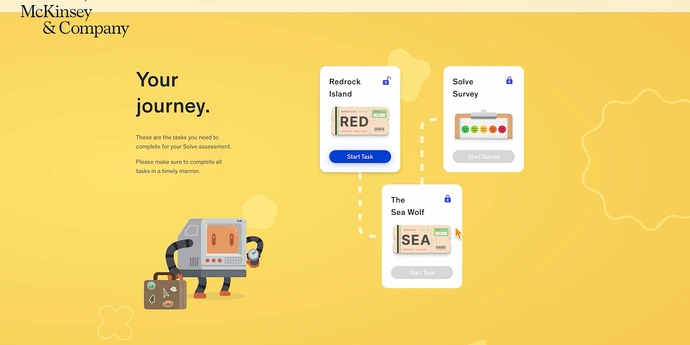
- McKinsey Solve
- Recruiter screen
- First round of interviews
- Second round of interviews
Here’s a general overview of the timeline:
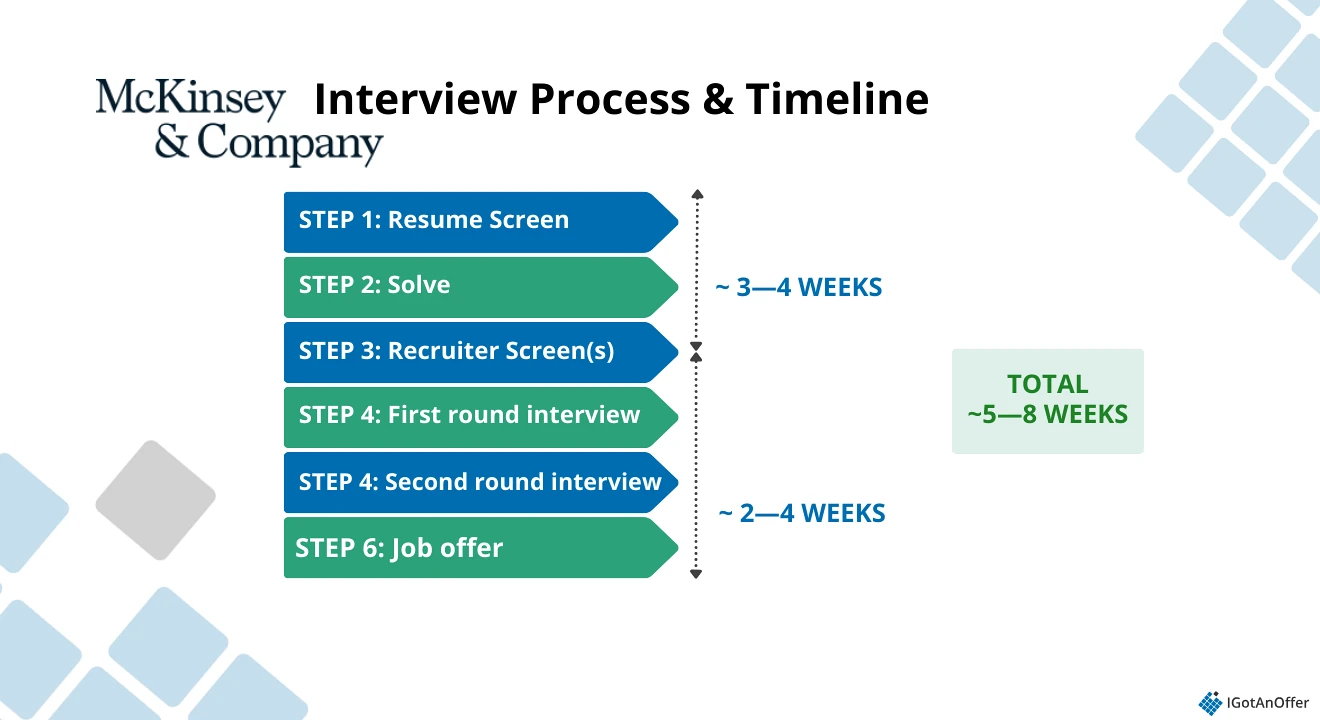
Note that this may not reflect your specific interview timeline. Actual timelines depend on several factors. The timeline above is based on the expected recruitment timelines at the University of Chicago (an MBB target school).
You can expect to get case interviews during your first-round and second-round interviews.
What differentiates the first round from the second round is the interviewer. You'll usually get Associates (2+ years of experience) or Engagement Managers (4+ years of experience) lead first-round interviews. The second round is led by Partners (10+ years of experience).
In theory, McKinsey takes into account your performance at both first- and second-round interviews when making final offer decisions. However, in practice, your performance during the second round carries more weight. This is simply because Partners will have a stronger voice when the recruiting group discusses your application.
Read our guide to the McKinsey interview process for a more detailed deep dive.
Now let’s take a look at everything you need to know about the McKinsey case interview: its structure, the difference between the McKinsey business analyst and associate interviews, sample case interview questions (and how to answer them), and the core competencies McKinsey tests.
Coaches who contributed to this guide













2. How the McKinsey case interview works↑
The most important thing you need to know about the McKinsey case interview is that it’s interviewer-led, as opposed to other major firms that do interviewee-led cases.
2.1 McKinsey case interview structure
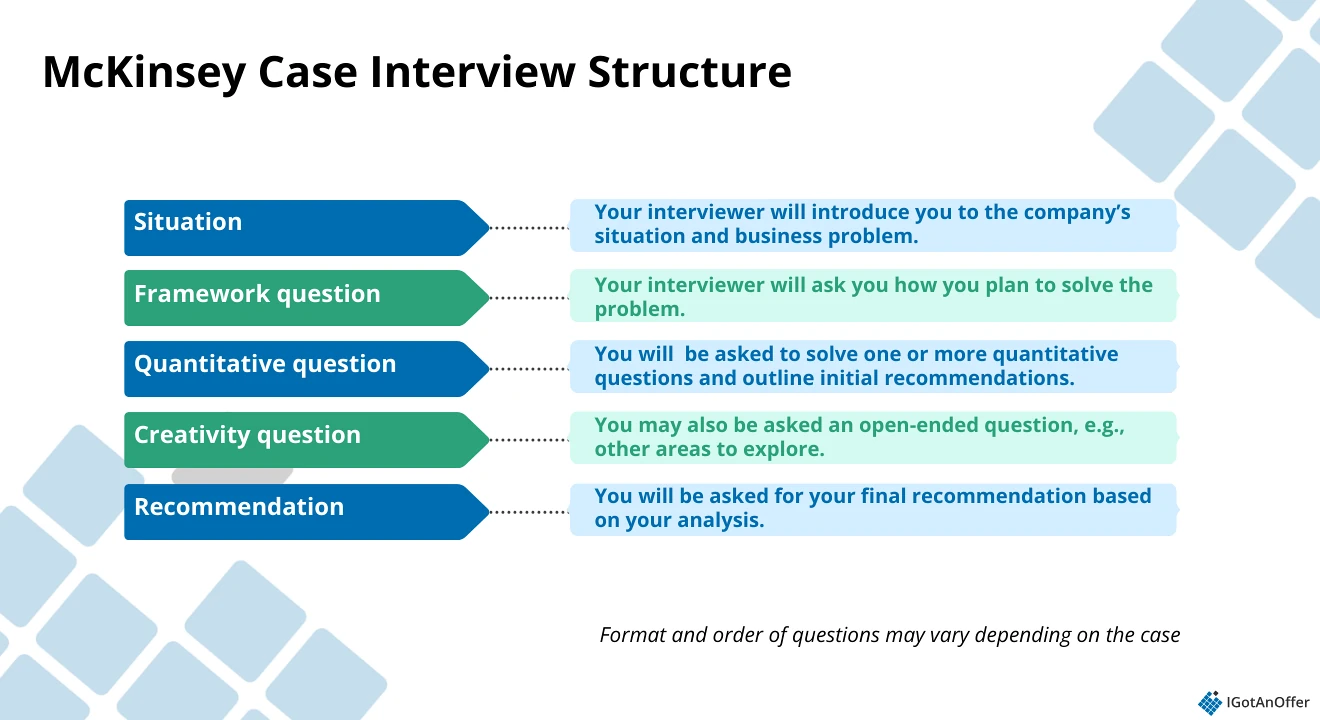
Most McKinsey case interviews use the following structure:
- Situation
- Framework question
- Quantitative question
- Creativity question
- Recommendation
2.1.1 Situation
First, your interviewer will introduce you to the company’s situation and business problem. Examples: an industrial facility facing a profit challenge, or a company that needs help making a strategic decision about a new product.
They will then ask you questions about the situation. They may also provide you with documents such as graphs and tables with figures about the company.
At this stage, you will be allowed to use scrap paper to structure your thoughts and perform calculations. However, you will not be allowed to use a calculator.
2.1.2 Framework question
Then, the interviewer will ask you to identify the areas you would look at to solve the problem - this is the framework question.
2.1.3 Quantitative question
You will then be asked to solve one or more quantitative questions, and afterward, you will be expected to outline some initial conclusions.
2.1.4 Creativity question
At some point during your interview, you will be asked a creativity question, i.e., an open-ended question such as “What other areas should the company explore to increase its online sales?”
2.1.5 Recommendation
Finally, at the end of the case, your interviewer will ask you to make an overall recommendation for the company based on the analysis you have just carried out.
Although the format and order of questions may vary from one case to the next, you will almost invariably come across these types of questions during your McKinsey interviews and should therefore prepare for them.
An additional exercise we would recommend doing is to take a look at the different case interviews available on McKinsey's website. As you go through each case, you should try to map each question to the 5 types of questions we have listed above.
For an overview of the different types of case problems you might face, see our guide on the 10 types of case interviews.
2.2 Differences between McKinsey and other cases
There are two main differences between the way McKinsey conducts case interviews vs. other firms.
-
McKinsey cases are interviewer-led
According to Jenny (ex-McKinsey management consultant), case interviews at McKinsey are interviewer-led to ensure that all required test areas are covered and that less is left to chance, compared to interviewee-led interviews.
“The interviewee could lead the case down a different direction and not be able to demonstrate the skills needed for the role,” she says. We’ll cover these skills in the section about core competencies below.
This means your interviewer will likely control the pace of the interview. They’ll have a list of questions prepared. They might even interrupt you if they see you spending too much time on one question.
Other firms like Bain and BCG, on the other hand, have candidate-led interviews. They may be testing for the same core competencies; the difference will be in the way the interviews are led.
-
McKinsey cases are more challenging
There is a lot of competition to get into McKinsey, and your interviewer will probably challenge the quality and logic of your answers more than at other firms.
That being said, interviewers are instructed to always be well-intentioned and will not try to “trip you up” or misguide you.
3. Difference between Business Analyst and Associate interviews at McKinsey↑
According to Bilal (ex-McKinsey management consultant), McKinsey Business Analyst (BA) and Associate candidates get the same interview format and questions. They are also tested on the same skill sets/core competencies.
The difference lies in the academic/professional background requirement and interview expectations. Associates are expected to be more experienced than BAs. To qualify, you’ll need to have more years of experience plus an MBA degree. Sometimes, an MS degree is enough, but this varies by office.
Below, Siddharth (ex-McKinsey junior engagement manager) goes into more detail about the expectations for BA vs. Associates, depending on your academic and/or professional background:
- If you're a BA candidate, you're expected to have no knowledge whatsoever other than the very basics. Rely on your instincts.
- If you’re a post-MBA Associate candidate, you are expected to understand some finance basics (e.g., EBITDA). Rely a bit on your experience and what you have learnt.
- If you’re an advanced degree associate candidate, you’re expected to be able to explain what you’ve worked on, but not expected to have knowledge in other domains
- If you’re a lateral hire / experienced professional, you’re expected to have an understanding of what you’ve been doing. The expectations also change by role, with senior roles requiring more of team management, sales, and ownership expectations, with an ever-increasing bar
Additionally, an Associate’s case interview performance needs to be top-notch. There is less room for errors compared to the BA interview.
Click here to learn more about the different McKinsey career paths.
3.1 Case interview core competencies
According to the ex-McKinsey case experts we’ve worked with, here are the core competencies that McKinsey assesses during case interviews:
3.1.1 Structured problem-solving
Interviewers want to know if you can break down a problem into MECE parts and drive the case forward, Bilal says.
MECE stands for Mutually Exclusive and Collectively Exhaustive. Consultants usually solve clients' problems using a framework. For a framework to be MECE, its different parts cannot overlap (Mutually Exclusive). But they need to cover all possible causes of the client's problem (Collectively Exhaustive).
In simple terms, this means you will be expected to solve questions with a clear step-by-step approach that is easy for your interviewer to understand.
There is no right or wrong structure, says Siddharth, as long as you work with a structure that’s MECE.
3.1.2 Numerical intuition
“There is a strong focus on number intuitiveness and quick math,” says Siddharth. You want to ask yourself if you’re comfortable with approximations, ratios, and sanity checks.
According to Ann, not doing sanity checks on maths is one of the most common mistakes she sees candidates commit.
Interviewers want to see if you’re able to do mental math both quickly and accurately, but they also want to see you do sanity checks on your final numbers. Focus on your zeros, and don't change millions to billions.
Check out our case interview math guide if you think you need a refresher.
3.1.3 Business intuition
McKinsey case interviews are designed to evaluate your business intuition, i.e., business sense + creativity.
Your interviewer will assess your ability to come up with a range of ideas that make business sense to solve the client issue at hand. For instance, you could be asked to find innovative ideas for a restaurant to grow sales or to decrease costs.
According to Siddharth, there is typically a low bar on what you know about the specific industry. “They might expect you to know a few very basic terms (e.g., profit, loss), but not complex business terms or industry-specific knowledge,” he says.
So it’s important to know that interviewers will not assess your business knowledge per se. For instance, you could get a case about re-insurance and not know anything about the re-insurance industry. This is perfectly normal.
In such a case, you'll be assessed not on your knowledge (or lack thereof), but on how you ask questions to understand an industry you're unfamiliar with or its specificities.
As mentioned, the only expectation is that you know basic business concepts such as revenues, fixed and variable costs, etc. If you need a crash course or a refresher, read our guide to finance concepts you need to know for consulting interviews.
3.1.4 Communication skills
Interviewers want to see how you communicate your ideas and interact with others. As a consultant working with clients, good communication skills will be critical to your success.
You'll want to show your interviewers that you can communicate confidently, professionally, and in a clear and structured way.
Bilal says one of the things interviewers will be looking for is your ability to communicate in a top-down manner, i.e., begin with the core message, follow it up with key supporting arguments, and finally, end with a key takeaway.
3.1.5 Coachability
Finally, interviewers assess your coachability during case interviews. They are looking to see how you respond when the interviewer steers you in a different direction during a case.
Ann says a common mistake she sees among candidates is being inflexible in their thinking. That’s a red flag. “If you're prodded, be open to changing your mind if it makes sense,” she says.
Your interviewers also expect you to respond to challenges with creativity. “You will be pushed to look for creative solutions, so keep your mind open for more,” Siddharth says.
4. McKinsey case interview questions↑
4.1 Case study question examples
One of the best things you can do to prepare for your McKinsey case interviews is to practice with realistic case questions. McKinsey has made several example case studies available, which are modeled after real-world consulting scenarios.
Important note: Feel free to open the practice consulting cases for reference, but open them in a new tab. You'll want to keep this page open because the sections below will help you be more strategic with your preparation, including your practice with sample cases.
You can find the available cases from McKinsey below:
In addition, we've put together the ultimate list of free practice cases, with materials from the world's leading consulting firms. We’ve included practice case books from university consulting clubs, like Harvard, MIT, London Business School, and more.
4.2 Types of case interviews
First- and second-round case interviews share the same format, but because the second round is conducted by Partners, expect the unexpected.
The only way to prepare for spontaneous questions is to broaden the range of your case interview knowledge and prepare for different types of case interviews, which include:
- Profitability cases
- Market entry cases
- Merger & acquisition cases
- Pricing cases
- Market sizing cases
- Operations cases
4.3 Case framework development
One of the core competencies you’ll be tested on during your McKinsey case interview is your ability to solve problems in a structured manner.
Many candidates believe that the only way to achieve this is to force-fit cases into existing frameworks. Knowledge of case frameworks is indeed useful, but only as building blocks to create your own.
Here’s IGotAnOffer’s method for creating custom frameworks:
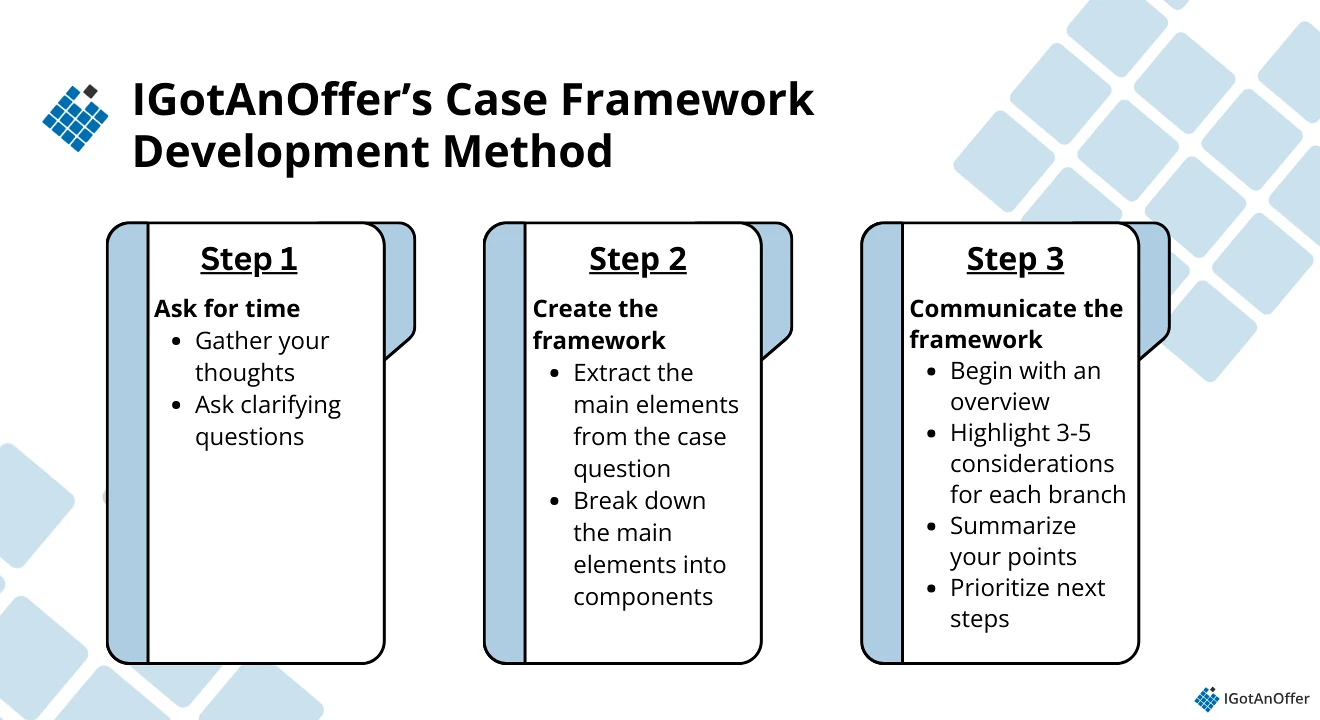
IGotAnOffer’s Framework Development Method
Step 1: Ask for time to gather your thoughts
Step 2: Create the framework
- Extract the main elements from the case question
- Break down the main elements into components
Step 3: Communicate the framework
- Spin your paper around
- Begin with an overview
- Highlight 3-5 considerations for each branch
- Summarize your points
- Prioritize next steps
Check out our guide to common case frameworks, where you'll find an example of how to use this framework development method.
4.4 McKinsey PEI
Personal experience interview (PEI) questions take up at least 10 minutes of your first- and second-round interviews.
For PEI, it’s best to familiarize yourself with McKinsey’s 4 themes. Their questions will mostly revolve around these 4, so it’s best to prepare 2 to 3 stories for each theme.
Here’s a quick look at how McKinsey defines each theme and their sample questions for each:
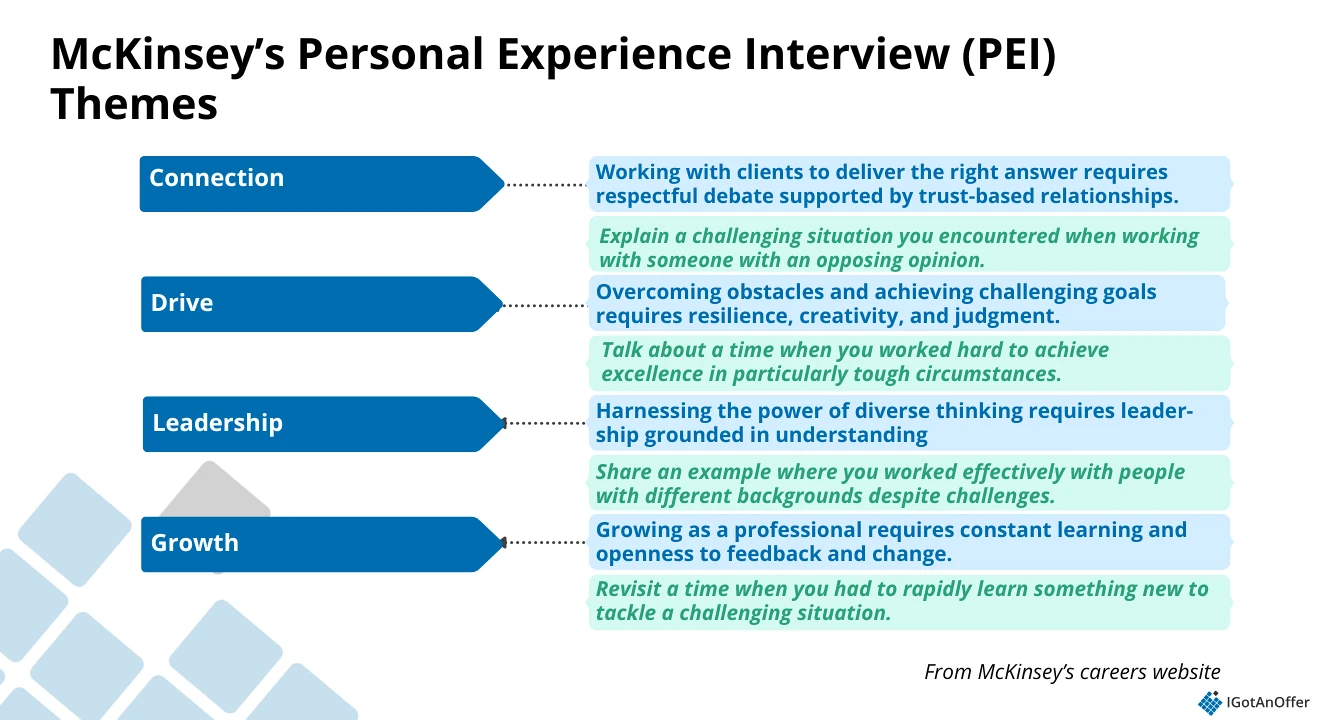
Though ‘ownership’ isn’t a specified theme, Bilal (ex-McKinsey management consultant) notes that there’s a particularly high bar for this competency in McKinsey. Our advice is to try to incorporate how you demonstrate this trait alongside the other themes.
A common mistake candidates make is forgetting the PEI. Do NOT forget the PEI.
“Most people focus too much on the case preparation and completely miss the PEI component. This can often be the most critical piece,” Siddharth says.
Below are a few of Siddharth’s quick tips on what to focus on depending on your level:
- For college grads/BAs, show leadership positions and how you worked on diverse roles with lots of moving parts. Show enthusiasm and the thirst to build something
- For MBAs, show a mix of pre-MBA experience and leadership roles during your MBA
- For advanced degrees, show how you were able to explain complex ideas in simple terms
- For lateral hires, use powerful examples from your career to sway the interviewer on your team. These need not be strictly within the domain of the work you are applying for
Check out our guide to McKinsey PEI to learn more about how you can best prepare for this interview.
5. McKinsey case interview tips↑
To increase your chances of getting that coveted McKinsey job offer, you’ll need to boost your interviewing skills.
Here are a few tips to keep in mind, with insights from our ex-McKinsey consulting experts, Jenny, Ann, Bilal, and Siddharth:
5.1. Don’t memorize your answers
“Memorizing your answers makes you sound robotic,” Jenny says. It also prevents you from properly adapting your answers to your interviewer’s questions.
The only way to achieve a structured yet conversational way of answering is through practice. Practice will also make you feel more confident, allowing you to be a lot more present and ready for any curveball questions.
Being present during an interview is important. You want to be able to read the room, Jenny says, so you’d know where to lengthen, shorten, or pause at certain parts of your stories.
5.2 Adapt your framework to your answer, not the other way around
We talked about this in a previous section, but it bears repeating: do not force your answer into an existing framework.
“There is no right or wrong structure. All you need is a structure that works,” Siddharth says.
For example, if you want to find out which approach sells more coffee, you can either structure by what customers want, or what the sellers sell.
“It doesn't matter what approach you take, as long as there is an approach and it is MECE,” he says.
According to Jenny, many candidates force-fit a previously seen case framework to an answer, so much so that the logic is no longer coherent.
Instead, familiarize yourself with the different case frameworks and use them as building blocks to create your own.
5.3 Make sure you understand the question
Ann says most candidates make the mistake of jumping into problem-solving mode instead of taking the time to understand the problem.
Her advice is to spend a few seconds asking clarifying questions. “Always make sure you understand the question and ask if you’re unsure,” she says.
5.4 Don’t jump straight into the math
Bilal says that jumping straight into the math is a common mistake candidates make during case interviews. This will make you appear unstructured.
So, to avoid this mistake, make sure you structure the formula out loud for your interviewer before doing your calculations. Remember, they’re assessing your communication and problem-solving skills, not just your math skills.
Having an in-depth understanding of the business terms below and their corresponding formulas is NOT required to get offers at McKinsey and other firms. But having a rough idea of what they are can be handy.
5.5 Always go back to the objective of the case
Another common mistake candidates make, according to Bilal, is losing track of the objective of the case.
Writing the premise of the case at the beginning is a practical way to remind yourself of your case objective. Always incorporate a summary of the points at the end of every answer, so tying everything together becomes a habit.
6. Preparation plan↑
In this section, we're going to cover the most important things you can do in order to prepare for your McKinsey case interviews. Let's begin with maths preparation.
6.1 Learn or get a refresher on relevant knowledge
While you won’t be expected to have in-depth math, business, or finance knowledge, you’ll still want to have the basics down. Below is a list of our guides to get you started:
- Case interview math
- Finance concepts
- MECE framework
- Common case frameworks
- Different types of case interviews
Another aspect to focus on is data interpretation, so Siddharth’s advice is to practice interpreting data and drawing insights out of them with no math.
6.2 Develop a consistent method to crack cases
One of the biggest challenges of interviewing with McKinsey is solving cases that you’ve never seen before. Each case can be difficult, and you’ll have to perform well across multiple case interviews in order to get an offer.
As a result, it’s critical for you to have a consistent approach for solving cases. McKinsey uses interviewer-led case interviews, where you'll get questions about the following:
- Situation
- Framework development
- Quant question – Data provided
- Creativity question
- Recommendation
If you can crack each type of question (within a case), then you can crack the overall case.
6.3 Practice cases out loud
How you solve each case is important, but your interviewers will also be evaluating how you COMMUNICATE your answers. It's important to speak in a structured way that makes it easy to clearly understand your points.
To help you with this process, here is a broad list of consulting interview questions you can practice with.
Practicing by yourself is a great way to get started, and can help you get more comfortable with the flow of a case interview. However, this type of practice won’t prepare you for realistic interview conditions. By yourself, you can’t simulate thinking on your feet or the pressure of performing in front of a stranger. Plus, there are no unexpected follow-up questions and no feedback.
That’s why many candidates try to practice with friends or peers.
6.4 Practice with peers
If you have friends or peers who can do mock interviews with you, that's an option worth trying. It’s free, but be warned, you may come up against the following problems:
- It’s hard to know if the feedback you get is accurate
- They’re unlikely to have insider knowledge of interviews at your target company
- On peer platforms, people often waste your time by not showing up
For those reasons, many candidates skip peer mock interviews and go straight to mock interviews with an expert.
6.5 Practice with experienced McKinsey interviewers
In our experience, practicing real interviews with experts who can give you company-specific feedback makes a huge difference.
Find a McKinsey interview coach so you can:
- Test yourself under real interview conditions
- Get accurate feedback from a real expert
- Build your confidence
- Get company-specific insights
- Learn how to tell the right stories, better.
- Save time by focusing your preparation
Landing a job at a top consulting company often results in a $50,000 per year or more increase in total compensation. In our experience, three or four coaching sessions worth ~$500 will make a significant difference in your ability to land the job. That’s an ROI of 100x!
Click here to book McKinsey mock interviews with experienced McKinsey interviewers
7. Differences for specialist roles
The advice we've given in this article is aimed at candidates for general consulting at McKinsey, but much of it is also relevant for candidates applying for other roles (e.g. McKinsey Digital Labs, Implementation Consultant, Data Scientist, etc.) although as you'd expect, there are some differences.
Below, we've summarised our general guidance which will help you understand the differences at a high-level view. If you are currently in the interview process, your HR contact should be able to provide the details for your specific interview track.
7.1 McKinsey Digital Labs
Broadly speaking, there are two types of roles at McKinsey Digital Labs: consulting roles and specialist roles (e.g.: software developer).
- Consulting roles: if you're applying for an Analyst or Associate role, the interview process will follow the normal consultant interview track. You should therefore prepare for McKinsey-style case interviews, as well as McKinsey PEI questions.
- Specialist roles: specialists have function-specific interviews. For instance, software engineers / data scientists typically have a mix of technical questions (coding), and personal experience interview questions. Some of the data scientists we've worked with were also asked to solve a case in later rounds of interviews.
One of our coaches is a former consultant from McKinsey Digital Labs. We have interviewed him in the following blog post, which you can read if you want to learn more about the interview process at McKinsey Digital Labs.
7.2 Implementation Consultant
Implementation Consultant is a consulting role. As a result, McKinsey interviewers will test the same skills as for other consultants, including problem solving, leadership and communication skills.
In addition, it's likely that McKinsey interviewers will also test specific implementation skills, such as the lean and six-sigma methods. They may cover it with a PEI question, by asking you to provide an example of how you led the implementation of a six-sigma project. Or, they may cover it during a case interview, by asking you to solve an implementation-related case.
7.3 Research Analyst and Data Scientist
In our experience, the interview process for Research Analyst is quite similar to the one for Consultant. Candidates for Research Analyst roles regularly prepare with our coaches.
For a Data Scientist role, the interview process is probably quite different, including coding interviews with statistics and computer science questions.
For any of these specialised roles at McKinsey, we would also encourage you to double-check with your HR contact to understand the exact format.