

 Back to other articles


 Last updated: September 21, 2026
 Interviews
 Business analyst
 Case
Case Deeply researched
McKinsey business analyst interviews can be daunting. You need to show that you can solve complex client problems, communicate your thinking clearly, and work effectively with people.
You’ll have to demonstrate these skills across several parts of the interview, including fit and background questions, Personal Experience Interview (PEI) questions, and case and quantitative questions.
To help you prepare, we analyzed hundreds of McKinsey business analyst candidate reports on Glassdoor and also reviewed recent Reddit discussions. Below, we break down the hiring process, share sample questions, and give you practical tips and a preparation plan.
Here's an overview of what we'll cover:
Practice 1-on-1 with business analyst interview coaches
1. McKinsey business analyst role and salary ↑
1.1 What does a McKinsey business analyst do?
McKinsey business analysts work on client service teams, taking ownership of a workstream within a larger client problem. The work can include research, data analysis, interviews, hypothesis testing, recommendations, and helping clients implement agreed-upon changes.
Depending on the project, you could work in areas such as healthcare, corporate finance, operations, or the social sector. Given the demands of the role, McKinsey looks for candidates who demonstrate resilience, judgment, integrity, and curiosity.
1.2 How much does a McKinsey business analyst make?
According to Glassdoor, the median total pay for a McKinsey business analyst in the US is $158K/year.
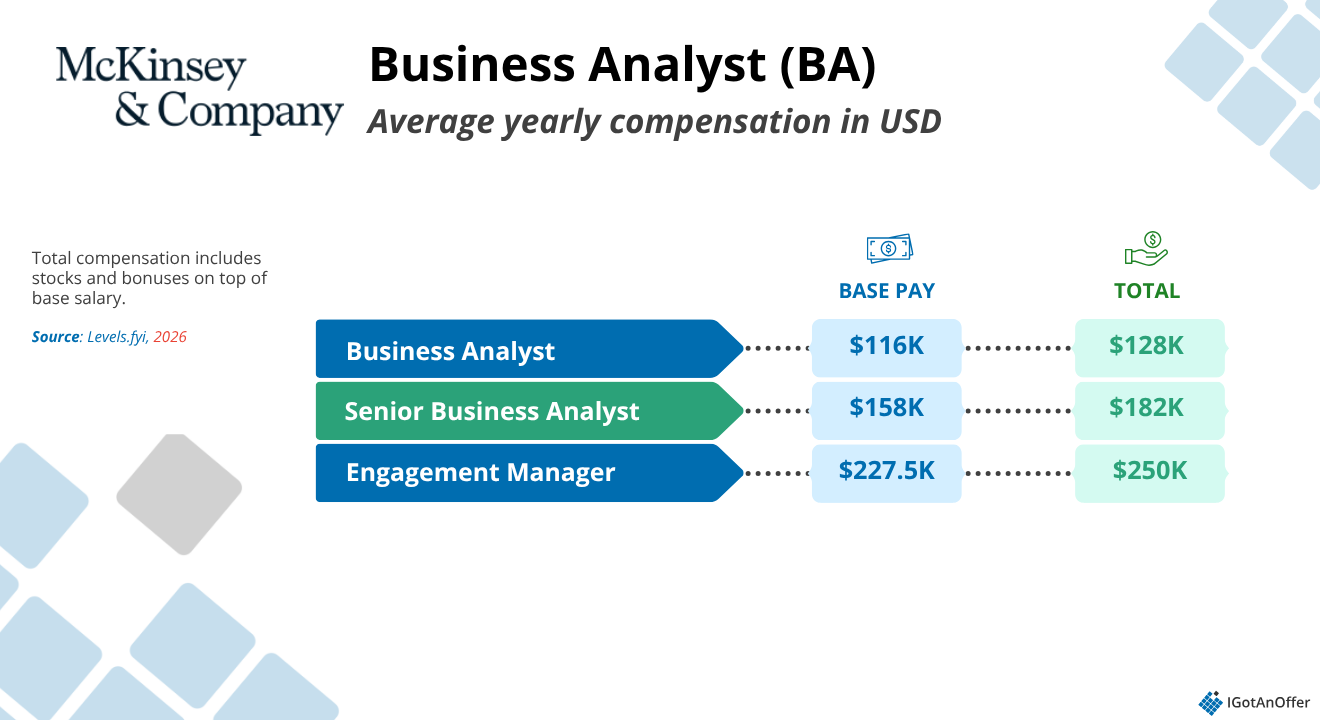
Levels.fyi lists a median total compensation of about $131K/year for McKinsey business analysts in the US, with compensation ranging from about $128K for Business Analysts to $250K for Engagement Managers.
As of September 2026, here is the compensation breakdown for McKinsey business analysts based on Levels.fyi data:
 We presume you already know which level you're applying for, but it's worth double-checking with your recruiter, who can confirm which level you're being evaluated for.
How you do in your interviews will help determine whether you get an offer, which is why hiring one of our McKinsey interview coaches can provide a significant return on investment.
If you do get an offer, ask your recruiter whether any part of the package is open to discussion. Consider booking one of our salary negotiation coaches to get expert advice.
Coaches who contributed to this guide










2. McKinsey business analyst interview process and timeline↑
McKinsey's hiring process usually takes about five to eight weeks, although the timeline can vary by office and role.
Here are the six steps you may go through:
- Resume screen
- McKinsey Solve
- Recruiter/video screen
- First-round interviews
- Second-round interviews
- Offer
2.1 Resume screen ↑
To score an interview, you'll need a quality resume tailored to the business analyst role at McKinsey. Once your resume is ready and you find a suitable role, you can apply through McKinsey Careers.
The resume screen is where recruiters compare your background with the requirements of the open position. They use that comparison to decide whether your experience is a strong enough match to move forward.
If you know someone at McKinsey, a referral may also help your application get noticed. In our experience, the simplest approach is to contact employees you already share a connection with on LinkedIn.
To help you put together a strong resume, we recommend following the tips below.
- Simplify. Avoid overly creative layouts. A simple resume passes through applicant tracking systems and reads quickly for recruiters and hiring managers.
- Verbalize. Start each bullet point under your previous roles with an action word.
- Quantify. Add numbers wherever you can: revenue gains, cost savings, scale of projects, or adoption of a recommendation you developed.
- Summarize. Include a skills section with keywords pulled directly from the job posting.
For more detailed guidance, read our consulting resume guide or get feedback from our McKinsey resume coaches.
2.2 McKinsey Solve ↑
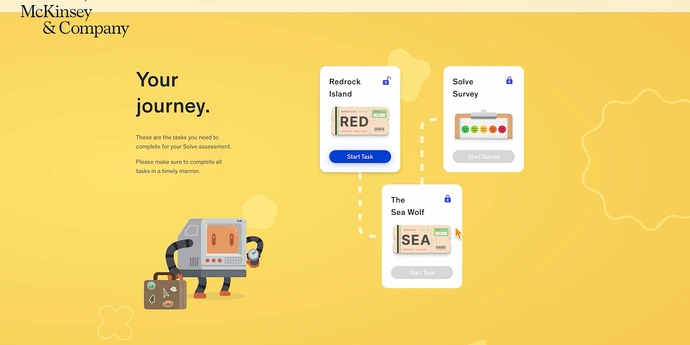
If you pass the resume screening, you’ll receive an invitation to complete the McKinsey Solve Game, a gamified assessment that tests your problem-solving abilities. At the time of writing, there are three scenarios you may encounter for your assessment:
- Redrock Study
- Sea Wolf (also known as Ocean Cleanup/Ocean Treatment)
- Sustainable Futures Lab (currently in beta testing)
You won’t necessarily get all three scenarios. If your invitation says you have 65 minutes to complete the assessment, then you'll likely get the first two. If it says you'll have 85 minutes, the Sustainable Futures Lab is likely included.
For details on how to prepare for each scenario, check out our McKinsey Solve guide.
2.3 Recruiter/video screen ↑
Some applicants report getting a recruiter or video screen before the main interview rounds. The recruiter may ask about your resume, motivation, and interest in consulting or McKinsey. They may also walk you through what to expect from the rest of the interview process.
Since the process can vary by role, McKinsey recommends checking with your recruiter about what your interview process will look like, including the types of questions you may get.
2.4 First-round interviews ↑
The first round usually includes two to three interview sessions of about 45 to 60 minutes each. Expect Personal Experience Interview (PEI) questions, case and quantitative questions, and sometimes fit and background questions about your resume, motivation, or interest in McKinsey.
Jenny (ex-McKinsey engagement manager) says McKinsey cases are interviewer-led. This means that the interviewer controls the sequence and introduces the next question or data set, whereas in a candidate-led case you are expected to decide the direction of the interview.
2.5 Second-round interviews ↑
The second round will typically be with a Partner or Senior Partner. You can expect more PEI and case questions, with your interviewer likely to dig deeper into your answers and ask more detailed follow-up questions.
2.6 Offer and salary negotiation ↑
If you pass the final round, your recruiter will contact you with an offer. Take some time to review it before you respond, especially if you plan to negotiate.
Salary negotiation tips
- Be polite. Remember that the person you're negotiating with is just doing their job. You'll get much farther in your negotiations if you approach the conversation with grace.
- Don't give a number right away. Whenever possible, it's better to wait until you receive an offer to start negotiating. This reduces the risk of giving a number that is lower than what McKinsey otherwise would have paid.
- Do your research. Have a number in mind before the conversation begins, and back it up with data. Research your position and level on Levels.fyi, ask around on professional networking sites like Blind, and factor in the cost of living where you are.
- Start high. Name a compensation number that is higher than your goal. Your McKinsey recruiter will likely negotiate it down to something closer to what you actually want.
- Negotiate everything. Your offer includes more than a base salary. You also have bonuses, vacation days, location, and remote work arrangements to consider. If the salary won't budge, there may be wiggle room elsewhere.
If you'd like help reviewing your offer and planning your negotiation, you can book a session with one of our salary negotiation coaches.
3. McKinsey business analyst example interview questions ↑
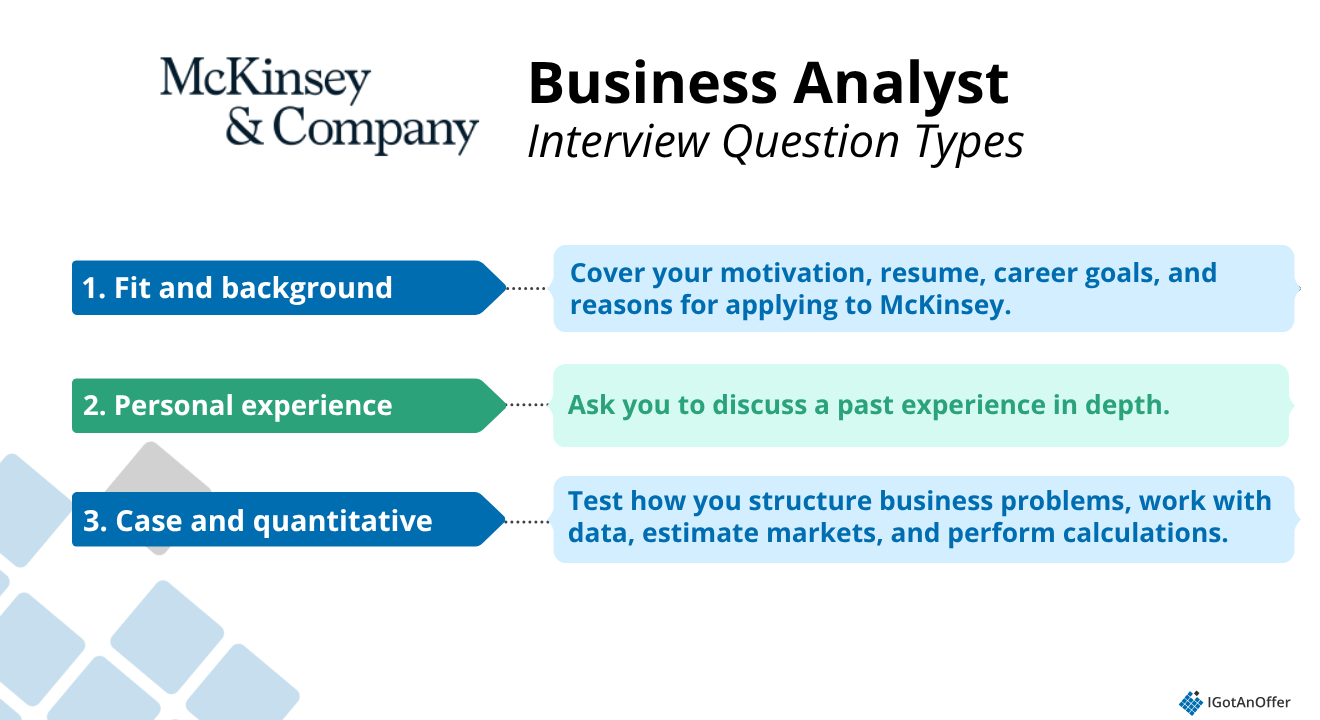
We analyzed hundreds of McKinsey business analyst candidate reports on Glassdoor and reviewed recent Reddit discussions. Based on what we found, we grouped the interview questions into three categories:
3.1 Fit and background questions
Fit and background questions help McKinsey understand why you want to join the firm and whether the role makes sense for your experience and career goals. Expect questions about your resume, motivation for consulting, career plans, and why you want to work at McKinsey.
These are different from PEI questions, which focus less on your overall background and motivation and more on how you handled a specific situation in the past.
Example McKinsey business analyst interview questions: Fit and background
- Why McKinsey?
- Why consulting?
- Tell me about yourself.
- Walk me through your resume.
- What do you know about McKinsey?
- What distinguishes you from other candidates?
- Why do you think you would be a good fit for McKinsey?
- Where do you see yourself in five to ten years?
3.2 Personal Experience Interview (PEI) questions
McKinsey bases its PEI questions on four themes: personal impact, entrepreneurial drive, inclusive leadership, and courageous change. You should be able to show how you’ve demonstrated these qualities through specific experiences from your past.
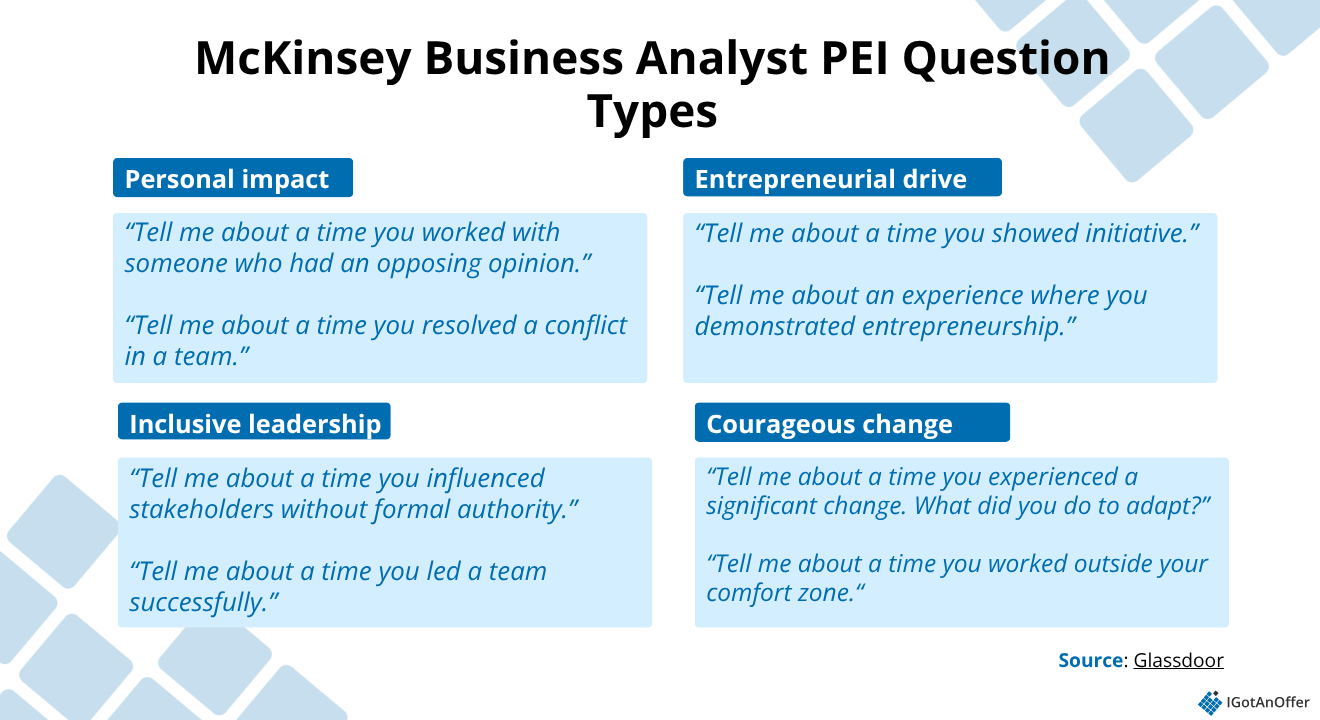
Your interviewer will usually focus on one experience and ask follow-up questions about what you did, why you made certain choices, and what happened. Peter (ex-McKinsey engagement manager) recommends preparing two examples for each theme.
You’ll need to know these stories well enough to answer detailed follow-up questions. Jenny (ex-McKinsey engagement manager) recommends knowing your story inside and out rather than memorizing a script, so you can adapt your answer based on what the interviewer asks.
Give each story a clear structure. We suggest preparing with a framework, such as IGotAnOffer's SPSIL method (Situation, Problem, Solution, Impact, Lessons). It's similar to STAR but addresses two common issues candidates face: distinguishing between the problem and their actions, and explaining what they learned from the experience.
Example McKinsey business analyst interview questions: Personal Experience Interview (PEI)
Personal impact
- Tell me about a time you worked with someone who had an opposing opinion.
- Tell me about a time you resolved a conflict in a team.
- Tell me about a time you had to convince someone to change their mind.
Entrepreneurial drive
- Tell me about a time you showed initiative.
- Tell me about an experience where you demonstrated entrepreneurship.
- Tell me about a time you faced a major challenge and how you handled it.
- Tell me about a time you had to learn something new quickly.
- Tell me about a time you failed. What did you learn?
- What is your biggest achievement?
Inclusive leadership
- Tell me about a time you influenced stakeholders without formal authority.
- Share an example of working effectively with people from different backgrounds.
- Tell me about a time you led a team successfully.
Courageous change
- Tell me about a time you experienced a significant change. What did you do to adapt?
- Tell me about a time you worked outside your comfort zone.
For more practice questions, check out our McKinsey PEI guide.
3.3 Case and quantitative questions
In a case interview, you’ll be given a scenario based on a business problem that a McKinsey client might face. You’ll be asked to structure the problem, analyze data, and make a recommendation.
You may also be asked quantitative questions as part of the case. These can involve interpreting data, performing calculations, or estimating figures, such as market size, revenue, or costs.
You’ll typically need to do the math without a calculator, so make sure you’re comfortable with mental math and common calculations such as percentages, ratios, and growth rates.
As mentioned earlier, McKinsey cases are interviewer-led. Your interviewer will guide you through the case and decide when to move on to the next question or data set.
Example McKinsey business analyst interview questions: Case and quantitative
Business cases
- Should the client enter this new market?
- A data backup and disaster recovery company is considering a deal. How would you begin evaluating it?
- A coffee shop chain's profits are falling. What factors would you investigate?
- How would you increase the profits of a chocolate factory?
- How could a telecom company increase its profits?
- How would you improve the profitability of a water taxi service?
- Give examples of costs in an operation.
- What are the key commercial issues in this situation, and what would you advise?
- How would you value a telecommunications market opportunity in the Midwest?
- How would you maximize a revenue stream?
- How would you improve a company's sales?
- How would you use AI to improve a manual business process?
- How would you increase vaccination rates in Africa?
- A school system is choosing between two water-filtration methods. Which should it choose and why?
- Work through a case about government spending on sports.
Quantitative calculations
- Complete finance-based calculations using the figures provided in the case.
- Calculate the synergies of an M&A deal.
- Prove or work through a mathematical equation.
- Solve mental-math and shape-based math questions.
Market sizing and estimation
- How many quarters could fit inside the Rogers Centre?
- How many tennis balls fit in an airplane?
- How many bathrooms are there in London?
- How large is the bread market?
- How many apples would a 10-acre orchard produce over 25 years?
For more example cases and preparation tips, see our McKinsey case interview guide. For methods you can use to structure your answers, see our case interview frameworks guide.
To brush up on your quantitative skills, use our market sizing guide and case interview math guide.
4. McKinsey business analyst interviewing tips ↑
You might be a fantastic business analyst, but unfortunately, that won't necessarily be enough to ace your interviews at McKinsey. Interviewing is a skill in itself that you need to learn.
Here are five tips you can use to approach your interviews the right way.
4.1 Ask clarifying questions
McKinsey encourages candidates to speak up and ask clarifying questions, especially since some of the prompts you'll get will be quite ambiguous. This will help you better understand what the interviewer is asking and avoid making incorrect assumptions.
4.2 Treat the interview like a conversation
One way to show clear communication is by treating your interview like a conversation. Explain your thought process and engage with your interviewer as you work through each question.
You should also be able to explain what your findings mean for the client, especially after a calculation or when you reach a recommendation.
4.3 Think out loud
According to McKinsey, you should explain your approach as you work so interviewers can understand how you think. State your assumptions and check that your interviewer is following.
This is especially important for quantitative questions. Bilal (ex-McKinsey management consultant) recommends stating the formula or approach you plan to use. This gives your interviewer a chance to correct your approach or offer a hint before you calculate.
4.4 Present multiple possible solutions
When possible, consider more than one solution before making your recommendation. This shows that you can look at a problem from different angles, weigh the tradeoffs between different approaches, and explain why you think one option is better than the others.
For complicated or ambiguous questions, break the problem into smaller parts and work through each one before arriving at your recommendation.
We recommend using case frameworks to help structure your answers. However, Jenny (ex-McKinsey engagement manager) warns against forcing a memorized framework onto every case. Use the framework as a guide, but adapt your structure to the specific case.
4.5 Center on McKinsey's PEI themes
Familiarize yourself with McKinsey's four PEI themes: personal impact, entrepreneurial drive, inclusive leadership, and courageous change.
Think about how your past experiences demonstrate these themes and prepare 10 to 15 strong stories you can adapt to different situations. Jenny recommends knowing each story well rather than memorizing a script, so you can choose the most relevant example and adjust it when the interviewer follows up. That way, you don't have to come up with a new story for every question.
5. How to prepare for your McKinsey business analyst interview ↑
Now that you know how the interview process works, let's focus on preparation.
Below, you'll find resources and four steps to help you get ready for McKinsey business analyst interviews.
5.1 Learn about McKinsey's work and culture
McKinsey is prestigious, so it's tempting to assume that you should apply without careful consideration. But it's important to remember that the prestige of a job alone won't make you happy in your day-to-day work. It's the type of work and the people you work with that will.
If you know people who work at McKinsey or used to work there, talk to them to understand what the culture is like. Here are also a few resources you can use to learn more about the firm and its culture:
- McKinsey Careers
- McKinsey consulting roles
- McKinsey interviewing guide
- McKinsey Solve
- How McKinsey stays on top (Fortune)
- Why McKinsey produces so many Fortune 500 CEOs (Fortune)
5.2 Practice by yourself
Your practice should cover the same three question types as the interview: fit and background questions, PEI questions, and case and quantitative questions. We recommend using the resources below to practice each area.
For fit/background and PEI questions:
For case and quantitative questions:
- McKinsey case interview guide
- Case interview frameworks guide
- Market sizing questions
- Case interview math guide
- 47 case interview examples
If you want to learn more about McKinsey’s interview process and what your career could look like at the company, here are a few more resources we recommend:
If you're interviewing at other companies, our other business analyst guides may help too:
A great way to practice all of these different types of questions is to interview yourself out loud. This may sound strange, but it helps you communicate more clearly once you're in the actual interview.
Play the role of both the candidate and the interviewer, asking questions and answering them, just like two people would in an interview.
5.3 Practice with peers
If you have friends or peers who can do mock interviews with you, that's an option worth trying. It's free, but be warned, you may come up against the following problems:
- It's hard to know if the feedback you get is accurate
- They're unlikely to have insider knowledge of interviews at your target company
- On peer platforms, people often waste your time by not showing up
For those reasons, many candidates skip peer mock interviews and go straight to mock interviews with an expert.
5.4 Practice with experienced interviewers
In our experience, practicing real interviews with experts who can give you company-specific feedback makes a huge difference.
Find a McKinsey business analyst interview coach so you can:
- Test yourself under real interview conditions
- Get accurate feedback from a real expert
- Build your confidence
- Get company-specific insights
- Learn how to tell the right stories, better.
- Save time by focusing your preparation
Landing a job at a top consulting company often results in a $50,000 per year or more increase in total compensation. In our experience, three or four coaching sessions worth ~$500 will make a significant difference in your ability to land the job. That's an ROI of 100x!
Book business analyst mock interviews with experienced interviewers.