

 Back to other articles

 Last updated: September 08, 2026
 Interviews
 Deeply researched
McKinsey’s interviews are some of the most challenging in the world, as you might expect from a globally prestigious company. Not knowing exactly what’s ahead makes it even more intimidating.
But fear not. Once you familiarize yourself with its process and strategically prepare, acing your McKinsey interview can be a lot more straightforward than you might think.
To help you maximize your chances of success, we’ve put together this ultimate guide. We’ll walk you through the entire interview process, including the types of questions you might get, along with insights from ex-McKinsey interviewers and tips on how to prepare.
As an overview, here are the steps of McKinsey’s hiring process:
- Step 1: Resume screen
- Step 2: Solve (McKinsey’s Problem-Solving Game)
- Step 3: Recruiter/video screen
- Step 4: First-round interviews
- Step 5: Second-round interviews
- Step 6: Job offer
Click here to practice 1-on-1 with an expert MBB interview coach.
Let’s get started!
1. About McKinsey↑
Before we go into McKinsey’s interview process, let’s get to know the company first.
If you want to go straight to the interview process, feel free to skip here.
1.1 Company profile
The firm was founded in Chicago in 1926 by James McKinsey, a professor of accounting at the University of Chicago. It started out by offering consulting services on accounting principles as a management tool.
McKinsey grew quickly in the 1940s and 1950s, especially in Europe. But in the 1960s, competitors like the Boston Consulting Group and Bain & Company started competing with McKinsey by marketing specific branded products, such as the Growth-Share Matrix, and by selling their industry expertise. In the 1970s, the firm therefore shifted its focus from geographic expansion to industry specialisation.
Today, McKinsey employs ~45,000 staff across 120+ offices and generates ~$16bn in revenues. The firm is sometimes dubbed the "CEO factory" as many of the company's alumni like have gone on to be CEOs of major corporations.
Top alumni:
- Sheryl Sandberg, Former COO, Meta
- James Gorman, Chairman Emeritus, Morgan Stanley
- Sundar Pichai, CEO, Google
- Oliver Bate, CEO, Allianz
- Lael Brainard, 14th director of the US National Economic Council
1.2 Working at McKinsey
Here are a few things about working at McKinsey that make it unique from other top consulting companies.
Extremely competitive pay
All MBB (McKinsey, BCG, and Bain) companies pay their consultants top dollar, but McKinsey is known for paying its entry-level consultants a lot more. Base salaries start at $110K for business analysts, and each year, they’re expected to go up by 10-20%.
In addition to this base salary, you'll also receive an annual bonus of about 20% depending on your personal performance. Finally, you can also expect a signing package and retirement contributions.
Global talent pool
According to Bilal (ex-McKinsey management consultant), McKinsey is a lot more open to a global talent pool, so staffing across offices is quite common. In comparison, Bain has a more local staffing model, at least in the USA.
Open to generalists
If you don’t have industry expertise but are keen to start from the ground up, McKinsey is an excellent entry point to consulting. Bilal says, “It puts less emphasis on industry experience compared to some other consulting firms.”
Great for exit opportunities
As we’ve noted above, McKinsey is known for being a “CEO factory.” So, if you’re looking at consulting as a way into business, it’s a great company to get into, given its track record of producing some of the world’s top CEOs and COOs.
Curious about how McKinsey compares to Bain and BCG? Check out our guide to the Big 3 consulting firms.
1.3 Career path at McKinsey
If you’re looking into McKinsey, you’re likely aiming for a career in consulting. But just in case you didn’t know, McKinsey offers two different types of roles: client-facing ones and internal positions. Let’s look at each type briefly:
1.3.1 Client-facing roles
If you want to get into consulting, you’ll apply for a client-facing role such as a business analyst. You’ll likely start as a generalist, which will allow you to dip into different industries while you gain enough experience and expertise to specialize. Even those coming with highly specialized backgrounds, such as medicine or law, are encouraged to explore other disciplines.
In addition to consulting roles, McKinsey also offers job opportunities under its Client Capabilities Network. You could work in data, digital, research, design, technology, and implementation, among many other disciplines.
1.3.2 Internal roles
In addition to the client-serving job types above, McKinsey has positions for internal business functions. Specifically, the following:
- Communications
- Finance
- Information Technology
- Legal and Risk
- Personnel and Human Resources
- Administrative
If you want to learn more about the career progression at McKinsey, take a look at our guide to McKinsey career paths.
Coaches who contributed to this guide







2. McKinsey hiring and interview process↑
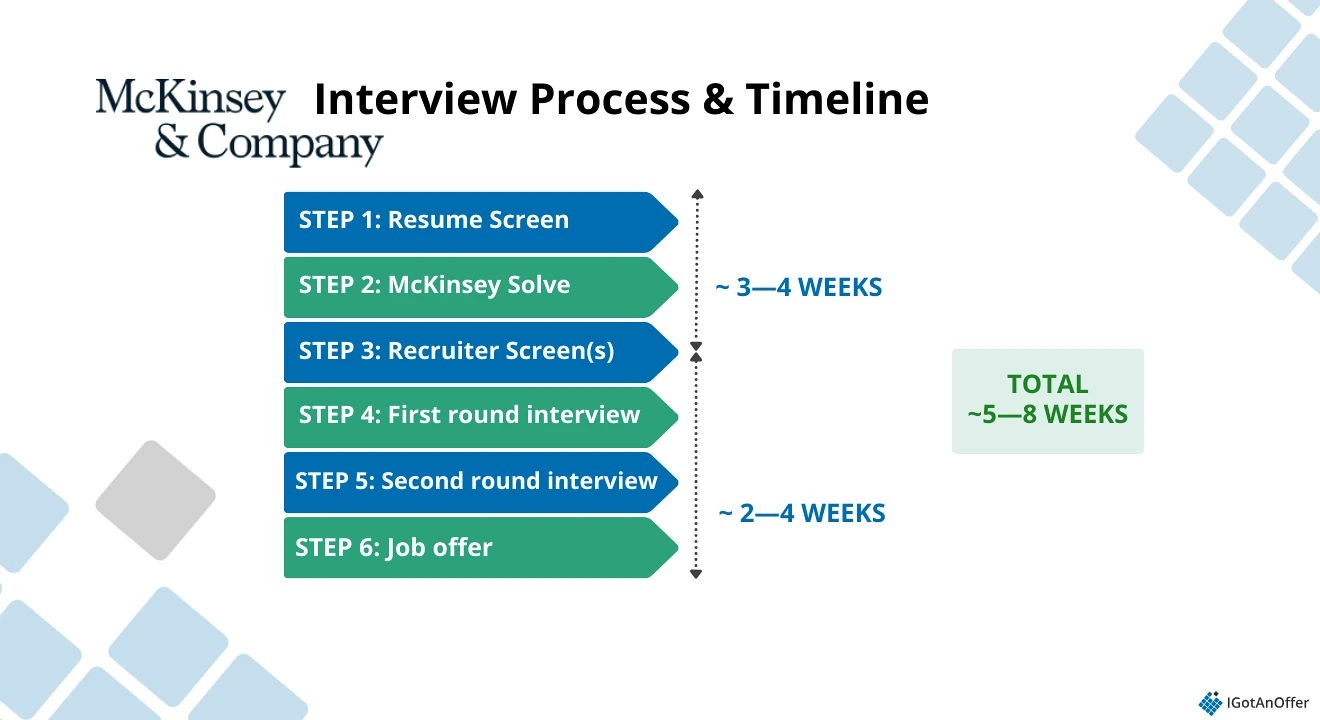
Now, let’s get into the actual McKinsey recruitment process. It typically has 6 steps and takes about 5 to 8 weeks, sometimes even longer.
Here are the steps you can expect:
- Step 1: Resume screen
- Step 2: Solve (McKinsey’s Problem-Solving Game)
- Step 3: Recruiter/video screen
- Step 4: First-round interviews
- Step 5: Second-round interviews
- Step 6: Job offer
Let’s walk through each step.
2.1 Resume screen↑
This is the first step in the application process. In a resume screen, Jenny (ex-McKinsey engagement manager) says recruiters are checking for pedigree, leadership, and academic excellence.
There are several ways to get your resume through to McKinsey:
#Official job portal
McKinsey posts its job openings via its official careers website. There, you can find their latest job openings and apply for a specific role you want.
As expected, McKinsey receives thousands of applications at a time. So you’d need to have an outstanding resume to get noticed.
If you’ve got an existing resume, get tips and insights on how to polish it with our consulting resume guide. Or, better yet, book an expert resume review session with one of our ex-MBB recruiters.
#Networking
Arguably, the best way to stand out from the crowd of resumes is through personal connections with McKinsey partners and managers.
If you have opportunities to network with McKinsey people, then that's a great chance for you to make a positive first impression. Click here to learn more about networking to get an interview.
#On-campus recruiting
If you’re about to graduate and looking into consulting, watch out for on-campus recruitment opportunities.
Below is a list of McKinsey feeder schools based on the most recent survey of employees in this Poets & Quants article:
- University of Toronto
- University of Michigan
- Northwestern University
- Harvard University
- Dartmouth College
- Georgia Institute of Technology
- University of Pennsylvania
- Duke University
- Brigham Young University
- Rice University
- The University of Sydney
- University of Chicago
- Stanford University
- Cornell University
If a recruiter finds you a potential good fit for McKinsey, you’ll be sent to the next stage, which is an online assessment.
2.2 Solve (McKinsey Problem Solving Game)↑
Solve is McKinsey’s gamified online assessment. The firm uses it to evaluate candidates early in the application process, assessing problem-solving, analytical, and critical thinking skills.
Some of its former names include the Problem Solving Game (PSG), the Imbellus test, or simply McKinsey’s Digital Assessment game.
McKinsey says that no specific preparation is needed for this digital assessment. However, in our experience, you can (and should) prepare for the test.
Check out our guide to the McKinsey Solve to learn more about this unique online assessment. If you want a more immersive way to practice the game (and have the budget for it), we highly recommend investing in the McKinsey Solve game simulation course by PSG Secrets.
If you manage to clear this round, a recruiter may contact you for another screening.
2.3 Recruiter/video screen↑
This screening, which may take the form of a phone call or a video call, is just another confirmation step for the recruiter. In this stage, you might get resume and motivational fit questions.
The recruiter will also detail the next steps of the interview process. This is your chance to ask any questions you might have about the rest of the interview and about working at McKinsey in general.
2.4 First-round interview↑
The first round of interviews will consist of 2 to 3 interview sessions. Each session will last for 45-60 minutes and will consist of personal experience interview (PEI) questions and problem-solving questions or case interviews.
2.4.1 PEI interviews
For PEI, it’s best to familiarize yourself with McKinsey’s 4 themes. Their questions will mostly revolve around these 4, so it’s best to prepare 2 to 3 stories for each theme.
Let’s look at how McKinsey defines each theme and their sample questions for each:
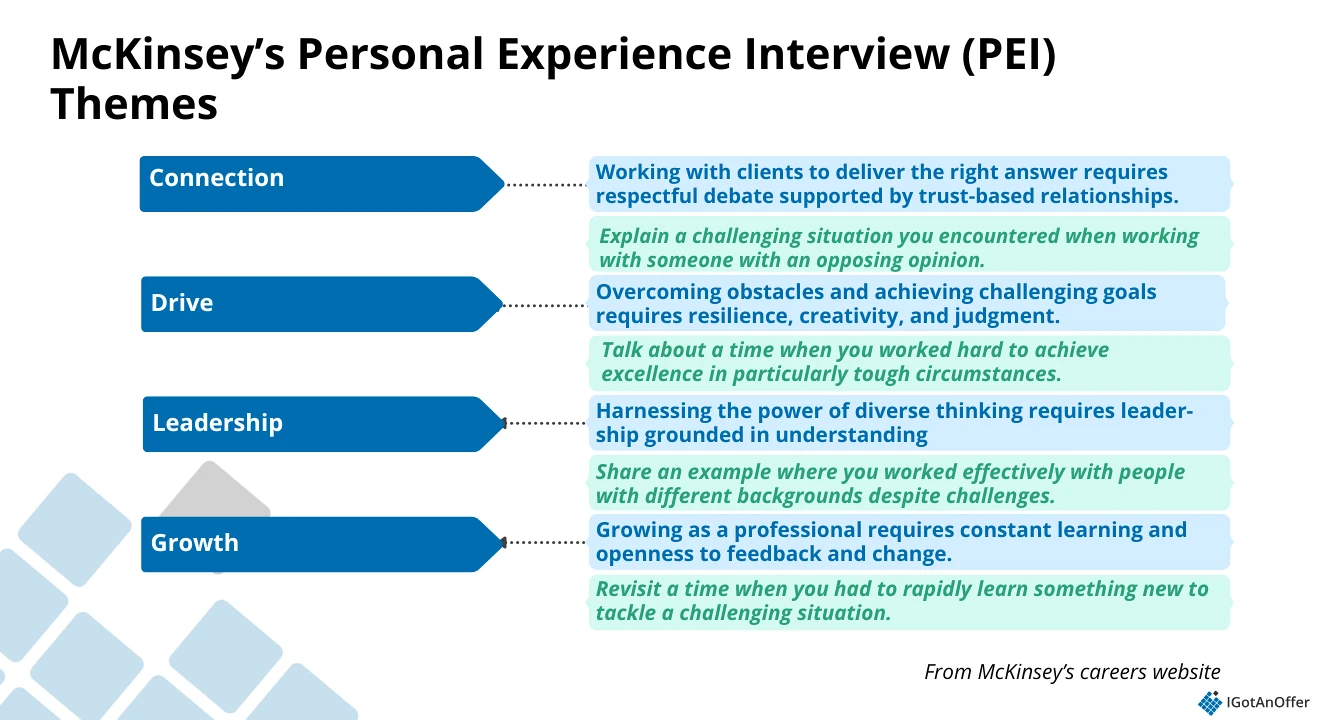
- Connection. Working with our clients to deliver the right answer requires respectful debate supported by trust-based relationships. Sample question: Explain a challenging situation you encountered when working with someone with an opposing opinion.
- Drive. Overcoming obstacles and achieving challenging goals requires resilience, creativity, and judgment. Sample question: Talk about a time when you worked hard to achieve excellence in particularly tough circumstances.
- Leadership. Harnessing the power of diverse thinking requires leadership grounded in understanding, empowering, and motivating people to be at their best. Sample question: Share an example where you worked effectively with people with different backgrounds despite challenges.
- Growth. Growing as a professional requires constant learning and openness to feedback and change. Sample question: Revisit a time when you had to rapidly learn something new to tackle a challenging situation.
Though ‘ownership’ isn’t a specified theme, Bilal (ex-McKinsey management consultant) notes that there’s a particularly high bar for this competency in McKinsey. Our advice is to try to incorporate how you demonstrate this trait alongside the other themes.
Check out our guide to McKinsey PEI to learn more about how you can best prepare for this interview.
2.4.2 Problem-solving (case interviews)
The second kind of interview you’ll face during your first round is a problem-solving interview, better known as a case interview.
According to Jenny, case interviews at McKinsey are interviewer-led to ensure all required test areas are covered and less left to chance, compared to interviewee-led interviews.
“The interviewee could lead the case down a different direction and not be able to demonstrate the skills needed for the role,” she says.
These skills or core competencies are the following:
- Structured problem-solving. Can you break down a problem into MECE parts and drive the case forward?
- Numerical intuition. Are you comfortable with approximations, ratios, and sanity checks?
- Business intuition. Can you figure out business models?
- Communication skills. Can you do top-down communication?
- Coachability. How do you respond when the interviewer steers you in a different direction during a case?
Check out our guide to McKinsey case interviews to learn more about how you can best prepare for this interview.
2.5 Second-round interview↑
The second round of interviews is similar in format to the first round of interviews. The biggest difference is that the interviews will be given by Partners and Senior Partners. This means you might get more spontaneous questions compared to the first round.
The only way to prepare for spontaneous questions is to broaden the range of your case interview knowledge and prepare for different types of case interviews, which include:
- Profitability cases
- Market entry cases
- Merger & acquisition cases
- Pricing cases
- Market sizing cases
- Operations cases
Additional interviews at McKinsey
Depending on the role, you might get one of these interview rounds at McKinsey:
Expertise interview
If you’re an experienced hire or interviewing for a technical role, you might get an interview testing your expertise.
This interview may involve coding challenges, problem-solving tasks, or other role-specific exercises. The goal of the interview is to evaluate whether you meet the level of proficiency required in the role you’re applying for.
Experience Day
Interviews for certain internal roles (e.g., business analysts) will involve an Experience Day, which can happen virtually or at one of the McKinsey Global Services offices. Depending on the role, you might undergo a role simulation, a group exercise (like a group case interview), or a series of interviews where you can also ask about the role and the firm itself.
2.6 Get a job offer↑
Finally, once you’ve passed each of the five steps above, you’ll receive your offer package from McKinsey.
Do note that McKinsey offers a standard base salary and leaves very little room for negotiation, unless you’re an experienced hire.
To increase your chances of getting that coveted McKinsey job offer, you’ll need to boost your interviewing skills. Here are a few tips to keep in mind, with insights from our ex-McKinsey consulting experts, Jenny and Bilal:
McKinsey Interview Tips
1. Don’t memorize your answers
“Memorizing your answers makes you sound robotic,” Jenny says. It also prevents you from properly adapting your answers to your interviewer’s questions.
The only way to achieve a structured yet conversational way of answering is through practice. Practice will also make you feel more confident, allowing you to be a lot more present and ready for any curveball questions.
Being present during an interview is important. You want to be able to read the room, Jenny says, so you’d know where to lengthen, shorten, or pause at certain parts of your stories.
2. Adapt your framework to your answer, not the other way around
According to Jenny, many candidates force-fit a previously seen case framework to an answer, so much so that the logic is no longer coherent.
To avoid this, familiarize yourself with common case frameworks but see them as building blocks for creating your own consulting framework. Here’s IGotAnOffer’s method for creating custom frameworks:
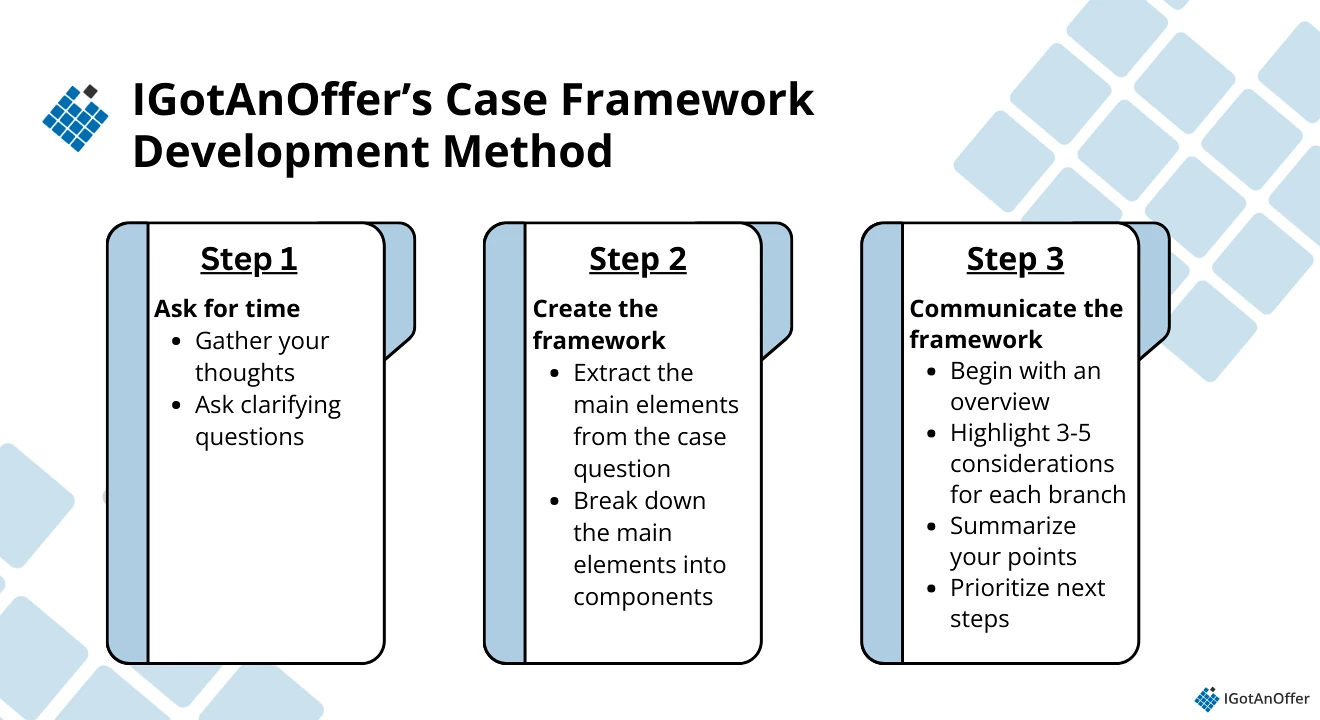
IGotAnOffer’s Framework Development Method
Step 1: Ask for time to gather your thoughts
Step 2: Create the framework
- Extract the main elements from the case question
- Break down the main elements into components
Step 3: Communicate the framework
- Spin your paper around
- Begin with an overview
- Highlight 3-5 considerations for each branch
- Summarize your points
- Prioritize next steps
Check out our guide to common case frameworks, where you'll find an example of how to use this framework development method.
3. Make sure you understand the question
Before jumping to problem-solving mode, make sure you understand the question. Spend a few seconds asking clarifying questions.
And this is important: if you’re unsure about a topic, don’t hesitate to own up to your knowledge gap. Ask questions until you fully understand enough to solve the problem.
4. Don’t jump straight into the math
Bilal says that jumping straight into the math is a common mistake candidates make during case interviews. This will make you appear unstructured.
So, to avoid this mistake, make sure you structure the formula out loud for your interviewer before doing your calculations. Remember, they’re assessing your communication and problem-solving skills, not just your math skills.
Having an in-depth understanding of the business terms below and their corresponding formulas is NOT required to get offers at McKinsey and other firms. But having a rough idea of what they are can be handy. Click here to learn more about case interview math.
5. Always go back to the objective of the case
Another common mistake candidates make, according to Bilal, is losing track of the objective of the case.
Writing the premise of the case at the beginning is a practical way to remind yourself of your case objective. And, always incorporate a summary of the points at the end of every answer, so tying everything together becomes a habit.
Are you prepared for your McKinsey interview?
We've coached more than 20,000 people for interviews since 2018. In our experience, practicing real interviews with experts who can give you company-specific feedback makes a huge difference.
Find a McKinsey interview coach so you can:
- Test yourself under real interview conditions
- Get accurate feedback from a real expert
- Build your confidence
- Get company-specific insights
- Learn how to tell the right stories, better.
- Save time by focusing your preparation
Landing a job at a top consulting company often results in a $50,000 per year or more increase in total compensation. In our experience, three or four coaching sessions worth ~$500 will make a significant difference in your ability to land the job. That’s an ROI of 100x!

 Management consultant
 Case
Case