Back to other articles


 Last updated: November 01, 2026


 Interviews
 Software engineer
 Deeply researched
Software engineer interviews at Stripe are really challenging. The questions are practical, specific to Stripe, and cover a wide range of topics.
The good news is that the right preparation can make a big difference and can help you land the job at Stripe. We wrote this ultimate guide to help you maximize your chances of success.
This guide covers the interview process for all software engineer roles at Stripe, so regardless of which role you’re targeting, you should find the information you need below.
To put it together, we reviewed recent accounts from candidates on Glassdoor, Blind, and Levels.fyi. We also spoke to Eli, an ex-Stripe senior software engineer who has interviewed 300+ candidates at Stripe and AWS, and Suman, an engineering leader at Stripe who has interviewed 250+ engineers over his career.
Here's an overview of what we'll cover:
- Role and salary
- Interview process and timeline
- Example interview questions
- Interviewing tips
- Preparation plan
Note that we have separate guides for the Stripe interview process, Stripe engineering manager interviews, and Stripe product manager interviews, so take a look at those if they are more relevant to you.
Click here to book a 1-on-1 session with an ex-Stripe interviewer.
Let's get into it!
1. Stripe software engineer role and salary ↑
Before we get into the interview process and questions, let's cover some basics about the role you're applying for.
1.1 What does a Stripe software engineer do? ↑
A Stripe software engineer builds the products businesses use to accept payments and manage money online. In 2025, more than 5 million businesses used them, generating $1.9 trillion in total volume.
Many of those businesses connect to Stripe through its API. In the onsite integration round, you’ll do what their developers do and write working code from API documentation.
1.2 How much does a Stripe software engineer make? ↑
Stripe's competitive pay is among the many factors that draw strong engineers to the company.
Below are the average salaries and compensation for the different software engineer levels at Stripe in the US. This is based on the reported data from Levels.fyi, as of October 2026.
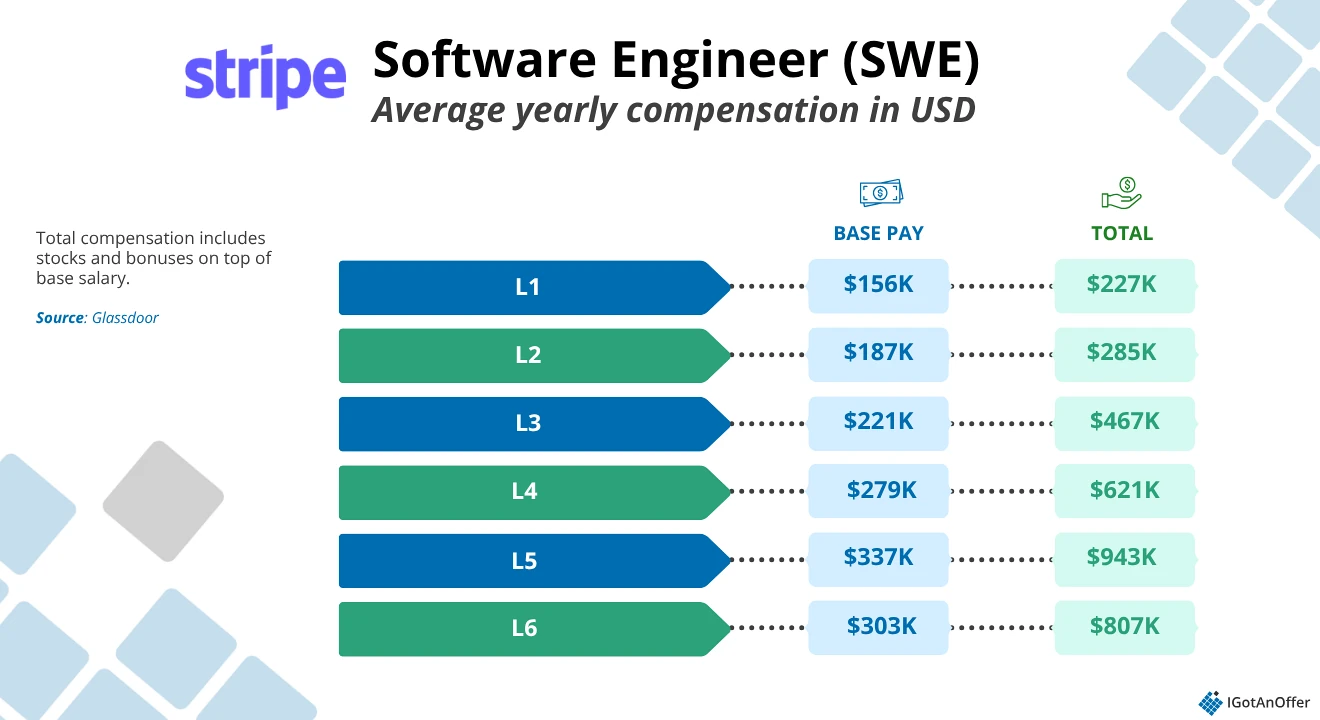
Ultimately, how you do in your interviews will help determine what you'll be offered. That’s why hiring one of our ex-Stripe interview coaches can provide such a significant return on investment.
And remember, compensation packages are always negotiable, even at Stripe. So, if you do get an offer, don’t be afraid to ask for more. If you need help negotiating, consider booking one of our salary negotiation coaches to get expert advice.
Coaches who contributed to this guide





2. Stripe software engineer interview process and timeline ↑
What's the interview process and timeline at Stripe for software engineers?
Stripe's software engineer interview process typically takes two to eight weeks and follows these steps:
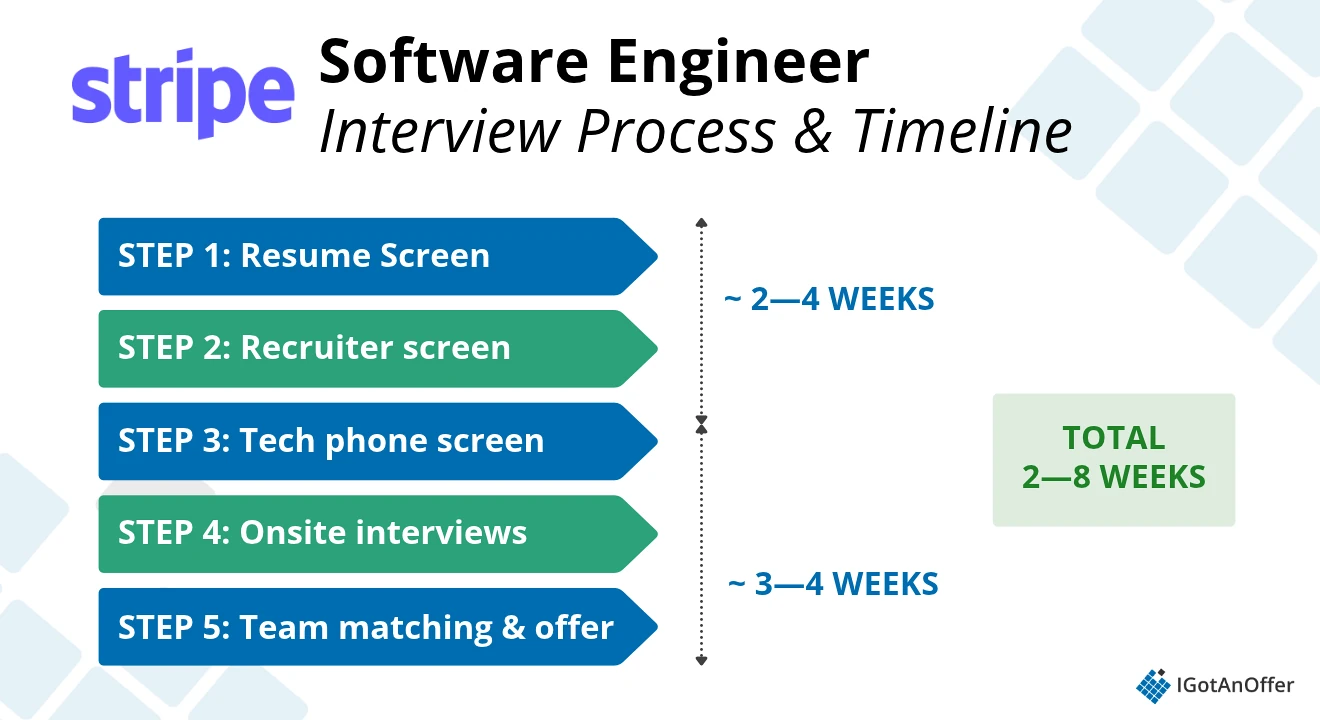
- Resume screen
- Recruiter call
- Technical phone screen
- Onsite interviews: five rounds
- Team matching and offer
The order of the online assessment and recruiter call can vary. Some candidates receive the assessment link before speaking with anyone at Stripe.
Let's take a look at each step.
2.1 Resume screen ↑
First, recruiters will review your resume and assess whether your experience matches the open position. This is the most competitive step in the process. Most candidates do not make it past this stage.
You can use this software engineer resume guide and this senior software engineer resume guide to help tailor your resume to the position you're targeting.
And if you're looking for expert feedback, you can also get input from our resume experts, who will cover what achievements to focus on (or ignore), how to fine-tune your bullet points, and more.
2.2 Recruiter screen ↑
If you pass the resume screen, you'll likely get a call from a recruiter. They'll brief you on the role and the interview process, including how many screenings to expect and what topics to prepare for. They'll also likely ask a few behavioral and resume questions, so be ready to answer such questions.
You'll also be asked to pick a programming language for your technical rounds. Choose carefully, since the onsite repositories are prepared in that language, and you'll need to make API calls and parse JSON quickly in it. We cover this in more detail in Section 3.3.
Note: Some candidates get a 60-minute HackerRank online assessment before the phone screen.
2.3 Technical phone screen ↑
The technical phone screen is also called the team screen. It’s a 45- to 60-minute live coding session with a Stripe engineer, usually in CoderPad or your own IDE. You’ll be given one practical problem in several stages of increasing difficulty.
These problems usually involve parsing strings, running calculations on transaction data such as shipping costs or currency conversions, or building a small system that you extend as new requirements come in. Advanced algorithms rarely come up.
Interviewers look for readable code with tests. They also expect you to move quickly, since each stage depends on the one before it.
Stripe doesn’t say how many stages you need to finish. If you run out of time during the interview, explain how you’d solve the rest of the problem. A Blind user who finished three of four stages and described a plan for the last one still moved on to the onsite.
2.4 Onsite interviews ↑
If you pass the phone screen, you've made it to the real test: the "onsite" interviews. These are usually held remotely.
You'll typically do 5 interviews in total, consisting of:
- Coding interview, also called the programming exercise
- Bug bash interview, also called the bug squash
- Integration interview
- System design interview
- Behavioral interview, usually with the hiring manager
Some loops now include an AI-assisted coding round, where you can use an AI tool as you code. Your recruiter will confirm which rounds apply to you.
We'll dig deeper into each round in Section 3.
2.5 Team matching and offer ↑
At Stripe, you typically interview for the company first and match with a team after the onsite. Reference checks can come before or alongside this stage too. You’ll receive your offer once you've matched with a team.
Note that matching can take a few weeks. While you wait, ask your recruiter which teams are hiring, and check in once a week. If you’re rejected, you’ll typically need to wait six months before reapplying, according to candidates on Blind.
3. Stripe software engineer example interview questions ↑
We base our question lists on real candidate data, so we've analyzed Glassdoor and Blind reports to identify the questions you're likely to be asked in your Stripe SWE interviews. Based on our analysis, questions typically fall into five categories:
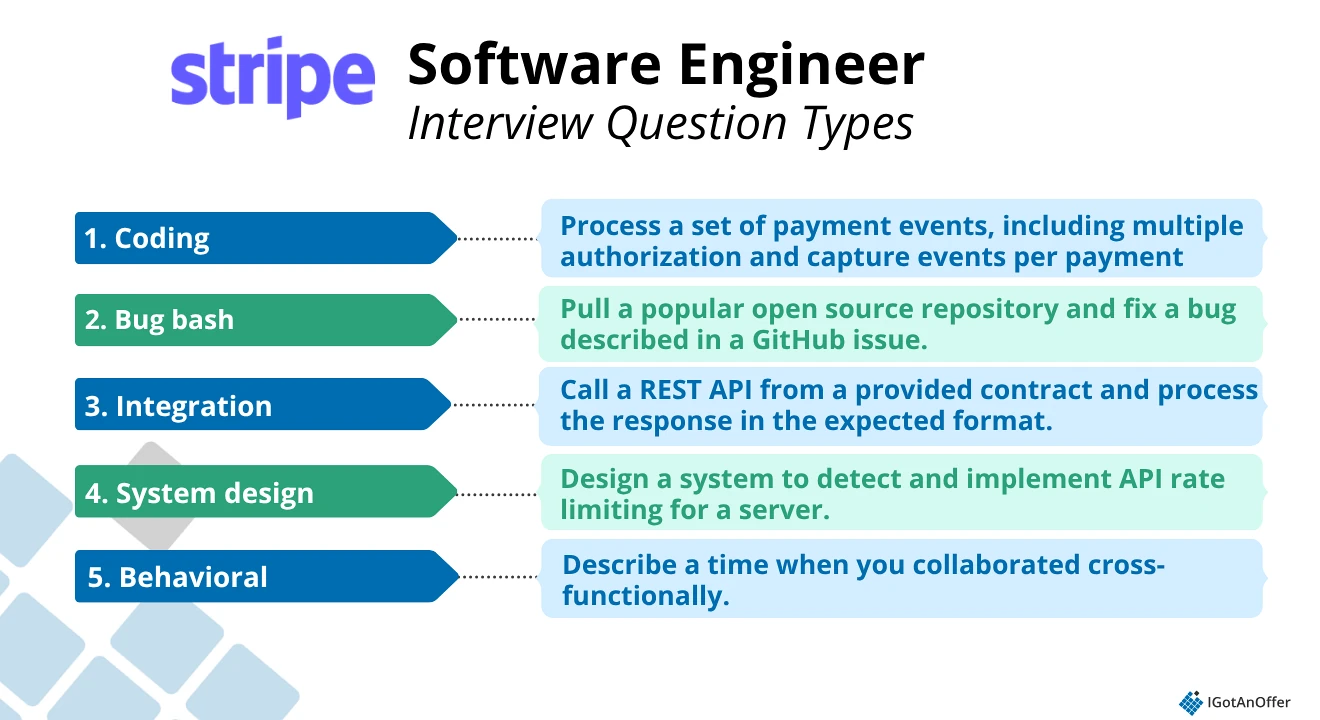
Let's take a closer look at each question type.
3.1 Coding ↑
Stripe software engineers turn messy business rules, such as fees and currencies, into reliable, production-ready code.
You’ll get the same kind of multipart problem you saw in the OA and phone screen, usually a longer one. The prompt can run to several paragraphs, so your first job is working out what it’s actually asking. Then you build a working version and extend it as new requirements come in.
You can expect these coding questions throughout the interview process, including the online assessment, the phone screen, and the onsite interviews.
In addition to practicing a wide variety of practical problems, Eli (ex-Stripe Sr. SWE) and Suman (Stripe engineering leader) share the following tips for cracking Stripe's coding questions:
- Clarify the requirements and explore the constraints before you start writing code
- Discuss the trade-offs of your approach before you commit to it
- Treat the interviewer like a colleague you're working through a technical issue with
- Go past the basic scenarios: find the complex ones and test your code thoroughly against them
Based on our analysis of Stripe software engineer questions reported on Glassdoor, here are examples of coding questions asked at Stripe.
Stripe software interview example questions: Coding
- Process a set of payment events, including multiple authorization and capture events per payment, and return a summary of each payment’s state (Solutions to a similar problem)
- Given a stream of Stripe checkout session events, identify sessions abandoned at each step of the checkout flow and calculate conversion rates
- Given an order and a table of shipping costs, calculate the total shipping cost. Then extend your solution to handle tiered shipping costs (Solutions to a similar problem)
- Build a custom tariff calculator based on a user’s transaction and region
- Process data from CSV and JSON files and validate it
- Build the data structures and logic for a server load balancer that assigns client connections and reassigns them when a server shuts down (Solutions to a similar problem)
Read our coding interview prep guide to learn more about how to approach these questions. We also recommend practicing with this list of 47 coding interview examples in addition to those listed above.
3.2 Bug bash ↑
The bug bash is Stripe's debugging round. It’s one of the rounds that sets Stripe's loop apart from other companies, according to Suman.
The task here is often to fix failing units in a GitHub repository and find the cause. One candidate mentioned the interviewer telling them that a full fix wasn’t required.
Suman notes that many candidates struggle here. "A lot of candidate[s] fumble during [the] debugging round, due to lack of depth or attention to detail," he says.
Here are examples reported by Stripe software engineer candidates:
Stripe software interview example questions: Bug bash
- Pull a popular open source repository and fix a bug described in a GitHub issue.
- Debug a serialization or deserialization issue in a Java JSON library (Java track).
3.3 Integration ↑
In the integration round, you get a repository in your chosen language and the documentation for an API, sometimes the Stripe API itself. You build a feature that calls the API. It's exactly how Stripe’s users work when they add Stripe to their products.
Since you’ll be making HTTP calls and parsing JSON, your choice of language is important.
Stripe software interview example questions: Integration
- Integrate an API into a given repository.
- Call a REST API from a provided contract and process the response in the expected format.
- Integrate an external library into an existing project.
- Given two branches in a Git repository, find the files that differ between them using public libraries.
For a structured way to approach multipart implementation problems, see our guide to how to answer coding interview questions.
3.4 System design ↑
System design is part of the loop for most mid- and senior-level candidates. You'll either design a service from scratch, or you'll get a simplified diagram of an architecture modeled on Stripe's and be asked to build a component that works with existing services.
Here are examples reported by Stripe software engineer candidates:
Stripe software interview example questions: System design
- Design a system to detect and implement API rate limiting for a server.
- Design a system for delivering webhooks to customers.
- Design a scalable system for processing payments in real time that ensures idempotency and prevents duplicate charges.
- Given a high-level diagram of a system modeled on Stripe, design one of its subsystems.
- Design a metrics logging system, front end and back end.
- Design a system to keep a running balance of payments for each vendor.
- Build a system to send out invoice notifications.
For a detailed breakdown of how to approach this round, see our system design interview guide and our guide to how to answer system design questions.
3.5 Behavioral ↑
The behavioral round is usually led by the hiring manager. It covers your past projects, how you work with other people, and why you want to join Stripe.
Your answers are judged against Stripe’s six operating principles:
- Users first
- Create with craft and beauty
- Move with urgency and focus
- Collaborate egolessly
- Obsess over talent
- Stay curious
Prepare one story from your own work for each principle. For “users first,” for example, you could describe a time you changed a technical decision after hearing from the people who used your work.
Specific questions from SWE behavioral rounds are rarely reported on Glassdoor, so we've supplemented the list below with questions from Stripe engineering manager loops, labeled in parentheses.
Stripe software interview example questions: Behavioral
- Tell me about yourself.
- Why Stripe?
- What do you know about Stripe?
- Walk me through a recent project you worked on.
- Describe a time when you collaborated cross-functionally.
- Tell me about a difficult technical decision you had to make. (Stripe EM)
- Give an example of a time you had to get stakeholder buy-in across the company. (Stripe EM)
For sample answers to the most common questions, see our software engineer behavioral questions guide. Also, see our behavioral interview questions guide, which covers our SPSIL answer framework and 40+ of the questions most asked in tech interviews.
4. Stripe software engineer interviewing tips ↑
You might be a great engineer, but that won't be enough on its own to get you through a Stripe interview. Interviewing is a skill in itself, one you need to learn and develop.
Stripe sets a high bar across every round. "Candidates should be exceptional in their craft, communication, and technology," says Suman. Let's look at some key tips to make sure you approach your interviews in the right way.
4.1 Clarify requirements before you code
Before you start coding, ask about the requirements and any edge cases the prompt doesn’t cover. Stripe’s problems come in stages, so a requirement you misread early may not surface until a later part, when fixing it can mean rewriting most of your code. “A common mistake is jumping straight into implementation without fully exploring the constraints or discussing tradeoffs,” says Eli.
In one recent Stripe assessment, a candidate had to summarize a list of payment events. In a problem like that, you’d want to know what happens if a capture arrives before its authorization, or if the same event appears twice. Confirm what your output should look like too, such as whether amounts are in dollars or cents.
4.2 Practice debugging unfamiliar code
Many candidates fumble the bug bash through “a lack of depth or attention to detail,” says Suman. Few engineers practice debugging on purpose, but you should.
A good way to practice is with a bug that’s already been fixed in an open-source library you use. Check out the code from before the fix and try to find the problem yourself with your debugger, saying out loud what you’re checking and why.
It’s slow the first few times, but reading stack traces and stepping through someone else’s code gets quicker with each bug you work through.
4.3 Don’t bluff
If you’re unfamiliar with something related to the question, say it. Don't pretend to know something you don’t and struggle through it to the end. The interviewer will see through this and dock points.
You can simply state, “I don’t know,” or you could say, “I’m not sure, but I believe that XYZ is the case.” Your interviewer will likely jump in to correct you if you’re wrong.
Alternatively, you can state what you are unfamiliar with and ask to look it up (e.g., “I think a priority queue is the appropriate solution here, but I’m unfamiliar with its library in C++. Could I look it up?”). Some interviewers will allow it, as it would help them understand how you would work to solve problems on the job.
4.4 Listen for subtle hints
You won’t always need to ask for hints if you catch the ones that interviewers are already giving you. If your interviewer tries to steer you in a direction, follow them. 99% of interviewers have good intentions, and they're trying to help you.
Pay attention to what they tell you, and don’t get so stressed that you don't pick up on what the interviewer is saying. If you talk through your answer, for example, you will give your interviewer more information and more chances to steer you in the direction they want you to go.
4.5 Communicate efficiently
During your technical interviews, you'll also be assessed on your communication skills and how you talk through the way you solve problems. Treat each technical interview as a conversation with a teammate.
In system design interviews, start by stating your assumptions to make sure you're aligned with your interviewer. And in behavioral interviews, set up your situation quickly before diving into your actions and results.
A great way to improve this skill is to familiarize yourself with answer frameworks, such as IGotAnOffer's SPSIL framework (Situation, Problem, Solution, Impact, Learning) for behavioral interviews, or the 4-step system design framework we recommend to candidates for tackling system design questions.
5. How to prepare for Stripe SWE interviews ↑
Now that you know what to expect, let's focus on how to prepare.
5.1 Learn more about Stripe
Most candidates fail to do this. But before investing tens of hours preparing for an interview at Stripe, you should take some time to make sure it's the right company for you.
Stripe is prestigious, so it's tempting to skip that step. But in our experience, prestige alone won't make you happy day to day. It's the type of work and the people you work with that will.
If you know engineers who work at Stripe or used to work there, it's a good idea to talk to them to understand what the culture is like. In addition, we would recommend reading the following:
- Stripe's operating principles (by Stripe)
- Stripe's 2025 annual letter (by Stripe)
- Stripe's API reference (by Stripe)
- Stripe's developer blog (by Stripe)
- Stripe interview process and timeline (by IGotAnOffer)
5.2 Practice by yourself
As we've outlined above, you'll have to prepare for a few different types of questions when preparing for Stripe software engineer interviews. In this article, we've recommended various deep-dive articles that will help you prepare for each question category.
Here's the complete list, plus a few other resources:
- Resources from Stripe:
- General prep: Stripe interview process and timeline
- Coding and bug bash:
- System design:
- Behavioral:
For more information on the process for other roles at Stripe, read our comprehensive interview guides below:
Once you're in command of the subject matter, you'll want to practice answering questions. But on your own, you can't simulate thinking on your feet or the pressure of performing in front of a stranger.
For that reason, many candidates try to practice with friends or peers.
5.3 Practice with peers
If you have friends or peers who can do mock interviews with you, that's an option worth trying. It's free, but be warned, you may come up against the following problems:
- It's hard to know if the feedback you get is accurate
- They're unlikely to have insider knowledge of interviews at your target company
- On peer platforms, people often waste your time by not showing up
For those reasons, many candidates skip peer mock interviews and go straight to mock interviews with an expert.
5.4 Practice with experienced Stripe interviewers
In our experience, practicing real interviews with experts who can give you company-specific feedback makes a huge difference.
Find a Stripe SWE interview coach so you can:
- Test yourself under real interview conditions
- Get accurate feedback from a real expert
- Build your confidence
- Get company-specific insights
- Learn how to tell the right stories, better
- Save time by focusing your preparation
Landing a job at a big tech company often results in a $50,000 per year or more increase in total compensation. In our experience, three or four coaching sessions worth ~$500 make a significant difference in your ability to land the job. That's an ROI of 100x!
Click here to book mock interviews with experienced Stripe ex-interviewers.











 Coding, System design