Back to other articles


 Last updated: October 22, 2026

 Interviews
 Software engineer
 System design
 Deeply researched
Netflix software engineer interviews can be nerve-racking. You need to show that you can build reliable software, communicate your thinking clearly, and work effectively with people in a way that aligns with Netflix’s culture.
You’ll be tested on coding, system design, and technical concepts. You’ll also get behavioral questions that explore your past experience and how you work with others.
In this guide, you'll learn what to expect in Netflix's software engineer interviews, based on candidate reports from Glassdoor and discussions on Reddit and Blind. We've also included sample questions, interview tips from ex-FAANG experts, and a preparation plan to help you get ready.
Here's an overview of what we'll cover:
Practice 1-on-1 with software engineer interview coaches
1. Netflix software engineer role and salary ↑
Before we cover your Netflix software engineer interviews, let’s first look at the role itself.
1.1 What does a Netflix software engineer do?
As a software engineer at Netflix, you’ll design and build software for its entertainment service.
Your exact responsibilities will depend on the team you join. For example, the Android team builds mobile features in Kotlin, while the Membership and Monetization Platform manages subscription plans, prices, and membership changes.
You will also help maintain the software once it’s in production. This can involve providing on-call support, investigating production failures, testing, and troubleshooting issues.
1.2 How much does a Netflix software engineer make?
According to Levels.fyi, $475K is the median annual total compensation for Netflix software engineers in the United States. The figures below show its average compensation breakdown for levels L3–L7, rounded to the nearest thousand dollars.
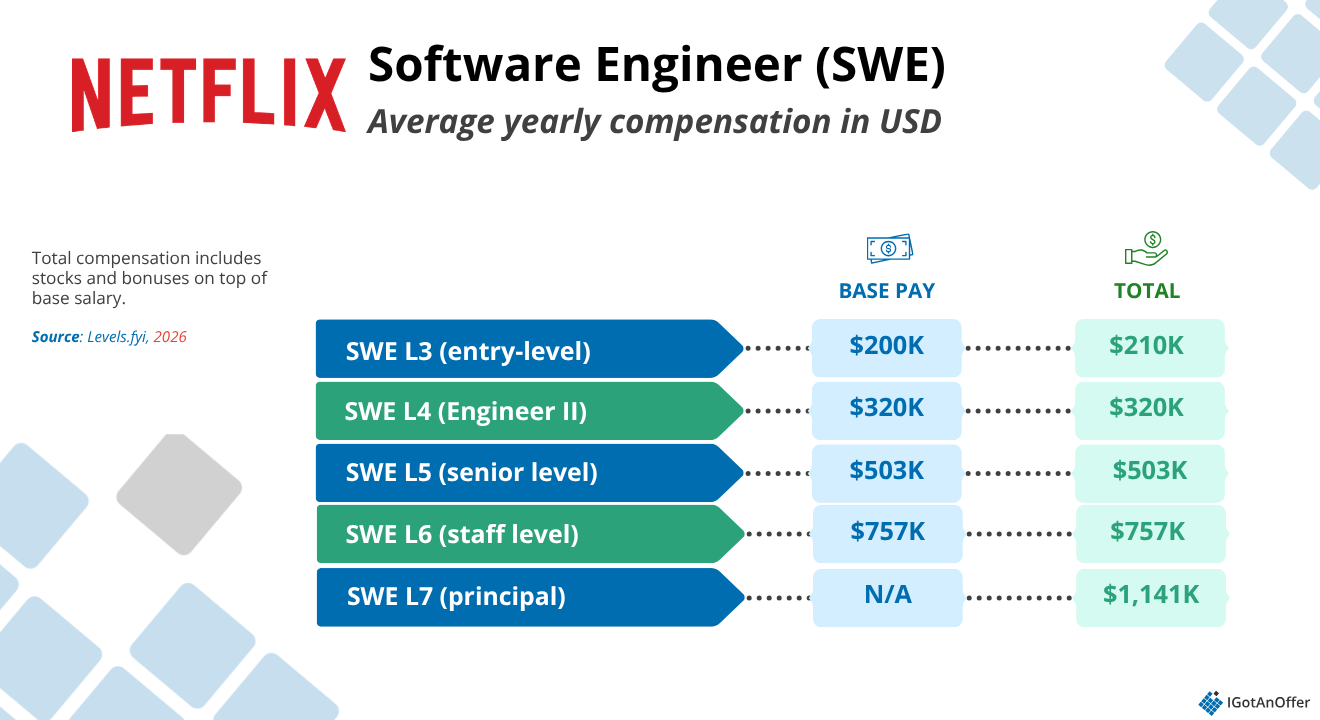
We presume you already know which level you're applying for, but it's worth double-checking with your recruiter, who can confirm which level you're being evaluated for.
It’s worth noting that Netflix’s stock option program lets you decide how to split your eligible compensation between salary and options. You can choose all cash, all options, or any mix that suits you. The options vest immediately, have a ten-year term, and stay with you if you leave Netflix.
Ultimately, how you do in your interviews will help determine whether you get an offer, which is why hiring one of our Netflix interview coaches can provide a significant return on investment.
If you do get an offer, ask your recruiter whether any part of the package is open to discussion. Consider booking one of our salary negotiation coaches to get expert advice.
Coaches who contributed to this guide







2. Netflix software engineer interview process ↑
The Netflix interview process typically takes 2–5 months, but it can be as short as 6–8 weeks. The timing depends on team urgency, interviewer availability, and the number of candidates being evaluated. You can ask your recruiter about the timeline for the team you’re applying to.
Here’s an overview of the stages:
- Resume screen
- Recruiter call
- Hiring manager screen
- Technical screen
- On-site interviews
- Hiring committee
- Salary negotiation
2.1 Resume screen ↑
The first step of Netflix's interview process is the resume screen. After you've submitted your application through the Netflix jobs portal or been contacted directly via email or LinkedIn, recruiters will evaluate your resume to see if your experience aligns with the open position.
This is a highly competitive step. To help you put together a targeted resume that stands out, follow the tips below:
Tips on crafting a resume
- Simplify. Avoid overly creative layouts. A simple resume passes through applicant tracking systems and reads quickly for recruiters and hiring managers.
- Verbalize. Start each bullet point under your previous roles with an action word.
- Quantify. Add numbers wherever you can, e.g., latency reductions, improvements in reliability, or the number of users your feature serves.
- Summarize. Include a skills section with keywords pulled directly from the job posting.
For more guidance on how to craft your resume, check out our tech resume guide. If you’d like personalized feedback, you can also book a resume review session with an expert who can help you identify areas for improvement.
2.2 Recruiter call ↑
If your resume passes the screen, a Netflix recruiter will usually reach out to schedule an initial 20-30-minute call. For some senior and staff roles, Christine, an ex-FAANG SWE who has coached Netflix candidates, says the hiring manager may conduct this initial screen instead.
Either way, the recruiter will send you Netflix's culture memo before your conversation. Read it carefully because this call focuses heavily on assessing cultural fit. Take note that Netflix is big on culture, and the recruiter call is where that evaluation begins.
The recruiter will also ask if you have any questions. Use this opportunity to clarify anything that wasn’t covered in the job posting, such as whether the interview process includes a coding interview, a take-home task, or both.
You can also ask, "What does success look like in the first 6-12 months for this role?" or “What's the biggest challenge the team is facing right now?” Their answers can help you understand the work you would take on and choose relevant examples to discuss in later interviews.
After a successful recruiter call, you’ll usually move on to the hiring manager screen. If you’ve already spoken with the hiring manager, your recruiter should let you know which stage comes next.
For an insider look into how to crack Netflix culture interviews, check out this video with ex-Netflix lead product manager and coach, Michael P. Then, use our Netflix culture interview guide to prepare stories that demonstrate each of the values in Netflix's culture memo.
2.3 Hiring manager screen ↑
After the recruiter call, you'll have one or more screening interviews with a hiring manager or future peers. This typically consists of one 45-60 minute interview, though some roles may have two separate screens.
Christine explains that hiring managers have considerable control over the process for their team. Ask your recruiter which technical areas the hiring manager wants to focus on so you can choose relevant projects to discuss.
Your interviewer’s goal here is twofold: to assess how you think and work in the context of the role you’re applying for. Expect questions about your technical background, decision-making process, and how you approach complex or ambiguous problems.
Specifically for a software engineer role, be ready to discuss one or two projects from your resume, including the architecture, alternatives you considered, and trade-offs you chose. Christine also says to be clear about the business reasoning behind your work: “Understand why you solve a problem, not just how.”
2.4 Technical screen ↑
You’ll typically be given a 45–60-minute live coding interview. This round assesses your coding skills, problem-solving approach, and technical fit for the role.
Christine says Netflix’s coding questions tend to be more practical and less LeetCode-style. Candidates also report algorithm questions, so be sure to include data structures and algorithms in your practice.
You may also receive a take-home coding exercise. For example, a candidate on Blind was asked to build a React app using an application programming interface (API). They were given three days to complete the assignment but asked to spend no more than four hours working on it.
2.5 On-site interviews ↑
The on-site interview loop is the most extensive stage of the Netflix process. It may take place in Netflix’s offices or via video call, with approximately eight interviews across two rounds:
Round 1: Deep-dive into skills and collaboration
This round typically consists of four or five 45–60-minute interviews with engineers from your prospective team, the hiring manager, and sometimes a recruiter or peer interviewer.
For SWE candidates, these interviews combine technical problems with discussions of past projects. You may need to design a system or explain an architectural decision, including the alternatives you considered. Behavioral questions explore how you work with others, handle setbacks, and give or receive feedback.
Round 2: Leadership, influence & organizational fit
You’ll typically meet a senior leader, an engineer or manager from another team, and another cross-functional leader. These conversations focus on how you make decisions and collaborate beyond your immediate team.
Expect questions about influencing a decision without formal authority, resolving conflicting priorities, and exercising judgment with incomplete information. You may also need to explain technical priorities to colleagues who are not engineers.
Across these two rounds, prepare for questions in these four areas:
Given how taxing these interviews are, your Netflix recruiter may offer to split your on-site over two days. We recommend taking this option if offered, or requesting it if not.
2.6 Hiring committee ↑
After the onsite interviews, your interview feedback will be reviewed by the hiring committee before a final decision is made. The review assesses your performance and your fit with Netflix culture.
Depending on the number of candidates still in process, this phase can take anywhere from a few days to several weeks.
If you don’t hear back after a couple of weeks, it’s perfectly fine to follow up with your recruiter for an update. Remember that response times depend on the team’s schedules, so please be patient, and use the waiting time to prepare for potential next steps.
2.7 Salary negotiation ↑
If you receive an offer, take some time to review it before you respond.
A full-stack candidate on Blind said that their offer was non-negotiable. If you receive an offer, ask your recruiter whether there’s room to negotiate and research the typical compensation for your level before making a decision.
Salary negotiation tips
- Be polite. Remember that the person you're negotiating with is just doing their job. You'll get much farther in your negotiations if you approach the conversation with grace.
- Don't give a number right away. Whenever possible, it's better to wait until you receive an offer to start negotiating. This reduces the risk of giving a number that is lower than what Netflix otherwise would have paid.
- Do your research. Have a number in mind before the conversation begins, and back it up with data. Research your position and level on Levels.fyi, ask around on professional networking sites like Blind, and factor in the cost of living where you are.
- Start high. If the offer is negotiable, ask for more than your target to leave room for discussion. Be prepared to explain how your experience and market data support the amount you’re asking for.
- Negotiate everything. Look at the complete offer, including the cash and stock options split, where you’ll be working, and the work arrangements. If the salary is fixed, ask your recruiter if there is any room to negotiate some of those other terms.
If you'd like help reviewing your offer and planning your negotiation, you can book a session with one of our salary negotiation coaches.
3. Netflix software engineer interview questions ↑
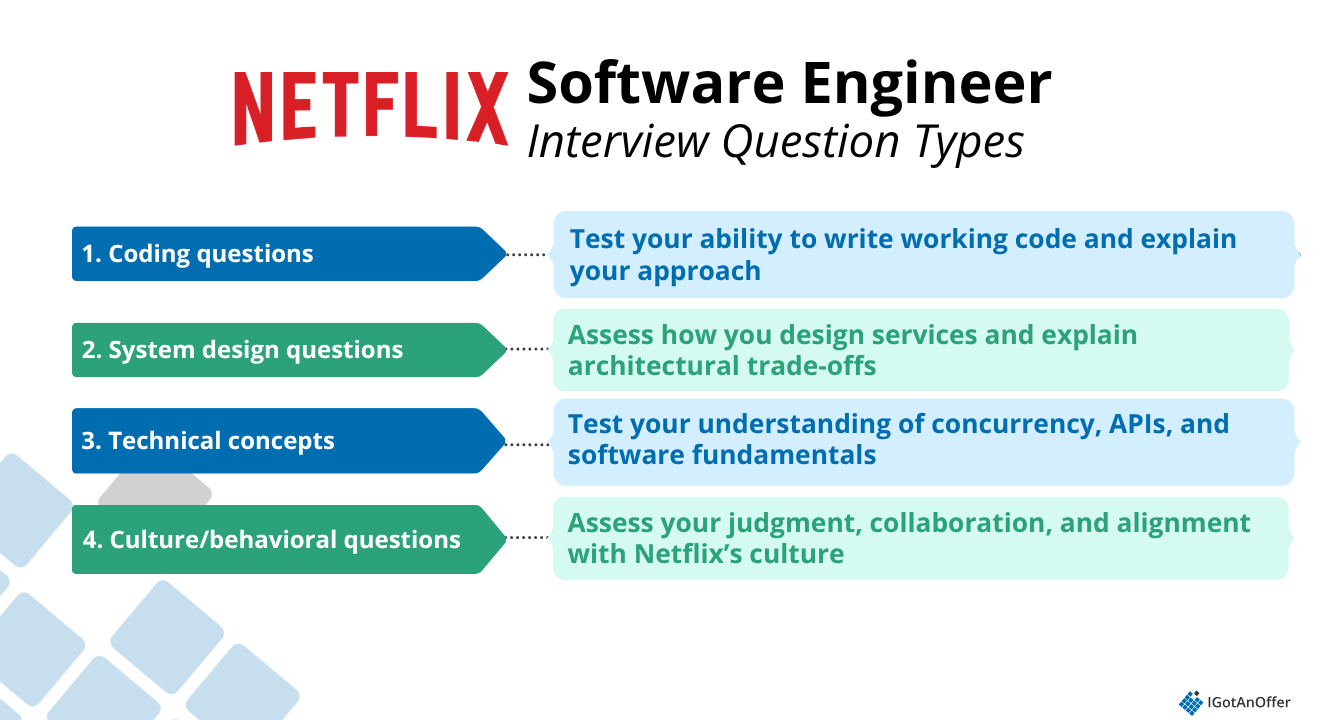
We’ve collected 30 practice questions from Netflix candidate reports and IGotAnOffer interview guides, including examples from Meta and OpenAI. Questions borrowed from other companies are labeled. We’ve grouped them into four categories:
3.1 Coding questions ↑
Netflix coding questions test your ability to turn a problem into working code and explain your approach. Expect practical implementation tasks as well as data structure and algorithm questions.
Reported topics include caching, rate limiting, log processing, arrays, graphs, and sorting. You should be able to choose suitable data structures and explain your solution’s time and space complexity.
Some problems develop through follow-up questions. A candidate on Reddit described a cache exercise that progressed from time-to-live expiration to least-recently-used eviction and concurrency. When practicing it, test what happens when an entry expires, or an existing key is updated.
Example Netflix software engineer interview questions: Coding questions
- Design a cache with time-to-live expiration. (Solution)
- Write code that limits how frequently requests are accepted. (Solution)
- Parse application logs to detect patterns in errors.
- Create a simple pipeline that processes streaming events in sequence.
- Return the intersection of two input arrays. (Meta) (Solution)
- Given a reference to a node in a connected, undirected graph, return a deep copy of the graph. (Meta) (Solution)
- How would you return the nodes’ values in a binary tree in level order, starting from the root? (Meta)
- How would you check whether the parentheses, square brackets, and braces in a string are correctly matched and nested? (Meta)
- Implement a function for changing directories. Given the current directory and a target path, return the absolute path. Support both the current-directory (.) and parent-directory (..) notation. Then add support for symbolic links from a dictionary. (OpenAI)
- How would you build a web crawler using multiple threads? Start with a given URL, avoid visiting any URL more than once, and handle failed page loads. (OpenAI)
For more practice questions, see our coding interview examples and Netflix interview questions guide.
3.2 System design questions ↑
Netflix system design questions ask you to plan how a service will work across multiple components. You’ll need to clarify its requirements, outline the architecture, and explain how your choices affect scale, reliability, and performance.
You could be asked to design a service such as a payment system or URL shortener, or a component such as a distributed counter. These are open-ended problems: for a counter, for example, whether every read needs an up-to-date total will affect how you coordinate updates across servers.
Be ready to explain those trade-offs rather than present one fixed design. Christine says you should be able to explain why you made each design decision, especially at senior level.
Example Netflix software engineer interview questions: System design questions
- Design a payment system.
- Design a distributed counter.
- How would you design a URL-shortening service?
- Propose an architecture for processing video uploads at large scale.
- Plan a notification service for a worldwide streaming product.
For a detailed breakdown of how to approach these questions, see our system design interview guide. If you're applying for a Staff-level role, you can also check out our Staff system design interview guide for advice on preparing at that level.
3.3 Technical concepts ↑
Technical concept questions test your understanding of core software engineering concepts and whether you can apply them to real-world problems. You may be asked to explain concepts such as concurrency, discuss their use cases, and identify potential challenges or trade-offs.
Example Netflix software engineer interview questions: Technical concepts
- What problems arise in multithreaded code with no locks, with locks, and with lock-free approaches?
- What are some use cases for concurrent systems?
- What is the difference between a software development kit (SDK) and an API, and when would you use each? (Explanation)
3.4 Culture/behavioral questions ↑
Behavioral questions explore how you’ve handled problems at work, worked with others, and responded to challenging situations.
Netflix places a strong emphasis on culture during its interviews. According to Michael (ex-Netflix lead product manager), interviewers compare your answers against Netflix’s culture and values.
“They’re literally taking notes against these words,” says Michael. So, expect questions that explore how your past experiences and behaviors align with Netflix’s culture.
Example Netflix software engineer interview questions: Culture/behavioral questions
- How did you adapt to a new team and gain the trust of its existing members?
- Why do you want to work at Netflix?
- What did you think of Netflix’s culture memo, and what stood out to you most?
- Recall an unexpected production issue and describe how it was resolved.
- Tell me about yourself and your education.
- Tell me about a time you disagreed with a teammate on a technical project.
- What is one thing you could improve?
- Discuss a complex engineering project and explain the trade-offs you chose.
- Describe a decision you made when some important information was unavailable.
- Give an example of challenging a product requirement.
- Describe receiving difficult feedback and how you acted on it.
- Describe taking responsibility for work beyond your assigned role.
For more help structuring your responses, see our Netflix culture and behavioral interview guide.
4. Netflix software engineer interviewing tips ↑
You might be a fantastic software engineer, but unfortunately, that won’t necessarily be enough to ace your interviews at Netflix. Interviewing is a skill in itself that you need to learn.
Let’s look at some key tips to make sure you approach your interviews in the right way.
4.1 Ask clarifying questions
Often, the questions you’ll get will be quite ambiguous. Make sure you ask questions that can help you clarify and understand the problem.
Be upfront if you encounter topics you have little experience with, but don’t give up on tackling them. Netflix isn’t just testing your technical skills but your ability to deal with problems you’re not familiar with.
4.2 Treat the interview like a conversation
Netflix wants to know if you have excellent communication skills. So make sure you approach the interview like a conversation.
Christine recommends treating the interview as if you were working with a coworker. Explain your choices, listen to their questions, and discuss the alternatives together.
Be sure to practice explaining technical decisions in a way that’s clear and easy for everyone to understand.
4.3 Think out loud
You need to walk your interviewer through your thought process before you actually start coding. Keep talking while coding so your interviewer can understand how you think.
Your interviewer may also give you hints about whether you’re on the right track or not. Be alert for these, and be ready to pivot once you’ve gotten the prompt. This shows you’re eager to learn and listen well to feedback.
4.4 State and check assumptions
You need to state assumptions explicitly, explain why you’re making them, and check with your interviewer to see if those assumptions are reasonable.
4.5 Present multiple possible solutions
Present multiple possible solutions if you can. Netflix wants to know your reasoning for choosing a certain solution.
For example, in the notification-service question in Section 3.2, you could compare sending messages as requests come in vs putting them in a queue. If there are too many requests to send at once, a queue lets the service work through the backlog. But some messages will have to wait. Would that delay be acceptable for this service? Explain your choice and what you’d do if a message failed to send.
4.6 Center on Netflix’s culture
Familiarize yourself with Netflix’s culture memo and align your responses with it.
For software engineering roles, Christine recommends preparing examples that demonstrate qualities such as judgment, ownership, and collaboration. Think of situations where you made an important technical decision, worked through ambiguity, or navigated a disagreement with a colleague.
Be ready to explain your reasoning, how you responded to other perspectives, and what ultimately influenced your decision.
4.7 Communicate efficiently using a clear structure
Clear and efficient communication matters as much as technical ability across every round. Using a framework can help keep your responses focused and give interviewers the signal they need without requiring them to extract it through follow-up questions.
You can use IGotAnOffer's SPSIL method (Situation, Problem, Solution, Impact, Learning) to structure your answers to behavioral questions.
It’s similar to STAR but fixes two common pitfalls candidates often face: (1) candidates often struggle to clearly distinguish between “task” and “action,” and (2) it includes a “learning” step, which STAR often overlooks, even though it’s one of the most important parts of your answer.
For technical rounds, state your assumptions before diving into a problem and summarize your approach before working through your solution. For a consistent answer method, see our coding interview framework and system design framework.
5. How to prepare for your Netflix SWE interview ↑
Now that you know what questions to expect, let's focus on how to prepare. Below is our four-step prep plan for Netflix SWE interviews.
If you're preparing for other companies as well, then check out our general coding interview prep guide.
5.1 Learn about Netflix's culture
Most candidates fail to do this. But before investing a ton of time preparing for an interview at Netflix, you should make sure it's actually the right company for you.
Netflix is prestigious, and so it's tempting to assume that you should apply without considering things more carefully. But it's important to remember that the prestige of a job by itself won't make you happy in your day-to-day work. It's the type of work and the people you work with that will.
If you know anyone who works at Netflix (or used to), it's a good idea to talk to them to understand what the culture is like.
We recommend checking out these resources to help you learn more about the company:
- Netflix’s culture memo
- Netflix’s work-life philosophy
- Sharing Our Latest Culture Memo (by Netflix)
- Netflix tech blog
- How Netflix Reinvented HR (Patty McCord, Harvard Business Review)
In addition, read Netflix’s latest annual report to understand its business priorities and risks. Look for issues related to your prospective team, then use them to prepare questions about its work. For example, if you’re applying to a video delivery team, you could ask how it balances playback quality with delivery costs:
- Netflix annual reports and proxies (by Netflix)
5.2 Practice by yourself
As we've outlined above, you will encounter four main question categories at Netflix: coding, system design, technical concepts, and culture/behavioral. The first step in your preparation should be to build a solid foundation in each area and practice answering questions independently.
Below are some useful resources to help you prepare for each question type.
For coding questions:
Practice writing and running code in the environment your recruiter recommends. Focus especially on data structures, object-oriented programming, concurrency, and debugging:
- Coding interview prep guide
- Coding interview examples
- Arrays interview questions
- Strings interview questions
- Linked lists interview questions
- Stacks and queues interview questions
- Trees interview questions
- Graphs interview questions
- Heaps interview questions
For system design questions:
For technical concepts:
Review concurrency and the differences between SDKs and APIs with these resources:
- Oracle’s Java concurrency tutorial (threads, synchronization, locks, and atomic variables)
- AWS: SDK vs. API (differences, use cases, and examples)
Try explaining the questions in Section 3.3 to a friend or colleague. If they can’t follow your answer, identify which parts are unclear and work on refining your explanation. You can use a short code sample for the concurrency questions, or a tool you’ve worked with for the SDK/API comparison.
For culture/behavioral questions:
- How to answer "Why Netflix?"
- Netflix culture and behavioral interview questions
- Common software engineer behavioral questions
A great complement to written practice is answering questions out loud. It sounds unusual, but it will significantly improve how you communicate under pressure during the real interview.
5.3 Practice with peers
If you have friends or colleagues who can do mock interviews with you, that is a worthwhile option to explore. The experience of performing in front of another person is genuinely useful and is free. That said, peer practice does have its limitations:
- It’s hard to know whether the feedback you receive is accurate.
- Your peers are unlikely to have any inside knowledge of Netflix's specific interview style.
- On peer platforms, people often waste your time by not showing up
For those reasons, many candidates move straight to practicing with an expert.
5.4 Practice with experienced Netflix interview coaches
In our experience, practicing real interviews with experts who can give you company-specific feedback makes a huge difference.
Find a Netflix SWE interview coach so you can:
- Test yourself under real interview conditions
- Get accurate feedback from a real expert
- Build your confidence
- Get company-specific insights
- Learn how to tell the right stories, better
- Save time by keeping your preparation focused
To put the cost in perspective, spending $500 on coaching would pay for itself 100 times over if it helped you secure an extra $50,000 in annual compensation.
Click here to book mock interviews with experienced Netflix interview coaches