Back to other articles
 Last updated: October 19, 2026


 Interviews
 Deeply researched
If you're lucky enough to get into the Anthropic AI Safety Fellows Program, it can be an incredible way to break into AI safety research. But to get in, you're going to have to dig deep and prepare tenaciously for the application and interview process.
The interview process is tough, but don't be intimidated. If you learn the proper techniques and prepare accordingly, you can set yourself apart from other applicants and (hopefully) get the offer.
This guide contains everything you need to kickstart your preparation for the Anthropic AI Safety Fellow interviews.
- Anthropic AI safety fellowship program overview
- Interview process and timeline
- Interview tips
- How to prepare
Click here to practice 1-on-1 with Anthropic interview coaches
1. Anthropic AI safety fellowship program overview ↑
The Anthropic Fellows Program is a paid research fellowship that funds engineers and researchers to work full-time on Anthropic's highest priority AI safety research questions.
It's highly competitive but is a great way to get into AI safety research right at the top of the industry.
1.1 About the program
The Anthropic Fellows Program lasts for four months and includes the following elements:
- Project selection and mentor matching with Anthropic researchers
- Full-time empirical research
- A public output, such as a paper submission
During the fellowship, safety fellows work on a research question tied to Anthropic's priorities. Anthropic mentors pitch project ideas, and each fellow chooses and shapes a project with their mentor, mostly using external infrastructure like open-source models and public APIs.
Anthropic announced the program as a pilot in late 2024, with a first cohort of 10 to 15 fellows. More than 200 fellows have taken part since early 2025, and the program now runs several workstreams. This guide focuses on the AI Safety Fellows workstream.
1.2 Who can apply?
You can apply if you're fluent in Python, can work full-time on the program for four months, and have the right to work in the US, UK, or Canada. You don't need a PhD, prior machine learning (ML) experience, or published papers. Past fellows have come from physics, mathematics, computer science, and cybersecurity backgrounds.
Anthropic originally designed the program to help experienced technical professionals move into AI safety research, though it accepts applications from people at any career stage.
In its program announcement, Anthropic says, "We care much more about your ability to execute on research than your credentials." It looks for candidates who code well, make progress on ambiguous problems, pick up new skills quickly, and want to work on reducing catastrophic risks from AI.
1.3 How to apply?
You fill out an application form run by Constellation, Anthropic’s recruiting partner for the program. The application involves:
- Choosing your workstreams
- Uploading your resume
- Answering written questions
Anthropic reviews applications on a rolling basis and runs several cohorts a year. This year, application deadlines have come roughly every three months (January, April, July, and October). Each cohort starts about three months after its deadline.
At the time of writing, candidates need to apply by October 18, 2026, to be considered for the January 2027 cohort.
1.4 What are the perks of the program?
The fellowship pays well and gives you resources that are hard to access outside a frontier AI lab. According to Anthropic's job posting and program announcement, fellows receive:
- Weekly stipend: 3,850 USD, 2,310 GBP, or 4,300 CAD per week for a 40-hour week, plus benefits that vary by country.
- Large research budget: $15,000 per month for compute and other research expenses.
- Direct mentorship: Potential mentors include alignment team leads Sam Bowman, Ethan Perez, and Samuel Marks, and AI control researcher Fabien Roger.
- Shared workspace: You can work alongside other fellows in Berkeley or London. Mentors visit these spaces regularly.
- Published research: Over 65% of fellows have published work from their fellowship.
- Possible route into Anthropic: Job offers aren’t guaranteed. Still, 25 to 50% of fellows in previous cohorts received a full-time offer.
If you’re moving into AI safety from another field, the fellowship itself is a strong addition to your resume. Fewer than 2% of applicants get in, and you leave with four months of hands-on safety research done under an Anthropic mentor.
2. Anthropic AI safety fellow interview process and questions ↑
The fellowship process starts with an early reference check. After that come two coding assessments, a research take-home, and a short final interview.
Here’s a quick overview of the stages:
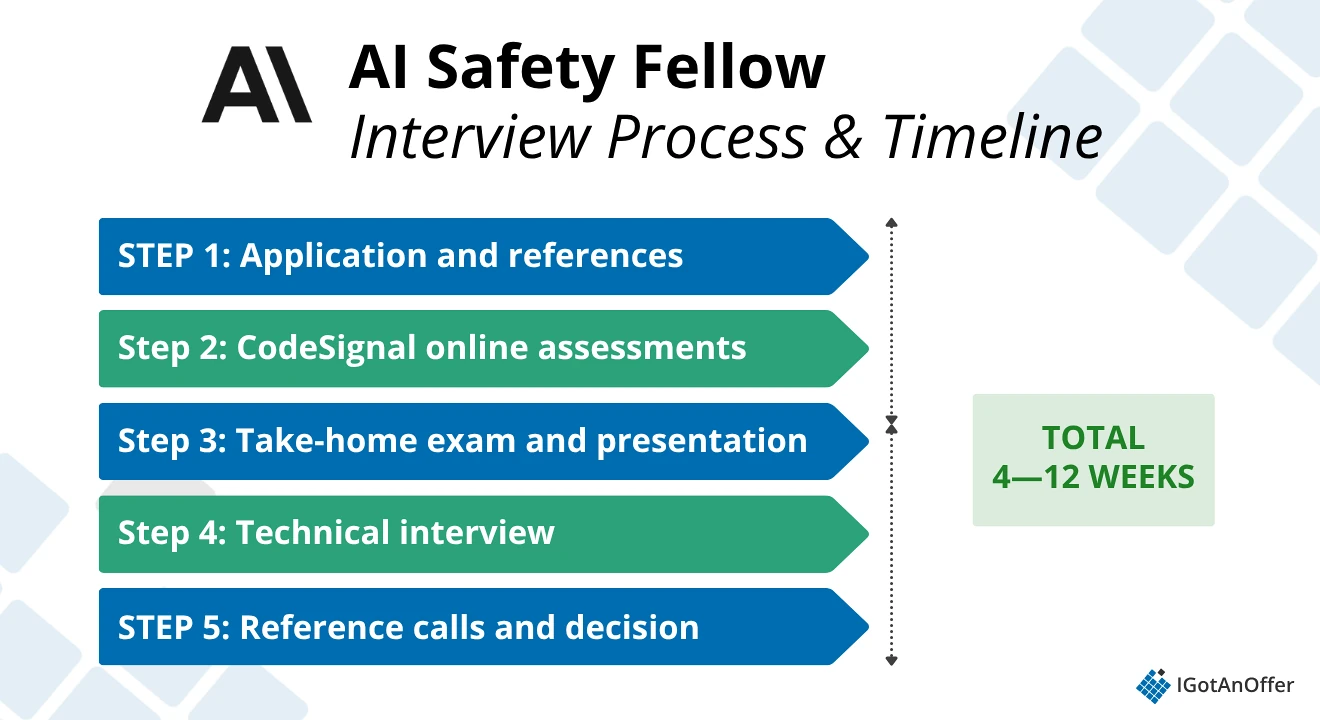
- Step 1: Application and references
- Step 2: Two CodeSignal online assessments
- Step 3: Take-home exam and recorded presentation
- Step 4: Technical interview
- Step 5: Reference calls and decision
Step 1: Application and references ↑
Anthropic asks for your references at the start of the process, before you take any tests.
You’ll typically name two references, and each will fill out a short form about you. Anthropic then looks at the application and references to decide who moves on to interviews.
The application also includes written questions. Here’s one you can expect, with a short sample answer based on our guide to answering “Why Anthropic?”.
Example Anthropic AI Safety Fellow interview question: Why are you interested in the program?
“I’m interested for two reasons. The first is the research. Reading Scaling Monosemanticity, Anthropic’s work on pulling interpretable features out of Claude 3 Sonnet, changed how I think about safety. Most of the work I’d seen tried to control model behavior from the outside. The research showed a serious attempt to understand what’s happening inside. That’s the kind of approach to the problem that I want to pursue if given the chance.
The second is the structure the program can provide. As a backend engineer, I have been replicating small interpretability experiments on open models in my spare time. What I’m missing is mentorship and compute. Four months with an Anthropic researcher would let me work on a real question. A published paper at the end would also give me a track record I can point to when I apply for AI research roles.”
Keep your answer specific to the fellowship. Name the research that drew you in and explain what you’d bring to it.
Step 2: CodeSignal online assessment ↑
If your application stands out, you’ll take two online CodeSignal assessments. Earlier cohorts took a single CodeSignal test with one problem split into four levels, but the format has since changed. Neither of the current assessments is a standard coding puzzle.
The first assessment is a multi-part coding task. In a recent cohort, applicants had to add features to a large existing codebase. Applicants spent most of their time just reading the code.
The second assessment is a debugging task. You fix bugs in machine learning code written with NumPy, a Python library for working with arrays of numbers.
How to approach Anthropic fellowship CodeSignal prompts
- Read before you write. Spend the first few minutes tracing how the main classes and functions connect. One applicant lost most of the test to bugs caused by calling one internal function incorrectly and finished two of the five parts.
- Learn how LLM inference works. You don’t need ML knowledge to qualify for the fellowship, but you still need to know how inference works. Otherwise, you might spend the whole test reading the code and never writing a line.
- Practice on unfamiliar code. Pick an open-source Python project you’ve never seen and add a small feature to it in a set time.
- Practice NumPy debugging. Most NumPy bugs come from array shapes and from operating along the wrong axis. Learn to spot both quickly.
You can’t use AI tools in either assessment. Anthropic’s candidate AI guidance asks for no AI help unless you’re told otherwise.
Below are a few examples of real CodeSignal OA prompts Anthropic has given in other technical interviews.
Example Anthropic fellowship CodeSignal prompts
- Add features like caching to an existing LLM inference server codebase
- Find and fix bugs in machine learning code written with NumPy
- Build a bank account system
- Build an in-memory database with commands to set, get and delete records, then add filtered scans, timestamps that expire and file compression
- Build a file cache with a size limit
- Simulate a cloud database
- Build a task scheduler
For worked solutions to the banking app and in-memory database prompts, see our Anthropic interview questions guide.
Step 3: Take-home exam and recorded presentation ↑
If you pass both assessments, you’ll get a take-home exam. Anthropic tells applicants it’s “a major data point for us in your application”.
You get five days to submit it and a five-hour limit on the work itself. Once you submit a form to start, Anthropic sends you a starter codebase and research questions. You then design and run machine learning experiments on language models using PyTorch. Finally, you make a slide deck and present your results in a short recorded video.
Only the technical tracks (AI, ML, and RL) take this exam. Applicants to the economics and policy tracks don’t.
Read the instructions carefully for any rules on AI use. Anthropic’s general candidate guidance is to complete take-homes “without Claude unless we indicate otherwise.”
Step 4: Final interview ↑
The last stage is a short live video interview with an Anthropic researcher. Expect a mix of technical questions and open research problems. In earlier cohorts, it was a 15-minute research brainstorm held after two live coding rounds.
The questions are broad and hard to predict, so you’ll need to propose ideas and reason through them out loud within a few minutes.
Types of questions to expect
Few questions from the final interview have been reported, so we’ve added questions Anthropic has asked in research engineer interviews. The untagged question is our own, based on what Anthropic says it looks for in fellows.
- ML fundamentals: How do scaling laws influence the safety evaluation of large models?
- Research brainstorm: How would you design an experiment to test for a specific emergent capability or bias in a large language model?
- Your views on AI safety: What do you think is the most important unsolved problem in AI safety, and why?
- Anthropic’s safety work: Which recent Anthropic alignment paper stood out to you, and what would you change about it?
For more questions and sample answers, see our guides to Anthropic interview questions and the Anthropic culture interview.
Step 5: Reference calls and decision ↑
After your final interview, Anthropic phones your references to ask about you. This happens before any offers go out, so inform your references to expect a call.
Anthropic sends decisions to everyone in a cohort at around the same time. Some finalists are also put on a waiting list in case a place opens up. If you don't hear back right away, it doesn't necessarily mean you've been rejected.
Once accepted, fellows go through a project selection and mentor matching process before starting their research.
3. Anthropic AI safety fellow interview tips ↑
You might be a fantastic engineer or researcher, but unfortunately, that won’t necessarily be enough to ace your Anthropic AI Safety Fellow interviews. Interviewing is a skill in itself that you need to learn.
Let’s look at some key tips to make sure you approach your interviews in the right way.
3.1 Prepare thoroughly for the CodeSignal test
The CodeSignal score is one of the few things reviewers can compare directly across thousands of applicants. Georg Lange (MATS and SPAR application reviewer for AI safety research programs) writes that this makes coding scores “more influential than many applicants realize.”
Also, type all your code inside the CodeSignal editor. CodeSignal monitors what happens in the test window, and pasting code in from somewhere else is flagged as possible cheating. According to Lange, this catches many applicants.
Booking a session with a coding coach is a good investment here. They can give you timed, multi-part problems like Anthropic’s, watch how you work through code you haven’t seen before, and show you where you’re losing time. For the debugging task, a code review coach can help you practice spotting bugs in someone else’s code. You can find both through our coding interview coaching page.
3.2 Choose references who know your work closely
Anthropic may check your references at the start of the process and again at the end. Choose people who have worked with you directly and can describe specific problems you solved or projects you led.
If your resume lists several roles, try to pick references from different jobs. Whoever you choose, let them know you’ve applied to the program before Anthropic gets in touch.
3.3 Practice explaining research ideas quickly
The final interview is short. In earlier cohorts, it lasted 15 minutes and covered two questions, which leaves only a few minutes for each answer.
Practice answering questions using open problems from Anthropic’s recommended research directions. Start by stating your idea in one sentence, then explain how you’d test it and what could go wrong.
Practice out loud with a timer. If you can, do it with a friend who can push back with questions. But we recommend practicing with a coach.
A friend can tell you when an explanation is hard to follow, but they probably won’t know what a researcher is listening for. A machine learning coach will. The coach will also ask follow-up questions and point out which parts of your answer need more work.
3.4 Make your written answers specific to you
Generic answers are one of the most common reasons applications fall flat, according to Lange. If your answer could describe any applicant, or sounds like AI wrote it, reviewers can easily dismiss your application.
Start with a personal or professional experience that led you to a specific problem in AI safety. If you’re coming from another field, describe the steps you’ve already taken toward AI safety, like a course you’ve completed or a small project you’ve built. Finish with the research area you’d like to work on and what you can bring to the subject with your background.
Our guide to answering "Why Anthropic?" covers how to make this kind of answer specific.
3.5 Be honest
Anthropic does not expect candidates to know everything. If you get a question that’s outside your area of expertise, let your interviewer know. Ask the right questions and show motivation to learn.
Similarly, when asked if you faced challenges or setbacks, don’t deny or frame your weakness as a strength. Instead, discuss how you’ve improved and learned from these challenges.
3.6 Engage with AI safety critically
Anthropic looks for fellows who are motivated to reduce catastrophic risks from AI. Your written answers are the clearest place to show this.
Being motivated doesn’t mean agreeing with everything Anthropic does. If you’re asked about its approach to safety, give an honest answer that weighs the trade-offs. For example, Anthropic builds some of the most advanced AI models while also researching how dangerous they could be. You could explain why you think Anthropic takes this approach, then say what concerns you about it.
4. How to prepare for the Anthropic AI safety fellow interview ↑
Now that you know what steps to expect, let's focus on preparing as efficiently as possible. Below are the four steps we recommend for the Anthropic AI safety fellow role.
4.1 Study Anthropic's safety research
The research brainstorm and your written answers both depend on how well you know Anthropic's work. Start with the safety workstream’s five research areas:
- Scalable oversight
- Adversarial robustness and AI control
- Model organisms of misalignment
- Mechanistic interpretability
- AI welfare
Here are some resources to get you started:
- Anthropic Fellows Program announcement (by Anthropic)
- Recommendations for technical AI safety research directions (by Anthropic)
- Alignment Science blog (by Anthropic)
- Core views on AI safety (by Anthropic)
- Concrete problems in AI safety (by Amodei et al.)
- Unsolved problems in ML safety (by Hendrycks, Carlini, Schulman, and Steinhardt)
- International AI Safety Report 2026 (chaired by Yoshua Bengio)
- AI Alignment course (by BlueDot Impact)
Once you have a feel for the field, read a few papers from past fellows to see what a typical four-month project produces:
- Subliminal learning: how models can pass behavioral traits to other models
- Rapid response to jailbreaks: a method for blocking new jailbreak techniques soon after they appear
- Agentic misalignment: stress tests of 16 frontier models in simulated corporate settings
- Open-source circuit tracing: a method for tracing a model’s internal reasoning, released as open source
4.2 Practice by yourself
As you’ve probably figured out from the interview stages above, the fellowship process tests several different skills. Start with the free resources below.
Online assessments
To prepare for the codebase format, pick an open-source Python project you haven’t worked on and add a small feature to it against a timer. For the debugging task, ask a friend to plant a few bugs in some NumPy code, then try to find them. Do both without an AI coding assistant.
Take-home exam
Do a full practice run in five hours. Pick a narrow question about a small open model and test it in PyTorch.Then make a few slides, and record a short video explaining your findings. This mirrors the real exam, so you’ll know how long each part takes.
4.3 Practice with peers
If you have friends or peers who can do mock interviews with you, that's an option worth trying. It's free, but be warned, you may come up against the following problems:
- It's hard to know if the feedback you get is accurate
- They're unlikely to have insider knowledge of interviews at Anthropic
- On peer platforms, people often waste your time by not showing up
For those reasons, many candidates skip peer mock interviews and go straight to mock interviews with an expert.
4.4 Practice with experienced interviewers
We've coached more than 20,000 people for interviews since 2018. In our experience, practicing real interviews with experts who can give you company-specific feedback makes a big difference.
Find an Anthropic interview coach so you can:
- Test yourself under real interview conditions
- Get accurate feedback from a real expert
- Build your confidence
- Get company-specific insights
- Save time by focusing your preparation
Many fellows go on to apply for full-time roles at Anthropic. If that’s your goal, these guides will help:
- Anthropic interview process
- Common Anthropic interview questions
- Anthropic software engineer interview
- Anthropic product manager interview
- Anthropic engineering manager interview
- Anthropic system design interview
- Anthropic culture interview
Landing the fellowship can lead to a full-time role at Anthropic and may result in a $50,000 per year or more increase in total compensation. Investing in a few coaching sessions worth ~$500 can make a significant difference in your ability to get the fellowship and eventually a career in AI research. That’s an ROI for 100x!
Click here to book mock interviews with Anthropic interview coaches
 Software engineer




 Behavioral