Back to other articles


 Last updated: October 22, 2026

 Interviews
 Technical program manager
 System design
 Deeply researched
System design interviews for technical program managers test how well you can reason through technical problems and guide teams toward a workable solution. Working through a high-level design, you’ll be expected to explain how the pieces fit together and discuss the trade-offs of your choices.
Interviewers want to see if you have enough technical understanding to be able to work through decisions with engineers without getting lost in the implementation details.
We’ve put together this guide to help you prepare. Here, you’ll find the skills to focus on, practice questions grouped by company, a linked TPM sample solution, a four-step answer framework, and a prep plan.
- Overview
- TPM system design questions (by company)
- How to answer system design questions as a TPM
- How to prepare
Practice 1-on-1 with technical program manager interview coaches
1. How do TPM system design interviews work? ↑
1.1 What is a system design interview for technical program managers?
In a technical program manager (TPM) system design interview, you will be given an open-ended technical problem and asked to design a system to solve it.
You’ll need to sketch the main components and explain how requests and data move between them. You’ll be expected to talk through why you chose the design, how it would handle more traffic or scale, and what happens if part of it fails.
Your goal is to show that you have the technical understanding to make sound decisions with engineers and connect those decisions to product needs. You also need to demonstrate the program management skills to guide a project from planning through delivery, accounting for the teams, dependencies, resources, and timelines involved.
You may also be asked to discuss a system you helped deliver. In that format, you’ll be asked to explain the design decisions, your contribution and impact, and what you learned. Both formats test whether you understand a system well enough to discuss its trade-offs and help teams deliver it. Ask your recruiter which format to prepare for.
1.2 How do expectations differ for TPMs, software engineers, and engineering managers?
You may get a similar design prompt for all three roles, but the depth and focus of your answer will differ.
The table below summarizes coach guidance from Marvin (ex-Amazon software development engineer); Miguel (ex-Google head of technical program management); and Mathew (ex-AWS software development manager).
Miguel explains the general expectation for TPMs this way: “You're not expected to have deep expertise in every component but rather to show you can work effectively with engineers to build a system.”
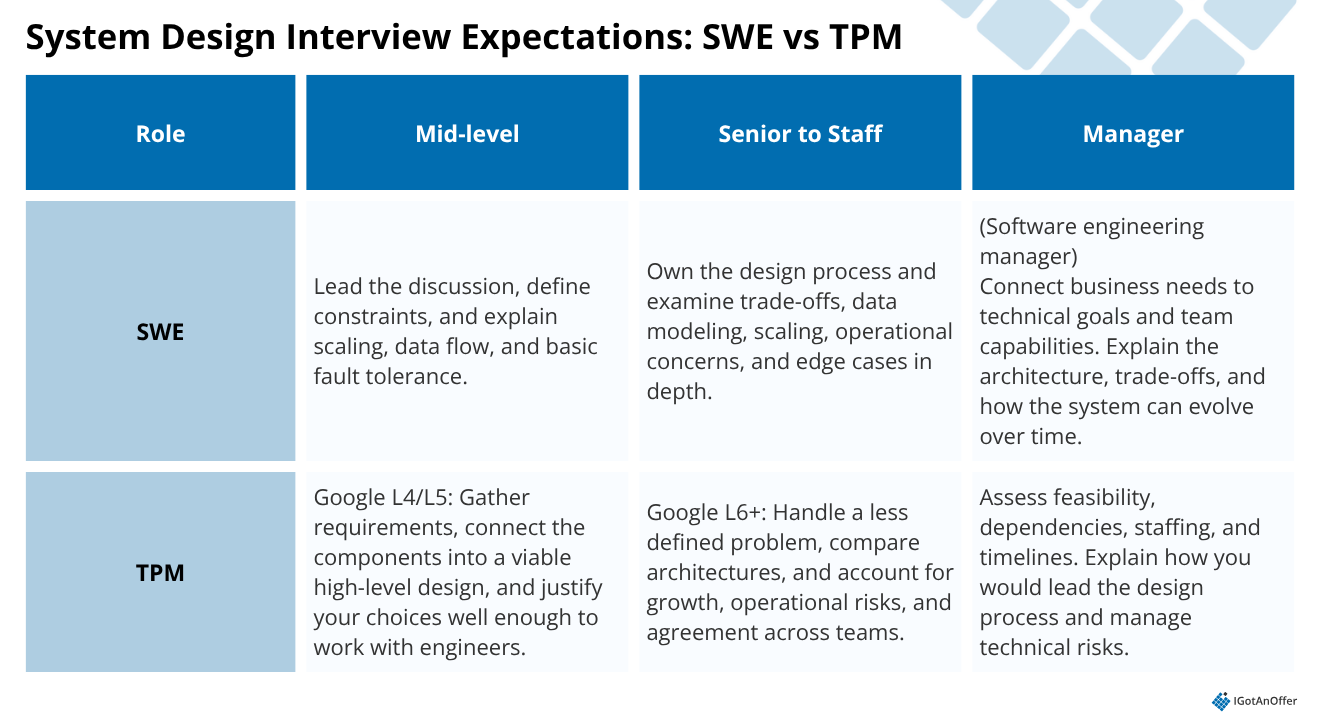
These expectations are a preparation guide, not a universal leveling rubric. Check the job description and ask your recruiter how much technical depth the team expects.
1.3 What skills are being evaluated?
Interviewers are looking for TPMs who can understand a technical problem, make reasoned decisions with engineers, and organize the work needed to deliver the solution. Based on Miguel’s guidance, focus on these four skills:
- Technical know-how: Explain how the components fit together and why your choices meet the requirements. Compare alternatives, including what each would cost you in performance, reliability, or complexity.
- Program delivery: Identify the teams involved, what each owns, and what they need from one another. Explain how those dependencies affect the order of the work, the rollout, and the risks you would address before launch.
- Structured thinking and problem-solving: Clarify the goal before proposing a design. Break the problem into manageable parts, state your assumptions, and revisit your choices when the interviewer changes a requirement.
- Communication: Walk your interviewer through your reasoning and respond to their questions. Check whether they want more detail on a component before spending the rest of the interview on it.
You can find company-specific interview guidance in our Google, Meta, Amazon, Microsoft, and Apple TPM guides. Check these alongside your recruiter’s instructions when choosing what to practice.
Coaches who contributed to this guide









2. TPM system design interview questions (by company) ↑
Practice with the 37 Google, Meta, and Amazon questions below. Where available, links to sample answers follow each question. Some videos are engineering-focused rather than TPM-specific.
2.1 Google TPM system design questions
Google TPMs work side-by-side with engineers on technical programs, so you will need to justify why one system design is better for a problem than another. Your discussion should address how the system will handle the demand that will come with millions of users of Google products.
Below are some example questions based on Glassdoor reports from Google TPM candidates and a few more from Miguel (ex-Google head of TPM).
Example Google TPM system design interview questions
- Design a global service with failover.
- Design a URL shortening service. (Sample Answer)
- Design a notification system for an app.
- Design a system for uploading and tagging pictures.
- Design architecture for a global ride-hailing service. (Sample Answer)
- How would you design a system to manage user preferences across multiple Google products?
- You are tasked with migrating a core service from a monolithic architecture to microservices. Walk through the program plan and technical considerations.
- How would you design a system to handle a fire in a data center?
- How would you design the server infrastructure behind Gmail?
- How would you roll out software updates to machines around the world?
- How would you design a web cache?
- How would you transfer 100 petabytes of data between the US East and West Coasts?
- How would you design a read-heavy social network like Facebook?
- How would you design a write-heavy file-storage service like Google Drive? (Sample Answer)
- How would you design a mapping service like Google Maps?
- How would you build a system to capture images of every street on Earth?
For more on what to expect at Google, check out our Google TPM interview guide and the TPM advice in our Google system design guide.
2.2 Meta TPM system design questions
At Meta, you may be asked to design a system from scratch in the Solution Design round. In the Technical Retrospective, you’ll discuss a system you’ve worked on, as outlined in Meta’s TPM interview guide.
The questions below come from Meta TPM candidate reports on Glassdoor and our Meta TPM interview guide.
Example Meta TPM system design interview questions
- Design a food-delivery system and explain how you would scale it to millions of customers. (Sample Answer | Video)
- Design a recommendation system for a multimodal content platform.
- Design a polling system for students across 30 colleges around the world.
- Describe the architecture of a project you led.
- How would you design a messaging service like WhatsApp? (Sample Answer)
- How would you build a live video streaming service like Facebook Live?
- How would you build a travel-booking system for Facebook users?
- How would you design a collaborative document editor?
- How would you build search suggestions that update as a user types?
- How would you identify and display trending topics on Twitter?
- How would you design a system to process millions of card transactions per hour?
Check out our Meta TPM interview guide for more company-specific preparation.
2.3 Amazon TPM system design questions
Amazon’s TPM interview preparation guide asks you to review distributed systems, service-oriented architecture (SOA), and n-tiered software architecture. It also emphasizes scaling, including caching, load balancing, non-relational databases, microservices, and sharding.
Example Amazon TPM system design interview questions
- How would you make a purchased ebook available to read within 60 seconds?
- How would you store and retrieve a shopper’s ten most recently viewed Amazon products?
- What database design would you use for a URL-shortening service? (Sample Answer)
- How would you build a service for auctioning advertising placements?
- What would the backend architecture of a parking application look like?
- How would you design AWS?
- How would you design Amazon’s online store?
- How would you design the software that controls an elevator?
- How would you design a vending machine?
- How would you design a virus scanner?
These questions are drawn from our Amazon TPM interview guide, which compiles questions reported by candidates on Glassdoor.
3. How to answer system design questions as a TPM ↑
Now that you have questions to practice, let’s look at how to structure your answer.
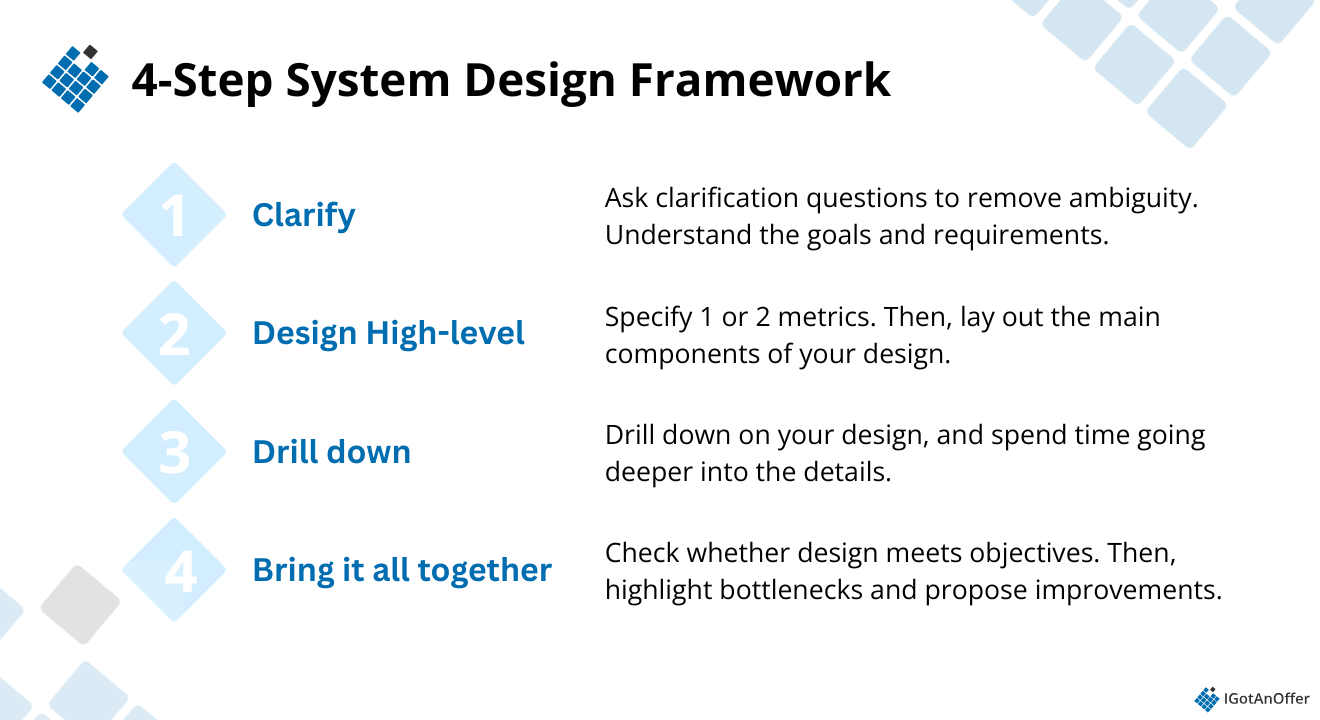
Use the four-step method below, adapted from IGotAnOffer’s system design framework. It helps you work from requirements to a design, then explain the technical choices and delivery decisions that follow.
Step 1: Ask clarifying questions
First, take a few minutes to align with your interviewer on the functional and non-functional requirements of the system you are designing. Ask about users, expected behavior, and how the service will be used (e.g., customer transactions, internal operations, or other services). Be sure you understand what the problem is before moving on.
Identify any assumptions that will affect your design. If possible, ask about non-functional requirements around scale (users and volume of requests), latency, reliability, and expectations for consistency.
Step 2: Design a high-level architecture
First, pick one or two key metrics (number of requests per second, peak number of concurrent users, response time, etc.). Use these to get an idea of scale and inform your design.
Next, describe the major parts of the system, including interfaces, application services, queues, and storage. Show the flow of requests and data through the system end-to-end.
Go deeper after you define your data layer and storage strategy. Compare storage options and describe your data model, consistency needs and high level partitioning approach.
Step 3: Drill down on your design
If you haven’t done so already, draw out your architecture and walk your interviewer through the data flow step-by-step.
Look for potential bottlenecks in the entire system; for example, limits on the number of requests, delays in processing or constraints on storage. Explain how your design handles real-world problems such as duplicate requests, unavailable dependencies, conflicting updates.
Complete your design by digging deeper into one component (e.g. message delivery, db replication, failover). If you don't know which area to investigate, ask your interviewer.
Step 4: Bring it all together
Before wrapping up, take a few minutes to revisit your design. Does it meet the requirements you defined at the start, especially around scale, latency, and reliability?
It’s okay to refine parts of your design at this stage, but explain your reasoning clearly. Summarize your key decisions and trade-offs, and highlight how your system can be delivered and operated over time (e.g., dependency ownership, phased rollout, monitoring).
Apply this framework to practice questions like the ones above. Use it across different scenarios so you can adapt it to varying systems and handle follow-up questions with confidence.
To help you make sure you cover the right information in your answer, check out our system design interview cheatsheet prepared by Mark (ex-Google engineering manager and interview coach). It was written for software engineering, but may also be adapted for technical program management.
4. How to prepare for TPM system design interviews ↑
As you can see from the complex questions above, there is a lot of ground to cover when it comes to TPM system design interview preparation. So it’s best to take a systematic approach to make the most of your practice time.
Below, you’ll find a prep plan with links to free resources.
4.1 Learn the concepts
In addition to the topics mentioned in Section 1.3, it’s also important to have a solid understanding of core system design fundamentals, as they form the foundation for building scalable systems.
You don't need to know EVERYTHING about sharding, load balancing, queues, etc.
However, you will need to understand the high-level function of typical system components. You'll also want to know how these components relate to each other, and any relevant industry standards or major trade-offs.
To help you get the foundational knowledge you need, take a look at our 9-part deep dive on system design concepts. Click on the topic to go directly to the article you need.
- Network protocols and proxies
- Databases
- Latency, throughput, and availability
- Load balancing
- Leader election algorithms
- Caching
- Sharding
- Polling, SSE, and WebSockets
- Queues and pub-sub
4.2 Study the company you're applying to
If you already have a system design interview scheduled at a specific company, take the time to familiarize yourself with the company and how its entire interview process works.
Before you prep, research your specific target. Check Glassdoor for recent TPM candidate reports for system design at that company.
Read your target company's engineering blog to understand the technical problems its teams work on. Look at the constraints behind their decisions. For example, did they choose a queue to handle traffic bursts, or change storage to reduce costs? That context can help you explain trade-offs in your own answers.
Here are relevant IGotAnOffer company-specific TPM guides to get you started:
- Google TPM interview guide
- Meta TPM interview guide
- Amazon TPM interview guide
- Apple TPM interview guide
- Microsoft TPM interview guide
4.3 Practice by yourself
A great way to start practicing is to interview yourself out loud. This may sound strange, but it will significantly improve the way you communicate your answers during an interview.
Use a piece of paper and a pen to simulate a whiteboard session, or use a whiteboard if you have one. If you have a virtual interview, practice using online whiteboarding tools like Excalidraw, Visual Paradigm, or Sketchboard.me.
To prepare effectively, we also recommend using the following resources:
- System design for technical program managers (Art of Yak Shaving): a walkthrough of scoping, architecture, and technical follow-up questions.
- Amazon’s official TPM interview preparation guide
- System design interview tips from experienced interviewers (by IGotAnOffer)
- Generative artificial intelligence (AI) system design interview guide (by IGotAnOffer)
- Machine learning (ML) system design interview guide (by IGotAnOffer)
- System design interview questions and prep guide (by IGotAnOffer)
Once you have a strong foundation in the material, the next step is practicing under real conditions. But by yourself, you can’t simulate thinking on your feet or the pressure of performing in front of a stranger. Plus, there are no unexpected follow-up questions and no feedback.
That’s why many candidates try to practice with friends or peers.
4.4 Practice with peers
Once you've done some individual practice, we strongly recommend that you practice with someone else interviewing you.
If you have friends or peers who can do mock interviews with you, that's an option worth trying. It’s free, but be warned, you may come up against the following problems:
- It’s hard to know if the feedback you get is accurate
- They’re unlikely to have insider knowledge of interviews at your target company
- On peer platforms, people often waste your time by not showing up
For those reasons, many candidates skip peer mock interviews and go straight to mock interviews with an expert.
4.5 Practice with ex-interviewers
In our experience, practicing real interviews with experts who can give you company-specific feedback makes a huge difference.
Find a system design interview coach so you can:
- Test yourself under real interview conditions
- Get accurate feedback from a real expert
- Build your confidence
- Get company-specific insights
- Save time by focusing your preparation
Landing a job at a big tech company often results in a $50,000 per year or more increase in total compensation. In our experience, three or four coaching sessions worth ~$500 make a significant difference in your ability to land the job. That’s a return on investment (ROI) of 100x.
Book mock interviews with experienced system design interviewers.