


 Back to other articles

 Last updated: September 27, 2026
 Interviews
 Technical program manager
 Deeply researched
Microsoft Technical Program Manager (TPM) interviews are really challenging. The questions are difficult, specific to Microsoft, and cover a wide range of topics.
The good news is that the right preparation can make a big difference and can help you land a job as a TPM at Microsoft. To help you get there, we have put together the ultimate guide below.
Here's an overview of what we'll cover:
- Role and salary
- Microsoft TPM process and timeline
- Example Microsoft TPM interview questions
- Interview tips
- How to prepare
Click here to practice with expert TPM interviewers
1. Microsoft technical program manager role and salary ↑
1.1 What does a Microsoft technical program manager (TPM) do?
A Microsoft TPM's job is to deliver complex technical initiatives, like a new Azure capability or a Copilot feature that spans several product teams. This involves resolving dependencies, removing blockers for engineers, and giving leadership an honest view of the timeline.
TPMs often work closely with product managers, but the two roles have different responsibilities. A product manager decides what a feature should do and who it's for. A TPM works out how to get it built across the teams involved and shipped on time. TPMs usually don't write code, but they need to follow an architecture discussion well enough to push back when a plan won't work.
Microsoft has used the "program manager" title for product roles in the past, so read the job description carefully to confirm you're applying for a TPM role. If it turns out to be a product role, our Microsoft product manager interview guide is a better fit.
1.2 How much does a Microsoft TPM make?
Microsoft offers competitive total compensation packages for TPMs. Below, you can see compensation for some Microsoft TPM levels in the US, based on verified user-submitted data from Levels.fyi:
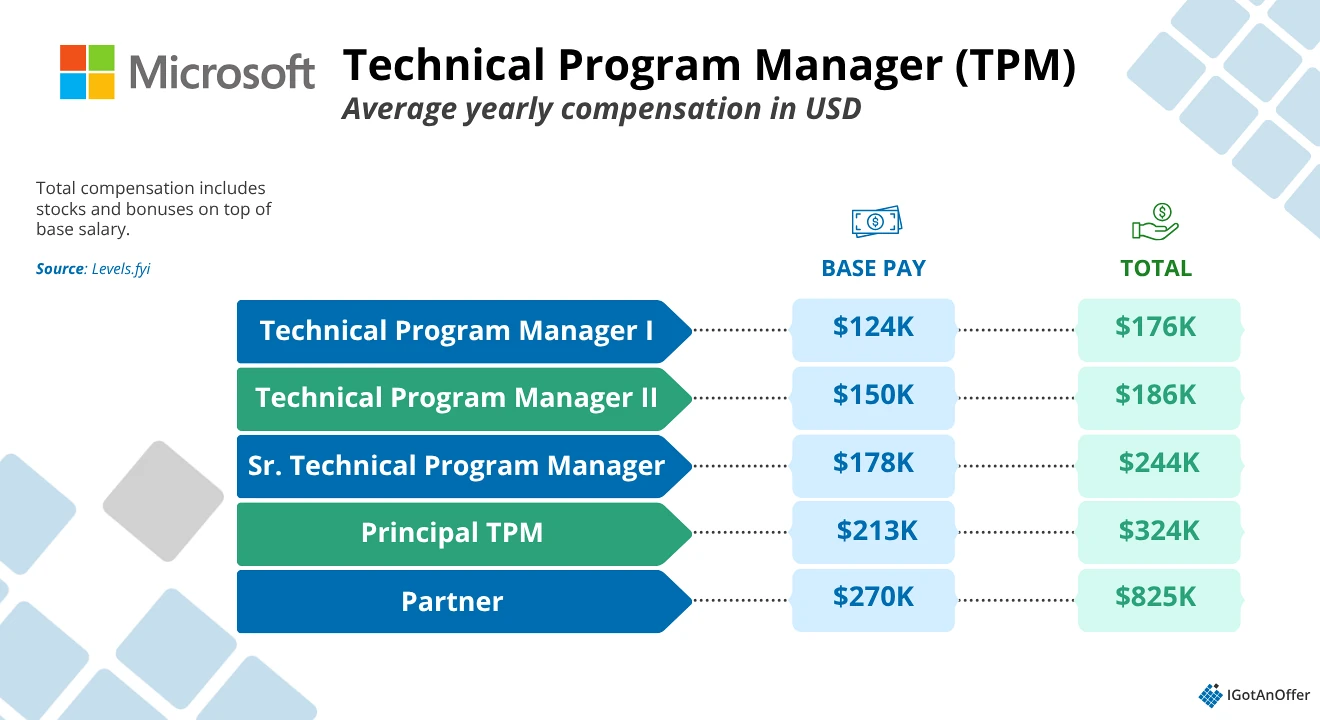
Microsoft adjusts pay based on location, so TPMs in more expensive cities typically earn more. For example, TPMs in New York typically earn more than those in lower-cost locations such as Atlanta.
Ask your recruiter which level you're being considered for. Philip (ex-Microsoft TPM) says expectations vary significantly by level and team, even for the same job title.
And remember, compensation packages are negotiable, even at Microsoft. If you get an offer, don't be afraid to ask for more. If you need help, consider booking one of our salary negotiation coaches to get expert advice.
Coaches who contributed to this guide




2. Microsoft technical program manager interview process and timeline ↑
2.1 What interviews to expect
What's the interview process and timeline at Microsoft for a technical program manager role? It typically takes three to eight weeks and follows these steps:
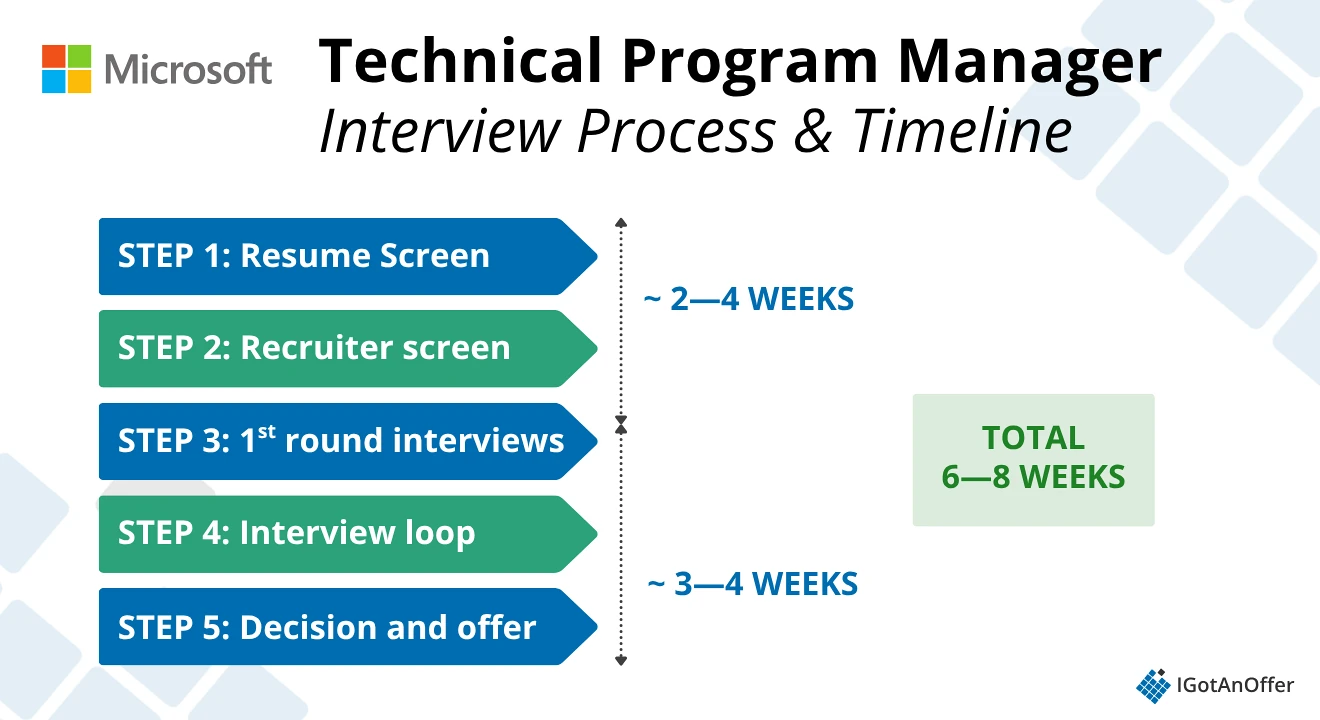
- Resume screen
- Recruiter call (1 interview)
- First-round interviews (1 to 2 interviews)
- TPM interview loop (typically 4 to 6 interviews)
- Offer and salary negotiation
Microsoft's hiring is decentralized. Product groups like Azure, Microsoft 365, and Xbox each run their own interviews, so the details of your loop depend on the team. Your recruiter will tell you what yours looks like.
Now, let's look at each step in more detail below.
2.1.1 Resume screen ↑
Before getting an interview, you'll need a quality resume tailored to the TPM role at Microsoft.
The resume screen is where recruiters compare your background with the requirements of the open position. Doing so helps them decide whether your experience is a strong enough match to move forward.
Once you find a suitable role, apply through Microsoft Careers. If you know someone at Microsoft, a referral may also help your application get noticed. In our experience, the simplest approach is to contact employees you already share a connection with on LinkedIn.
To help you put together a resume that stands out, follow the tips below.
- Simplify. Avoid overly creative layouts. A simple resume passes through applicant tracking systems and reads quickly for recruiters and hiring managers.
- Verbalize. Start each bullet point under your previous roles with an action word.
- Quantify. Add numbers wherever you can, i.e., model performance gains, scale of experiments, or adoption of a technique you developed.
- Summarize. Include a skills section with keywords pulled directly from the job posting.
For more detailed guidance, read our free TPM resume guide. You can also get feedback from our Microsoft resume coaches.
2.1.2 Recruiter call ↑
If your resume passes the screen, a Microsoft recruiter will schedule a 30- to 45-minute call. This is mostly a background and fit conversation, so expect questions like "Tell me about yourself", "Why Microsoft?", and "Walk me through your resume".
Unlike many engineering candidates, TPM candidates typically don't have to complete an online coding assessment after the recruiter call. However, about a quarter of TPM candidates on Glassdoor reported taking some form of skills test, so check with your recruiter to confirm whether you'll need to complete one.
2.1.3 First-round interviews ↑
After the recruiter call and online assessment (if you undergo the latter), you’ll move into one or two first-round interviews. Microsoft usually holds them over video, and each lasts 45 to 60 minutes.
You'll usually speak with a peer or hiring manager and get a mix of behavioral, program management, and light technical questions.
If these interviews go well, you'll get an invite to the full interview loop.
2.1.4 Technical program manager interview loop ↑
The interview loop is the main stage of the Microsoft TPM interview process. You can expect four to six interviews of about 45 to 60 minutes each.
During these interviews, you’ll mainly be assessed in three areas:
- Program management
- Technical depth
- Leadership
After the loop, each interviewer submits feedback and a hiring recommendation. Your recruiter will usually give you a timeline for the decision. If you haven't heard back within a week, it's reasonable to follow up.
The "as appropriate" (AA) interview
Many Microsoft loops include an "as appropriate" (AA) interview with a senior leader, often the hiring manager's manager. Historically, you'd only get this round if the rest of your loop went well, which is how it got its name.
However, this may no longer be the case for every team. A Microsoft hiring manager on Blind says the AA is now a regular part of the interview loop for the teams they’ve hired for. So, ask your recruiter whether you'll have one.
The AA interviewer typically focuses on anything that remains unclear from the earlier rounds. For example, if they're confident in your technical skills but unsure about fit, most of your questions will be behavioral. And if you've done well across the board, there may be little left to probe, so the interviewer will often spend part of the session selling you on the team instead.
2.1.5 Offer and salary negotiation ↑
If you pass the interview loop, your recruiter will present an offer package. Microsoft offers typically include base salary, an annual bonus, and restricted stock units (RSUs).
Microsoft recruiters expect you to negotiate, so you don't have to accept the first offer.
Here are some useful tips to help you negotiate your offer:
Salary negotiation tips
- Be polite. Remember that the person you're negotiating with is just doing their job. You'll get much farther in your negotiations if you approach the conversation with grace.
- Don't give a number right away. Whenever possible, it's better to wait until you receive an offer to start negotiating. This reduces the risk of giving a number that is lower than what Microsoft otherwise would have paid.
- Do your research. Have a number in mind before the conversation begins, and back it up with data. Research your position and level on Levels.fyi, ask around on professional networking sites like Blind, and factor in the cost of living where you are.
- Start high. Name a compensation number that is higher than your goal. Your Microsoft recruiter will likely negotiate it down to something closer to what you actually want.
- Negotiate everything. Your offer includes more than a base salary. You also have bonuses, vacation days, location, and remote work arrangements to consider. If the salary won't budge, there may be wiggle room elsewhere.
Once you're ready to practice, you can book a session with our salary negotiation coaches.
3. Microsoft technical program manager example interview questions ↑
The questions below come from two sources: interview reports on Glassdoor, and Peter, who spent nearly ten years as a Senior TPM at Microsoft.
You can expect three types of questions, matching the loop rounds we described above:
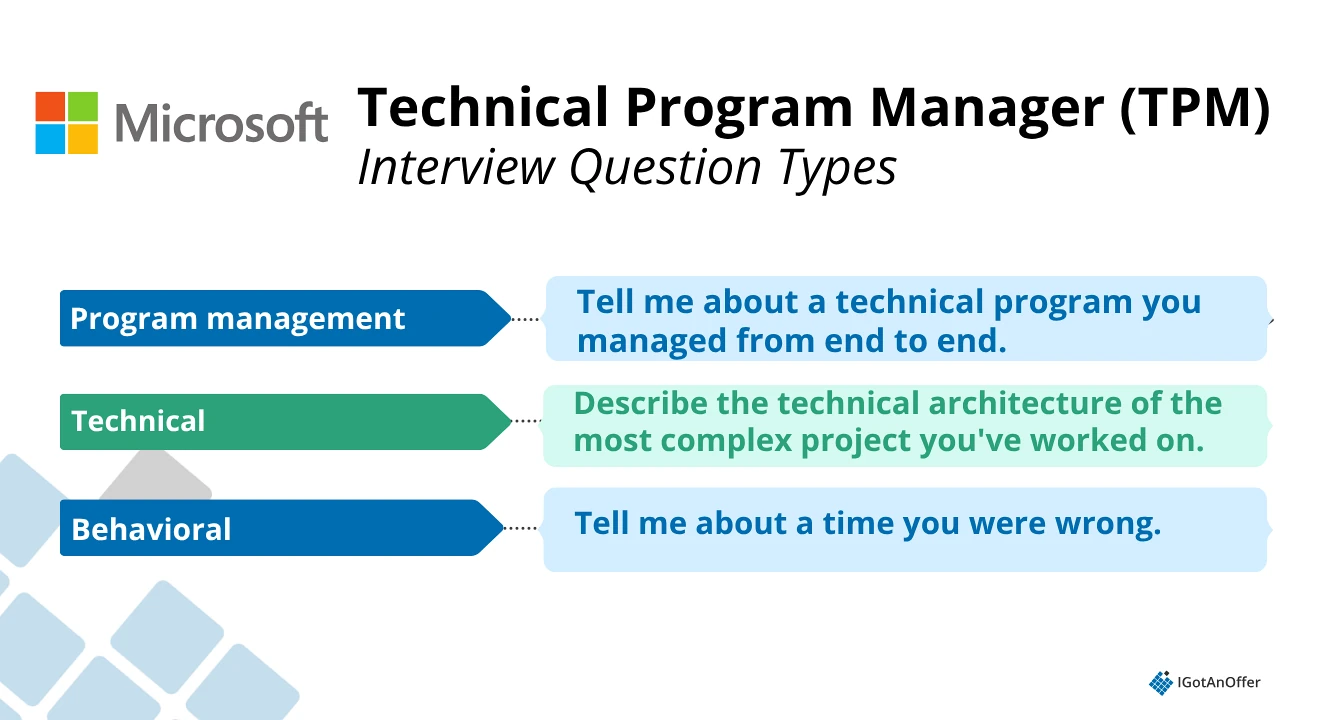
Note: Glassdoor has relatively few Microsoft TPM reports, so we've added questions from Google, Amazon, and Meta TPM interviews. These questions test the same skills, so they're good practice material. Note that we've edited the language in some places to improve clarity or grammar.
3.1 Program management interview ↑
Microsoft TPMs deliver programs through teams they have no authority over. In this interview, you’ll have to show that you plan programs end to end (scope, resources, risks, stakeholders) and that you have a record of delivering them.
You'll get a lot of prioritization questions here. Peter says the best way to tackle these questions is with the Eisenhower matrix. Meaning, you’ll sort every work item by urgency and importance, then ask three questions about each item.
- Does it fit what the organization is trying to do?
- Has it already been started, and does it need rescoping?
- How much effort will it take?
Then rank everything in a single ordered list before it goes into a tool like Jira. A single ranking forces the team to agree on what comes first, because capacity is limited. Click here to watch Peter walk through a full, step-by-step answer to a prioritization question.
However, you need more than a framework alone. According to Peter, Microsoft wants to see that you’ve handled similar situations in the past. A good way to demonstrate this is to pair the framework with a story about how you drove alignment, managed the risk, and communicated the plan.
Example Microsoft TPM interview questions: Program management
- Tell me about a technical program you managed from end to end.
- How would you address a situation where your customer's site went down at a critical moment?
- How do you prioritize and allocate resources when your team is too small? (Watch Peter's answer.)
- Walk me through the complete program lifecycle. (Google)
- What methodology do you use in your projects and programs? (Google)
- How do you handle additional requirements in the middle of a project? (Google)
- Imagine you find a critical bug in software the day before the release date. How do you handle the situation? (Google)
- How do you manage risks on your programs? (Amazon)
Check out our program management primer for tech interviews for more guidance on this question type.
3.2 Technical interview ↑
Microsoft TPM loops typically include one technical round. The bar is lower than for Microsoft software engineers, because the company doesn’t expect TPMs to write production code. Still, interviewers want to see if you can contribute to an architecture discussion.
You’ll find that technical questions come in three forms:
- System design is the one you're most likely to face, and it usually gets its own round in the loop.
- Technical explanation questions can come up in any round, often prompted by something on your resume.
- Coding is rare for TPMs, and most recent candidates report none at all.
We'll look at each below.
3.2.1 System design questions
Interviewers mostly base this round on your own projects. They’ll ask you to walk through the architecture of a product you built and defend the trade-offs you made.
Given Microsoft's cloud focus, expect the discussion to cover scalability, reliability, and cost. If you're interviewing with an Azure team, you’ll need to learn the common cloud architecture patterns.
Example Microsoft TPM interview questions: System design
- Describe the technical architecture of the most complex project you've worked on.
- Design a live streaming service that can serve large traffic when a celebrity streams. (Meta)
- Design a global system to upgrade software on a fleet of machines. (Google)
- How would you deploy a cloud computing solution that builds in redundancy for the compute cluster? (Google)
Click here for more in-depth guidance on system design interviews, including a step-by-step answer method and example solutions.
3.2.2 Technical explanation questions
According to Peter, technical explanation questions test your understanding of technical concepts and how clearly you can explain them. Interviewers usually pick topics from the technologies on your resume, so brush up on anything you've claimed experience with.
An example question you might get is "How does the cloud work?" According to Peter, your answer should begin with you first understanding your audience. This will help you decide which details to focus on and how technical your explanation should be.
For example, if you’re explaining the cloud to a senior leader, you'd talk about business benefits like elastic scaling and freeing up the infrastructure team. Whereas with an engineer, you'd go deeper into building blocks like managed services and APIs.
For a non-technical audience, you might use an everyday example instead, such as how Netflix streams video from servers around the world.
Example Microsoft TPM interview questions: Technical explanation
- How does the cloud work? (Watch Peter's answer.)
- Explain the XYZ technology listed on your resume.
- What happens when you enter a URL in your browser? (Google)
- What is the difference between TCP and UDP? (Meta)
- Explain hashing algorithms for encryption. (Google)
You'll find a full answer framework for this question type in our guide to technical interview questions.
3.2.3 Coding questions
You’ll rarely find coding questions in Microsoft TPM interviews. A few recent Glassdoor reports describe loops with no coding at all, even.
If coding does come up, the questions are much easier than software engineering LeetCode problems, and pseudocode is usually fine if you're coming from a non-engineering background.
Example Microsoft TPM interview questions: coding
- Write a program to reverse a string (no built-in functions can be used). (Google)
- Write a program to find if an integer is a palindrome. (Google)
- Write a program that traverses a linked list. (Amazon)
If you want to refresh the fundamentals, our coding interview prep guide is a good place to start.
3.3 Behavioral interview ↑
Microsoft asks more behavioral questions than any other type.
One of the questions we see coming up frequently is stakeholder questions. If you come across them, you’ll want to first properly frame your answer.
Peter says you should "never frame someone as being difficult”. This is because people often have a reason for being “challenging”. Instead, listen first to understand their concerns, then find common ground on what's right for the business and propose a compromise.
Example Microsoft TPM interview questions: behavioral
- Tell me about yourself.
- Why Microsoft?
- Tell me about a time you were faced with a challenge and how you resolved it.
- How do you deal with difficult stakeholders? (Watch Peter's answer.)
- Tell me about a time you were wrong.
- Describe a situation where you changed your approach based on feedback.
- Tell me about a time you failed.
- Tell me about a time your team didn't agree on the path forward.
For more guidance, check out our leadership primer and people management primer for tech interviews.
4. Microsoft technical program manager interviewing tips ↑
You can be excellent at your job and still fail your Microsoft TPM interviews because your interview skills aren't up to par. The tips below draw on Peter's experience interviewing at Microsoft and coaching TPM candidates to help you ace your interview.
4.1 Spend your story time on actions and results
A lot of candidates spend too long setting up their story. But context doesn’t exactly score you points in interviews. Of course, context helps the interviewer follow your story, but what you should highlight are your actions and your results.
When highlighting results, you need concrete numbers, even if the project was a while ago. "It's okay if you don't know the exact number. You want to be close, but you don't want to lie," Peter says.
4.2 Answer with intention
Many of the questions you’re asked in a TPM interview will be open-ended. That means there are no right or wrong answers. You have to choose what area to focus on within the large possible space of responses.
You’ll also want to be intentional by tailoring your answers to the specific domain you’re applying for as a TPM, if applicable.
One way to make sure you’re going in the right direction is to first refine the scope of the question.
Consider the larger topic, then either ask for clarification from the interviewer or propose some context/constraints within which you will respond. For example:
Question: "What’s your approach to leading a team?" (The interviewer could be asking about your principles and values, or they may just want to know your best practices for implementing them.)
Response (clarification): "Leading a team is a pretty broad topic. Can you elaborate a bit on what you’re after?"
Response (assumption): "This question makes me think about principles. Let me talk about three that are important to me and how I apply them."
4.3 Break problems into smaller tasks
Coding questions in tech interviews can usually be broken down into 2–5 smaller tasks, each of which should take just a few minutes to complete. As you make your plan, write down these steps and explain them to your interviewer so they can follow your thought process.
Then, work through each step one at a time (and cross each off as you complete it). Keep your interviewer updated throughout the process with verbal cues. For example, you can say: “I’ve completed task X. Next, I’ll work on Y, then Z.” This is just so your interviewer has a clear view of your progress.
4.4 Don't jump straight into answering
Answering a question right away may seem like a great way to show your confidence and knowledge, but it can be a huge red flag to interviewers. It shows them that you:
1) haven’t taken the time to pause and truly think about your answer,
2) haven’t bothered to ask clarifying questions or discuss possible approaches, and
3) are not being collaborative with your interviewer.
All three are bad signs for how you may work within teams, especially for a cross-functional role. For Microsoft interviewers, your collaboration and communication skills are just as important as your technical capabilities.
It’s okay to pause or jot down notes, as long as you let the interviewer know that’s what you’re doing.
Example:
Question: "Can you tell me about a time you had to disappoint your supervisor?"
Response: "That’s a great question. Give me just a minute to collect my thoughts."
That simple statement gives you time to consider and structure your response and also signals that you are thoughtful in your communications, even in an interview setting.
4.5 Show a growth mindset
Microsoft interviewers want to see how you deal with challenges, learn from mistakes, and respond to feedback. That means your stories don’t always need to end in a perfect outcome.
According to Peter, a stakeholder conflict that ended in only a partial win, for example, can still be a strong answer if you can explain what you learned from it.
When you’re preparing your stories, have a few that show you changed your approach based on new information or admitted you were wrong. Make sure you can explain what you learned and how you applied it afterward.
4.6 Make sure answers are data-driven and fact-based
Use specific numbers and metrics in your answers, without breaking confidentiality laws. Microsoft is a highly data-driven company, so make sure your answers are too.
Interviewers will especially want to know what financial metrics you tracked, what tools you used, and how you leveraged data to support decisions in your previous roles.
5. How to prepare for Microsoft technical program manager interviews ↑
Now that you know what questions to expect, let's focus on how to prepare. Here are the four most important things you can do to prepare for Microsoft TPM interviews.
5.1 Learn about Microsoft's culture
Before investing tens of hours in prep, take some time to make sure Microsoft is the right company for you. Prestige alone won't make you happy day to day. The type of work and the people you work with will.
If you know TPMs who work or used to work at Microsoft, talk to them about the culture from the inside. In addition, we recommend reading the following resources:
- Microsoft's culture page
- Microsoft's mission and company information
- Microsoft interview tips
- Microsoft: How we hire
- Harvard Business Publishing case study on Microsoft's culture change under Satya Nadella
- Satya Nadella on rediscovering Microsoft's soul, an HBR IdeaCast interview where he explains why he started with culture rather than products
- Microsoft CEO Satya Nadella: Be bold and be right
5.2 Practice by yourself
As we've seen, you'll face three types of questions at Microsoft: program management, technical, and leadership and behavioral. The first step of your preparation is to get on top of each type by yourself.
A good starting point is watching this mock interview with Peter, where he answers one question of each type in full. We also recommend the following free resources to help you practice each question type:
For program management prep:
- Program management primer for tech interviews
- PMP exam prep course (LinkedIn Learning)
- Atlassian's Agile project management guide
- How to answer prioritization questions (from Peter's interview)
For technical prep:
- System design interview guide
- Technical interview questions guide
- Coding interview prep guide (if your team includes a coding element)
- How to explain a technical concept to any audience (from Peter's mock interview video)
For leadership and behavioral prep:
- Leadership primer for tech interviews
- People management primer for tech interviews
- 16 most-asked behavioral interview questions
If you're also interviewing at other companies, our other TPM guides may help too:
- Google TPM interview guide
- Amazon TPM interview guide
- Meta TPM interview guide
- Apple TPM interview guide
- TPM interview prep guide
5.3 Practice with peers
If you have friends or peers who can do mock interviews with you, that's an option worth trying. It's free, but be warned, peer practice comes with its problems too:
- It's hard to know if the feedback you get is accurate
- They're unlikely to have insider knowledge of interviews at Microsoft
- On peer platforms, people often waste your time by not showing up
For those reasons, many candidates skip peer mock interviews and go straight to mock interviews with an expert.
5.4 Practice with experienced Microsoft interviewers
In our experience, practicing real interviews with experts who can give you company-specific feedback makes a huge difference.
Find a Microsoft TPM interview coach so you can:
- Test yourself under real interview conditions
- Get accurate feedback from a real expert
- Build your confidence
- Get company-specific insights
- Learn how to tell the right stories, better
- Save time by focusing your preparation
Landing a job at a big tech company often results in a $50,000 per year or more increase in total compensation. In our experience, three or four coaching sessions worth ~$500 make a significant difference in your ability to land the job. That's an ROI of 100x!
Click here to book TPM mock interviews with experienced Microsoft interviewers.
 Program management