Back to other articles


 Last updated: November 10, 2026


 Interviews
 Product manager
 Deeply researched
If you're interviewing for a product manager role at Google, there's a good chance your recruiter will mention problem space understanding. It's one of the new interview themes Google has introduced for PMs, so there's far less written about it than about the rest of the interview process.
The Google problem space understanding interview is usually paired with product vision, Google's version of product sense. In some cases, though, it's a stand-alone round.
In this guide, we'll cover everything you need to know to prepare, with insights from Nimish Hegde (Google PM) and Gal (ex-Google senior PM).
- What is the problem space understanding interview at Google?
- What competencies is Google evaluating?
- Example interview questions
- How to answer problem space understanding questions
- How to prepare
Click here to work with a Google PM interview coach
1. What is the problem space understanding interview at Google? ↑
The problem space understanding interview tests how well you handle an ambiguous real-world product problem before you settle on a solution. It's one of five interview types in Google's product manager interview loop, alongside product vision, product analysis, strategic insights, and execute with judgment.
Google hasn’t said why it introduced the round, but Nimish has a theory:
“I suspect the intent is to more explicitly evaluate a PM’s ability to operate in complex environments where the right solution isn’t immediately obvious, requiring them to consider many underlying external factors to their product or features before building.”
In this interview, you'll usually be given a situation that doesn't have one right answer. For example, you might be asked what you'd do if you've committed to a launch date and Engineering tells you the product won't be ready. Your interviewer will want to understand how you'd get to the root of the problem.
Part of what makes this hard is that "the solution can come from many different directions," says Gal (ex-Google senior PM). If a bug is affecting a lot of users, Engineering could fix it, or you could add a pop-up telling users that the feature is experimental.
Either of these could be a reasonable choice, depending on how long the fix would take and how many users it would help, so be ready to talk through how you'd decide.
1.1 How is problem space understanding different from product vision? ↑
Product vision evolved from what Google used to call product insight. A typical question is "How would you build maps for blind people?", which asks you to identify user needs and define what to build.
According to Nimish (Google PM), “Problem Space Understanding emphasizes understanding the underlying problem, balancing technical and business constraints, and navigating competing stakeholder needs.”
Interviewers want to see how you define the problem you’re given, and much of it will depend on how you read the situation and the constraints your interviewer adds.
1.2 What the Google problem space understanding + product vision interview looks like ↑
When the two themes are paired, you'll usually have one 45-minute interview that covers both. Most of that time (~ 30 to 35 mins) tends to go on the main discussion, with the rest set aside for introductions and any questions you have at the end.
This may also be the first interview you have after the recruiter call. According to Gal (ex-Google senior PM), most candidates now start with a hiring manager, and that’s where product vision and problem space understanding can come up. You can expect the theme again in your final loop.
Interviewers at Google aren't tied to a question bank, so you may get behavioral questions as well. Your recruiter should be able to tell you what the interview will cover and whether it'll be paired or stand-alone.
For more on the overall PM process, read our Google product manager interview guide.
Coaches who contributed to this guide





2. What competencies does Google evaluate in the problem space understanding interview? ↑
Your Google interviewer wants to see that you can make sound product decisions when you have competing priorities and imperfect information. Nimish recommends focusing on six competencies:
- Problem framing: Find the root problem rather than accepting the initial symptom or request.
- Technical and business understanding: Show enough technical fluency to assess a solution’s feasibility, along with a clear understanding of customer impact and business value.
- Stakeholder awareness: Show that you understand what Engineering, Design, Sales, leadership, and customers each care about.
- Trade-off reasoning: Compare credible solutions, then explain what you're prioritizing and what you're willing to sacrifice.
- Decision-making under ambiguity: Make a recommendation you can defend even without perfect information.
- Clear communication: Explain complex problems and decisions in a way that different audiences can understand.
If you're interviewing at L4, you won't be expected to have the answer to every question. Nimish believes independent product judgment matters more at that level. It's fine to admit what you don't know, as long as you involve the right people and "still move the problem forward."
3. Google problem space understanding example interview questions ↑
The questions below come from examples shared by Google PM coaches Nimish and Gal, our Google PM interview guide, and reports on Blind and Glassdoor.
Some come from related Google PM interviews that test the same skills, as these themes can overlap. For example, the launch date question can also come up in execute with judgment. Note that we've edited some questions for language and clarity.
3.1 Example problem space understanding questions ↑
Product vision and strategy
- How would you build maps for blind people?
- How would you improve Google Maps for advertisers?
- Design a product for an underserved segment.
- How would you think about Google's strategy in emerging markets?
- What do you think this role involves, and how do you think the product works?
Conflicting priorities and stakeholders
- How would you resolve conflicting product requirements? Who decides which requirement takes priority?
- Your largest customer is pushing for a feature that isn't on your roadmap, and Sales has already approached Engineering about building it. What do you do?
- Your engineering team is unhappy with the roadmap you've proposed. How would you handle that?
- You've committed to a launch date, but Engineering tells you the product won't be ready. What do you do?
- How would you convince Engineering to work on a business-requested feature that would interfere with their existing work and deadline?
- How would you deal with an internal team trying to build the same thing as you?
Bugs and product issues
- A bug is affecting customers and driving up support requests. How would you approach resolving it?
- Google Search is seeing a decline in engagement among teenagers. How would you approach this?
Our guide to prioritization and trade-off questions has a three-step framework you can use for questions like these, along with more examples to practice with.
3.2 Follow-up questions to expect ↑
During your problem space understanding interview, expect your interviewer to change the scenario partway through your answer by adding new information or constraints.
Nimish (Google PM) says a structured answer is relatively easy to give when everything is hypothetical, but "introducing conflicting priorities or changing constraints makes you demonstrate your actual judgment."
He suggests preparing for pushback like this:
- Engineering says the feature will take six months, but Sales has already promised it to the customer. What do you do?
- Your largest customer says they'll leave unless you prioritize their request. How would you handle that?
- Engineering strongly disagrees with your recommendation. How would you handle that?
- What would make you change your recommendation?
Don't be alarmed if your interviewer pushes back. You can change your recommendation if the new information justifies it, as long as you explain what changed.
4. How to answer problem space understanding questions ↑
Nimish (Google PM) doesn't recommend memorizing a rigid framework when tackling a problem space understanding question. Instead, a general structure will help you stay organized when the scenario is ambiguous. He suggests six steps.
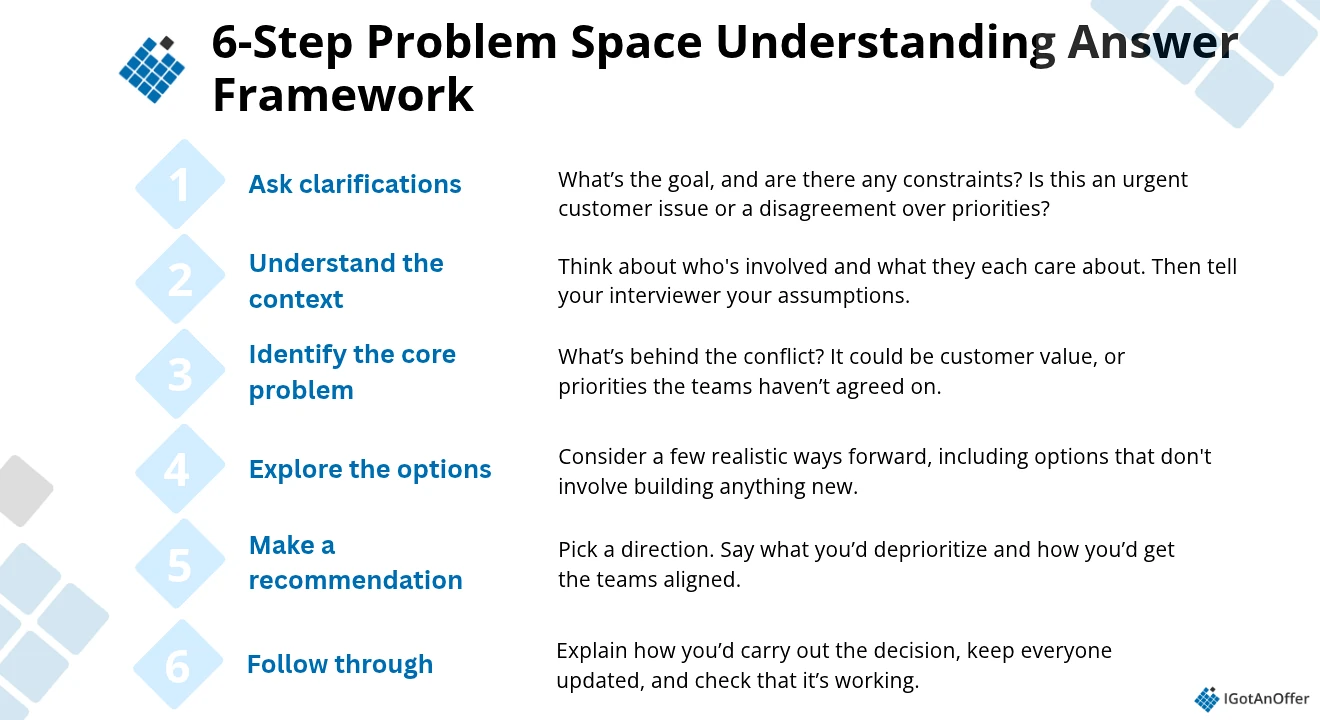
- Clarify the situation: Start by asking what the goal is and whether there are any immediate constraints. Clarify whether you're dealing with an urgent customer issue, a prioritization disagreement, or a longer-term decision.
- Understand the context: Think about who's involved and what they each care about. Then tell your interviewer your assumptions.
- Identify the core problem: Look at what's behind the conflict. For example, if Sales wants an urgent feature that Engineering doesn't support, it could come down to customer value or priorities the teams haven't agreed on.
- Explore the options: Consider a few realistic ways forward, including options that don't involve building anything new.
- Make a recommendation: Pick a direction, then tell your interviewer what you're deprioritizing and why, and how you'd get the teams aligned.
- Follow through: Talk through how you'd carry out the decision, keep stakeholders informed, and check that it's working.
Of all six steps, Nimish puts the most weight on your willingness to make a decision:
“It’s easy to say you’d consider customer impact, engineering effort, and business priorities. What’s harder, and ultimately more valuable, is explaining how you’d balance them when they conflict.”
5. How to prepare for the Google product manager problem space understanding interview ↑
Now that you know what questions to expect, let’s focus on preparation.
Below, you’ll find links to free resources and four introductory steps to help you prepare for your Google problem space understanding interview.
5.1 Learn about Google’s culture
Most candidates fail to do this. But before investing tens of hours preparing for an interview at Google, you should take some time to make sure it’s the right company for you.
Google is prestigious, so it’s tempting to skip that step completely. But in our experience, prestige alone won’t make you happy day to day. It’s the type of work and the people you work with that will.
If you know PMs who work at Google or used to work there, it’s a good idea to talk to them to understand what the culture is like. In addition, we would recommend reading the following:
- Ten things we know to be true (by Google)
- Google’s company blog (by Google)
- Google product manager interview (by IGotAnOffer)
5.2 Practice by yourself
As we’ve outlined above, you’ll have to prepare for a few different types of questions, especially if this interview is paired with product vision. In this article, we’ve recommended various deep-dive articles that will help you prepare for each question category.
Here’s the complete list, plus a few other resources:
- General prep: Google product manager interview
- Product vision:
- Problem space understanding:
- Behavioral:
Once you're in command of the subject matter, you'll want to practice answering questions. By yourself, though, you can't simulate thinking on your feet, and you won't get the unexpected follow-up questions that make this interview hard.
5.3 Practice with peers
If you have friends or peers who can do mock interviews with you, that’s an option worth trying. It’s free, but be warned, you may come up against the following problems:
- It’s hard to know if the feedback you get is accurate
- They’re unlikely to have insider knowledge of interviews at your target company
- On peer platforms, people often waste your time by not showing up
For those reasons, many candidates skip peer mock interviews and go straight to mock interviews with an expert.
5.4 Practice with experienced Google interviewers
In our experience, practicing real interviews with experts who can give you company-specific feedback makes a huge difference.
Find a Google PM interview coach so you can:
- Test yourself under real interview conditions
- Get accurate feedback from a real expert
- Build your confidence
- Get company-specific insights
- Learn how to tell the right stories, better
- Save time by focusing your preparation
Landing a job at a big tech company often results in a $50,000 per year or more increase in total compensation. In our experience, three or four coaching sessions worth ~$500 make a significant difference in your ability to land the job. That's an ROI of 100x!
Click here to book mock interviews with experienced Google ex-interviewers.

 Behavioral, People management and Leadership