

 Back to other articles

 Last updated: June 26, 2026
 Interviews
 Strategy and operations manager
 Deeply researched
Uber strategy and operations interviews are tough to prepare for. Good resources are hard to find, and the questions are wide-ranging, data-heavy, and tied closely to how Uber's marketplace works.
The good news is that the right preparation can make a big difference and help you land the job at Uber.
To help you prepare strategically, we’ve created this guide. It includes insights from official Uber sources, recent candidate reports, and our experience coaching candidates for strategy and operations interviews.
Here's an overview of what we'll cover:
Click here to practice 1-to-1 with strategy and operations ex-interviewers
1. Uber strategy and operations role and salary ↑
Before we get into the interviews, let's look at the role itself.
Uber's strategy and operations roles sit across the company's main lines of business, including Rides, Uber Eats, and Uber for Business. Job titles vary, and you'll see variations such as:
- Strategy and operations manager
- Strategic operations manager
- Central operations manager
- Business operations manager
- Operations and logistics manager
1.1 What do strategy and operations roles do at Uber?
After years of growth-first expansion, Uber now runs as a mature, data-driven platform. Pricing, incentives, and supply decisions are tested and adjusted constantly at the city level. Strategy and operations managers are the people who design those tests and act on the results.
The work is analytical and cross-functional. You'll spend time in data, but you'll also coordinate with product, marketing, finance, and local teams to put your recommendations into practice.
That mix of analysis and coordination shows up in the core competencies Uber looks for:
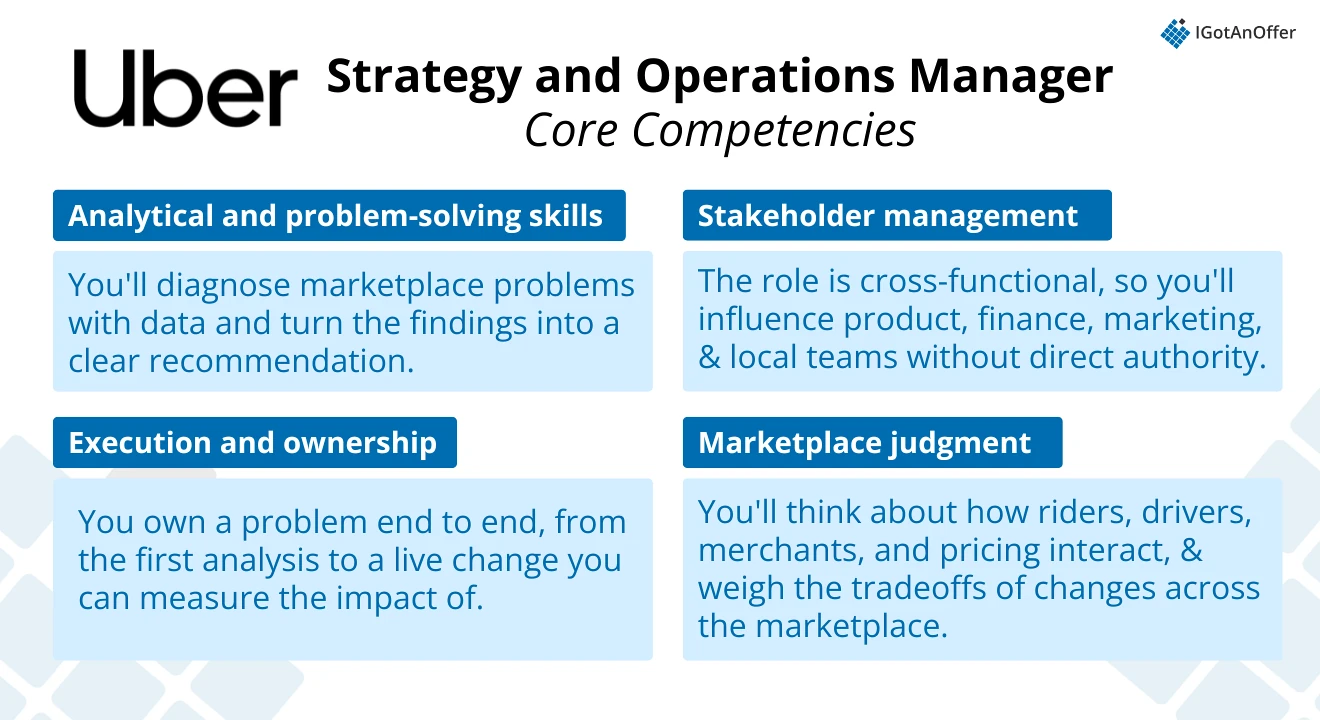
- Analytical and problem-solving skills. You'll diagnose marketplace problems with data, from supply gaps to pricing issues, and turn the findings into a clear recommendation.
- Marketplace judgment. You'll reason about how riders, drivers, merchants, and pricing interact, and weigh the tradeoffs of any change across the marketplace.
- Execution and ownership. You'll take a problem from analysis through to a launched, measurable change, not just a slide deck.
- Stakeholder management. The role is cross-functional, so you'll influence product, finance, marketing, and local teams without direct authority over them.
What skills are required?
Beyond those competencies, Uber's job posts for strategy and operations roles list a few common prerequisites:
- Bachelor's degree, often with an MBA preferred for manager-level roles
- Several years of experience in operations, strategy, consulting, investment banking, or a similar analytical field
- Familiarity with the tools of the job, since you'll work directly with data
- Data fluency, since you'll pull and analyze data directly in SQL and Excel rather than wait on an analyst
Uber tends to hire former consultants and analysts into these teams, so structured problem-solving and comfort with ambiguity matter as much as technical skill.
1.2 How much is salary and compensation for the strategy and operations role at Uber?
For this guide, we’ll focus only on the Business Operations role to give you a sense of how much Uber pays for strategy and operations roles.
The figures below come from Levels.fyi for Uber's Business Operations Manager role in the United States, which is the closest reported match for strategy and operations manager positions.
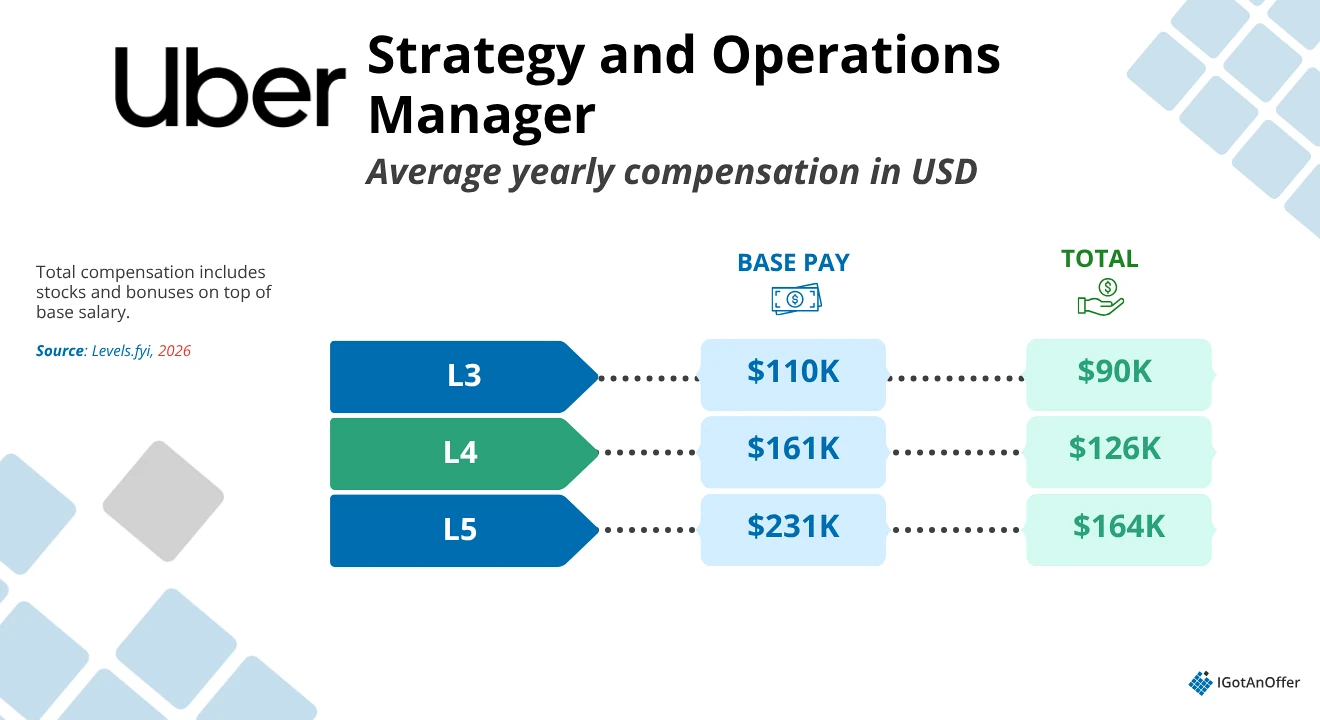
Ultimately, how you do in your interviews will help determine what you’ll be offered. That’s why hiring one of our ex-Uber interview coaches can provide such a significant return on investment.
And remember, compensation packages are always negotiable, even at Uber. So if you do get an offer, don’t be afraid to ask for more. If you want to receive expert support, consider booking one of our salary negotiation coaches.
Coaches who contributed to this guide








2. Uber strategy and operations interview process and timeline ↑
In this section, we'll walk through the typical stages of Uber's strategy and operations interview process. Once you understand the sequence, we'll look at each stage in more detail.
2.1 Interview process and timeline
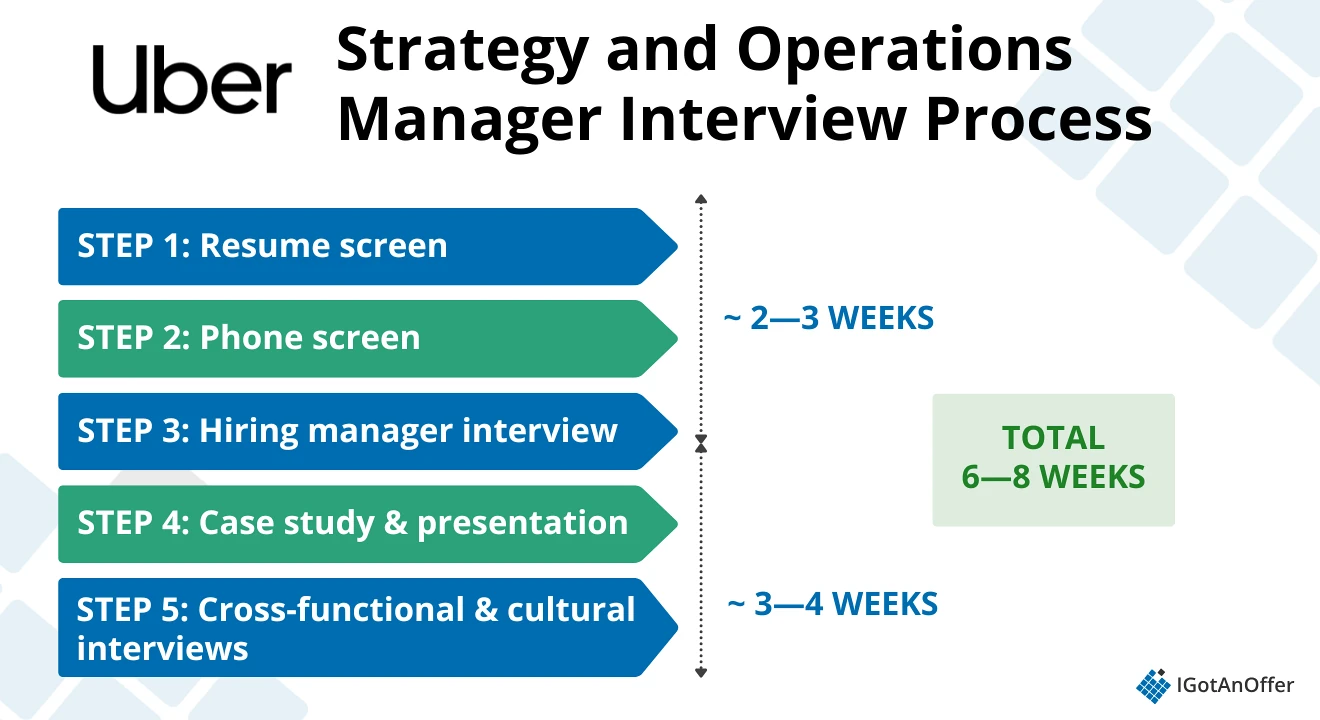
The Uber interview process usually has four to five stages and takes around four to eight weeks to complete. Here are the steps you can expect:
2.2 What steps to expect
In most cases, here are the steps you'll go through:
- Resume screen
- Recruiter phone screen
- Hiring manager interview
- Case study and panel presentation
- Cross-functional and cultural interviews
Throughout the process, Uber evaluates candidates against a few broad areas, the same criteria it uses for internal promotions. These are your analytical and problem-solving ability, your impact and execution, your leadership and stakeholder management, and your technical depth with data.
You'll see different question types target each one, which we cover in detail in Section 3.
2.2.1 Resume screen ↑
This is the most competitive part of your Uber application process. You’ll have to make sure your resume matches the exact position you’re applying for.
If you haven't yet got an interview at Uber, you'll want to get your resume up to scratch.
To help you put together a targeted resume that stands out from the crowd, follow the tips below.
Tips for crafting a resume
- Simplify. Avoid using overly creative resume layouts. A simple resume layout accomplishes two things: it helps your resume pass through the applicant tracking system (ATS) and makes it easy to read for recruiters and hiring managers.
- Verbalize. Start each bullet point under your previous roles with an action word.
- Quantify. Add numbers to illustrate your impact in each role. If you were in a leadership role, how many people were in your team? If you’ve successfully launched a product, what metrics did you use to measure its success?
- Summarize. Make your resume ATS-friendly by having a skills section. Insert keywords from the job requirements that are relevant to your professional experience.
The tips above are a starting point. For detailed steps and examples to follow, see our tech resume guide.
If you’re looking for expert feedback, you can also get help on your resume from one of our tech recruiters, who will cover what achievements to focus on (or ignore), how to fine-tune your bullet points, and more.
2.2.2 Recruiter phone screen ↑
Uber's recruiter phone screen often runs for 60 minutes, so expect it to go deeper than a standard introductory call.
The recruiter walks through the role, the team, and what the hiring manager is looking for. They'll ask about your background, your motivations, and questions like:
- Why Uber?
- Why this role?
It helps to prepare a short introduction (2 to 3 minutes max) so you won’t ramble on due to nerves. Check out our guide to behavioral interview questions for tips on how to answer these types of questions confidently.
Give the recruiter plenty of reasons to put you through to the next round and convey your enthusiasm for working at Uber.
If you get past this first HR screen, the recruiter will then help schedule your next rounds of screening. Uber EM and coach Ketki’s advice is to leverage the guidance of your recruiter at this stage, so you know exactly how to prepare for each round.
“The process is designed to ensure you’re not caught off guard, so focus on aligning your preparation with those expectations. Take time to understand the purpose of each round and prepare accordingly, targeting the skills and competencies being evaluated,” she says.
2.2.3 Hiring manager interview ↑
Next is the hiring manager round. This mixes behavioral questions with a verbal case, so be ready to switch between talking about your experience and reasoning through a live business problem.
You can also use this opportunity to learn more about the role and team you’re applying for, so come prepared with thoughtful questions.
If Uber is really excited about your profile, they might send you to full loop interviews straight away and skip this screening step.
2.2.4 Case study and panel presentation ↑
This is a centerpiece of the Strategy and Operations Manager interview process. You'll be given a case study, often as a take-home with a data packet, and asked to build a short presentation of around four to six slides.
You then present your analysis and recommendation to a panel. The case is based on a real Uber business problem, and you're expected to draw conclusions from messy or incomplete data.
The panel is usually collaborative, like a joint exploration of the problem. But also, prepare for a more hands-off panel that stays quiet while you present, too, just in case.
2.2.5 Cross-functional and culture interviews ↑
Depending on the team, you may also have a series of interviews with cross-functional stakeholders, often around three. These are the people you'd work alongside day to day, such as members of other operations teams, product, or finance. Interviewers want to see how you'd partner with these people and communicate across functions.
There's also a shorter culture interview, usually about 30 minutes. This round checks how well you fit Uber's cultural norms, the company's internal list of values.
Expect mostly situational and behavioral questions across both. You may also get questions that only an internal employee would easily know, so the more you understand about how Uber operates, the better.
3. Example Uber strategy and operations interview questions ↑
We've analyzed the questions Uber asks in its strategy and operations interviews using candidate reports from Glassdoor and Blind. They fall into three broad types, which you'll meet at different points in the process.
Here's an overview of the three types:
3.1 Behavioral and cultural fit ↑
Behavioral questions run throughout the process, but they show up most in the recruiter screen, the hiring manager round, and the culture interview.
Uber uses these questions to assess how you've handled real situations and how well you align with its eight cultural norms:
- We build globally and live locally.
- We are customer-obsessed.
- We celebrate differences.
- We do the right thing.
- We act like owners.
- We persevere.
- We value ideas over hierarchy.
- We make big, bold bets.
When you prepare your stories, think about which norm each one demonstrates. For example, a strong answer about owning a problem end-to-end maps neatly to "we act like owners."
Example behavioral questions asked at Uber strategy and operations interviews
- Tell me about yourself.
- Why Uber? (Sample answer)
- Tell me about a time you failed.
- Tell me about a time you faced conflict and how you handled it.
- Why this role?
- Tell me about a project you're proud of
- Tell me about a time you made a recommendation with incomplete data.
- Tell me about a time you had to influence a stakeholder without authority.
- How do you handle working with people who are unhappy with you or your company?
To prepare, work through our guide to behavioral interview questions to learn a repeatable method for structuring your answers.
3.2 Business case and analytical questions ↑
As a strategy and operations manager, your job is to solve marketplace problems with data. The business case and analytical questions test exactly that.
Uber's cases are usually candidate-led, which means you guide the conversation. You're expected to ask the right questions, probe for data, and propose each next step yourself, rather than waiting to be led.
Many of these cases are diagnostic. You're handed a metric that's moving in the wrong direction and asked to find the cause before recommending a fix.
According to Valentina (International Growth Strategist), there are three key things to do to perform well at a business case interview:
- You should be structured and use frameworks, but not overly structured. “Walking your interviewer through each step demonstrates both analytical agility and clear thinking—essential for Strategy and Ops roles.”
- You must be comfortable with mental math. “To stand out, you need to work on doing quick, live ‘back-pocket' calculations.”
- You need to practice for case interviews in advance.
The last piece of advice, especially, will help you avoid common pitfalls, like focusing on analysis without making a recommendation.
“Even with incomplete data, you should synthesize your findings and propose a clear direction,” Valentina says.
For instance, you can say, 'Based on current data, I recommend Market X due to its growth potential, pending validation of supply chain feasibility.' A decisive conclusion shows you’re ready to drive impact.
Example case and analytical questions asked at Uber strategy and operations interviews
- First-time users are rising, but retention is falling in a market. How would you diagnose the cause?
- Uber Eats delivery times are increasing. How would you find and fix the problem?
- How would you increase driver retention in a competitive market?
- If you entered a new city with a limited budget, what would your go-to-market plan be?
- What metrics would you use to measure the health of a marketplace?
- A competitor undercuts Uber's pay split with drivers, offering 90/10 against Uber's 80/20. How would you respond?
- How would you help Uber move into grocery delivery using its existing driver network?
A few of these cases involve market sizing and live math, so practice working through numbers out loud. For frameworks and practice, see our guides to case interview frameworks, case interview math, and market sizing.
3.3 Case study presentation ↑
The take-home case and panel presentation require their own preparation, as the format often catches many candidates off guard.
You'll receive a prompt and a data packet. Your task is to build a short slide deck, usually four to six slides, with a clear recommendation backed by the data.
Some packets are deliberately large and messy, with thousands of rows and gaps in the data, so part of the test is whether you can make defensible assumptions and find the signal. The deck weighs your thinking.
The panel wants to see how you structure a problem, handle imperfect data, and land on a recommendation you can defend under questioning.
At the time of writing, candidate reports for the Uber strategy and operations case study on Glassdoor and other forums are relatively limited. So, we've supplemented the list with general strategy and operations cases from our BizOps interview guide, with question types that are clearly relevant to Uber's marketplace.
Example case study presentation prompts asked at Uber strategy and operations interviews
- What are the key buckets in the delivery P&L?
- You’re given a file with 25,000 rows of raw data. Using our Open API error codes, evaluate the trends causing order errors and suggest possible solutions for the vendor.
- We’re thinking of expanding to a new market. How would you determine the growth opportunity if there’s no transactional data available?
- Consider the impacts of the three-sided marketplace when one user group grows.
- How would you improve the CSAT score of an airport?
- Estimate the revenue from student licensing. There are 9 schools with a combined student population of 20,000. About 60% of these students are expected to use the licenses. LinkedIn sells licenses in bundles of 10,000 for $250,000. After graduation, 20% of students are expected to retain their licenses and continue paying individually. Production and engineering costs are estimated at 30% of total revenue. However, there’s a 15% cannibalization rate, meaning some students already have licenses. The lifetime value of a Lynda license is $75.
- Calculate profitability. The total revenue from UC partnerships is estimated at $2,750,000, with an additional $1,650,000 expected from students who retain their licenses after graduation. Production and engineering costs are $825,000, and cannibalization accounts for $1,237,500. After accounting for costs, estimated profitability is $2,337,500. Based on this analysis, what would you recommend?
For a step-by-step walkthrough of a real strategy and operations case, see our BizOps interview guide and our operations case interview guide.
4. Interview tips ↑
Being a strong operator isn't always enough to pass the interviews. Interviewing is a separate skill. Here are some tips to help you approach Uber's process the right way.
4.1 Make sure you understand the problem before solving it
This applies best to business case questions, but may also apply to any other question you’ll get during an Uber strategy and operations interview.
To ensure you understand the question, listen carefully and take notes while the interviewer presents the case. Take the time to gather your thoughts and ask clarifying questions.
This is what a strategy and operations person does: they sit down with the team, listen carefully to the problem, and ask questions before trying to solve the problem. They do this because it's impossible to solve a business problem you don't understand in detail. Therefore, you should follow a similar approach in your cases.
Additionally, if there are any concepts brought up that you don’t understand, don’t be afraid to ask for clarification. It’s also good practice to repeat the explanation in your own words so your interviewer can validate your understanding.
4.2 Talk through your thought process in a structured way
What Uber wants to see in your interview is your approach to solving problems. They want to see how you think, so you’ll need to show them.
Uber values structure over perfect answers. When solving a problem, you need to first clearly define the problem, prioritize stakeholders, and outline trade-offs in your solution.
“Demonstrating logical, data-driven thinking—rather than aiming for an ideal result—shows you’re ready to tackle ambiguity in the role,” says Valentina.
4.3 Don’t get stuck in a framework
While Uber wants to see you approach problems in a structured way, what they don’t want is to see you force your answer to fit a standard framework.
Some of our successful candidates have mentioned that excessive reliance on frameworks may hinder performance.
During the interview, trust your instinct, and don’t be afraid to deviate from the framework if needed. A framework is there to help you craft a better answer, not make you twist your answer to fit the framework.
4.4 Check in with your interviewer
Interviewers vary in their willingness to provide hints. Some may wait for you to ask for details about the customer or product, while others expect you to make assumptions on your own.
Gauge this by asking a direct question or specifying your assumptions. If the interviewer appears not to want to engage, minimize additional questions to showcase your ability to make decisions on your own, but continue to explain the thinking behind each assumption.
4.5 Tie your answers to Uber's cultural norms
Uber weighs cultural fit heavily, especially in the behavioral and culture rounds. Study the eight cultural norms and prepare stories that show them in action.
When you propose a solution, think about whether it reflects how Uber says it operates, such as acting like an owner or doing the right thing.
4.6 Prepare thoughtful questions
You'll have time at the end of each round to ask questions. Coming without any can signal a lack of interest in the role.
Prepare questions you couldn't easily answer with a search. Ask about the team's priorities, how success is measured in the role, or how the team works with product and finance.
5. Preparation plan ↑
Now that you know what to expect, let's focus on how to prepare. Below are some free resources and a few steps to get you ready for your Uber strategy and operations interviews.
5.1 Learn how Uber's business works
The example questions make it clear that you need to understand Uber's marketplace and its economics in detail. Do your homework before the interviews.
Here are some resources to start with:
- Uber investor relations and quarterly reports
- Uber's eight cultural norms
- Uber newsroom
- Uber’s strategy teardown
It’s a good initiative to use the Uber and Uber Eats apps before your interview so you can speak about the product from experience.
5.2 Learn a consistent method for each question type
Uber's questions fall into a few categories: behavioral and cultural fit, business cases and analytical problems, and the case study presentation. Approaching each with a repeatable method builds strong habits that reduce stress on the day.
These guides are a good starting point:
- Behavioral interview questions
- Case interview frameworks
- Case interview math
- Market sizing guide
- Operations case interview guide
- General BizOps interview questions and prep
Once you’re in command of the subject matter, you’ll want to practice answering questions. But by yourself, you can’t simulate thinking on your feet or the pressure of performing in front of a stranger. Plus, there are no unexpected follow-up questions and no feedback.
That’s why many candidates try to practice with friends or peers.
5.3 Practice with peers
If you have friends or peers who can run mock interviews with you, it's worth trying. It's free, but there are drawbacks:
- It’s hard to know if the feedback you get is accurate
- They’re unlikely to have insider knowledge of interviews at your target company
- On peer platforms, people often waste your time by not showing up
For those reasons, many candidates go straight to mock interviews with an expert.
5.4 Practice with experienced interviewers
In our experience, practicing with experts who can give company-specific feedback makes a big difference.
Find an Uber strategy and operations interview coach so you can:
- Test yourself under real interview conditions
- Get accurate feedback from an expert
- Build your confidence
- Learn company-specific insights
- Practice telling the right stories
- Focus your preparation where it counts
Valentina shares, “Mock interviews with experienced coaches build confidence and executive presence. A trained leadership coach, for example, can help refine your communication style, uncover blind spots, and prepare you to step into the role with clarity and impact.”
Landing a job at a big tech company often results in a $50,000 per year or more increase in total compensation. In our experience, three or four coaching sessions worth ~$500 make a significant difference in your ability to land the job. That’s an ROI of 100x!
Click here to book strategy and operations mock interviews with experienced interviewers.