


 Back to other articles
  Last updated: August 24, 2026

 Interviews
 Site reliability engineer
 Deeply researched
NVIDIA site reliability engineer (SRE) interviews are demanding. To do well, you'll need a solid grasp of Linux and networking fundamentals, hands-on Kubernetes experience, and the ability to design reliable systems and troubleshoot production issues when they arise.
Sounds difficult? We're here to help. This guide walks you through the interview process, real sample questions, and tips to help you walk into each round prepared. We’ve also added some links for free learning materials when you want to go deeper.
Here's an overview of what we'll cover:
Interviewing for a different role at NVIDIA? Check out our NVIDIA software engineer interview and NVIDIA product manager interview guides to learn more.
Click here to practice 1-on-1 with NVIDIA SRE ex-interviewers
1. NVIDIA site reliability engineer role and salary ↑
Before we get into your NVIDIA SRE interviews, let's look at the role itself.
1.1 What does an NVIDIA site reliability engineer do?
Site reliability engineers at NVIDIA keep the company's GPU compute infrastructure running for the engineering teams and customers who depend on it. This is the backbone behind NVIDIA's service, and much of it spans thousands of GPU nodes across data centers and the cloud.
The role applies software engineering principles to operations, with a heavy focus on automation, monitoring, and incident response. Your day-to-day work will include managing production Kubernetes clusters, monitoring performance across CPU, memory, disk, and network, and troubleshooting issues before they reach users.
What you own depends on your team, as different SRE teams operate at different layers of the stack:
- GPU cloud platform: the hosted infrastructure that internal R&D groups and external AI customers build on
- CI/CD systems: the build and test pipelines that engineering teams ship through
- Observability and telemetry: the monitoring and alerting system other teams rely on to see system health
- HPC and CDN infrastructure: high-performance compute clusters and content delivery at scale
Many roles carry on-call responsibility against a near 100% availability target, sometimes on a follow-the-sun schedule across time zones.
Based on NVIDIA SRE job postings, the company also looks for strong Linux troubleshooting, solid networking knowledge across TCP/IP and DNS, and experience with monitoring stacks like Prometheus and Grafana. Proficiency in Python and shell scripting is expected across nearly every team.
1.2 How much does an NVIDIA site reliability engineer make?
NVIDIA offers competitive compensation for SREs, in line with other top tech companies.
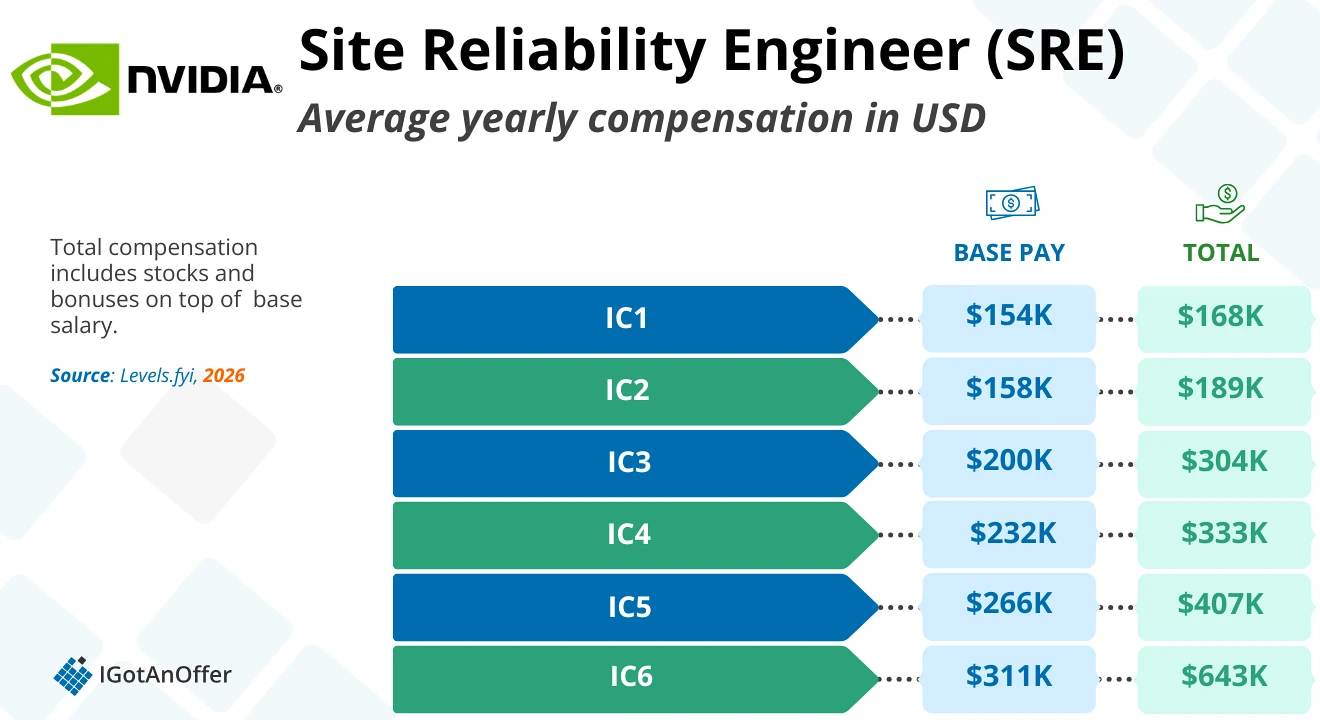
Based on Levels.fyi data, total compensation for the site reliability engineer role at NVIDIA in the US ranges from around $189K per year at IC2 to $643K at IC6. The median total package is approximately $345K.
A large share of that comes as equity. NVIDIA grants it as NSUs (NVIDIA Stock Units), which are the same as the RSUs (Restricted Stock Units) other companies use. They vest over four years, but more of your equity comes in the first two years than in a standard even split.
Here are the average salaries and compensation for the different site reliability engineer levels at NVIDIA.
Ultimately, how well you perform in your interviews will shape what you're offered. That's one reason working with an ex-NVIDIA interview coach can offer a strong return on investment.
As with all top tech companies, compensation is negotiable. If you receive an offer, don't be afraid to ask for more. If it's your first time negotiating, work directly with one of our salary negotiation coaches to get in-depth and personalized advice.
2. NVIDIA site reliability engineer interview process and timeline ↑
Here is what to expect from the NVIDIA software engineer interview process, from your first application to the offer stage. For a complete breakdown across all NVIDIA roles, see our NVIDIA interview process guide.
2.1 What interviews to expect
The NVIDIA interview process for the site reliability engineer role typically takes 6-8 weeks from application to offer. Note that timelines vary based on how quickly feedback moves between stages.
Most candidates go through these steps:
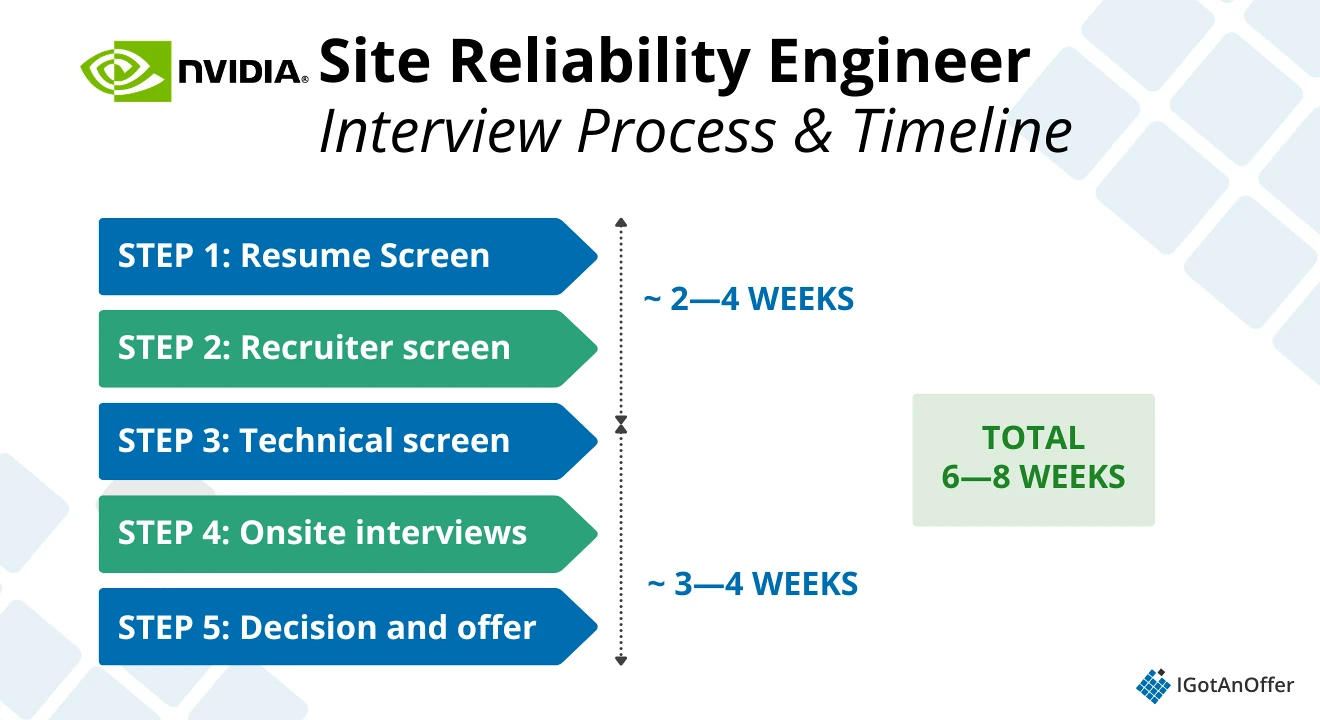
- Resume screen
- Recruiter screen (30 min)
- Technical screen (often a HackerRank test or phone screen)
- Onsite interviews (4-5 rounds, 45-90 min each)
- Hiring decision and offer
Let's look at these steps in more detail.
2.1.1 Resume screen ↑
First, a recruiter reviews your resume to check whether your experience matches the open role. This is the most competitive stage. We’ve found that ~90% of candidates don’t make it past this stage.
To improve your chances, tailor your resume to both NVIDIA and the specific role, and highlight hands-on experience with Linux, Kubernetes, networking, and automation. A referral from someone at NVIDIA can also help you get noticed.
For tips on writing your resume, see our software engineering resume examples. You can also get feedback from our team of ex-FAANG recruiters, who will cover what achievements to focus on (or ignore), how to fine-tune your bullet points, and more.
2.1.2 Recruiter screen ↑
If your resume passes, an NVIDIA recruiter will reach out for a call that usually lasts around 30 minutes.
The recruiter will confirm details on your resume, ask about your motivation for joining NVIDIA, and gauge your fit for the role. It’s your opportunity to show a genuine interest in the company's mission and technology. Come prepared with answers that show you've researched your target role, NVIDIA's products, recent developments, and the team you'd be joining.
Use this call to also ask about the number of interviews, the focus of each round, and the expected timeline. Avoid discussing salary expectations this early, since it can limit your negotiating power later.
2.1.3 Technical screen ↑
The next stage is the first technical assessment. The goal here is to test your core problem-solving and coding skills before the onsite.
Some candidates receive a HackerRank test, often mixing Bash and Python scripting problems at easy to medium difficulty. Others complete a phone screen with an engineer covering Linux, networking, and general SRE knowledge. You won't be allowed to use outside tools such as ChatGPT, and doing so results in disqualification.
The exact format varies by team, since NVIDIA gives hiring managers significant autonomy over how they run their interviews.
2.1.4 Onsite interviews ↑
The onsite loop is the most intensive part of the process. You'll typically face 4 to 5 back-to-back rounds, each lasting 45-90 minutes, conducted virtually or at an NVIDIA office.
The exact mix varies by team, but SRE loops commonly include the following rounds:
- Technical fundamentals (Linux, networking, and operating system internals)
- Kubernetes and containers
- Troubleshooting
- Coding, including Bash and Python scripting
- System design
- Behavioral or managerial
We cover each of these rounds in detail, with examples, in Section 3.
Your interviewers will all be from the specific team you're applying to join. This means the depth and focus of each round can shift depending on what the team works on.
2.1.5 Hiring decision and offer ↑
After your onsite, interviewers submit their feedback, and a hiring committee reviews it alongside your application. This usually takes one to three weeks.
NVIDIA doesn't always decide on a rolling basis. Some teams interview several candidates before making a call, which can stretch the timeline. If you haven't heard back within two weeks, a polite follow-up to your recruiter is reasonable.
If you get an offer, your recruiter will schedule a call to discuss terms, and you may have a final conversation about team matching.
For detailed negotiation strategies, check out our video on the 10 rules of salary negotiation and our guide on negotiating offers at Amazon, whose processes are similar to NVIDIA’s.
2.2 What is NVIDIA looking for?
Throughout the interviews, NVIDIA assesses whether you align with its five core values:
- Innovation
- Intellectual honesty
- Speed and agility
- Excellence
- One team
For SRE candidates specifically, interviewers want real production experience that goes beyond textbook knowledge. They want clear communication, since you'll explain incidents and trade-offs to both technical and non-technical colleagues. And they want evidence that you can stay methodical when a system is failing.
One thing to keep in mind is how decentralized the process is. Hiring managers design their own team's interviews, so your experience may differ from another candidate's. When possible, ask your recruiter what each round will cover so you can focus your prep.
3. Example NVIDIA site reliability engineer interview questions ↑
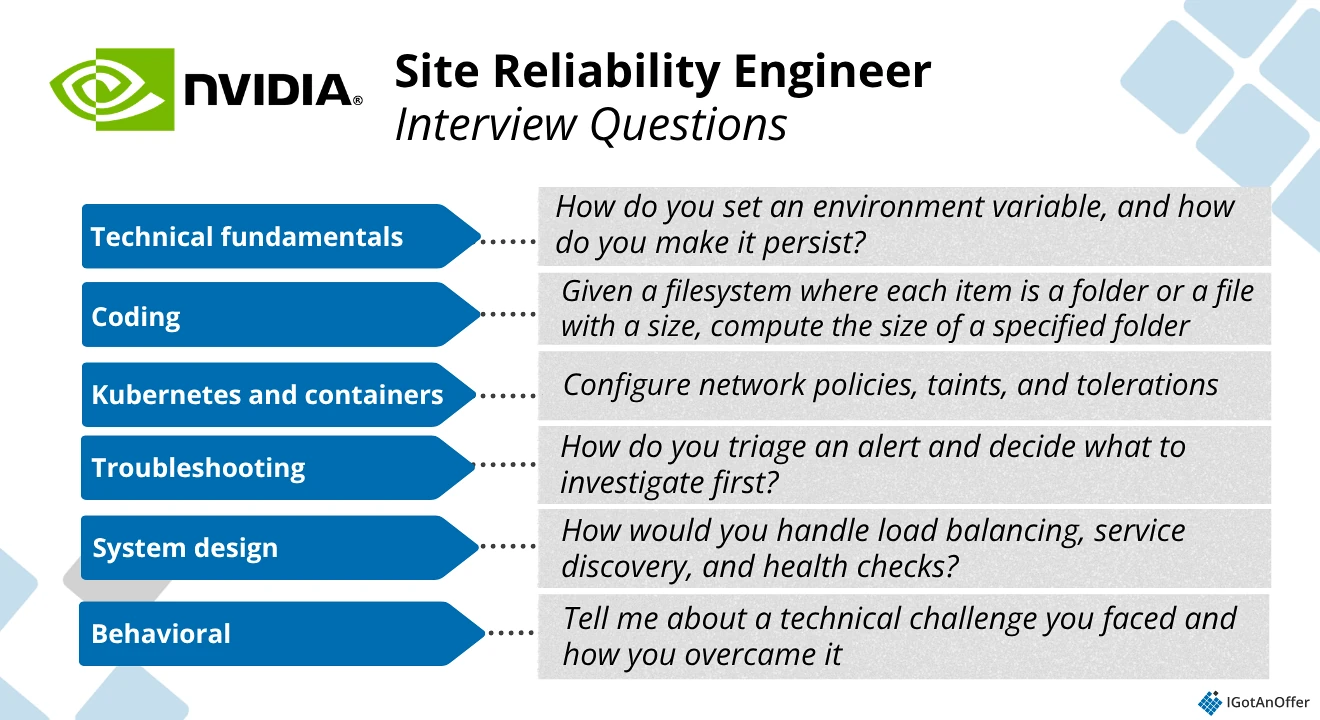
Now that you know how the process works, let's look at the kinds of questions you can expect. NVIDIA SRE questions tend to fall across the areas below:
The questions below come from NVIDIA SRE candidate reports on Glassdoor and firsthand write-ups from people who interviewed for the role.
3.1 Technical fundamentals questions ↑
NVIDIA SRE loops typically open with core systems knowledge. Interviewers want to see that you understand what happens beneath the commands you run, since diagnosing a production incident means reasoning about processes, memory, and traffic when the usual tools aren't enough.
Expect rapid-fire questions that move from a concept to how you'd apply it. For example, you might be asked how you’d diagnose an unresponsive process, followed up by questions about how the kernel schedules processes, how you'd inspect its memory, and which signal you'd send to recover.
Add depth by explaining the layer beneath the command. If you name top to find a runaway process, explain what it reads from /proc and what the load average actually measures.
Example NVIDIA SRE interview questions: Technical fundamentals
Linux
- How do you set an environment variable, and how do you make it persist?
- What's the difference between df and du?
- What do nmcli, iptables, and firewalld do?
- How would you block a specific IP address using Linux firewall rules?
Networking
- What are DNS, HTTP, and HTTPS, and what are their default ports?
- Explain the SSH, NFS, SFTP, and FTP protocols
- How are packets transferred across the internet and an intranet?
- How does DHCP assign IP addresses, and how do routers fit into that flow?
Operating system internals
- Explain paging and segmentation
- Explain deadlocks and semaphores
- What's the difference between killing a process with -9 and without it?
- What happens at the kernel level when you type ls -l? (Google) (Solution)
To brush up on all three areas, this SRE prep guide on GitHub is a useful free resource.
3.2 Coding questions ↑
NVIDIA SREs write a lot of automation, so interviewers check that you can code cleanly and script practical solutions. You’ll typically encounter coding questions in two forms: algorithmic problems and hands-on scripting tasks.
The algorithm questions are usually at LeetCode medium difficulty. Some interviewers will ask you to solve a problem without reaching for built-in functions, since they want to see that you understand what the abstraction does underneath.
The scripting side is more practical. Expect real tasks like parsing a log file, transforming text with sed and awk, or looping through data the way you would in a maintenance script. Many roles let you choose your language, though GPU and systems-level teams often expect C++.
To help you prepare, we’ve included real NVIDIA SRE coding questions reported by candidates on Glassdoor, along with example questions from Google for a similar role.
Example NVIDIA SRE interview questions: Coding
Algorithms
- Given a collection of ads (data structure given), what is the mean and median of the array? (Solution)
- Given a filesystem where each item is a folder or a file with a size, compute the size of a specified folder (Google)
- Given a data structure of rows (source, ratio, destination), find the conversion value for a given source and destination, e.g. (EUR, 1.23, GBP) (Google) (Solution)
Scripting
- Write a Bash script that loops through every line in a text file and performs an operation on each
- Handle file input and output in Bash
- Use sed and awk to process and transform text
- Solve a set of Python problems covering data structures and string manipulation
For more practice, see our coding interview prep guide and our list of coding interview examples.
3.3 Kubernetes and containers questions ↑
Kubernetes comes up more often in NVIDIA SRE interviews than in many other companies' SRE loops. NVIDIA uses Kubernetes to deploy and manage workloads across its GPU clusters, and as an SRE, you need to know how to keep these systems running reliably and troubleshoot issues when they arise.
This round is often hands-on. Some candidates are dropped into a live cluster and asked to debug a failing deployment while the interviewer watches how you narrow down the cause. Others face conceptual questions on the tooling around Kubernetes, including Helm, Docker, and monitoring stacks like Prometheus.
Either way, prepare by running a cluster yourself, since the round is built to surface real operating experience.
Example NVIDIA SRE interview questions: Kubernetes and containers
- Configure network policies, taints, and tolerations
- How does port mapping work in Docker?
- How would you build an image from a Dockerfile?
- What's the difference between a Helm chart and a Helm release?
- What monitoring and logging options would you use for a managed Kubernetes cluster?
- How would you provision worker nodes and handle control plane updates?
3.4 Troubleshooting questions ↑
Troubleshooting is core to the SRE role, so expect at least one round built around it. Interviewers want to see a structured approach that leads you to the root cause step by step.
You may be given an incident and asked to talk through how you would troubleshoot the problem. Good answers form a hypothesis, test it against the evidence, and rule things out methodically instead of guessing.
You may also be asked how you'd communicate the problem to others while working through it, since on-call SREs keep stakeholders informed as much as they fix systems.
Example NVIDIA SRE interview questions: Troubleshooting
- How do you troubleshoot an issue when you're on call?
- How do you triage an alert and decide what to investigate first?
- How would you explain an issue to a non-technical person during and after the fix?
- How would you approach a network troubleshooting problem?
3.5 System design questions ↑
Mid-level and senior candidates at NVIDIA are typically given a system design round focused on reliability, scalability, and availability. The emphasis is on how your design behaves in production, including where it might fail and how you'd recover.
You'll usually be given an open-ended problem and asked to reason through the trade-offs out loud.
Example NVIDIA SRE interview questions: System design
- Design a microservices-based deployment architecture using Docker, with a focus on scalability and high availability
- How would you handle load balancing, service discovery, and health checks?
- How would you integrate CI/CD into a containerized build pipeline?
- Design a system for copying a file to remote servers (Google)
Check out our guide to the 11 most-asked system design interview questions for more practice questions, sample answers, and tips for answering these questions.
3.6 Behavioral questions ↑
The final round is usually a behavioral interview with the hiring manager, covering communication, ownership, and cultural fit. Individual contributor candidates face it, so expect it even if you are not interviewing for a management role.
Prepare specific stories that show how you collaborate across teams, adapt to change, and take ownership of outcomes.
NVIDIA SRE candidates tend to face fewer behavioral questions. But at a minimum, you'll at least face some "culture" type questions that test your fit at NVIDIA.
Example NVIDIA SRE interview questions: Behavioral
- Why do you want to join NVIDIA? (Sample answer)
- Describe a difficult interaction with a customer. How did you handle it?
- Tell me about a time you worked on an initiative and saw a chance to make it bigger. How did you convince your team?
- Tell me about a technical challenge you faced and how you overcame it
- Tell me about a time you had to adapt to changing requirements
- Tell me about a time you made a mistake. What did you learn?
To prepare, work through our guide to behavioral interview questions to learn a repeatable method for structuring your answers.
4. NVIDIA site reliability engineer interviewing tips ↑
You might be a strong site reliability engineer, but that alone won't guarantee you pass the interviews. Interviewing is a skill you have to practice. Here are some tips to help you approach your NVIDIA SRE interviews the right way.
4.1 Ask clarifying questions
Many NVIDIA SRE questions are open-ended, especially in troubleshooting and system design. Before diving in, restate the problem and ask questions to confirm your understanding. Jumping straight to a solution without clarifying is a common way to lose points.
4.2 Show your production experience
NVIDIA interviewers want to see that you understand how tools behave in production, beyond how they work in theory. When you answer, ground your reasoning in real systems you've run, real incidents you've handled, and real trade-offs you've made.
Prepare two or three strong examples in depth rather than simply summarizing a project you’ve built. For guidance on structuring these stories, see our sample answer to the "project you're most proud of" question.
4.3 Think out loud
Walk your interviewer through your thought process as you work through the problem. In troubleshooting and design rounds, for example, explain why you're ruling certain options in or out as you go.
Your interviewer may also give you hints about whether you're on the right track, so listen carefully and be prepared to adjust your approach if needed.
4.4 Prepare for hands-on rounds
Some NVIDIA SRE rounds are hands-on. You might debug a live Kubernetes cluster or solve scripting problems on HackerRank. Practice in a real terminal, do the work under time pressure, and talk through it as you go.
4.5 Center your answers on NVIDIA's values
Familiarize yourself with NVIDIA's five core values: innovation, intellectual honesty, speed and agility, excellence, and one team. In your behavioral round, choose stories that show these qualities, especially your ability to own mistakes and learn from them.
For example, you can describe an incident you caused, how you flagged the issue, and what you changed afterward to prevent it from happening again.
4.6 Be honest about what you don't know
Be genuine in your responses. NVIDIA interviewers appreciate authenticity and honesty.
If you faced challenges or setbacks, discuss how you improved and learned from them. If you’re asked about your failures, don’t disguise them as strengths.
NVIDIA values intellectual humility; admit where you went wrong and what you were able to learn from the failure.
4.7 Practice system design
Even more than with coding problems, answering system design questions is a skill in itself. You should start with a high-level design and then drill down on the system component of the design. Our guide to the 11 most-asked system design interview questions has sample answers to practice against.
5. How to prepare for NVIDIA site reliability engineer interviews ↑
Now that you know what to expect, let's look at how to prepare efficiently for your NVIDIA SRE interview. Below are the four steps we recommend.
5.1 Learn about NVIDIA's culture
This is a key step many candidates skip. Before investing your time in a long and demanding interview process like NVIDIA's, make sure it's the right company for you.
Because NVIDIA is a well-known and powerful company, many people assume they should apply without weighing the role more carefully. Prestige alone doesn't make a job the right fit.
If you know engineers who work or used to work at NVIDIA, reach out to learn about the culture and daily work. It's also worth doing your own research, starting with these resources:
- NVIDIA's culture and values (by NVIDIA)
- NVIDIA life and careers blog (by NVIDIA)
- Life at NVIDIA (by NVIDIA Careers)
- Monitoring GPUs in Kubernetes with DCGM (by NVIDIA), how SRE teams expose GPU telemetry to Prometheus and Grafana, the exact stack the interview asks about
- Automate Kubernetes AI cluster health with NVSentinel (by NVIDIA), node and cluster level health diagnosis, triage, and remediation, straight from how NVIDIA's own DevOps and SRE teams operate
- What's the company culture like at NVIDIA? (by Built In), an outside read on the culture drawn from employee feedback
- NVIDIA interview process (by IGotAnOffer)
5.2 Practice by yourself
Once you've learned more about NVIDIA, study the types of questions you'll be asked. A few strong resources, several of which we used in writing this guide:
For coding:
- Coding interview prep guide: a step-by-step framework with practice questions
- How to answer coding interview questions: a structured method for live coding rounds
- Coding interview examples: practice problems across question types
- Data structure interview questions: the underlying fundamentals, with dedicated sections on arrays, strings, graphs, trees, linked lists, stacks and queues, sorting, dynamic programming, and Big-O analysis
For Kubernetes and containers:
- The official Kubernetes documentation, plus a local cluster you can break and fix
For system design:
- System design interview guide: our 4-step framework, plus practice questions
- How to answer system design questions: a minute-by-minute breakdown of a strong answer
- 19 system design interview tips: advice from ex-interviewers at Amazon and Google
- Staff system design interview: for lead and above candidates
For behavioral questions:
- Our behavioral interview prep guide for common questions and how to structure answers
5.3 Practice with peers
Once you're in command of the material, you'll want to practice answering out loud. By yourself, though, you can't simulate thinking on your feet or the pressure of performing in front of a stranger. There are also no unexpected follow-ups and no feedback.
If you have friends or peers who can run mock interviews with you, that's worth trying. It's free, but it comes with drawbacks:
- It's hard to know whether the feedback is accurate
- Peers are unlikely to have insider knowledge of NVIDIA's interviews
- On peer platforms, people often don't show up
For those reasons, many candidates skip peer mocks and practice with an expert instead.
5.4 Practice with experienced SRE interviewers
We have coached more than 20,000 people for interviews at top tech companies since 2018. In our experience, practicing real interviews with experts who can give you company-specific feedback makes a significant difference.
Find an NVIDIA SRE interview coach so you can:
- Test yourself under real interview conditions
- Get accurate feedback from a real expert
- Build your confidence
- Get company-specific insights
- Learn how to tell the right stories, better
- Save time by keeping your prep focused
Landing a job at a big tech company often results in a $50,000 per year or more increase in total compensation. In our experience, three or four coaching sessions worth ~$500 make a significant difference in your ability to land the job. That’s an ROI of 100x!
Click here to book mock interviews with experienced SRE interviewers












 AI system design