


 Back to other articles
  Last updated: March 11, 2026

 Interviews
 Data analyst
 Deeply researched
Meta’s data analyst interviews are demanding.
The entire interview process spans multiple rounds. As a data analyst candidate, you’ll be tested on the role’s key skills, all at the scale of one of the world's largest technology companies.
The Meta data analyst interview process covers a distinct mix of challenges: You'll need to write complex SQL queries, define and investigate product metrics, and demonstrate strong cross-functional communication. You'll also face behavioral questions designed to assess how you collaborate, handle ambiguity, and align with Meta's culture.
The good news? With the right preparation, you can significantly improve your chances of landing a data analyst role at Meta.
To put together this guide, we gathered insights from real candidate reports from Glassdoor and official Meta resources to give you an accurate, detailed picture of what to expect.
Here's an overview of everything we'll cover about Meta’s data analyst interviews:
- Role and salary
- Interview process and timeline
- Example interview questions
- Interviewing tips
- Preparation plan
Click here to practice 1-on-1 with ex-Meta interviewers.
1. Meta data analyst role and salary ↑
Before we get into the interview process, let's take a closer look at the Meta data analyst role itself.
1.1 What does a Meta data analyst do?
As a data analyst (DA) at Meta, your core job is to turn data into insights that help Meta’s business and product teams make faster, better decisions. You'll work across Meta's family of platforms, including Facebook, Instagram, WhatsApp, and Messenger.
Unlike the data scientist role at Meta, which is heavily focused on experimentation and statistical analysis, the data analyst role sits closer to the business side. Your work centers on generating quick, reliable insights that inform product and business strategy.
Day-to-day, your responsibilities will typically include:
- Writing SQL queries to extract and manipulate data from large datasets
- Building dashboards and reports in tools like Tableau or Meta's internal analytics platforms
- Defining and tracking metrics to monitor product and business performance
- Presenting findings to cross-functional stakeholders, including product managers, engineers, and marketing teams
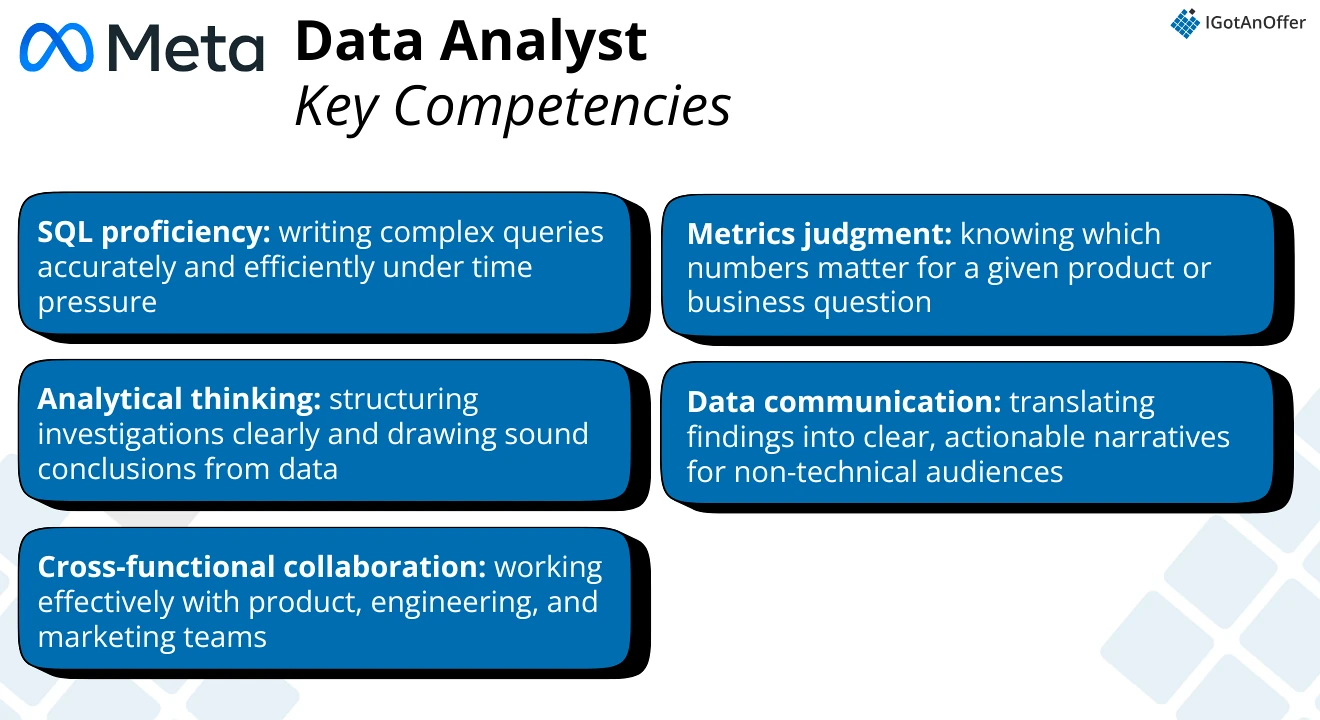
To do this well, you'll need a strong combination of technical and communication skills. Key competencies for the role include:
1.2 Meta data analyst vs. similar roles
Candidates often confuse the data analyst role with two similar Meta positions: data scientist (product analytics) and product analyst.
These roles share some common ground but they differ in where they sit within the organization and what they're actually asked to do.
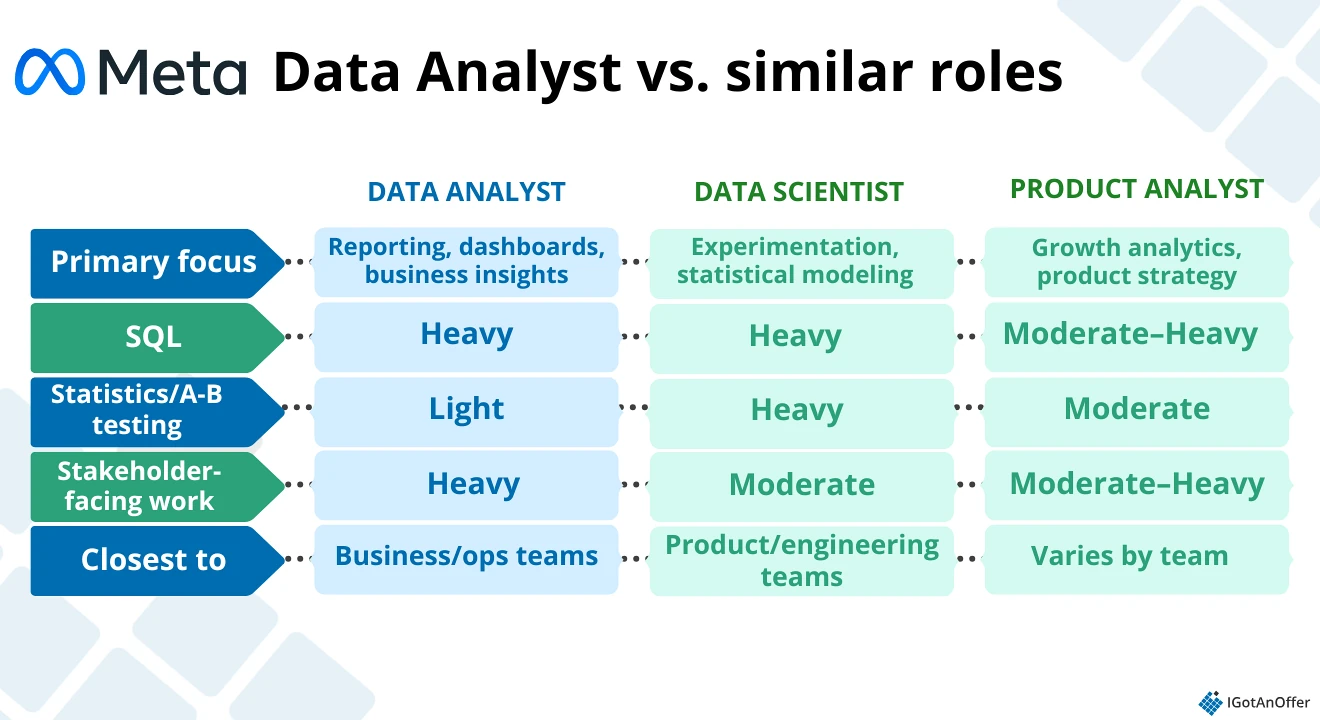
Of the three, the data analyst role is the most business-facing. While data scientists spend much of their time designing and analyzing experiments, data analysts focus on turning existing data into clear, actionable insights for non-technical stakeholders. (The product analyst role sits somewhere in between, though its scope varies significantly by team.)
If you're uncertain which role you're interviewing for, confirm with your recruiter because the interview process and question types differ meaningfully across the three.
1.3 How much does a Meta data analyst make?
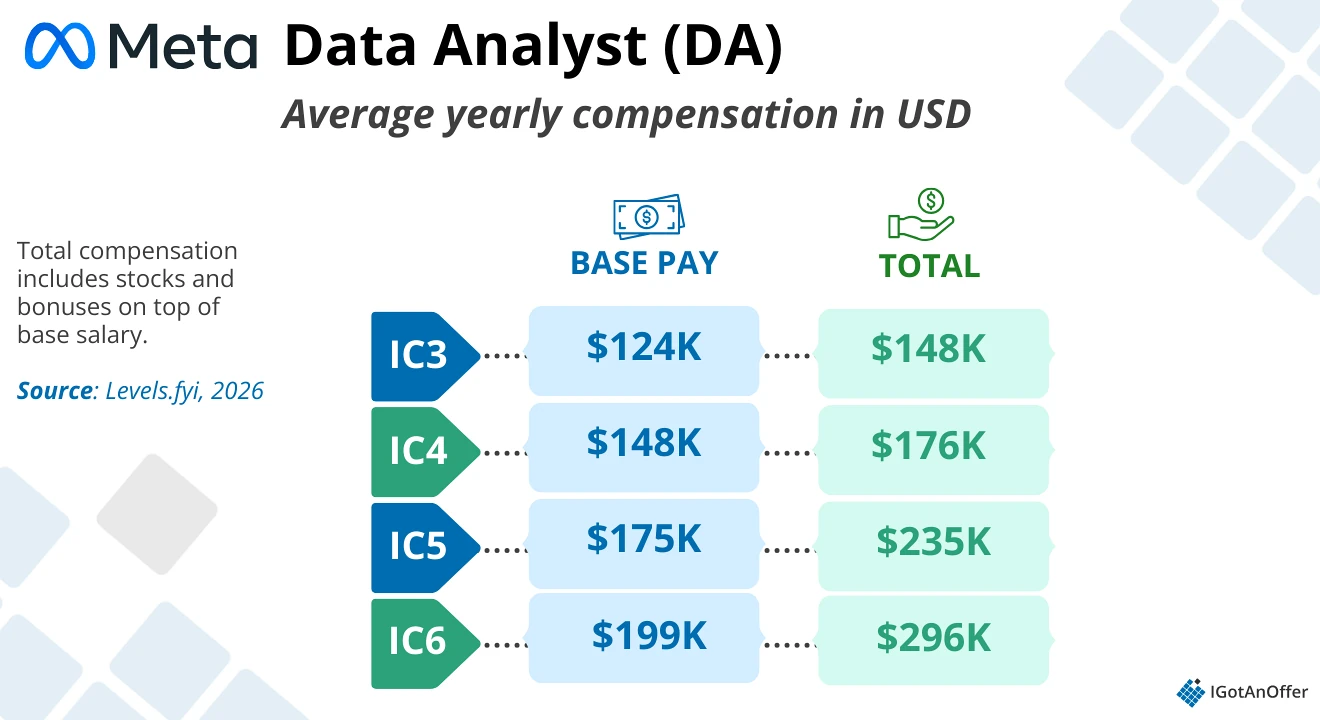
The compensation for Meta data analysts is among the highest in the tech industry, with a median total compensation of around $248K as of early 2026.
That median figure includes base salary, RSUs, and bonuses. As with all Meta roles, the stock component can be significant, so it's worth understanding how each part of the package is structured when you receive an offer.
Below you can see the average salary and compensation of the different data analyst levels at Meta US, as of March 2026, based on Levels.fyi.
Ultimately, how you do in your interviews will help determine your offer. That’s why hiring one of our ex-Meta interview coaches can provide such a significant return on investment.
And remember, compensation packages are always negotiable, even at Meta. If you do get an offer, don’t be afraid to ask for more!
If you need help negotiating, read our Meta salary negotiation guide for tips and consider booking one of our salary negotiation coaches to get expert advice.
2. Meta data analyst interview process and timeline ↑
2.1 What steps to expect
The Meta data analyst interview process typically takes 4 to 8 weeks and follows these steps:
- Resume screen
- Recruiter screen
- Technical SQL screen (~45–60 minutes)
- Full loop round (3–4 interviews, 45 minutes each)
Here's what each stage involves.
2.1.1 Resume screen ↑
First, recruiters will look at your resume and assess if your experience matches the open position. This is the most competitive step in the process, as millions of candidates do not make it past this stage.
To stand out, you’ll need to have an outstanding resume. Take a look at real Meta resume examples to see which kinds of resumes get noticed.
If you’re looking for expert feedback on your resume, you can get input from our team of ex-Meta recruiters, who will cover what achievements to focus on (or ignore), how to fine-tune your bullet points, and more.
Getting an employee referral might also help. According to Glassdoor, 25% of candidates who got interviews with Meta had employee referrals.
So, if you know someone who works at Meta, this could help you get your foot in the door. Just know that a referral won’t guarantee you the role; it will simply help your resume get noticed.
2.1.2 Recruiter screen ↑
In most cases, you'll start your interview process with Meta by talking to an HR recruiter on the phone. They are looking to confirm that you've got a chance of getting the job at all, so be prepared to explain your background and why you’re a good fit at Meta.
You should expect typical behavioral and resume questions like, "Tell me about yourself," "Why do you want to work at Meta?", or "Tell me about your current day-to-day."
If you get past this first HR screen, the recruiter will then help schedule an initial interview with a peer or hiring manager.
One great thing about Meta is that they are very transparent about their recruiting process. Expect your HR contact to walk you through the remaining steps in the hiring process and share with you a helpful email listing resources you can use to prepare.
2.1.3 Technical screen ↑
The technical screen is a 45–60 minute live coding session on CoderPad. You'll be given two to three SQL problems of increasing difficulty, observed in real time by an interviewer.
Candidates on Glassdoor consistently report that this stage covers joins, subqueries, CTEs, and window functions. These tests are all applied to realistic product or business scenarios rather than abstract puzzles. Some candidates also get a brief product or metrics question at the end of the screen alongside the SQL.
One important thing to note: CoderPad doesn't execute your code. You'll need to write syntactically correct queries without being able to run them and check the output.
Practice writing SQL longhand without an execution environment, as it's a skill in itself and one that catches many candidates off guard.
2.1.4 Full loop round ↑
If you clear the technical screen, you'll be scheduled for the full loop. These are a set of 3–4 back-to-back virtual interviews, each 45 minutes, covering different skill areas.
The full loop typically includes the following:
- SQL deep dive: A more challenging coding round than the technical screen, covering complex multi-table queries and window functions.
- Product sense and case round: You'll define metrics, investigate a data problem, and present your findings to a non-technical stakeholder.
- Behavioral round: Structured questions assessing how you work, handle challenges, and align with Meta's values.
- Additional interview: Some candidates report a fourth round covering data visualization and Tableau, or a broader discussion with a hiring manager.
The exact composition of your loop can vary by team and level, so confirm the structure with your recruiter in advance.
2.2 What happens behind the scenes
Throughout the interview process at Meta, the recruiter usually plays the role of "facilitator" and moves the process from one stage to the next. Here's an overview of what typically happens behind the scenes:
- After the initial screen, the interviewer(s) you've talked to submit their ratings and notes to the internal system. Your recruiter then reviews the feedback and decides to move you to the full loop interviews or not, depending on how well you've done.
- After the Full Loop, the interviewers will make a recommendation on hiring you or not, and the recruiter compiles your "packet" (interview feedback, resume, referrals, etc.). If they think you can get the job, they will present your case at the next candidate review meeting.
- Candidate review meetings are used to assess all candidates who have recently finished their Full Loops and are close to getting an offer. Your packet will be analyzed, and possible concerns will be discussed. Your interviewers are invited to join your candidate review meeting, but will usually only attend if there's a strong disagreement in the grades you received (e.g., 2 no-hires, 3 hires). At the end of the candidate review meeting, a hire/no-hire recommendation is made for consideration by the hiring committee.
- The hiring committee includes senior leaders from across Meta. This step is usually a formality, and the committee follows the recommendation of the candidate review meeting. The main focus is on fine-tuning the exact level and, therefore, the compensation you will be offered.
It's also important to note that hiring managers and people who refer often have little influence on the overall process. They might help you get an interview at the beginning, but that's about it.
3. Meta data analyst example questions ↑
There are three primary categories of questions you’ll answer during the Google data analyst interview:
The questions below are drawn primarily from Meta data analyst candidate reports on Glassdoor.
Where DA-specific reports are limited, we've supplemented with questions from Meta data scientist candidates. This is because both roles share significant overlap with the DA role in terms of what gets tested.
Note that many of these questions are asked in the form of case studies. Take a look at our data science case study interview guide for more information on how to handle these types of questions.
Let’s get into the example questions.
3.1 SQL questions ↑
SQL is the most heavily tested skill at every stage of the Meta data analyst process.
DA candidates on Glassdoor consistently report being asked between 5-10 SQL questions across the initial screen and full loop.
Meta's approach to SQL questions is about structured thinking. Interviewers want to see how you break a business problem into a query, handle edge cases, and explain your logic at each step.
We've broken these down into two categories:
- SQL fundamentals: Conceptual questions that test your understanding of how SQL works. They test whether you know why certain approaches are more efficient or appropriate than others.
- Query writing: The bulk of what you'll face at Meta. These questions test your ability to translate a business problem into a working SQL query, handling joins, CTEs, window functions, and edge cases under time pressure.
The questions below progress from foundational to complex. Earlier questions in an interview tend to test core mechanics like joins, aggregations, and filtering, while later questions introduce window functions, CTEs, and multi-step logic applied to product data.
Here are some sample SQL interview questions from Glassdoor:
Meta data analyst interview question examples: SQL questions
1. SQL fundamentals
- What's the difference between HAVING and WHERE? Walk me through when you'd use each.
- How do you identify and remove duplicate records from a large table?
2. Query writing
- Given a table of Facebook posts, write a query to find the number of days between each user's first and last post of the year, for users who posted at least twice.
- Given a user actions table (sign-in, like, comment) with timestamps, find the number of monthly active users for a given month, where an active user also took action in the prior month.
- Given a user_posts table and a post_shares table, write a query to find the average number of shares per post for each user.
- Given a rides table and a users table, find the cancellation rate of requests made by unbanned users between two specified dates.
- Given a table with page_id, event timestamp, and an on/off status flag, find the number of pages currently active.
- Given a table of friend requests (sender_id, receiver_id, status), write a query to find the daily friend request acceptance rate.
- Given a product sales table with promotional campaign flags, show total units sold per product family and the ratio of promoted to unpromoted units sold, ordered by total units sold ascending.
- Using a user logins table, calculate how many users logged in an identical number of times on a specific date.
- Write a query using window functions to calculate a 7-day rolling average of daily revenue.
- Write a query to identify users who were active in month 1 but not in month 2.
For more SQL practice, check out our coding interview questions list and Meta coding interview guide.
3.2 Product analytics questions ↑
The product analytics round tests your ability to work with metrics in a business context. This means defining what to measure, investigating why a number changed, and communicating your findings clearly to a non-technical stakeholder.
If the previous SQL round shows interviewers that you can pull the numbers, the product analytics round shows them you know what to do with the data.
A DA at Meta is regularly asked to define what "healthy" looks like for a product, explain why something moved, and present that story to a non-technical stakeholder who needs to act on it.
These questions reflect what the data analyst role actually involves day to day. You'll face questions across three areas:
- Metrics design: Defining what to measure and why. Meta wants to see that you can identify the right signals for a product or feature.
- Product investigation: Diagnosing why a metric moved. These questions test whether you can structure an investigation logically, segment data systematically, and rule out causes methodically under pressure.
- Data storytelling: Communicating findings to non-technical stakeholders. As a DA, your analysis only creates value if the people who need to act on it can understand it, so expect questions that test how clearly you can present and explain data.
Here are some example product analytics interview questions.
Meta data analyst interview question examples: Product analytics
1. Metric design
- What product signals and metrics would you use to determine who a user's best friend is on Facebook, so you can prioritize their content in the news feed? Which metric matters most and why?
- How would you measure the success of Facebook Marketplace? (Meta data scientist)
- How would you measure the health of Facebook Groups? (Meta data scientist)
- You've been asked to build a Tableau dashboard to track ad performance. What metrics would you include and how would you organize them?
2. Product investigation
- If daily active users dropped 15% overnight, how would you investigate? (Meta data scientist)
- Facebook Stories engagement is down 20% week-over-week. Walk me through your investigation process. (Meta data scientist)
- What data would you look at to determine whether a new feature is cannibalizing engagement from an existing one?
3. Data storytelling
- Given a dataset of video watch times, how would you visualize key findings for a product team?
- A stakeholder asks you to summarize a product analysis. How would you present your findings to a non-technical audience?
- What are effective ways to make data more accessible to non-technical people?
For a deeper look at how to approach metric questions, read our guide on how to crack metric questions.
3.3 Behavioral questions ↑
In addition to the question types outlined above, you can also expect to be asked some behavioral questions about your past work, how you handle challenges, and why you're interested in Meta.
Behavioral interviews at Meta can be tricky. There’s no clear-cut “correct” answer, which makes it harder to gauge your performance in the moment.
That said, this round carries significant weight in the hiring decision. Meta is looking for thoughtful, self-aware candidates who can navigate ambiguity, communicate clearly, and work well across teams.
An answer about navigating ambiguity, for example, is a chance to show how you moved quickly with incomplete information rather than waiting for perfect conditions.
Remember, Meta's core values include Move Fast, Build Awesome Things, Be Direct, and Focus on Long-Term Impact. Your answers should subtly reflect these values.
Let’s look at some questions.
Meta data analyst behavioral interview question examples
- Why Meta?
- Tell me about a data project you're proud of. What was the impact?
- Describe a time you had to present data findings to a non-technical audience. How did you approach it?
- Tell me about a time you worked with incomplete or messy data. What did you do?
- Give an example of a time you influenced a business decision using data.
- How would your current manager describe you in three words — and what constructive criticism might they offer?
- How do you handle ambiguity when given an open-ended analytical question with no clear success criteria?
- Tell me about a time you had to prioritize competing analytical requests. How did you decide?
- Tell me about a time you handled a difficult stakeholder.
For a deeper dive into how to prepare for this round, see our guide to Meta behavioral interview questions.
4. Meta data analyst interviewing tips ↑
You might be a fantastic data analyst, but unfortunately, that won’t necessarily be enough to ace your interviews at Meta. Interviewing is a skill in itself that you need to learn.
Let’s look at some key tips to make sure you approach your interviews in the right way.
4.1 Ask clarifying questions
Often, the questions you’ll get will be quite ambiguous. Make sure you ask questions that can help you clarify and understand the problem.
Be upfront if you encounter topics you have little experience with, but don’t give up on tackling them. Meta isn’t just testing your technical skills but your ability to deal with problems you’re not familiar with.
4.2 Treat the interview like a conversation
Meta wants to know if you have excellent communication skills. So make sure you approach the interview like a conversation.
Meta will also be testing you on your ability to tell a clear and concise story through data, especially to stakeholders who may or may not have a technical background.
Be sure to practice communicating data in a way that’s clear and easy for everyone to understand.
4.3 Think out loud
You need to walk your interviewer through your thought process before you actually start coding. Meta recommends that you talk even while coding, as they want to know how you think.
Your interviewer may also give you hints about whether you’re on the right track or not. Be alert for these, and be ready to pivot once you’ve gotten the prompt. This shows you’re eager to learn and listen well to feedback.
4.4 State and check assumptions
You need to state assumptions explicitly, explain why you’re making them, and check with your interviewer to see if those assumptions are reasonable.
4.5 Present multiple possible solutions
Present multiple possible solutions if you can. Meta wants to know your reasoning for choosing a certain solution.
When dealing with complicated or ambiguous questions, show your ability to deconstruct such problems into groups and demonstrate how you can combine these groups for your proposed solution.
4.6 Anchor every metrics answer to a business goal
When asked to define or investigate a metric, don't jump straight to listing numbers. Start by clarifying what the product or feature is trying to achieve, then define what "success" actually looks like in that context. Meta wants to see that you understand why metrics matter, not just how to calculate them.
This is especially important for product investigation questions. A strong answer segments the data systematically (by platform, region, user cohort, time of day) rather than listing every possible cause at random.
5. Preparation plan ↑
Now that you know what questions to expect, let's focus on how to prepare. Below is our four-step prep plan for Meta.
5.1 Learn about Meta's culture
Most candidates fail to do this. But before investing a ton of time preparing for an interview at Meta, you should make sure it's actually the right company for you.
A good place to start is Meta's six core values, which appear throughout the interview process and should inform how you frame your answers:

Beyond the values, it's worth spending time understanding the broader company context. If you know anyone who works at Meta, a conversation with them will give you more useful insight than any resource list.
Meta recommends the following resources to help you understand the company:
- Meta's mission statement and core values
- Meta Newsroom
- Meta Life
- How to get users and grow (by Alex Schultz, VP of Growth at Meta)
- How Facebook Used Science And Empathy To Reach Two Billion Users (by FastCompany)
In addition, we recommend reading the following:
- Facebook's hacker culture (by Mark Zuckerberg, via Wired)
- Meta annual reports and strategy presentations (by Meta)
- Meta's approach to tech trends (by CB Insights)
- Meta org culture analysis (by Panmore Institute)
5.2 Practice by yourself
You'll need to prepare across three main question categories: SQL, product analytics, and behavioral. Here's a complete list of resources, including our own guides and ones recommended by Meta.
Official Meta guides:
General
SQL
- Practice for 3 types of SQL interviews
- SQL Course
- Mode Analytics SQL tutorials
- DataLemur Meta SQL questions
- Meta coding interview guide
- Python | SQL Comparison
- Data Transformations in R
- The Ultimate DSA guide
Product analytics and metrics
- How to crack metric questions
- How to crack product improvement questions
- How to crack data science case studies
Behavioral
- Meta behavioral interview questions
- People management questions in tech interviews
- Dealing with conflict, dealing with stakeholders
- Why Meta?
For a more in-depth guide to Meta interviews in general, we also created our very own Meta interview fact sheet.
Once you’re in command of the subject matter, you’ll want to practice answering questions. But by yourself, you can’t simulate thinking on your feet or the pressure of performing in front of a stranger. Plus, there are no unexpected follow-up questions and no feedback.
That’s why many candidates try to practice with friends or peers.
5.3 Practice with peers
Practicing by yourself will only take you so far. One of the main challenges of data scientist interviews at Meta is communicating your different answers in a way that's easy to understand.
As a result, we strongly recommend practicing with a peer or a friend. Even better if you can find someone with the same background or has interviewing experience.
However, be warned, as you may come up against the following problems:
- It’s hard to know if the feedback you get is accurate.
- They’re unlikely to have insider knowledge of interviews at your target company.
- On peer platforms, people often waste your time by not showing up.
For these reasons, many candidates skip peer mock interviews and go straight to mock interviews with an expert.
5.4 Practice with experienced ex-Meta interviewers
In our experience, practicing real interviews with experts who can give you company-specific feedback makes a huge difference.
Find a Meta data analyst interview coach so you can:
- Test yourself under real interview conditions
- Get accurate feedback from a real expert
- Build your confidence
- Get company-specific insights on SQL and analytics questions
- Save time by focusing your preparation
Landing a data analyst role at Meta typically results in a $50,000+ per year increase in total compensation compared to similar roles elsewhere. In our experience, three or four coaching sessions worth ~$500 make a significant difference in your ability to land the job. That's an ROI of 100x.
Click here to book a mock interview with an experienced data analysis interviewer.









 People management and Leadership