


 Back to other articles

 Last updated: October 02, 2026

 Interviews
 Finance and strategy manager
 Deeply researched
If you’re preparing for the Amazon Finance Manager interview, this guide covers everything you need to know. You’ll learn the full interview process, plus example questions and a step-by-step preparation plan.
Amazon is globally recognized as a top-tier destination for tech talent, but it is also competitive for finance roles. The company offers compensation well above the industry average and the opportunity to work at the center of one of the world’s most sophisticated retail and cloud infrastructures.
Because of this, the hiring bar is extremely high. The interview process is notoriously rigorous, with the final loop alone stretching across 4 to 7 back-to-back interviews in a single day.
To put together this guide, we analyzed hundreds of Amazon finance manager candidate reports on Glassdoor. Below, you’ll find a detailed breakdown of the hiring process, real sample interview questions, and the essential prep resources you need to succeed.
- Role and salary
- Interview process and timeline
- Example interview questions
- Interviewing tips
- Preparation plan
Click here to book 1-on-1 coaching with finance manager ex-interviewers
1. Amazon finance manager role and salary
Before we dive into your Amazon finance manager interviews, let’s take a look at the role itself.
1.1 What does an Amazon finance manager do?
As an Amazon Finance Manager (L6), you act as a co-pilot for the business, using financial data to drive growth while protecting margins. Ashley (corporate finance manager and ex-Amazon interviewer) says that the scope of the role is broad, spanning controllership and fiduciary oversight to strategic growth and operational efficiency.
You’ll work closely with cross-functional teams, including operations, marketing, and engineering, to evaluate new initiatives. You may also support a wide range of Amazon businesses, such as Cloud Computing (AWS), Digital Entertainment (Prime Video & MGM Studios), Global Logistics, and Corporate Accounting.
Your typical responsibilities include building financial models for new products, performing “Deep Dives” into Profit & Loss (P&L) variances, and managing the annual planning process (known at Amazon as Operating Plan 1 (OP1) and Operating Plan 2 (OP2)).
1.2 What competencies are being assessed during the interview?
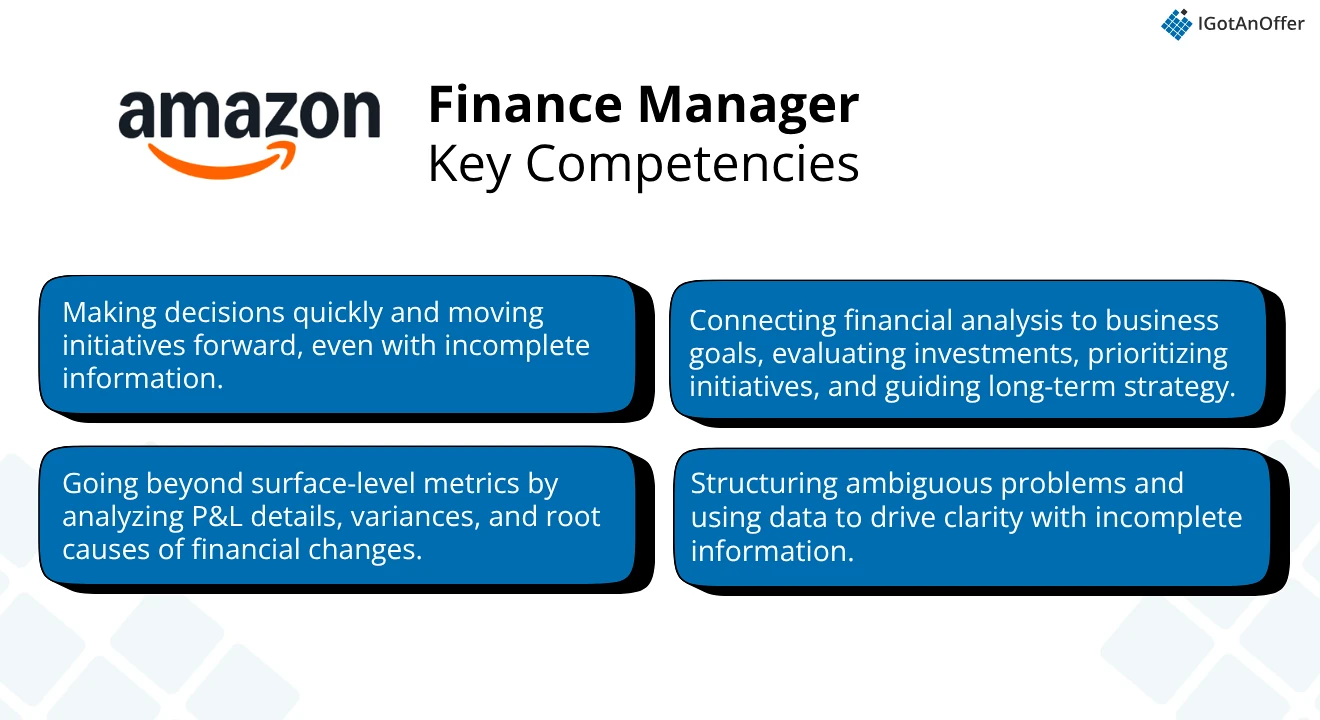
According to Ashley (corporate finance manager and ex-Amazon interviewer), here are the key competencies being evaluated during your Amazon finance manager interview:
- Bias for action: Amazon looks for candidates who can make decisions quickly and move initiatives forward even with incomplete information. Finance managers are expected to take ownership, identify issues early, and proactively recommend solutions.
- Strategic thinking: Ability to connect financial analysis to broader business goals, evaluate investments, prioritize initiatives, and guide long-term strategy.
- Dive deep: Going beyond surface-level metrics by analyzing the details of a P&L, investigating variances, and identifying the root causes behind financial or operational changes.
- Operating in ambiguity: Ability to structure unclear problems, form hypotheses, and use data to drive clarity in fast-moving environments with incomplete information.
What skills are required to be an Amazon finance manager?
To be considered for a Finance Manager role at Amazon, candidates typically need a high degree of financial "ownership" and the ability to influence business decisions through data.
Based on recent Amazon finance job listings, common requirements include:
- Relevant Experience: Typically 5+ years of experience in finance, financial planning and analysis (FP&A), or a related analytical field (often requiring an MBA or professional certification like a CPA/CFA).
- Analytical Rigor: A proven track record of building complex financial models, performing "Deep Dives" into P&L variances, and managing large-scale budgeting processes.
- Technical Proficiency: Advanced Excel skills are mandatory, and most roles require (or strongly prefer) proficiency in SQL to pull raw data from Amazon’s massive databases.
- Strategic Influence: The ability to work cross-functionally with operations, marketing, and engineering to align financial goals with business growth.
“Finance leaders at Amazon aren’t just ‘number crunchers’; they have a seat at the table as true thought partners to the business,” says Ashley.
This means you must have the backbone to challenge business leaders when the data doesn't support a strategy, ensuring that every investment is made with long-term value in mind.
1.2 How much does an Amazon finance manager earn?
Based on Glassdoor’s data computations, the estimated average pay of an Amazon Finance Manager is 43% higher than the national average for other US Finance Managers. The median base pay is $131,000 a year, while total compensation (including cash bonuses and stock) averages $206,000.
As of early 2026, here is the salary breakdown for the Finance Manager role based on Levels.fyi data:
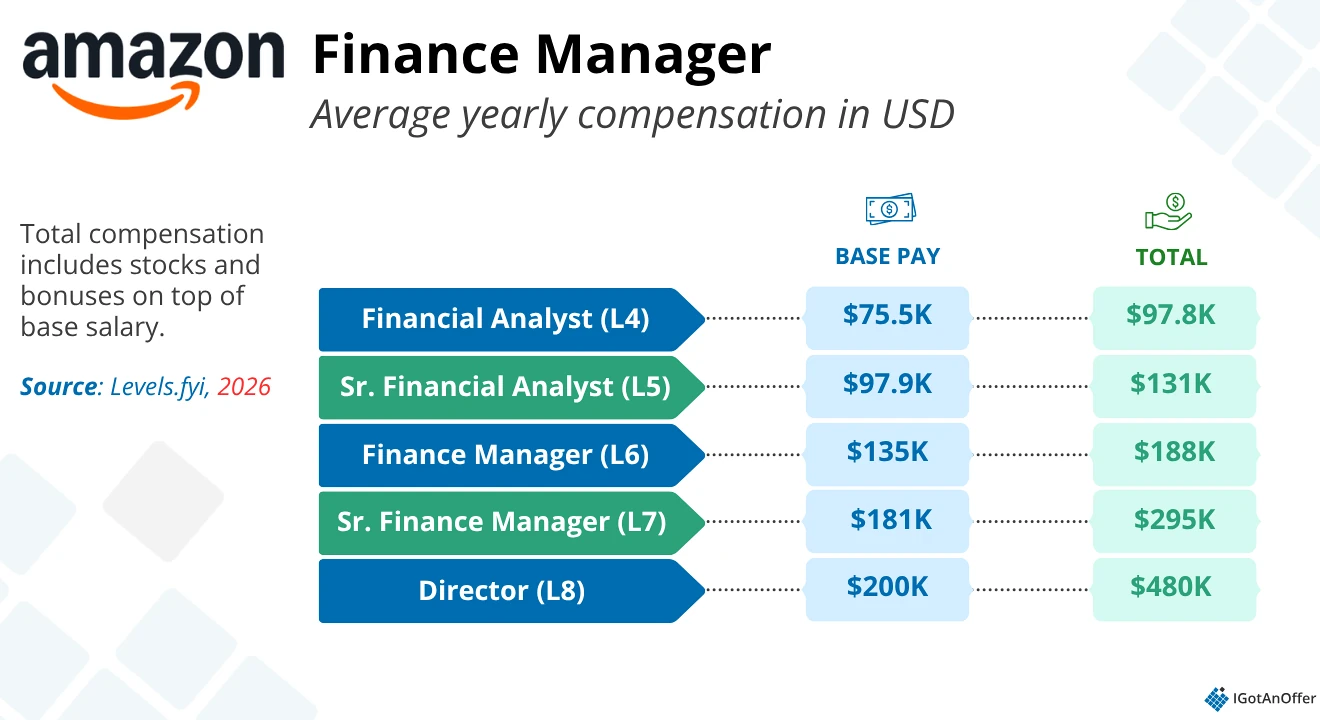
Ultimately, how you do in your interviews will determine what level you’re offered. That’s why hiring one of our finance manager interview coaches can provide such a significant return on investment.
And remember, compensation packages are always negotiable, even at Amazon. So, if you do get an offer, don’t be afraid to ask for more.
Read our guides on Amazon salary negotiation for some practical tips. If you need expert support practicing what you’ve learned, consider booking one of our salary negotiation coaches.
Coaches who contributed to this guide






2. Amazon finance manager interview process and timeline ↑
What's the interview process at Amazon for the finance manager role? The process is longer than most roles at the company and can take two to four months on average. The interview loop alone can include four to seven rounds (sometimes even more).
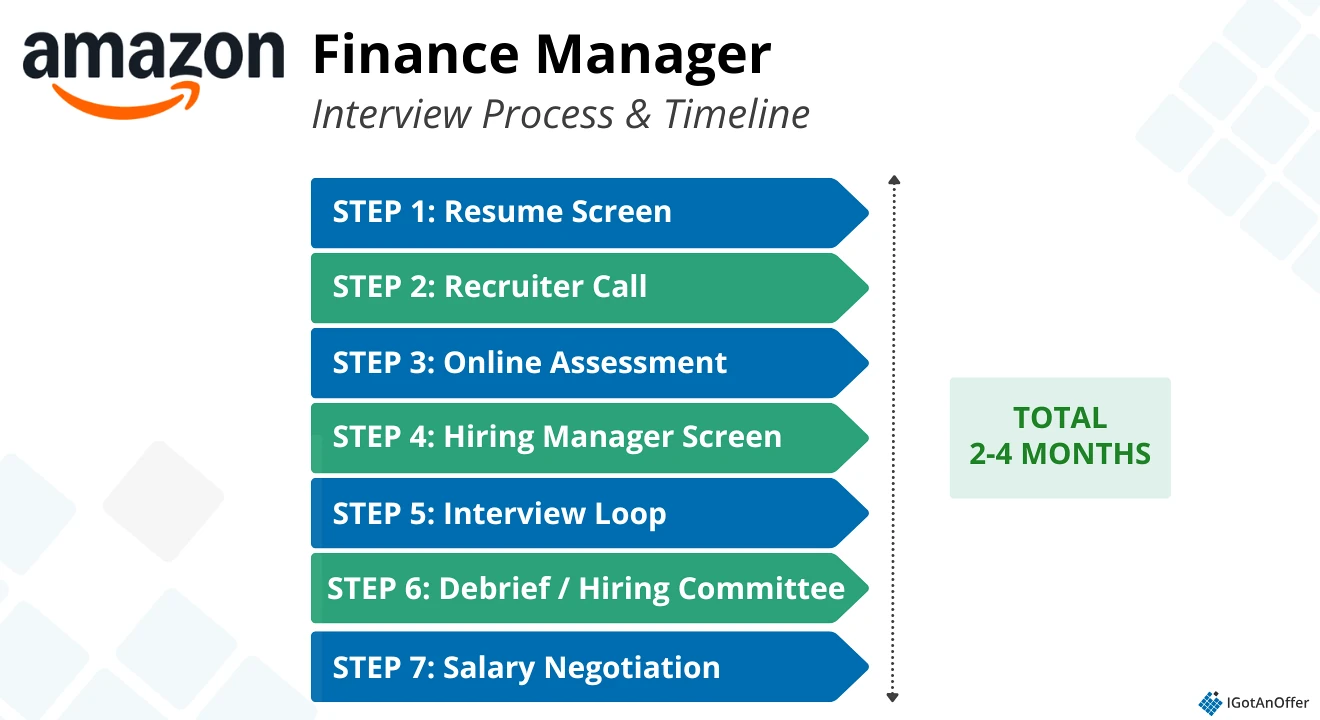
Now, let’s take a look at each step in detail.
2.1. Steps to expect
2.1.1 Resume screen ↑
First, recruiters will look at your resume and assess if your experience matches the open position.
This is the most competitive step in the process—we’ve found that ~90% of candidates don’t make it past this stage.
If you’re currently polishing your resume or writing one, read our Amazon resume guide. It includes examples from real candidates who secured interviews at Amazon, plus a template to help you get started.
If you’re looking for expert feedback, you can also get input from our team of ex-Amazon recruiters. They’ll cover which achievements to focus on (or ignore), how to fine-tune your bullet points, and more.
2.1.2 Recruiter call ↑
If you pass the resume screening stage, you’ll likely get an email or a call from an Amazon recruiter, during which they’ll discuss with you the overall interview process.
This call is non-technical in most cases. You should expect questions like "Tell me about yourself," "Why Amazon?" and "Walk me through your resume." Be prepared to discuss your previous experience and explain your motivation for applying to Amazon.
During this call, the recruiter should give you information on how the overall interview process will work and may answer your questions about the timeline, location, or job description. This is when you should ask about which teams are hiring and express any role preferences.
Your recruiter should also provide you with helpful interview prep materials. If all goes well, the recruiter will get back in touch with you to schedule the online assessment.
2.1.3 Online assessment ↑
You’ll receive either a work sample simulation or a work-style assessment before the interview loop. This assessment evaluates how you respond to common workplace scenarios and make decisions based on the information available.
In the work-style assessment, you’ll be given a mix of question formats. You may be asked to record short verbal responses, select answers to situational prompts, or listen to workplace scenarios and explain how you would respond. Many of these situations mirror issues you might encounter on the job.
In the work sample simulation, the test simulates a work email inbox. You’ll receive messages from colleagues or managers containing instructions, data, or requests, and you’ll need to review the information and decide how to respond or prioritize tasks.
Check out our Amazon online assessment guide to learn more.
2.1.4 Hiring manager screen ↑
The hiring manager screen is typically a 30 to 60-minute interview focused on evaluating your fit for the specific role.
During this call, the hiring manager will ask a mix of role-specific questions and behavioral questions based on Amazon’s Leadership Principles (LPs). Expect questions about your past experience, how you approach financial analysis and business decisions, and how you partner with stakeholders.
This interview helps the hiring manager determine whether to move you forward to the final interview loop.
2.1.5 Interview loop ↑
The next step is the interview loop, where you'll participate in 4 to 7 interviews (sometimes more). These interviews may take place either on-site at an Amazon office or virtually.
Each interview in the loop usually lasts 30 to 60 minutes and will be with a mix of people from the team you’re applying to join, including peers, the hiring manager, and senior leaders.
Most interviews focus on behavioral questions based on Amazon’s Leadership Principles. Depending on the interviewer’s style, you may get 2-3 deep-dive questions around a specific LP or several shorter questions covering multiple principles.
One of your interviews in the loop will be with the Amazon Bar Raiser.
This interviewer is not part of the team you’re applying to join. Their role is to ensure Amazon’s hiring standards remain high and consistent across teams, so they focus more on overall candidate quality than on specific team needs.
Click here to learn more about the Amazon Bar Raiser interview.
2.2 What happens behind the scenes
Your recruiter is leading the process and taking you from one stage to the next. Here's what happens at each of the stages described above:
- After the phone screen, your hiring manager decides whether to move you to the interview loop or not, depending on how well you've done up to that point.
- During the interview loop, interviewers will assess if you’ve got the right role-related skills. They’ll also assess your culture fit using the Amazon Leadership Principles, with the help of a Bar Raiser.
- The Bar Raiser oversees the deliberation, playing a crucial role in the group’s final decision.
- Your recruiter should be in touch within 5 days of your interview loop, either with an offer or to break the bad news.
It's also important to note that recruiters and people who refer you have little influence on the overall process. They can help you get an interview at the beginning, but that's about it.
3. Amazon finance manager example interview questions ↑
Here at IGotAnOffer, we believe in data-driven interview preparation and have used Glassdoor data to identify the types of questions that are most frequently asked at Amazon. Here are the two types of interview questions you’ll need to be prepared for as an Amazon finance manager:
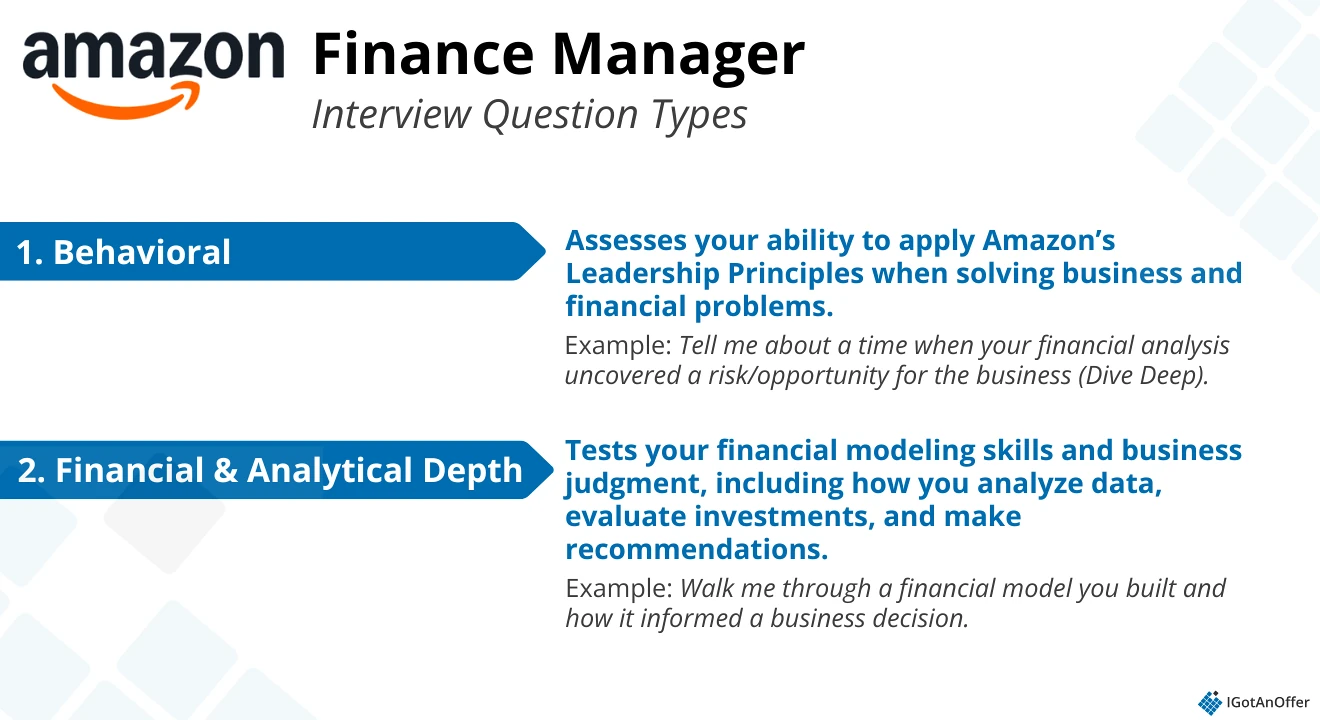
3.1 Behavioral ↑
If you’re applying for an Amazon Finance Manager role, you can expect most, if not all, of your interviews to be behavioral ones.
Behavioral questions are designed to dive deep into how you’ve handled past situations in order to predict your future performance.
According to Ashley (corporate finance manager and ex-Amazon interviewer), you’ll be asked to provide specific examples of how you’ve led projects and navigated financial challenges. Each interviewer will ask you 2-3 questions mapped to specific Leadership Principles in order to evaluate your fit for the team.
For example, answering “Tell me about a time when you identified a financial risk or opportunity using data” is all about “Dive Deep”. But it will also cover how you make data-backed financial decisions, an important finance manager skill.
Another example: “Tell me about a time when you challenged a business partner’s proposal based on financial analysis. What happened?” is about the LP, “Have backbone; disagree and commit,” but it will also assess your stakeholder management and business partnering skills.
Learn how to answer behavioral questions in our Amazon behavioral interview guide.
3.1.1 Amazon Leadership Principles
The Leadership Principles tie into every step of the Amazon interview process, and interviewers will test your affinity with them through behavioral questions.
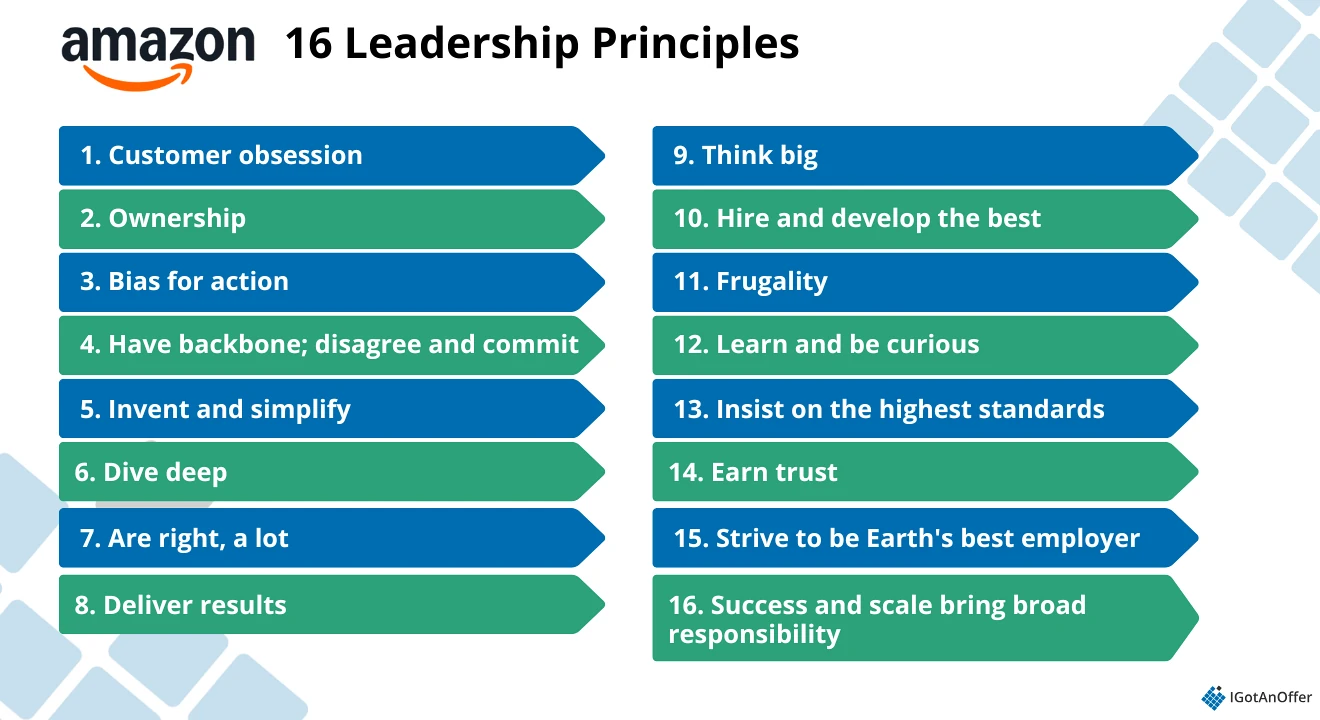
In most cases, your recruiter will inform you which Amazon LP to focus on at each stage. Be ready to draw from your prepared stories and adapt them to demonstrate the specific principle being assessed.
- Customer Obsession - "Leaders start with the customer and work backwards. They work vigorously to earn and keep customer trust. Although leaders pay attention to competitors, they obsess over customers.”
- Ownership - "Leaders are owners. They think long-term and don’t sacrifice long-term value for short-term results. They act on behalf of the entire company, beyond just their own team. They never say ‘that’s not my job."
- Bias for Action - "Speed matters in business. Many decisions and actions are reversible and do not need extensive study. We value calculated risk-taking.”
- Have Backbone; Disagree and Commit - "Leaders are obligated to respectfully challenge decisions when they disagree, even when doing so is uncomfortable or exhausting. Leaders have conviction and are tenacious. They do not compromise for the sake of social cohesion. Once a decision is determined, they commit wholly.”
- Invent and Simplify - "Leaders expect and require innovation and invention from their teams and always find ways to simplify. They are externally aware, look for new ideas from everywhere, and are not limited by ‘not invented here.’ Because we do new things, we accept that we may be misunderstood for long periods of time.”
- Dive Deep - "Leaders operate at all levels, stay connected to the details, audit frequently, and are skeptical when metrics and anecdote differ. No task is beneath them.”
- Are Right, A Lot - "Leaders are right a lot. They have strong judgment and good instincts. They seek diverse perspectives and work to disconfirm their beliefs.”
- Deliver Results - "Leaders focus on the key inputs for their business and deliver them with the right quality and in a timely fashion. Despite setbacks, they rise to the occasion and never settle.”
- Think Big - "Thinking small is a self-fulfilling prophecy. Leaders create and communicate a bold direction that inspires results. They think differently and look around corners for ways to serve customers.”
- Hire and Develop the Best - "Leaders raise the performance bar with every hire and promotion. They recognize exceptional talent and willingly move them throughout the organization. Leaders develop leaders and take seriously their role in coaching others. We work on behalf of our people to invent mechanisms for development like Career Choice.”
- Frugality - "Accomplish more with less. Constraints breed resourcefulness, self-sufficiency, and invention. There are no extra points for growing headcount, budget size, or fixed expense.”
- Learn and Be Curious - "Leaders are never done learning and always seek to improve themselves. They are curious about new possibilities and act to explore them.”
- Insist on the Highest Standards - "Leaders have relentlessly high standards — many people may think these standards are unreasonably high. Leaders are continually raising the bar and driving their teams to deliver high-quality products, services, and processes. Leaders ensure that defects do not get sent down the line and that problems are fixed so they stay fixed.”
- Earn Trust - “Leaders listen attentively, speak candidly, and treat others respectfully. They are vocally self-critical, even when doing so is awkward or embarrassing. Leaders do not believe their or their team’s body odor smells of perfume. They benchmark themselves and their teams against the best.”
- Strive to be Earth’s Best Employer - “Leaders work every day to create a safer, more productive, higher performing, more diverse, and more just work environment. They lead with empathy, have fun at work, and make it easy for others to have fun. Leaders ask themselves: Are my fellow employees growing? Are they empowered? Are they ready for what's next? Leaders have a vision for and commitment to their employees' personal success, whether that be at Amazon or elsewhere.”
- Success and Scale Bring Broad Responsibility - “We started in a garage, but we're not there anymore. We are big, we impact the world, and we are far from perfect. We must be humble and thoughtful about even the secondary effects of our actions. Our local communities, planet, and future generations need us to be better every day. We must begin each day with a determination to make better, do better, and be better for our customers, our employees, our partners, and the world at large. And we must end every day knowing we can do even more tomorrow. Leaders create more than they consume and always leave things better than how they found them.”
Learn more in our guide on Amazon Leadership Principles.
Here’s a list of questions that can help you showcase each Leadership Principle. Do note that some questions may touch on multiple LPs (‘Invent and simplify’ stories can also show ‘Frugality, etc.).
Use these example questions from Glassdoor to make sure you have a story that demonstrates each LP.
Amazon finance manager interview questions: Leadership principles
Ownership
- Walk me through a project that required capital prioritization choices and how you influenced leaders and the business to achieve an expected outcome.
- Describe a time you took on a project that was beyond your scope of work.
- Tell me about a time when you had to make a critical decision without consulting your manager.
- Tell me when you had to give up short term goal over long term.
Bias for Action
- Describe a calculated risk you took when speed was critical.
- Tell me about a time you had to change a process.
Have Backbone; Disagree and Commit
- Tell me about a time that you disagreed with a decision but still backed it as if it were your own.
- Describe a time you disagreed with your manager. What was the outcome?
- Tell me about a time that you pushed back on management decision you felt was the incorrect course to take.
Invent and Simplify
- Name a situation where you improved a financial model or process.
- Tell me about a process you improved.
- Tell me about a complex problem you solved with a simple solution.
Dive Deep
- Tell me about a time you had to dig deep to identify the root cause of a problem.
- Tell me about a time you handled a complex accounting issue.
- Tell me about your experience managing data sets and providing insights.
- Tell me about a time when your financial analysis uncovered an opportunity to improve efficiency.
- Tell me a time when you had to make a decision using data.
Deliver Results
- Describe a time you faced a significant challenge/problem at work. How did you handle it?
- Describe a time you faced multiple competing deadlines and how you ensured timely delivery.
Earn Trust
- Describe a time you had a difficult interaction.
- Tell me about a time you helped your colleagues to improve.
Learn and Be Curious
- Tell me about a time you realized you needed a deeper level of knowledge.
- Tell me about a time you made a bad decision. What did you learn from it?
Are Right, A Lot
- Tell me an example of a decision you took with uncertainty.
- Describe a time you made a difficult decision with incomplete information.
- Tell me about a time when you dealt with ambiguity.
Think Big
- Tell me about a time you used innovation to solve a problem.
Click here to download the complete Amazon Leadership Principles question bank in PDF.
3.2 Financial & Analytical Depth ↑
In addition to behavioral questions, you'll also be tested on your financial and analytical skills. According to Ashley, candidates should expect technical questions that test their financial modeling skills and business judgment.
These questions evaluate how well you analyze financial data, build models, and translate insights into recommendations that help the business make better decisions.
Let’s look at some real example questions from Glassdoor. For more practice, we also included examples from Google, Meta, and Microsoft.
Amazon finance manager interview questions: Financial & Analytical Depth
- How do you price a product that is newly marketed to Brazil (Amazon)
- Walk me through a financial model you built (Amazon)
- Walk me through a time when you had to analyze complex financial data and present it to a non-financial audience? How did you ensure that they understood the information and were able to make informed decisions based on your analysis? (Amazon)
- Define EBITDA (Earnings Before Interest, Taxes, Depreciation, and Amortization) and other financial metrics (Google)
- How would you build a budget based on drivers? (Google)
- Walk me through your process to create a baseline of a cash flow statement (Meta)
- Walk me through a discounted cash flow (DCF) model (Meta)
- What information would you look for to build financial models? (Meta)
- How would you estimate revenue/expense? (Meta)
- How would you structure a partnership for tax purposes? (Meta)
- What would be the legal structure of a partnership? (Meta)
- Why would Microsoft have more cash than revenue on its financial statements? (Microsoft)
- How would you explain valuation to me in lay terms? (Microsoft)
4. Amazon finance manager interviewing tips ↑
You might be a great finance manager with excellent financial modeling and analytical skills, but unfortunately, that’s not enough to ace your interviews at Amazon.
Let’s look at some key tips to make sure you approach your interviews in the right way.
4.1 Keep your answers concise
To keep your answers concise and focused, Amazon recommends structuring them in the STAR (Situation-Task-Action-Result) format. But if you find this format confusing, we recommend the SPSIL (Situation-Problem-Solution-Impact-Lessons) method we developed.
Here’s a quick look at our suggested approach:
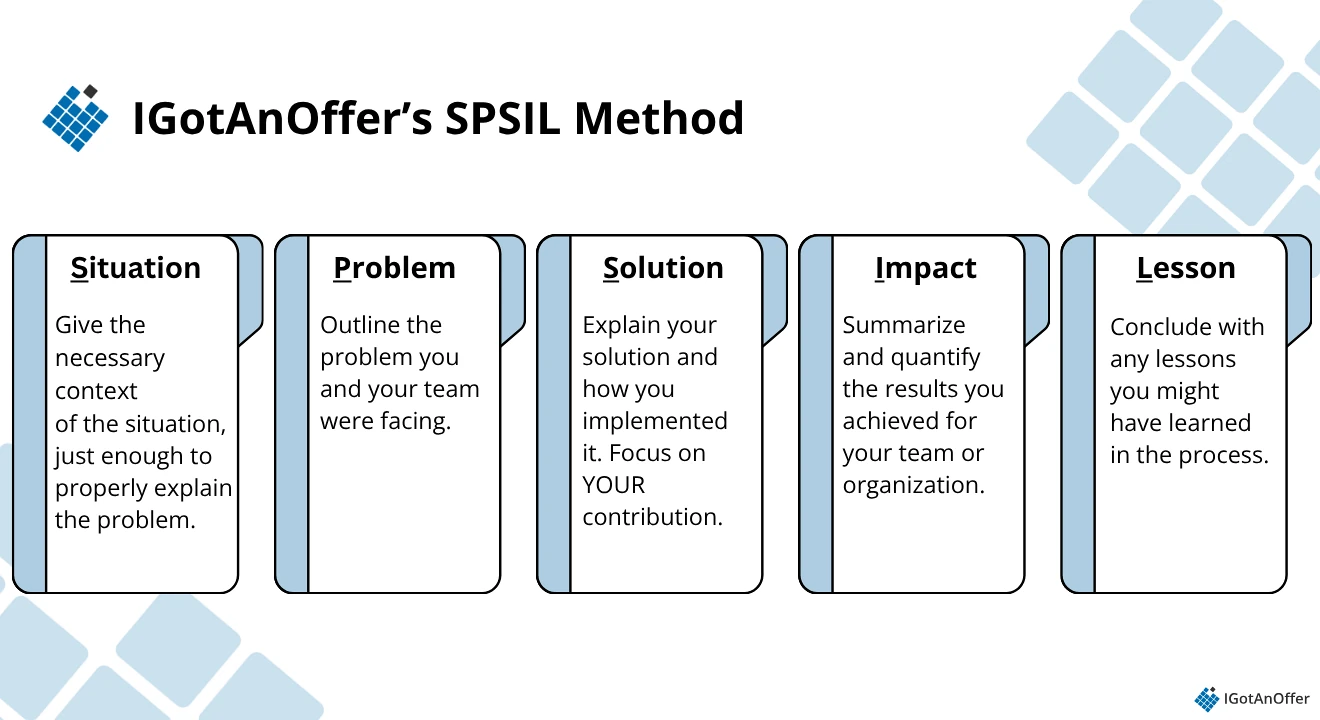
IGotAnOffer’s SPSIL (Situation-Problem-Solution-Impact-Lessons) method
- Situation: Start by giving the necessary context of the situation you were in. Describe your role, the team, the organization, the market, etc. You should only give the minimum context needed to understand the problem and the solution in your story. Nothing more.
- Problem: Outline the problem you and your team were facing.
- Solution: Explain the solution you came up with to solve the problem. Step through how you went about implementing your solution, and focus on your contribution over what the team / larger organization did.
- Impact: Summarize the positive results you achieved for your team, department, and organization. As much as possible, quantify the impact.
- Lessons: Conclude with any lessons you might have learned in the process.
It covers very similar themes to the STAR method. But a lot of the candidates we work with find this framework easier to use, as there’s no overlap between any of the steps in your story.
Check out our guide on how to answer Amazon behavioral questions, including a full explanation of the answer method and some more questions with sample answers.
4.2 Get used to setting up the situation in 30 seconds or less
Spending too much time on the Situation step is one of the most common mistakes candidates make. Use a timer while you practice to ensure you provide only necessary information.
4.3 Don’t get stuck in a framework
Using a framework offers a structured approach to answering questions. However, some of our successful candidates have mentioned that excessive reliance on frameworks may hinder your performance.
During the interview, trust your instinct, and don’t be afraid to deviate from the framework if needed. A framework is there to help you craft a better answer, after all.
4.4 Have a solid ‘about me’ introduction ready
Prepare a strong answer for your “about me” introduction, or the classic “Tell me about yourself” question. This is often the first question in an investment banking interview and sets the tone for the rest of the conversation.
Your introduction should briefly summarize your background and experience while highlighting what makes you unique as a candidate.
4.5 Internalize the Amazon Leadership Principles
As you’ve seen in Section 3, Amazon’s Leadership Principles play a significant role in finance manager interviews. You’ll need to understand these principles well and be able to reflect them clearly in your answers.
Check out our guide to the Amazon Leadership Principles interview to get started on your study. This article featuring Amazon CEO Andy Jassy is also another helpful resource on the nuances of the LPs.
4.6 Stay focused on essential details
Interviewers hear a lot of behavioral stories a day. If you go into unnecessary details, you are likely to lose their attention.
Share your stories with a few different people before your interview and ask them what details they would suggest cutting.
One way to make sure you’re focused on the right details, according to Melissa (ex-Amazon Bar Raiser), is to include at least one core competency in a story that also demonstrates your functional expertise.
That said, the balance between core competencies and functional depth will depend on the role and who is interviewing you.
4.7 Mix and match
You'll probably have a lot of overlap with your stories, especially since Amazon Finance Manager interviews can extend up to seven rounds (sometimes even more) in the onsite loop. In each round, you may be asked questions tied to 2-3 Leadership Principles.
Because of this, the same story can often apply to multiple principles. If you practice adapting stories so they can answer various questions, 10–15 strong stories should be enough to get you through even the toughest interview.
4.8 Make sure answers are data-driven and fact-based
Use specific numbers and metrics in your answers, without breaking confidentiality laws. Amazon is a highly data-driven company, so make sure your answers are too.
Interviewers will especially want to know what financial metrics you tracked, what tools you used, and how you leveraged data to support decisions in your previous roles.
Ashley (corporate finance manager and ex-Amazon interviewer) emphasizes the importance of quantifying your impact. If you can’t clearly measure the results of your work with data, it becomes difficult for interviewers to assess the true value of your contributions.
4.9 Prepare for your Bar Raiser interview
You won’t know which one of your interviewers will be the Bar Raiser, but you’ll want to be prepared for them either way.
The Bar Raiser is considered the steward of Amazon’s Leadership Principles. In a hiring committee, their job is to calibrate and push for alignment, especially when the panel is split on a hiring decision.
In general, here are some traits that Bar Raisers look out for in candidates:
- A customer-first and data-driven mindset that guides decisions
- Clear, thoughtful, and structured communication
- Taking responsibility for outcomes, not just tasks
- Willingness to challenge decisions and the status quo (respectfully) with data and logic, and push for what’s right
- Ability to learn quickly and evidence of coachable leadership: learning, teaching, and raising others
- Clear thinking and the ability to adjust well in ambiguous situations
With these in mind, take some time to study the job description for the Finance Manager role you’re applying for. Go over the qualifications for the role, as well as its key objectives.
Put yourself in the shoes of a Finance Manager who is already working in this position. How would you handle the financial, operational, and stakeholder challenges that are likely to arise in the role? What skills will you need to demonstrate to show interviewers that you can raise the bar for this type of position?
“The biggest pitfall is attempting to give 'off-the-cuff' answers. Without the right level of preparation, candidates often fail to provide the depth of detail required to prove they meet the bar,” says Ashley.
Learn more in our guide to Amazon Bar Raiser interviews.
5. Preparation plan ↑
Now that you know what questions to expect, let's focus on how to prepare. Below is a step-by-step prep plan you can follow, plus some resources to help you prepare:
5.1 Deep dive into the role/organization
Most candidates fail to do this. But, even before investing hours preparing for an interview at Amazon, you should take some time to make sure it's actually the right company for you.
Amazon is prestigious, so it's tempting to assume that you should apply without careful consideration. But it's important to remember that the prestige of a job alone won't make you happy in your day-to-day work. It's the type of work and the people you work with that will.
If you know people who work at Amazon or used to work there, talk to them to understand what the culture is like. The Leadership Principles we discussed above can give you a sense of what to expect, but there's no replacement for a conversation with an insider.
Finally, we would also recommend checking out the following resources:
- Amazon's technology culture video mix (by Amazon)
- Amazon Finance page (by Amazon)
- Amazon annual reports, proxies, and shareholder letters (by Amazon)
- Amazon strategy study (by Cascade)
- Amazon vision and mission analysis (by Panmore Institute)
- Amazon strategy teardown (by CB Insights)
- The Leadership Principles Explained by Amazon CEO Andy Jassy
- An Amazon interviewer dives deep into how she uses the Leadership Principles (by Amazon)
5.2 Practice by yourself
As we’ve established in this guide, your Amazon finance manager interview will mostly consist of behavioral questions.
To practice, we recommend starting with our guide on Amazon behavioral interview questions to learn how to prepare your stories using the STAR or SPSIL framework. Then, check out our guide on Amazon Leadership Principles to learn what type of stories you should prepare.
For technical prep, these resources should help you review the most common topics tested in finance interviews:
- Investopedia for accounting and finance fundamentals, such as financial statements, working capital, capital expenditures, and cash flow
- Corporate Finance Institute (CFI) for financial modeling, variance analysis, forecasting, and capital budgeting
- Wall Street Prep for financial statements, financial modeling, corporate finance concepts, and Excel-based financial modeling templates
Familiarity with SQL is also highly recommended, as you’ll likely need it to run any type of reporting at Amazon. Although it’s rare to get SQL questions during your interview, it’s still best to be prepared. Book a session with one of our SQL coaches to ensure you're ready to hit the ground running.
Once you’re in command of the subject matter, you’ll want to practice answering questions. But by yourself, you can’t simulate thinking on your feet or the pressure of performing in front of a stranger. Plus, there are no unexpected follow-up questions and no feedback.
That’s why many candidates try to practice with friends or peers.
5.3 Practice with peers
If you have friends or peers who can do mock interviews with you, that's an option worth trying. It’s free, but be warned, you may come up against the following problems:
- You can’t be sure the feedback you get is accurate
- They’re unlikely to have insider knowledge of interviews at your target company
- People often waste your time by not showing up on peer platforms
For those reasons, many candidates skip peer mock interviews and go straight to mock interviews with an expert.
5.4 Practice with experienced finance management interviewers
In our experience, practicing real interviews with experts who can give you company-specific feedback makes a huge difference.
Find an Amazon finance manager interview coach so you can:
- Test yourself under real interview conditions
- Get accurate feedback from a real expert
- Build your confidence
- Get company-specific insights
- Learn how to tell the right stories, better
- Save time by focusing your preparation
Landing a job at a big tech company often results in a $50,000 per year or more increase in total compensation. In our experience, three or four coaching sessions worth ~$500 make a significant difference in your ability to land the job. That’s an ROI of 100x!
Click here to book mock interviews with experienced finance management interviewers.

 Case
Case