

Research engineer interviews at Google DeepMind are tough to crack. The coding bar is high, the ML rounds go deep, and the people interviewing you have often co-authored the papers you studied to prepare.
In this guide, we're going to cover everything you need to know to prepare for research engineer interviews at Google DeepMind.
We've gathered insights from candidates who've navigated DeepMind's interview process, analyzed reports from Glassdoor and Blind, and synthesized information from official Google DeepMind sources to put together this comprehensive guide.
Below, you'll find a detailed overview of the interview process, example questions, how to answer them, and a preparation plan.
Here's an overview of everything we cover:
- Role and salary
- Interview process and timeline
- Example interview questions
- Interviewing tips
- Preparation plan
Click here to practice 1-on-1 with an ex-DeepMind interviewer
Let's get started!
1. DeepMind research engineer role and salary ↑
Before we dive into the interview process, let's understand what a research engineer at DeepMind actually does.
1.1 What does a DeepMind research engineer do?
Research engineers (RE) at DeepMind sit at the intersection of research and engineering. DeepMind describes them as the bridge between theory and implementation. They:
- design,
- build,
- and scale the systems that research depends on.
Unlike research scientists, who lead the research direction and usually hold a PhD, research engineers are experimentalists focused on making the research run at scale. The work still contributes to published research, and engineering contributions often earn co-authorship credit, but REs aren't measured on publication output the way scientists are.
You're expected to write high-quality production code, collaborate closely with research scientists, and move quickly through experiment cycles.
The types of problems you work on depend on your team, but broadly, research engineers at DeepMind are involved in:
- Implementing and optimizing frontier models
- Building robust infrastructure for distributed computing
- Turning research hypotheses into working experiments
- Writing production-quality code
- Applying expertise across domains like Gemini, robotics, and scientific projects
What distinguishes this role from a traditional software engineer position is the emphasis on machine learning depth and staying current with research in your domain. But unlike a pure research role, you're constantly building systems that have to work at DeepMind's scale.
1.2 What skills are required for a DeepMind research engineer?
Most RE positions ask for a degree in computer science, mathematics, applied statistics, machine learning, or a related field. A Bachelor's or Master's is usually enough. A PhD helps, but it isn't always required for research engineer roles the way it is for research scientists.
You also need hands-on work building ML systems at scale. DeepMind looks for people who've trained large transformer-based models, worked with distributed computing setups, or implemented research papers in production. Open-source contributions and a track record of shipping ML projects matter a lot here.
A few technical skills come up repeatedly in DeepMind interviews:
- Strong Python and a working knowledge of JAX or PyTorch
- Deep understanding of the maths behind ML, including linear algebra, probability, and optimization
- Ability to derive concepts from first principles rather than just recite them
- Experience reading and implementing recent research
Soft skills matter too. Research engineers work closely with research scientists, so you'll need to communicate trade-offs clearly, push back on ideas, and contribute to papers. Comfort with ambiguity helps too, since most projects start without a clear path to the answer.
1.3 How much does a DeepMind research engineer make?
DeepMind's competitive compensation is among the numerous factors that draw high-performing engineers to the company.
DeepMind sits inside Google, so its compensation tracks closely with Google's research and engineering bands.
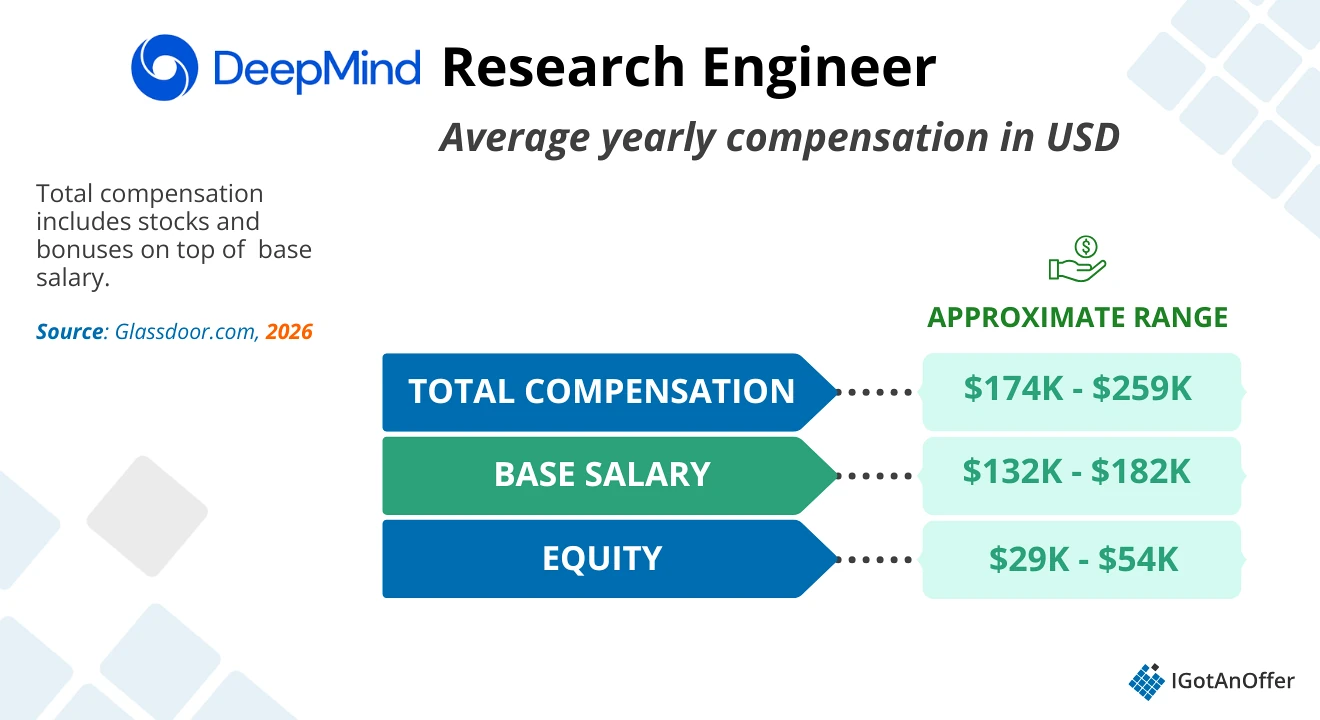
How you do in your interviews will help determine what you'll be offered. That's why hiring one of our tech interview coaches can provide such a significant return on investment.
And remember, compensation packages are always negotiable, even at DeepMind. If you do get an offer, don't be afraid to ask for more. If you need help negotiating, consider booking one of our salary negotiation coaches to get expert advice.
2. DeepMind research engineer interview process and timeline ↑
DeepMind runs a hiring process that's separate from the rest of Google. That matters because advice written for a standard Google software engineer interview will only get you part of the way. DeepMind adds maths and ML rounds that other Google teams generally don't have, and the bar for research depth runs through every stage.
2.1 What interviews to expect
The DeepMind research engineer interview process typically takes around six to seven weeks, and can run longer with the hiring committee review. It follows this general structure:
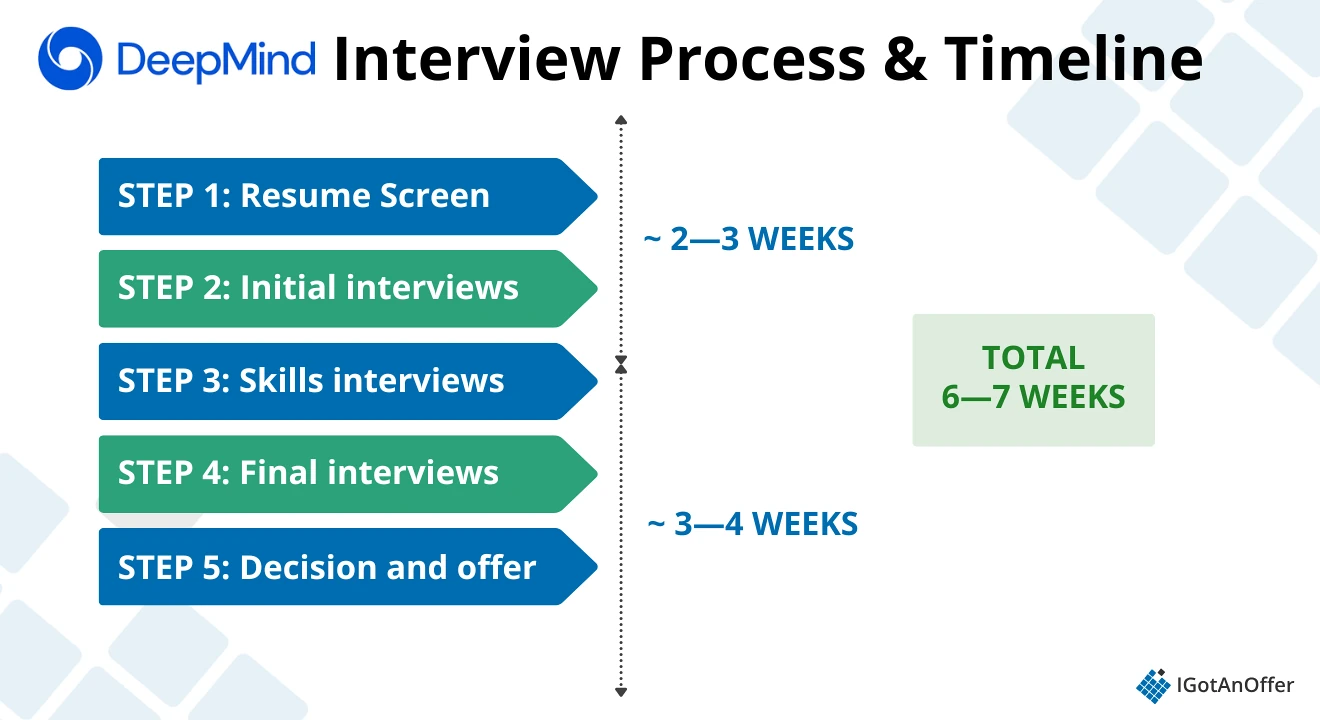
- Resume screen
- Initial interviews
- Skills interviews
- Final interviews
- Decision and offer
2.1.1 Resume screen ↑
First, recruiters will look at your resume and assess if your experience matches the open position. This is the most competitive step in the process—we’ve found that ~90% of candidates don’t make it past this stage.
To help you put together a targeted resume that stands out from the crowd, follow the tips below:
Tips for crafting a resume
- Study the job description: Your work experience should relate directly to the role qualifications you're applying for. DeepMind typically doesn't hire entry-level candidates, so emphasize your senior-level accomplishments.
- Be specific and quantify: Use data to back up your claims. What scale systems did you work on? How many users did your features impact? What measurable improvements did you drive? DeepMind cares deeply about scale, availability, and impact.
- Emphasize ownership and leadership: Highlight situations where you operated with significant autonomy, drove decisions, and owned outcomes. Show examples of emergent leadership, even if you weren't in a formal management role.
- Demonstrate culture alignment: While you shouldn't explicitly reference the culture memo in your resume, your experience should demonstrate the behaviors DeepMind values.
- Be concise: Keep your resume to 1-2 pages maximum. Recruiters don't have time for lengthy documents, so make every word count.
It can also be helpful to get an employee referral. Many DeepMind roles aren't posted publicly, and a good number are filled through referrals or internal Google candidates. So if you have a connection to someone who works there, it can help you get your foot in the door.
If you’re looking for expert feedback, you can also get help on your resume from one of our tech resume experts, who will cover what achievements to focus on (or ignore), how to fine-tune your bullet points, and more.
2.1.2 Initial interviews ↑
If you pass the resume screen, you'll start with a 30-minute introductory call with your recruiter. This is a conversational HR screen covering your background, the role, and the rest of the process.
You can expect general questions, such as
- Walk me through your resume. (Be ready to discuss key projects and decisions.)
- Tell me about yourself. (Give a concise overview of your background, key experiences, and how they led you to this opportunity.)
- Why DeepMind specifically? (Reference DeepMind's mission, recent research, or landmark projects like AlphaFold or Gemini.)
The recruiter also uses this call to work out whether you're a better fit for the more research-focused or the more applied side of the organization, so come ready to talk about the kind of work you want to do.
You may also join an interview with the hiring manager at this stage. They'll dig into your background in more depth, ask about your experience with ML and engineering, and help you build a better understanding of what their team works on.
2.1.3 Skills interviews ↑
The skills round involves two or three further calls, evaluating you against the competencies needed for the role. You'll also meet potential peers during these conversations, which gives you a chance to ask questions about working life at DeepMind.
For research engineers, the skills interviews break down into:
- Two coding rounds testing your ability to solve algorithmic problems in a real coding environment
- A set of ML rounds testing the depth and breadth of your ML knowledge, including the maths behind it and how you'd apply it to design problems
The two parts are usually gated, so you'll need to clear the coding rounds before moving on to ML, sometimes with a wait of a couple of weeks in between. Candidates often describe the ML rounds as the “toughest part of the process”.
Compared to a standard Google software engineer interview, DeepMind's skills round is heavier on maths and ML. The coding bar is similar, but DeepMind expects your code to actually run by the end of the round.
We cover the questions for each round in detail in Section 3.
2.1.4 Final interviews ↑
In the final round, you'll meet team leads and leadership, including your potential manager. DeepMind frames this stage as a mutual assessment. Meaning, they're still checking your core skills, but through the lens of team goals, plans, and culture.
For research engineers, the final round usually breaks down into:
- Team lead interview: A conversation with a team lead from the team you're joining. Expect questions on your background, your experience with ML experimentation and modeling, and open-ended ML problems.
- Senior team lead interview: A similar conversation with a more senior team lead, focused more explicitly on whether you're a fit for the team and its work.
- Behavioral interview: A conversation with a People and Culture partner covering motivation and culture questions, like why you want to join DeepMind.
Anything on your resume can come up in the team lead rounds, so be ready to defend the decisions behind your past work in detail. For the behavioral interview, read DeepMind's recent research and be ready to talk about why this lab specifically, not just AI in general.
We cover how to approach these rounds in Section 3.4.
2.1.5 Decision and offer ↑
After your interviews, the hiring team reviews your application against DeepMind's criteria. If you're the best candidate for the role, your recruiter will share the news and walk you through the compensation and benefits package, then formally invite you to join.
One candidate noted on Blind that their level wasn't discussed at any point during the process, so don't expect to know your exact level until after you've cleared the loop.
2.2 How does DeepMind evaluate applications?
At the end of each interview, including the screens, your interviewer grades your performance using a standardized feedback form. The form records the questions you were asked, the interviewer's notes on your answers, and a final recommendation on a scale that runs from "Strong no hire" through to "Strong hire."
All feedback forms are combined in a packet, which includes your resume and feedback from the initial phone screens, and it is sent to a third-party hiring committee for review. You’ll be notified when this happens.
Because DeepMind sits inside Google, this is the same broad feedback structure used across Google. The difference for DeepMind roles is the weight placed on research and ML depth, which runs through the scoring even for engineering positions.
There are four general responses that you may receive from DeepMind’s hiring committee:
- You’re hired! Now you just wait to receive your offer package and go through salary negotiations.
- They want you on board, but have to find a team match first.
- They need more information about you. They might schedule 1 or 2 more interviews, after which the hiring committee will reconvene to make a decision.
- You get rejected. Try not to be too disappointed; many candidates get in after multiple attempts. Read our article on Google rejection and get ready to try again in a few months.
3. DeepMind research engineer example questions ↑
Now that you've learned how DeepMind’s interview process works, let's go into detail on what kind of questions you can expect to face.
DeepMind research engineer candidates get questions across four different categories:
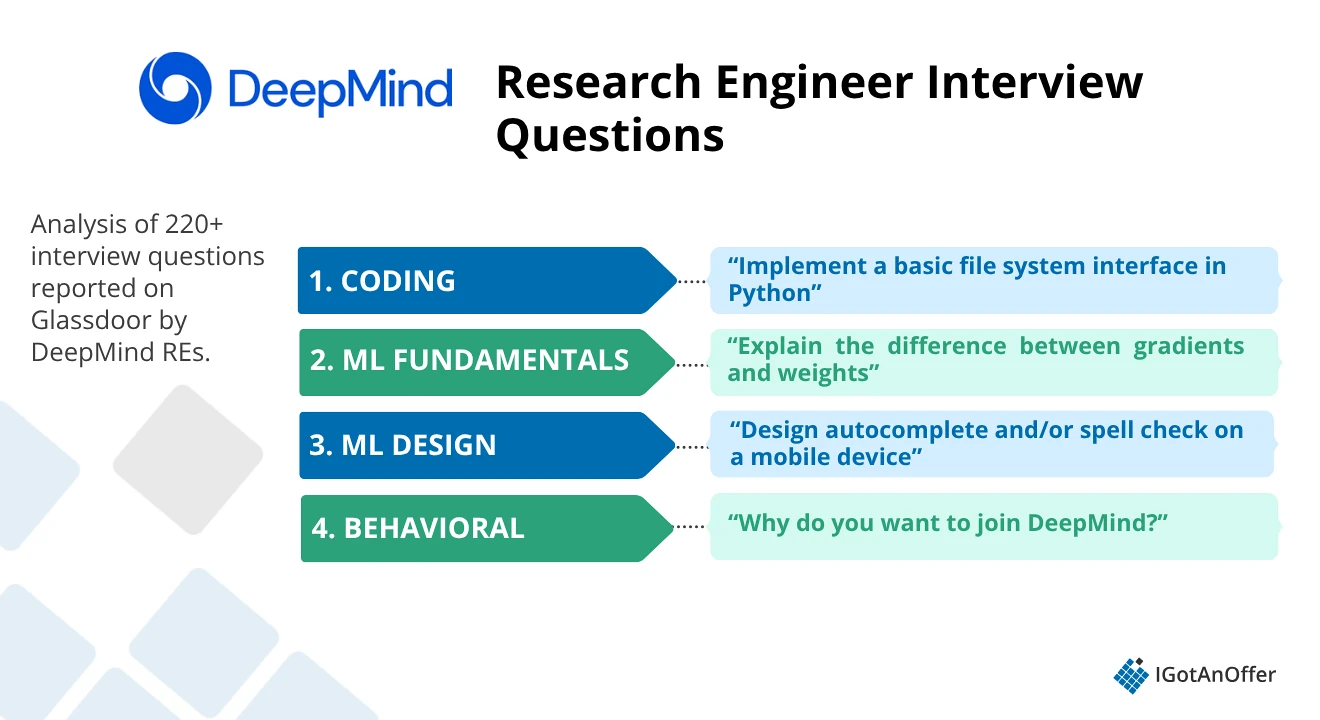
Where necessary, grammar and phrasing have been edited to make questions easier to understand.
3.1 Coding questions ↑
Research engineer candidates typically face two rounds focused on data structures and algorithms. Expect LeetCode-style problems in the medium to hard range, similar to a standard Google interview. In fact, most questions appear to be drawn from Google's internal question bank.
Unlike a standard Google interview, DeepMind expects your code to run. You'll work in an environment like CoderPad, and by the end of the round, you're expected to have a working solution.
Many candidates recommend practicing with the top 50 latest Google-tagged problems on LeetCode. Google also sends review materials and has a whole page dedicated to practice coding questions.
Note: DeepMind's reported policy is to limit or prohibit AI coding assistants in technical rounds, so plan to solve problems unaided rather than leaning on tools you might use day to day.
Based on our analysis of the most recent RE coding questions reported on Glassdoor, here are the most commonly asked coding topics at DeepMind.
Example coding questions asked in DeepMind research engineer interviews
- Implement Trie for prefix matching. (Solution)
- Implement a Snapshot Array that supports pre-defined interfaces (note: see link for more details). (Solution)
- A group of two or more people wants to meet and minimize the total travel distance. You are given a 2D grid of values 0 or 1, where each 1 marks the home of someone in the group. The distance is calculated using Manhattan Distance, where distance(p1, p2) = |p2.x - p1.x| + |p2.y - p1.y|. (Solution)
- You are given two non-empty linked lists representing two non-negative integers. The digits are stored in reverse order, and each of their nodes contains a single digit. Add the two numbers and return them as a linked list. (Solution)
For more coding practice, check out our Google coding interview questions guide, and for broader prep advice, see our guide on how to get better at coding interviews..
3.2 ML fundamentals questions ↑
After the coding screens, research engineer candidates face an ML fundamentals interview that tests maths, statistics, and core machine learning knowledge.
Candidates sometimes call this the "quiz." It used to be a rigid set of textbook questions, but the format has loosened in recent years. Recruiters often tell candidates in advance that maths and stats will be covered.
The key here is the mathematical intuition behind your answers. It's not enough to say you prefer L1 regularization because it produces sparse features. You need to “explain the intuition, in terms of how the gradients affect the weights in L1 to cause that sparsity”, as one candidate put it.
So when you prepare, don't just memorize definitions. For each concept, be ready to explain why it works, derive it if asked, and connect it to how models behave in practice.
Example ML fundamentals questions asked in DeepMind research engineer interviews
- Explain the difference between gradients and weights.
- What are convex functions, and what's special about them?
- A bag contains a mix of balls of different colours. Given some observations, what's the probability that the next ball drawn is a particular colour?
- Why would you prefer L1 over L2 regularization? Walk through the mathematical intuition, including how the gradients affect the weights.
- Walk me through how regression, SVMs, kernel SVMs, and Bayesian networks work, and explain when you'd use each.
- Derive the ELBO for a graphical model.
3.3 ML design questions ↑
After the fundamentals round, research engineer candidates typically face one or more ML design interviews. These are the heart of the technical loop, and candidates regularly describe them as the hardest part of the process.
To do well, be ready to justify your decisions from first principles. If you reach for a particular loss function, optimizer, or architecture, expect to explain why it's the right call and what the alternatives trade off.
The questions you'll be asked are similar to system design questions, in that you'll need to outline a high-level approach for a system or problem. The primary difference is that you'll be expected to specifically develop a machine learning solution and talk about the pipeline (data collection, preprocessing, model architecture, etc).
Example ML design questions asked in DeepMind research engineer interviews
- How would you build, train, and deploy a system that detects if multimedia and/or ad content violates terms or contains offensive materials?
- Design autocomplete and/or spell check on a mobile device.
- Design autocomplete and/or automatic responses for email.
- Design the YouTube recommendation system.
For broader practice on ML system design, see our machine learning engineer interview guide.
3.4 Behavioral questions ↑
Here, you'll face questions about your past work, how you handle challenges, and why you want to join DeepMind. DeepMind frames these as a mutual assessment, checking your skills through the lens of team goals, culture, and mission.
DeepMind's mission runs deep, and candidates are expected to show genuine motivation for the work. Read DeepMind's recent research and be ready to talk about why this lab specifically, not just AI in general.
Since DeepMind sits inside Google, its culture overlaps with Google's. That includes the concept of "Googleyness," which Google has reframed over time as culture add. As Albert (ex-Google SWE) puts it:
"Google is different in that all interviewers can leave good or bad feedback related to Googleyness, and it's something constantly being evaluated.”
Example behavioral questions asked in DeepMind research engineer interviews
- Why do you want to join DeepMind?
- Tell me about your favorite project.
- Walk me through the reasoning behind a key design choice you made on a past project.
- Describe a time you disagreed with a coworker. How did you handle it?
- What's an achievement you're most proud of?
- Tell me about a recent/interesting project you worked on.
- Tell me about a time you had to resolve a conflict in a team.
- What is your favorite Google product?
Go deep into Google’s culture by reading our guide on Googleyness & leadership interview questions. Then, practice with our step-by-step method for answering behavioral questions.
4. DeepMind research engineer interviewing tips ↑
You might be a fantastic research engineer, but unfortunately, that won't necessarily be enough to ace your interviews at DeepMind. Interviewing is a skill in itself that you need to learn.
Let's look at some key tips to make sure you approach your interviews in the right way.
4.1 Communicate your thought process
Don't code silently. Walk your interviewer through your reasoning. One candidate who passed said:
"I explained my thinking/solution before coding, but ended up changing some details during implementation to handle cases I hadn't thought of upfront."
This is fine. What matters is that you're talking through your reasoning. Interviewers can't read your mind; they can only judge you based on your answer.
Your interviewer may also give you hints about whether you're on the right track. Be alert for these, and be ready to pivot once you've picked up on them. This shows you're eager to learn and listen well to feedback.
4.2 Manage your time ruthlessly
You have a short time per coding problem (about 20 minutes). Practice with a timer. Many candidates fail because they spend 10 minutes thinking and run out of time.
4.3 Show the mathematical intuition
DeepMind's ML rounds reward intuition. It's not enough to know that a method works; you need to explain why. For every core concept, practice deriving it and explaining the reasoning behind it. This is the single biggest thing that separates strong candidates in the fundamentals and depth rounds.
4.4 Present multiple possible solutions
When answering coding or ML design questions, aim to present multiple possible solutions if you can. For complex or ambiguous problems, break them down into smaller, logical pieces and explain how you'd approach each one, then show how they fit together. This demonstrates both structured thinking and your ability to reason through trade-offs.
4.5 Learn a technique for answering behavioral questions
When answering your DeepMind research engineer interview questions, you should focus on your most relevant achievements and experiences and clearly communicate them. An easy way to achieve this is to use a step-by-step method to tell your stories.
The STAR method (Situation, Task, Action, Result) is a popular approach for answering behavioral questions because it’s easy to remember. You may have already heard of it.
However, we’ve found that candidates often find it difficult to distinguish the difference between steps two and three or task and action. Some also forget to include lessons learned in the results step, which is especially crucial when discussing past failures.
So we've developed the IGotAnOffer SPSIL framework (Situation, Problem, Solution, Impact, Learning) to correct some of the pitfalls we've observed with STAR.

- Situation: Give the necessary context. Describe your role, the team, and the organization. Include only the minimum needed to understand the problem and solution.
- Problem: Outline the problem you and your team were facing.
- Solution: Explain the solution you came up with, stepping through how you implemented it. Focus on your contribution over what the wider team did.
- Impact: Summarize the positive results you achieved. Quantify the impact as much as possible.
- Lessons: Conclude with any lessons you learned in the process.
This structure works for almost any behavioral question, and it keeps your answers focused on impact and learning rather than just describing what happened.
4.6 Ask clarifying questions
Often, the questions you'll get will be quite ambiguous, especially in the ML design rounds. Make sure you ask questions that help you clarify and understand the problem.
Be upfront if you encounter topics you have little experience with, but don't give up on tackling them. DeepMind is testing your technical knowledge and your ability to deal with problems you're not familiar with.
4.7 State and check assumptions
You need to explicitly state your assumptions, explain why you're making them, and check with your interviewer to see if they're reasonable. This matters most in the design rounds, where the problem is open-ended, and the interviewer is watching how you frame it.
4.8 Brute force, then iterate
When coding, don’t necessarily go for the perfect solution straight away. DeepMind recommends that you first try to find a solution that works, then iterate to refine your answer.
5. Preparation plan ↑
Now that you know what questions to expect, let's focus on how to prepare.
The performance bar at DeepMind is extremely high. The process covers coding, maths, ML knowledge, and design, which is a lot of ground. A structured plan makes a real difference.
We've coached more than 20,000 people for interviews since 2018. Below is our four-step prep plan for DeepMind.
5.1 Understand DeepMind's culture and the role
Most candidates skip this. But before investing tens of hours preparing, you should make sure DeepMind is actually the right company for you.
DeepMind is prestigious, so it's tempting to ignore that step. But in our experience, prestige alone won't make you happy day-to-day. It's the type of work and the people you work with that will.
If you know engineers or researchers who work at DeepMind, or used to, it's a good idea to talk to them to understand what the culture is like. In addition, we would recommend reading the following:
- About Google DeepMind
- DeepMind's research areas
- DeepMind's mission and responsibility approach
- DeepMind Blog
- DeepMind Careers
- How DeepMind tackles AGI safety and responsibility (by DeepMind)
- AlphaFold: a solution to a 50-year-old grand challenge in biology (by DeepMind)
- Google DeepMind's annual research highlights (by DeepMind)
5.2 Practice by yourself
As we've outlined above, you'll have to prepare for several different categories of questions ahead of your DeepMind research engineer interviews.
In this article, we've recommended various deep-dive articles that will help you prepare for each question category. Here's the complete list, plus a couple of extras we think could be useful.
Coding:
- General: Coding interview prep
- Google-specific: Google coding interview questions
- Topic-specific: arrays, graphs, dynamic programming, and strings
ML fundamentals and design:
- System design fundamentals
- ML system design exercises
- Google system design interview
- ML system design interview
- Google MLE interview guide
- Deep Learning textbook (the standard reference for the maths and ML knowledge tested in the quiz)
Behavioral questions:
- Behavioral interview questions
- Google behavioral interview guide
- Googleyness & leadership interview questions
Once you're in command of the relevant subject matter, you'll want to practice answering questions.
But by yourself, you can't simulate thinking on your feet or the pressure of performing in front of a stranger. Practicing alone also doesn't prepare you for unexpected follow-up questions, and it doesn't give you feedback.
That's why many candidates try to practice with friends or peers.
5.3 Practice with peers
If you have friends or peers who can do mock interviews with you, that's an option worth trying. It's free, but be warned, you may run into the following problems:
- It's hard to know if the feedback you get is accurate.
- They're unlikely to have insider knowledge of interviews at DeepMind.
- On peer platforms, people often waste your time by not showing up.
For those reasons, many candidates skip peer mock interviews and go straight to mock interviews with an expert.
5.4 Practice with experienced ex-DeepMind interviewers
In our experience, practicing real interviews with experts who can give you company-specific feedback makes a huge difference.
Find a DeepMind interview coach so you can:
- Test yourself under real interview conditions
- Get accurate feedback from a real expert
- Build your confidence
- Get company-specific insights
- Learn how to tell the right stories, better
- Save time by focusing your preparation
Landing a job at a big tech company often results in a $50,000 per year or more increase in total compensation. In our experience, three or four coaching sessions worth ~$500 will make a significant difference in your ability to land the job. That's an ROI of 100x.
Book mock interviews with experienced ex-DeepMind interviewers.