

 Back to other articles
 Last updated: October 06, 2026
 Interviews
 Data engineer
 Data modelling
 Deeply researched
Amazon business intelligence engineer (BIE) interviews can be daunting. You need to show that you can solve business problems with data, write SQL, and communicate your thinking clearly.
You’ll demonstrate these skills through an online assessment and technical interview questions. You’ll also need to show alignment with Amazon’s Leadership Principles when you answer behavioral questions.
To help you prepare, we analyzed 140+ Amazon BIE candidate reports on Glassdoor and also reviewed recent Reddit discussions. Below, we break down the hiring process, share sample questions, and give you practical tips and a preparation plan.
Here's what we'll cover:
- Role and salary
- Interview process and timeline
- Example interview questions
- Interviewing tips
- Preparation plan
Practice with experienced tech interview coaches
1. Amazon business intelligence engineer (BIE) role and salary ↑
Before we cover your Amazon business intelligence engineer interviews, let’s look at the role first.
1.1 What is the Amazon business intelligence engineer role?
Amazon business intelligence engineers (BIEs) use data and statistical methods to help teams answer business and product questions. The work includes building reports and dashboards, defining key performance indicators (KPIs), and writing Structured Query Language (SQL) queries.
The role varies by team. For example, Amazon Business’s analytics team works across pricing, selection, and managed spend. Other teams may have different responsibilities and requirements, so it’s important to read each job description to find a position that matches your background and interests.
1.2 What competencies are being assessed during the interview?
According to Amazon’s official BIE interview guide, you will be evaluated on the following technical competencies:
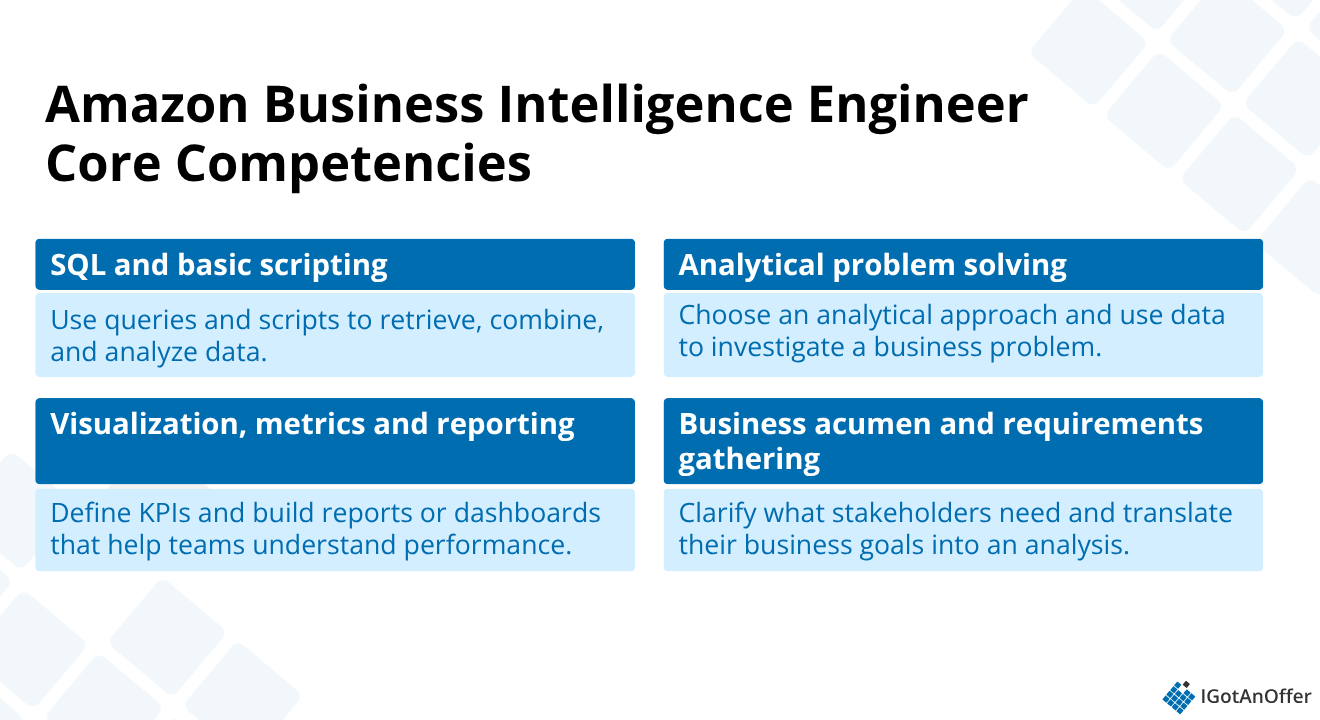
- SQL and basic scripting: Use queries and scripts to retrieve, combine, and analyze data.
- Analytical problem solving: Choose an analytical approach and use data to investigate a business problem.
- Visualization, metrics and reporting: Define KPIs and build reports or dashboards that help teams understand performance.
- Business acumen and requirements gathering: Clarify what stakeholders need and translate their business goals into an analysis.
Prepare to explain how you used these skills in a project: the business problem you were trying to solve, the data you needed, the analysis you chose, and what the team did with the result.
1.3 How much does an Amazon business intelligence engineer make?
The median total compensation for an Amazon business intelligence engineer in the US is $180K per year, according to Levels.fyi. Below, you can see reported compensation by level as of September 2026.
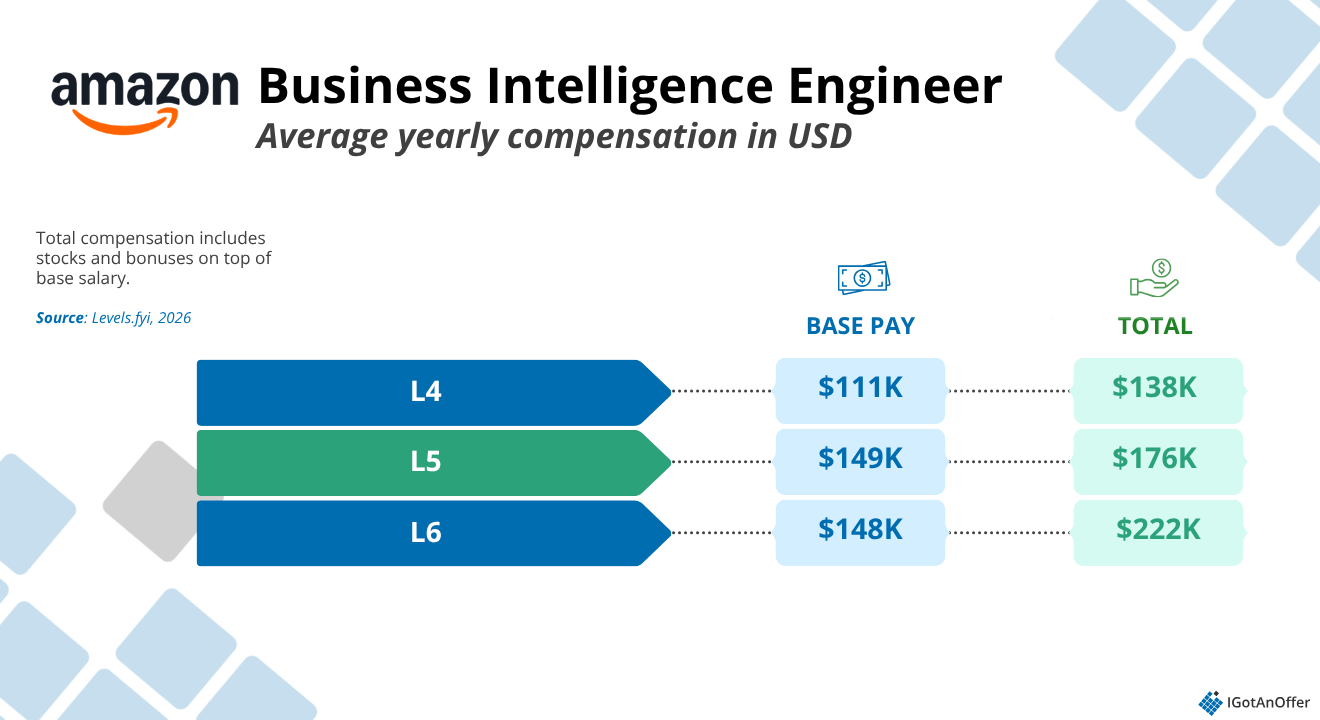
While we presume that you already know which level you are applying for, it’s still good to double-check with your recruiter. They should be able to advise you on which level you’re being evaluated.
Ultimately, how you do in your interviews will help determine what you’ll be offered. That’s why hiring one of our ex-Amazon interview coaches can provide such a significant return on investment.
And remember, compensation packages are always negotiable, even at Amazon. So, if you do get an offer, don’t be afraid to ask for more. Get practical tips from our Amazon salary negotiation guide. If you need help negotiating, consider booking one of our salary negotiation coaches to get expert advice.
Coaches who contributed to this guide


2. Amazon business intelligence engineer interview process and timeline ↑
The Amazon interview process for the BIE role can take roughly two to eight weeks, sometimes longer, according to Glassdoor reports. Here are the steps you can expect to take during your application:
- Resume screen and referrals
- Online assessment
- Technical phone screen
- Interview loop
- Interview outcome and offer
2.1 Resume screen and referrals ↑
Before getting an interview, you'll need a quality resume tailored to the business intelligence engineer role at Amazon.
The resume screen is where recruiters compare your background with the requirements of the open position. Doing so helps them decide whether your experience is a strong enough match to move forward.
If you know someone at Amazon, a referral may also help your application get noticed. In our experience, the simplest approach is to contact employees you already share a connection with on LinkedIn.
Here are a few tips to help you put together a resume that stands out:
Tips for crafting a resume
- Simplify the design. Avoid overly creative layouts. A simple resume is easier for applicant tracking systems to process and for recruiters and hiring managers to scan quickly.
- Use action verbs. Start each bullet point under your previous roles with an action word, such as “developed,” “built,” or “improved.”
- Quantify your impact. Add numbers wherever you can, such as query performance gains, hours saved through automation, or adoption of a dashboard you developed.
- Include relevant skills. Add a skills section with keywords pulled directly from the job posting.
If you’re currently polishing your resume or writing one, read our Amazon resume guide. It includes examples from real candidates who secured interviews at Amazon, plus a template to help you get started.
If you’re looking for expert feedback, you can also get input from our team of ex-Amazon recruiters. They’ll cover which achievements to focus on (or ignore), how to fine-tune your bullet points, and more.
2.2 Online assessment ↑
After you apply, Amazon sends an online assessment (OA), either through the application process or your recruiter. Amazon’s BIE guide lists three required parts: SQL Challenge, Working with SQL, and Work Styles, followed by an optional survey.
The SQL sections assess your technical skills. To prepare, practice writing queries and explaining how they work, including joins, aggregations, and window functions.
Work Styles asks how you approach work, using statements about your preferences and behavior. Read Amazon’s Leadership Principles beforehand and answer honestly about how you normally work.
Amazon gives you seven days from the date it sends the assessment to complete all required sections. You should hear back within two business days of completing it. Depending on your results and the role, your next step may be a technical phone screen or the interview loop.
For more on the assessment formats, see the Amazon online assessments guide.
2.3 Technical phone screen ↑
If you’re invited to a technical phone screen, expect one or two calls with a senior leader on the team. According to Amazon’s BIE guide, each call lasts around 60 minutes, but this may vary. A BIE II applicant on Reddit reported a 75-minute interview covering leadership principles, visualization, and SQL. Check your recruiter’s instructions for the duration and topics you should prepare for.
The phone screen covers behavioral, situational, SQL, and technical questions. You’ll also be assessed on your alignment with Amazon’s Leadership Principles, so prepare relevant stories that demonstrate them.
2.4 Interview loop ↑
The interview loop consists of five 55-minute interviews with members of Amazon’s business intelligence community. You’ll be asked a mix of technical questions and behavioral questions, including questions about your past experience.
Based on our analysis of Amazon BIE interview reports on Glassdoor, these questions generally fall into six categories:
- Behavioral questions
- SQL and coding questions
- Data management questions
- Analytical problem-solving questions
- Visualization, metrics and reporting questions
- Business acumen and requirements gathering questions
Do note that each Amazon business unit or team will have different technical requirements. Your recruiter should be able to advise you on which aspects to focus on.
Keep in mind that one of your loop interviewers will be a Bar Raiser, a trained interviewer who brings an independent perspective to the hiring decision. They assess your alignment with Amazon’s Leadership Principles and your potential to succeed beyond the immediate role.
Amazon says each interviewer typically asks two or three behavioral questions about successes or challenges you've faced. Prepare examples from your experience that show how you applied Amazon’s Leadership Principles.
2.5 Interview outcome and offer ↑
You should receive your interview outcome within five business days, according to Amazon, although the wait can be longer. One BIE candidate reported waiting seven business days without a response. Follow up with your recruiter if you haven’t heard back by the expected date.
If you pass the interview loop, your recruiter will present an offer package. Be sure to review the base salary, sign-on payments, and restricted stock units (RSUs), and ask how the package changes from year to year.
Here are some tips to help you negotiate a good offer:
Salary negotiation tips
- Be polite. Remember that the person you're negotiating with is just doing their job. You'll get much farther in your negotiations if you approach the conversation with grace.
- Don't give a number right away. Whenever possible, it's better to wait until you receive an offer to start negotiating. This reduces the risk of giving a number that is lower than what Amazon otherwise would have paid.
- Do your research. Have a number in mind before the conversation begins, and back it up with data. Research your position and level on Levels.fyi, ask around on professional networking sites like Blind, and factor in the cost of living where you are.
- Start high. Name a compensation number that is higher than your goal. Your Amazon recruiter will likely negotiate it down to something closer to what you actually want.
- Negotiate everything. Your offer includes more than a base salary. Ask about the sign-on bonus, RSUs, and any other parts of the package the recruiter can change. If the salary won't budge, there may be wiggle room elsewhere.
For a detailed walkthrough, read our Amazon salary negotiation guide. Once you’re ready to practice, you can book a session with our salary negotiation coaches.
3. Amazon business intelligence engineer example questions ↑
Now that we've covered the process, let's look at the questions you may be asked.
Amazon business intelligence engineer interviews typically cover six main areas:
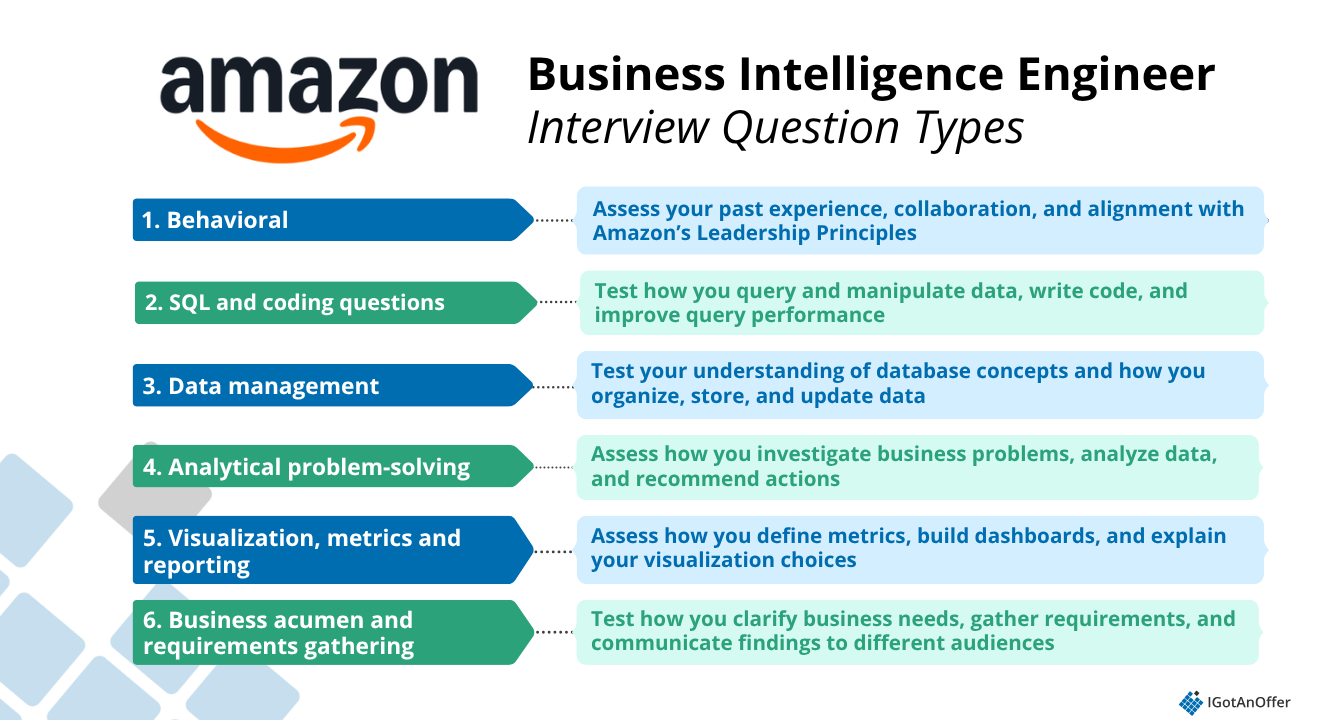
- Behavioral questions
- SQL and coding questions
- Data management questions
- Analytical problem-solving questions
- Visualization, metrics and reporting questions
- Business acumen and requirements gathering questions
We analyzed Amazon BIE interview questions reported on Glassdoor between 2022 and 2026. Note that we’ve edited the language in some places to improve clarity or grammar.
Let's get into the example questions.
3.1 Behavioral questions ↑
You can expect behavioral questions during the technical phone screen and interview loop.
3.1.1 Amazon Leadership Principles
Amazon’s Leadership Principles tie into every step of the interview process, and interviewers will test your affinity with them through behavioral questions.
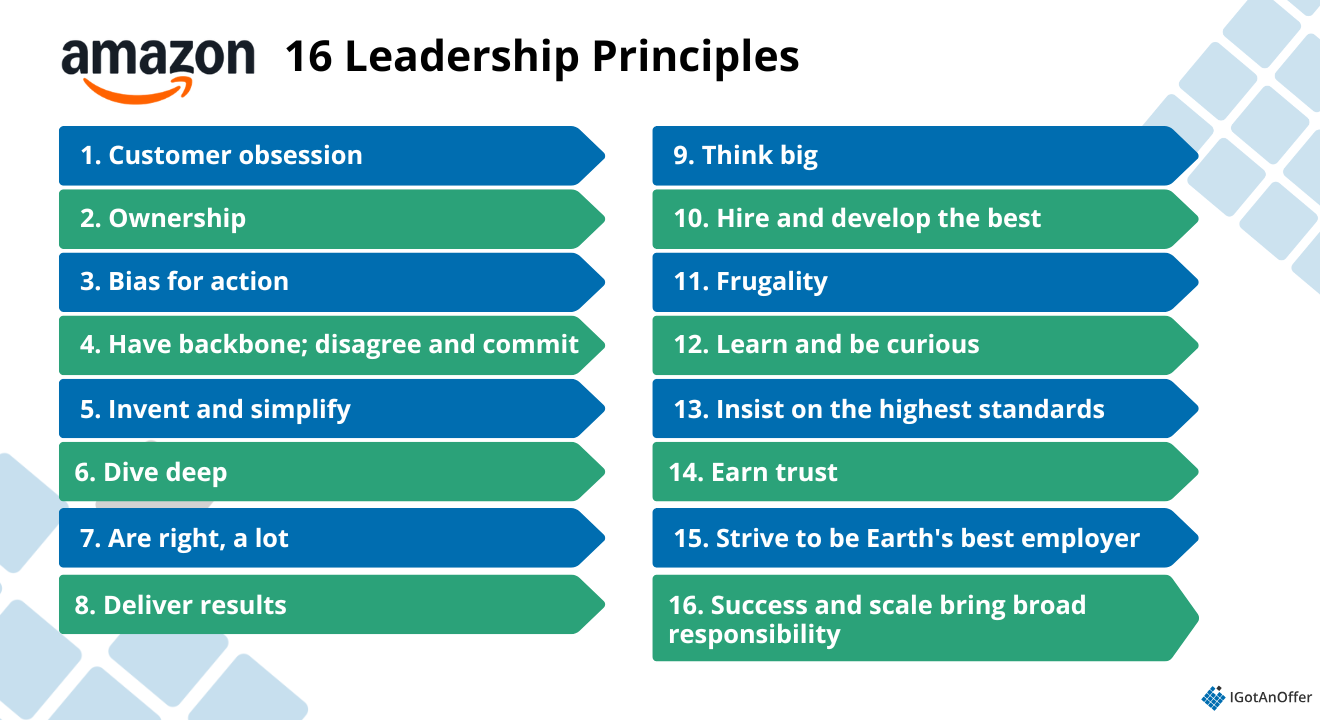
Here’s a brief overview of all 16 principles:
- Customer Obsession: Understand customers’ needs.
- Ownership: Take responsibility beyond your immediate tasks.
- Invent and Simplify: Find simpler approaches.
- Are Right, A Lot: Test your judgment against other perspectives.
- Learn and Be Curious: Keep developing your knowledge.
- Hire and Develop the Best: Help others grow.
- Insist on the Highest Standards: Fix problems at their source.
- Think Big: Consider broader possibilities.
- Bias for Action: Make timely, considered decisions.
- Frugality: Work within resource constraints.
- Earn Trust: Listen, be candid, and acknowledge mistakes.
- Dive Deep: Investigate details and question assumptions.
- Have Backbone; Disagree and Commit: Challenge respectfully, then support the decision.
- Deliver Results: Complete important work despite obstacles.
- Strive to be Earth’s Best Employer: Support colleagues’ safety, growth, and inclusion.
- Success and Scale Bring Broad Responsibility: Consider the wider consequences of your work.
Choose a few experiences that demonstrate Amazon’s Leadership Principles and that you can discuss in detail. For each one, make sure you can explain what you did, why you made certain choices, and what happened.
Give each story a clear structure. The STAR method (Situation, Task, Action, Result) is the most common, but we recommend IGotAnOffer’s SPSIL method (Situation, Problem, Solution, Impact, Lessons). It’s easier to use because there’s no overlap between steps, and it prompts you to include lessons learned.
Below are a few behavioral question examples, grouped by the principle they can help you demonstrate. Keep in mind that one story may demonstrate more than one principle. You can adapt it to different questions by focusing on the actions and results relevant to the principle being assessed.
Example Amazon business intelligence engineer interview questions: Leadership Principles
Customer Obsession
- Tell me about a time you delivered a result that directly helped a customer.
- Tell me about a time you handled a difficult customer.
Ownership
- Describe a time when you sacrificed short-term goals for long-term success.
Invent and Simplify
- Tell me about a time when you simplified a complex process.
Are Right, A Lot
- Tell me about a time when you had to choose between multiple solutions to a problem.
Learn and Be Curious
Insist on the Highest Standards
- Tell me about a time when you worked to improve the quality of a product / service / solution that was already getting good customer feedback. Why did you think it needed improvement? How did customers react?
Bias for Action
- Tell me about a time you achieved good results with limited data.
Earn Trust
- Tell me about a time you and a teammate had different goals.
- Tell me about a time you worked with a business team. Who were they, what was the problem, what solution did you develop, and what was the quantitative result?
- Tell me about a time you received negative feedback. What did you do with it?
- Tell me about a time you failed at work.
Dive Deep
- Tell me about a time you were trying to understand a problem on your team and you had to go down several layers to figure it out. Who did you talk with and what info proved most valuable? How did you use that info to help solve the problem?
Have Backbone; Disagree and Commit
- Tell me about a time you disagreed with a manager.
- Tell me about a time you proposed a solution and faced resistance to implementing it.
- Tell me about a time when you (or your boss) made an unpopular decision that had to be executed by your team.
Deliver Results
- Tell me about a time you exceeded a goal.
- Tell me about a time you delivered a project under a tight deadline.
3.1.2 Background and motivation
You may also be asked about your experience and reasons for applying. Prepare a short introduction and be ready to explain how your previous work relates to the BIE role.
- Tell me about yourself, including your background and relevant experience.
- Why do you want to work at Amazon?
- What are your strengths and weaknesses?
- Tell me about an end-to-end project and the business needs it addressed.
- What size of datasets are you used to working with?
- What statistical knowledge and scripting languages, such as Python or R, have you used?
For a breakdown of how to answer behavioral questions, including example answers, see our Amazon behavioral interview guide. Read our Amazon Leadership Principles guide for more practice questions and advice on demonstrating each principle.
3.2 SQL and coding questions ↑
You’ll get technical questions covering both SQL and coding. These questions test your ability to work with data, write queries, and use basic scripting to solve problems.
For SQL questions, you may be asked to retrieve, combine, or summarize data. Review window functions, aggregate functions, subqueries, joins, and query optimization. Be prepared to explain why you should choose a particular query and how you could improve its performance.
Coding questions typically involve writing a program manipulating the data using a language such as Python. You’ll need to know how to use dictionaries, loops, lists, strings, and set operations. When solving a problem, test your solution with a simple example and consider any edge cases.
Let’s take a look at some examples of SQL and coding questions.
Example Amazon business intelligence engineer interview questions: SQL and coding
SQL
- What is the difference between inner and left join? (solution)
- Write a query to find the second highest salary in a table of employee data. (solution)
- Write a query to find the top three items in each warehouse by revenue.
- Find the number of customers whose last transaction was higher than their previous transaction.
- What is the difference between ROW_NUMBER(), RANK(), and DENSE_RANK()? (solution)
- How would you find the salary of employees who have worked at the company for at least five years?
- What is the difference between HAVING and WHERE? (solution)
- Write a SQL query to return only customers who ordered both Product A and B but not Product C from a sample dataset/tables.
- Amazon wants to identify customers who bought both Alexa devices and books for a campaign promoting the next Kindle version. What tables and fields would you expect to need? Write a query to return those customers’ client_id values.
- How do you add a column to a table? (solution)
- How would you optimize a SQL query using indexing and partitioning?
- Given two tables with m and n rows, what are the minimum and maximum numbers of rows returned by each type of join?
- A product table receives a new row with a new timestamp whenever a product is updated. Find the latest row for a product ID, with and without analytical functions.
- Given employee details and employee project details tables, find employees who have not been assigned a project.
- Given a table of routes with source and destination columns, find sources that never appear as destinations.
Python and programming
For sample answers and more practice, see our coding interview questions guide and Amazon coding interview guide. The Amazon guide focuses primarily on SDE interviews, but the coding exercises apply just as well to the BIE role.
3.3 Data management questions ↑
Data management questions cover how you organize, store, and update data. You may be asked to explain concepts such as primary keys, analytical databases, and other concepts, and give examples of when you would use them.
You may also get scenario-based questions, such as how you would ingest JSON data in near real time. For these questions, start by clarifying the requirements, such as how quickly users need the data and what queries they’ll run. Then explain how those requirements affect your approach.
Let’s take a look at some examples of data management questions.
Example Amazon business intelligence engineer interview questions: Data management
- What is a primary key?
- You are ingesting near-real-time data from JSON outputs. How would you optimize both reads and writes on the destination table?
- What is the difference between a transactional database and an online analytical processing (OLAP) database?
For more database practice, see the data management questions in our Amazon data engineer interview guide. Although it covers a different role, its questions on keys, schemas, and table updates help you review concepts relevant to BIE interviews.
3.4 Analytical problem-solving questions ↑
Case questions give you a business problem that you'll need to work through and solve. For BIE interviews, the problem may involve a decline in a metric, delayed deliveries, or changes in customer behavior.
There could be different approaches to the same case, so there usually isn’t one correct answer. Interviewers are more interested in how you frame the problem, work through the trade-offs, and justify your approach.
Start by clarifying the goal and constraints, then state your assumptions and explain what data you would need. Compare the possible approaches and explain how you would measure whether your recommendation works.
Example Amazon business intelligence engineer interview questions: Analytical problem-solving
- Explain how you would go about analyzing a dataset of sales transactions to find trends, anomalies, and correlations.
- How would you approach solving a problem where the business needs to understand customer retention and lifetime value using available data?
- How would you investigate delayed product arrivals at a specific location? What data would you extract, which metrics would you use, and how would you address the issue?
- What would you do if you came into the office one morning and found that traffic to Amazon.com was much lower than on an average day?
Our data science case interview guide includes analysis cases about business performance and customer behavior, which overlap with BIE analytical questions. You may also find the CAPER framework useful for structuring your analysis and recommendation.
3.5 Visualization, metrics and reporting questions ↑
For data visualization questions, you’ll likely be asked about your experience building end-to-end dashboards and choosing KPIs or metrics.
Prepare an example of a dashboard you’ve built and be ready to explain it to someone who hasn’t seen it before. Think of the decisions you made as you built it: Who used it? What did they need to know? Why did you choose those metrics and charts? Be ready to explain your choice of tool as well.
Example Amazon business intelligence engineer interview questions: Visualization, metrics and reporting
- How do you define a metric? Give an example of a metric you created.
- Describe a project you visualized in the past. Explain the business use case and the X and Y axes.
- Why would you choose Tableau over other visualization tools?
For practice choosing metrics, see our product metrics interview guide. The guide was written with PMs in mind, but the advice on choosing and evaluating metrics is particularly useful for BIE interviews.
3.6 Business acumen and requirements gathering questions ↑
Business acumen and requirements gathering questions focus on understanding what a team needs before you build a report or write a query.
For example, if a stakeholder asks for a sales dashboard, you might need to clarify what decision they’re trying to make, who will use the dashboard, and how often the data needs to be updated. You should also explain how you would confirm these requirements with the stakeholder before you start building.
Let's look at some example questions.
Example Amazon business intelligence engineer interview questions: Business acumen and requirements gathering
- How would you present your findings to different audiences, such as technical teams and executives?
- How do you gather requirements, how often do you gather them, and what do you ask?
The clarification step in our data science case interview guide can help you practice requirements gathering. It shows you how to establish the business objective, available data, and scope before proposing an analysis.
4. Amazon business intelligence engineer interviewing tips ↑
You might be a fantastic business intelligence engineer, but unfortunately, that won’t be enough to ace your interviews at Amazon. Interviewing is a skill in itself that you need to learn.
Let’s look at some key tips to make sure you approach your interviews in the right way.
4.1 Ask clarifying questions
Often the questions you’ll be asked will be quite ambiguous, so make sure you ask questions that can help you clarify and understand the problem.
4.2 Be concise but detailed
When answering behavioral questions, start with a short description of a situation you want to cite and be prepared to go into further detail once asked.
Always use specific information and never generalize. The best way to do this is to prepare a single specific example of a past experience to illustrate your answer to a question.
When talking about your past accomplishments, Bilwasiva (Amazon applied scientist and interviewer) advises quantifying your achievements wherever possible. “Use metrics and data to demonstrate the impact of your contributions.”
4.3 Think out loud
Remember that you’ll be assessed on your collaboration and communication skills during your technical rounds. So be sure to demonstrate these skills by asking the right questions, listening well to hints and suggestions, and explaining your thought process clearly.
Walk your interviewer through your thought process before you actually start writing SQL queries or coding. Amazon also recommends that you talk even while problem-solving, as they want to know how you think.
4.4 Present multiple possible solutions
When you code, present multiple possible solutions if you can. Amazon wants to know your reasoning for choosing a certain solution.
If you’re suggesting a particular technology as part of a solution, be sure you understand that technology well enough to explain why you’re suggesting it.
4.5 Focus on your fundamentals
While we do advise practicing medium to hard LeetCode questions for your SQL and Python rounds, we have to emphasize brushing up on your fundamentals as well. This is especially important for BIEs with 1 to 3 years of experience, but may also be helpful for those being considered for higher levels.
Focus on the fundamentals of database, data warehousing, and data modeling concepts as well as basic statistics for your analytical problem-solving interviews (regression model, A/B testing, probability, etc.).
4.6 Strike a balance between your ambitious and collaborative nature
"Practice saying I versus We. The interviewer wants to know how you contributed,” Jitesh (ex-Amazon data engineer and interviewer) says.
However, be sure to get the right balance. Use 'I' to clearly demonstrate your own actions and elaborate on the impact YOU had. Then acknowledge team effort by talking about what 'we' did as a team. The ideal Amazon candidate is ambitious and driven, but your interviewer will also want to see evidence of how well you collaborate with others.
4.7 Center on Amazon’s Leadership Principles
Go deep on Amazon’s Leadership Principles. We can’t stress enough how heavily Amazon emphasizes culture alignment, so be sure to prepare for this as much as you prepare for your technical interviews.
The best way to prepare is to have at least one or two stories for each leadership principle. To be more efficient, you can adapt your stories so they can respond to various leadership principles.
4.8 Review your code
After coding, be sure to review what you’ve done, clean up mistakes, and pinpoint ways you can optimize the query for performance. This will allow you to demonstrate your knowledge of SQL optimization techniques.
5. How to prepare for your Amazon business intelligence engineer interviews ↑
Now that you know what questions to expect, let's focus on how to prepare. Here are the four most important things you can do to prepare for Amazon's business intelligence engineer interviews.
5.1 Learn about Amazon's culture
Before investing tens of hours preparing for an interview at Amazon, you should take some time to make sure it's actually the right company for you.
Amazon is prestigious, and it's tempting to assume that you should apply without considering things more carefully. But it's important to remember that the prestige of a job (by itself) won't make you happy in your day-to-day work. It's the type of work and the people you work with that will.
If you know business intelligence engineers who work at Amazon or used to work there, talk to them to understand what the culture is like. The Leadership Principles we discussed above can give you a sense of what to expect, but there's no replacement for a conversation with an insider.
We would also recommend checking out the following resources:
- Amazon vision and mission analysis (by Panmore Institute)
- The Leadership Principles Explained by Amazon CEO Andy Jassy
- An Amazon interviewer dives deep into how she uses the Leadership Principles (by Amazon)
- Amazon's technology culture video mix (by Amazon)
- Amazon strategy teardown (by CB Insights)
5.2 Practice by yourself
Once you’ve learned more about Amazon, study up on the types of questions that you’ll be asked during the interviews.
These resources should help you review the most common topics tested in Amazon business intelligence engineer interviews:
Behavioral questions
SQL and coding questions
Data management questions
- Amazon data engineer interview guide: data management questions. Use the questions on keys, schemas, and table updates to review database concepts shared by DE and BIE roles.
Analytical problem-solving questions
- Data science case interview guide. Focus on analysis cases and the CAPER framework to practice structuring a business problem and selecting data for your analysis.
- Product metrics interview guide for PMs: investigating metric changes. Its DEC method helps you define a change, investigate possible causes, and explain a conclusion, as you would for a BIE question about falling traffic or sales.
Visualization, metrics, and reporting questions
- Product metrics interview guide for PMs: defining metrics. Practice connecting business goals to user actions, choosing measures, and explaining their limitations before applying those skills to BIE reporting questions.
Business acumen and requirements gathering questions
- Amazon’s BIE interview preparation guide
- BizOps interview questions and prep. Its case framework starts with clarifying a problem’s scope and goals, which helps you practice confirming business requirements before proposing a BIE analysis.
Finally, a great way to practice all of these interviews is to interview yourself out loud. This may sound strange, but it will significantly improve the way you communicate your answers during an interview. Play the role of both the candidate and the interviewer, asking questions and answering them, just like two people would in an interview. Trust us, it really helps!
5.3 Practice with peers
If you have friends or peers who can do mock interviews with you, that's an option worth trying. It's free, but be warned, you may come up against the following problems:
- It's hard to know if the feedback you get is accurate
- They're unlikely to have insider knowledge of interviews at your target company
- On peer platforms, people often waste your time by not showing up
For those reasons, many candidates skip peer mock interviews and go straight to mock interviews with an expert.
5.4 Practice with experienced interviewers
In our experience, practicing real interviews with experts who can give you company-specific feedback makes a huge difference.
Find a tech interview coach so you can:
- Test yourself under real interview conditions
- Get accurate feedback from a real expert
- Build your confidence
- Get company-specific insights
- Learn how to tell the right stories, better.
- Save time by focusing your preparation
Landing a job at a big tech company often results in a $50,000 per year or more increase in total compensation. In our experience, three or four coaching sessions worth ~$500 will make a significant difference in your ability to land the job. That's an ROI of 100x!
Book mock interviews with ex-Amazon interviewers to prepare for your BIE interviews.