


 Back to other articles
 Last updated: October 02, 2026
 Interviews
 Deeply researched
The Amazon online assessment (OA) is your first major hurdle in the hiring process. You need to pass it to reach the interview stage.
Preparing for it is tricky because the OA isn't the same for everyone. The assessment you get can vary depending on your role, level, team, and location. Some engineering candidates may also face a new AI-assisted coding round.
In this guide, we break down the OA by role, so you can jump straight to the section that applies to you.
To put it together, we reviewed Amazon's official assessment guide and recent accounts from candidates who've taken the OA. We also spoke to Kevin, an ex-Amazon technical program manager and bar raiser who has interviewed candidates for both engineering, product, and program management roles.
- What is the Amazon online assessment?
- Types of Amazon online assessments (with example questions)
- How the Amazon online assessment differs by role
- How to prepare for the Amazon online assessment
- What happens after the Amazon online assessment?
Click here to practice 1-on-1 with ex-Amazon interviewers
1. What is the Amazon online assessment? ↑
The Amazon online assessment is a set of tests you usually take before you've spoken to anyone at Amazon. It typically tests hard skills, such as coding or writing, as well as how you approach workplace situations and align with Amazon's Leadership Principles (LPs).
The exact assessment each candidate may get will vary by role and team. You could face coding questions, an AI-assisted coding task, system design scenarios, a work simulation, a work style assessment, or a writing assessment.
Most OAs take around 70 minutes to two hours, and you'll often have about a week to complete yours after receiving the link. Since timing and deadlines can also vary, check your invitation email to confirm what your OA includes and when you’ll have to complete it.
For how the OA fits into the wider hiring process, see our guide to the Amazon interview process.
Coaches who contributed to this guide





2. Types of Amazon online assessments (with example questions) ↑
Amazon's assessments fall into two broad categories: work sample simulation and work style assessment.
Work sample simulation puts you through realistic tasks from the job, whereas work style assessment checks how well your work style matches Amazon's culture.
Depending on your role, you might also take a separate technical or written test. Engineers, for example, take a coding challenge, while PMs and TPMs often take a writing assessment.
Here's an overview of each assessment and what it tests:
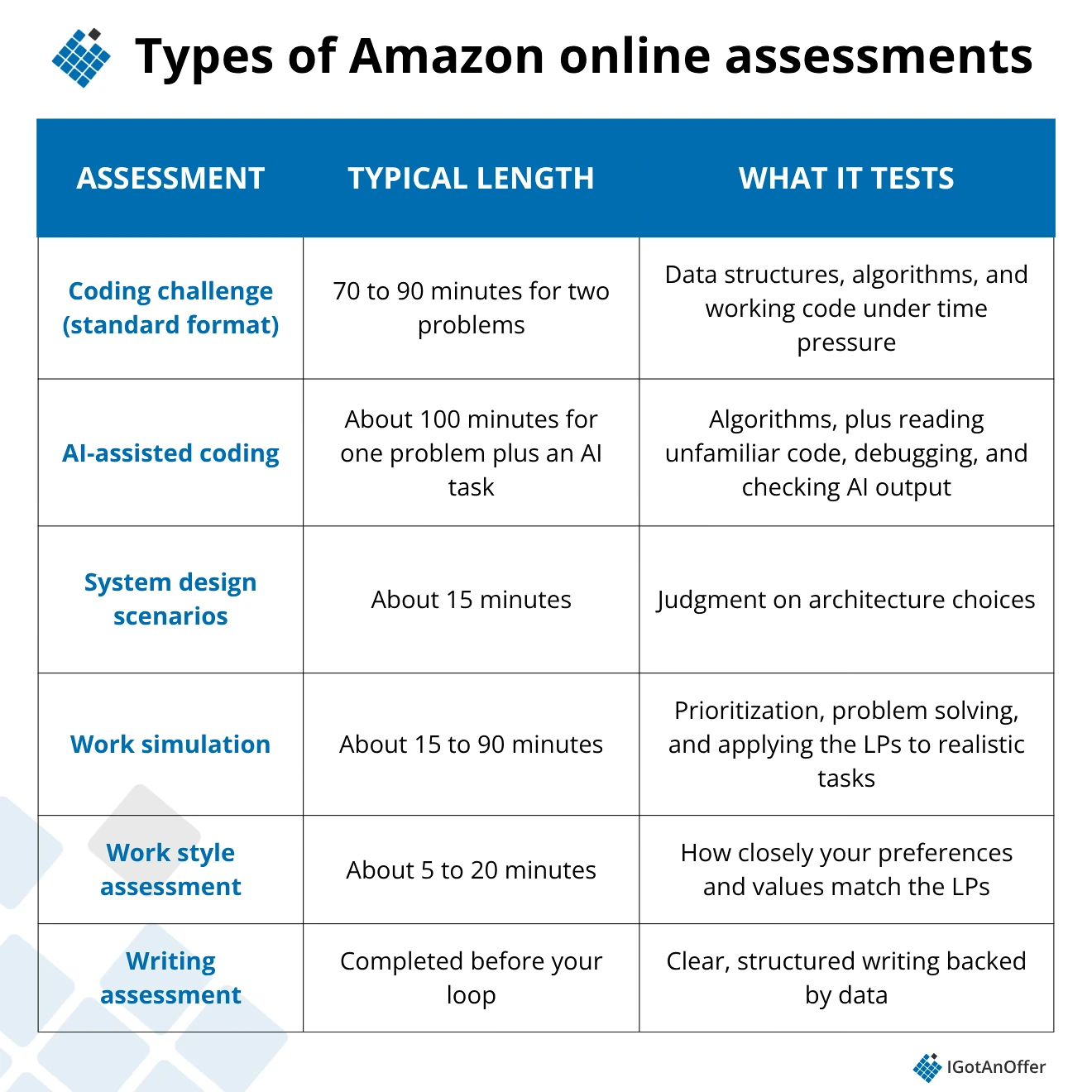
Below, we explain each assessment and share example questions from recent OA reports on LeetCode, Reddit, Blind, Levels.fyi, and Medium, plus Amazon's own examples.
You may not see these exact questions, but they'll show you what the format looks like and how hard the questions get.
We've edited the language in some places for clarity, and added a solution link wherever one is available.
2.1 Coding challenge ↑
Software engineers take the coding challenge on HackerRank. It currently comes in two formats: 1) the standard format, where you solve two algorithm problems, and 2) the newer AI-assisted format, where you’ll be asked to solve one algorithm problem followed by an AI task.
Your Amazon OA experience may differ from someone else's, even if you're applying at the same level. In 2026, one SDE 2 candidate got two algorithm problems, while another SDE 2 candidate got one algorithm problem plus the AI task. Amazon hasn't said how it decides which one you get, but your invitation email should tell you what to expect.
2.1.1 The standard format
In the standard format, you get two problems to solve. They’re typically at LeetCode medium difficulty, but harder ones may also come up. You have the option to write your code in most mainstream programming languages, including Java, Python, C++, and JavaScript.
For your prep, Amazon publishes the topics it draws from on its Software Development Topics page. These include data structures, algorithms, object-oriented design, databases, operating systems, and other computer science fundamentals.
Example Amazon OA questions: Coding challenge
- You're playing a game with n levels, and each level costs you some health. You can use an armor ability once to block up to a set amount of damage. Return the minimum starting health you need to finish every level with health above 0.
- Given an integer array, find the contiguous subarray with the largest sum. (Solution)
- Given a list of intervals, merge all the overlapping ones and return the result. (Solution)
- Solve a shortest path problem on a weighted graph, such as finding how long a signal takes to reach every node from a starting point. (Solution)
- Solve a string problem that combines two sequences into one, with an added step that counts inversions. (Solution)
For more practice, work through our list of 49 Amazon coding interview questions and our data structure interview questions.
2.1.2 The new AI-assisted format: fixing bugs with an AI assistant
Amazon's AI-assisted coding round is a newer OA format in which you fix bugs in an existing codebase using a built-in AI assistant. You'll take it with your camera on, since the assessment is proctored.
You'll have the option to choose between three tech stacks: Node.js, Python with Django, or Java with Spring Boot. Then, you're given a small app, sometimes with a live preview of the website, and a handful of bugs to fix.
The bugs look like everyday backend issues. Meaning, if you have hands-on development experience, you'll probably recognize the kind of problems you're fixing. A Levels.fyi user found the test fairly easy for exactly that reason. Most of the work is finding your way around code you didn't write and getting useful answers out of the AI.
Here are some of the AI tasks recent candidates have been given:
Example Amazon OA questions: AI coding
- Fix the backend API bugs in a wallet application, such as incorrect paths, URLs, and names, so that all six tests pass.
- Fix six bugs in an existing Spring Boot API.
- Fix three bugs in a website, using a live preview of the site to check your changes.
For sample prompts to practice with and tips on checking the AI's output, see our guide to AI-assisted coding interviews.
2.2 System design scenarios ↑
If you're applying for SDE 2, you'll also get a short 15-minute system design round. It has a multiple-choice format, so you won't be drawing any diagrams. Instead, you’ll be given a scenario (e.g., deciding whether a relational database fits the problem) and rank the actions from most to least effective.
You don't need deep system design knowledge for this part. Knowing the common tradeoffs, such as when to use SQL or NoSQL, should be enough. Our Amazon system design interview guide covers these tradeoffs in more depth.
2.3 Work simulation ↑
The work sample simulation is a sort of “day in the life” type of activity or simulation video game. You’ll receive prompts as emails, videos, or instant messages from a virtual manager or teammate, and decide how you'd handle each situation.
The situations you’ll face depend on your role. If you're an engineer, you'll read emails and watch short videos of team meetings. You might also get a small debugging task.
For roles outside of engineering, Amazon says you may need to interpret a data chart, respond to a customer, resolve an issue, or find information spread across several sources. In a program role, for example, you can expect questions on managing stakeholders and deciding what to prioritize.
Here are three scenarios from recent Amazon OAs.
Example Amazon OA questions: Work simulation scenarios
- You're managing the launch of a new project in North America. Rank the options for working with stakeholders and running monthly reviews from most to least effective.
- Work through a series of emails from your manager: take ownership of tasks, prioritize work across several regions, meet with vendors, and report back to internal stakeholders. Then write a reply as an email.
- Watch a short video of a team meeting and choose the best next step for the issue raised.
2.4 Work style assessment ↑
The work style assessment is a short multiple-choice questionnaire given to both technical and non-technical roles at Amazon. It's centered on Amazon's culture and Leadership Principles.
Each question shows you two statements side by side. You pick the statement that sounds more like you, then indicate how strongly it reflects you, using a scale like "most like me" or "more like me". You'll only have seconds to answer each question, as you’ll be going through many of them in a short time.
The statements aren't always easy to compare. Sometimes the two options don't seem related, and the same theme comes back several times in different wording.
Don’t try to game this section. Kevin’s answer to passing the personality test is to “simply answer as your most ethical self would in those scenarios.”
Example Amazon OA questions: Work style statements
- "I like for things to be clearly structured" or "I look forward to the opportunity to learn new things."
- "When a plan fails, I adjust quickly" or "When a plan fails, I stick with it and push harder."
- "I stay calm when things go wrong" or "I find setbacks hard to shake off."
2.5 Writing assessment ↑
The writing assessment is a short document, often one to two pages, that you complete before your interview loop.
The assessment is a good reflection of how Amazon works. Amazon meetings often start with everyone reading a written document, and PMs and TPMs spend a significant amount of time communicating through writing.
Kevin says the assessment may even mirror internal formats like a PR/FAQ (a mock press release with frequently asked questions) or a six-page narrative.
You'll want to keep your writing structured and concise here. Amazon values "data-driven, crisp communication without unnecessary fluff," says Kevin. Make your point in as few words as possible, back each claim with data where you can, and make sure each paragraph flows logically into the next.
Example Amazon OA questions: Writing assessment prompts
- What is the most innovative project that you have worked on?
- Talk about an experience in which you were able to simplify the lives of your customers.
- Write a short PR/FAQ for a new feature that would solve a problem your customers face today.
3. How the Amazon online assessment differs by role ↑
3.1 Software development engineers (SDEs)
For SDEs, the OA comes right after the resume screen. You get seven days to finish it and typically hear back within two days. If you don't pass, Amazon encourages you to practice and reapply after six months.
The SDE OA varies slightly by level. Most SDE candidates take a coding challenge, a work simulation, and the work style assessment. SDE 2 candidates specifically get a short system design section, while intern candidates skip the work simulation.
For the coding challenge, you'll get one of the two formats covered in section 2.1: the standard format with two algorithm problems, or the newer AI-assisted format with one algorithm problem and an AI task.
3.2 Product managers, program managers, and TPMs
PM, program manager, and TPM candidates usually skip the online simulation. Instead, you'll get a writing assessment after your phone screen. It's due two days before your interview loop.
3.3 Software development managers (SDMs)
Instead of a standard engineering OA, some SDM candidates get a writing assessment. This usually comes after the initial interviews and before the onsite. If you get one, Amazon will give you a few prompts to choose from, and you'll need to submit a written response to one of them.
3.4 Other roles
Candidates for roles outside engineering, such as sales or risk and compliance, usually take a work simulation tailored to the job, followed by the work style assessment. Some also get an extra simulation built for the role. An AWS sales candidate, for example, took a sales simulation in addition to the other two.
4. How to prepare for the Amazon online assessment ↑
Now that you know what to expect from the Amazon online assessment, let's look at how you can prepare for it.
4.1 Practice medium LeetCode problems under a 45-minute timer
Start with the topics on Amazon's Software Development Topics page, then practice medium-tagged LeetCode questions under a timer. Give yourself about 45 minutes per problem, or 40 if you expect the AI-assisted coding round. This will help you stay within the allotted time on the actual OA.
If you're running out of time during the OA, prioritize submitting working code and leave a comment explaining how you'd improve it. One Blind user who hit Python's recursion limit did this and still got invited to the onsite.
For practice problems, work through our list of 49 Amazon coding interview questions. For a broader plan, including a data structures and algorithms refresher and an answer method, see our coding interview prep guide.
4.2 Get comfortable using AI tools
Practice with the stack you plan to use on the day. As we mentioned earlier, Amazon will give you a choice between Node.js, Python with Django, and Java with Spring Boot.
Then find a small open-source project using that stack and practice debugging it with an AI tool. You can work on one of the project's open issues, or deliberately break one of its tests and use an AI assistant to find and fix the bug.
Once you're comfortable, do a timed run that mirrors the 100 minutes you'll spend in the real OA. Use 40 minutes on an algorithm problem, then about 60 minutes fixing bugs in your practice project.
4.3 Internalize the Amazon Leadership Principles
The LPs run through almost every part of the OA, from the work simulation to the work style assessment. Make sure you understand all 16 principles and prepare around 10 to 15 bulletproof stories from your experience that you can adapt to different LPs.
Check out our guide to the Amazon Leadership Principles and Amazon behavioral interview guide to get started on your study.
4.4 Write a practice document before your writing assessment
If you're a PM, TPM, or SDM, write at least one full practice document using one of the prompts in section 2.5. Try to cover the customer problem, your decisions, and the result, and keep it to two pages.
Set yourself a deadline when you write your practice document, so you get used to writing under time pressure.
4.5 Take Amazon's practice test
Amazon offers an unscored practice test with two sample coding questions, plus a video walkthrough of the coding platform. Doing both helps you get used to the interface, so it's less likely to slow you down on the day.
The practice test above only covers the standard format. If you get the AI-assisted format, you'll receive a separate practice test for the repository task. Take it before the real OA, since it shows you how the tabs, tests, and debugger work in the environment.
4.6 Give yourself more time than the invitation suggests
The time a recruiter gives you can be well short of what the assessment actually takes. One candidate was told the work simulation would take 30 minutes, but it ended up taking an hour and a half. Amazon itself recommends setting aside up to two hours for the SDE OA.
4.7 Learn to structure your written answers
Most of the OA is multiple choice, but some sections require written responses. For example, a work simulation might ask you to reply to an email from your manager, while the writing assessment may ask you to describe a past project.
For questions like these, Kevin recommends the STAR method (Situation, Task, Action, Result). We suggest a slightly expanded version, which is IGotAnOffer’s SPSIL framework (Situation, Problem, Solution, Impact, Lessons learned). It covers the same ground as the STAR, but the last two steps remind you to show the results of your work and lessons you took from it to give your answer more depth.
Regardless of the framework you choose, both SPSIL and STAR should give your answer a clear beginning, middle, and end.
Learn more about how to use the frameworks in our Amazon behavioral interview guide.
5. What comes after the Amazon online assessment ↑
After you complete the OA, Amazon will review your results to decide whether to move you forward. If you pass, the next step is typically a phone screen or the full interview loop, depending on the role.
How quickly you'll hear back varies. Recent candidates have heard back anywhere from the next day to two weeks later. In the meantime, keep an eye on your spam folder, because Amazon's emails sometimes land there.
If you pass, expect the interviews to dig much deeper into your skills and how you've applied Amazon’s Leadership Principles.
To prepare for your specific role, our guides below break down each interview round, with example questions and tips from ex-Amazon interviewers:
- Amazon software development engineer (SDE 1) interview
- Amazon software development engineer (SDE 2) interview
- Amazon software development manager interview
- Amazon product manager interview
- Amazon program manager interview
- Amazon technical program manager interview
- Amazon machine learning engineer interview
- Amazon data engineer interview
- Amazon data scientist interview
- Amazon applied scientist interview
- Amazon business intelligence engineer interview
- Amazon technical account manager interview
- Amazon finance manager interview
Practicing alone can only take you so far, since you can't recreate the pressure of a real interview or get instant feedback. You can practice for free with a friend or a peer, but that also comes with limitations. In our experience, practicing with experts who know Amazon's hiring bar makes a big difference.
Find an Amazon interview coach so you can:
- Test yourself under real interview conditions
- Get accurate feedback from a real expert
- Build your confidence
- Get company-specific insights
- Learn how to tell the right stories, better
- Save time by focusing your preparation
Landing a job at a big tech company often results in a $50,000 per year or more increase in total compensation. In our experience, three or four coaching sessions worth ~$500 make a significant difference in your ability to land the job. That’s an ROI of 100x!
Click here to book mock interviews with experienced Amazon interviewers.













 Account manager



 Coding