

 Back to other articles

 Last updated: August 12, 2026
 Interviews
 Management consultant
 Case
Case Deeply researched
If you’ve applied for a consulting role at Boston Consulting Group (BCG), you’ll need to get ready for one of the first hurdles you’ll need to clear in your application: the BCG online case assessment.
Like McKinsey and Bain, BCG uses an online assessment tool to filter its pool of candidates early on in the process. However, BCG’s assessment is a little different in that it uses a chatbot named Casey to guide you through the case.
In this article, we’ll cover everything you need to know about the BCG online case assessment: the test format and question types, practical tips from our expert coaches and real BCG candidates, links to resources, and a prep plan you can follow to help you ace the test.
- What is the BCG online case assessment?
- BCG online case question types
- BCG online case assessment tips
- How to prepare for the BCG online case assessment
Let’s get started.
Click here to book a session with a BCG interview coach
1. What is the BCG online case assessment?↑
The BCG online case assessment (often called "Casey") is BCG’s digital screening tool designed to simulate a live case interview. The tool was developed by HireQuotient, a start-up in Singapore co-founded by BCG alumnus Eugene Goh.
What makes the BCG online case assessment unique is that it comes in the form of a chatbot named Casey. Casey acts as your interviewer, guiding you through a business case and asking questions as you work toward a recommendation.
According to Adrian (ex-BCG associate director), the BCG online case grades the same parameters as a traditional case, only in a different format. These parameters include your reasoning, quick maths, logic, data analysis, and your ability to filter and group information.
As for the cases themselves, James (ex-BCG senior manager) says you can expect topics such as market sizing, financial analysis, competitive analysis, data interpretation, and decision-making.
1.1 What’s the purpose of the BCG online case assessment?
The purpose of the BCG online case assessment is to help the firm hire the best and most diverse people as quickly as possible. It’s one of the first steps in BCG's hiring process.
The BCG online case assessment gives the firm a greater chance of finding high-potential candidates who may or may not fit the usual profile of a successful consultant. They can do so without having to spend tons of time and resources interviewing people who look qualified on paper but may not actually have the right skills for the role.
1.2 At what stage in the hiring process will I be given the BCG online case?
You’ll encounter the BCG online case early in your application process. It was originally created as part of the initial screening or Round 0 (R0), and some regions still have it at this stage, but now many candidates report the BCG online case as part of their Round 1 (R1) interviews.
Here’s an overview of what your application process at BCG may look like:
-
Round 0 Initial screening
-
Resume and cover letter screening
-
-
Round 1 interview
-
1 BCG online case assessment
-
1 Live case interview
-
-
Round 2 interview
-
Live case interviews
-
In some regions, the Quantitative Reasoning test may take the place of the BCG online case. If it’s unclear in your recruiter’s email whether you’ll get the online case assessment, it’s best to clarify which steps to expect.
1.3 What’s the format of the BCG online case assessment?
Of the three MBB digital assessments, BCG’s format is the closest to a live case interview. The BCG online case assessment has two sections: the 30- to 35-minute Casey chatbot case test proper and a 1-minute video recommendation.
Let’s look at each section more closely.
1.3.1 Casey chatbot case test
This is the first section of the BCG online case assessment. Here, you’ll work through a case with the Casey chatbot acting as your interviewer.
Your first task is to identify the most relevant data from a set of around eight datasets. This tests your ability to apply the MECE (Mutually Exclusive and Collectively Exhaustive) principle and determine which information you need to solve the case.
You’ll then answer eight to ten questions, with a mix of multiple-choice and open-ended questions. Most will involve case maths and data or chart analysis.
Once you start the chatbot portion, you won’t be able to pause the test or go back to previous questions. After completing it, you’ll be prompted to take a one-minute video recommendation.
In Section 2, we’ll cover the different types of questions you’ll encounter in this section.
1.3.2 Video interview
The second section is a one-minute video interview, where you’ll be asked to give your final recommendation to the client in the case.
This part of the assessment tests your ability to synthesise your thoughts quickly and confidently present your recommendation.
As in a live case interview, a good format to follow when making your final recommendation is:
- Open with the question or objective of the case
- Summarise your findings
- Make your recommendation and acknowledge the risks involved
What happens if I fail the BCG online case?
If you think you performed poorly on your online case, just remember that you’ll be evaluated on several factors, and not just your grade on the test.
Unless you specifically receive a rejection letter, you still stand a chance of getting to the live case interviews.
If you do get a rejection email, you have to wait for one to two years until you can reapply.
Coaches who contributed to this guide








2. BCG online case question types↑
Now that you have an idea of what the BCG online case assessment generally looks like, let’s get into the different types of questions you can expect during the Casey chatbot case test portion.
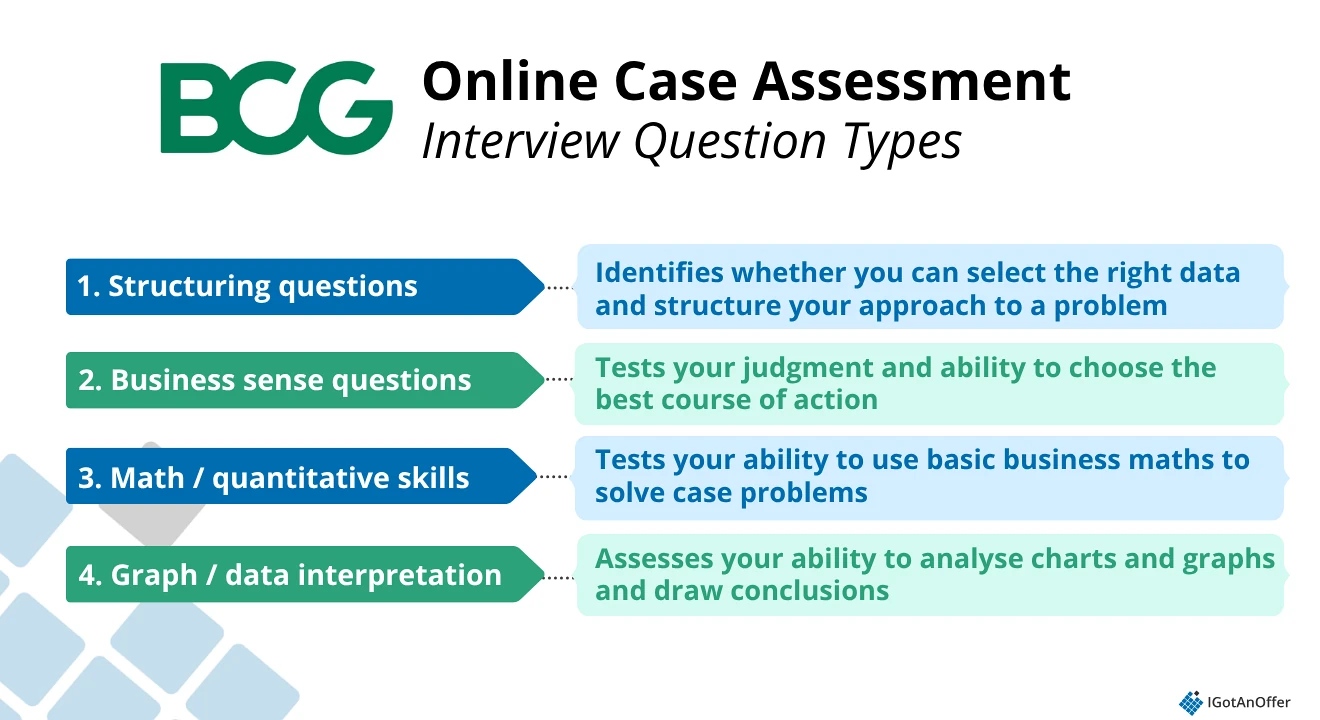
2.1 Structuring questions
Structuring questions evaluate your ability to identify the right data or information, which you’ll then use to structure an approach to solve a given problem.
In the BCG online case, you’ll be asked to choose the datasets that are the most relevant to the problem at hand. It’s usually a multiple-choice question followed by an open-ended question that asks you to justify your choice.
One thing to watch out for when answering structuring questions: “Some of the datasets will be completely irrelevant, while others will be relevant for only one part of the problem or will leave a gap that is impossible to guess through,” says Petr (BCG consultant).
That’s why it’s very important not to skim through the prompt. Make sure you understand the objective of the case. Not only is it crucial for choosing your datasets, but it will also help you get through the rest of the case test.
According to Petr, most candidates make the mistake of choosing two datasets that give them the same information yet lack a crucial piece of data.
For example, in a retail profit-maximizing case, a candidate might select an itemised profit and loss (P&L) per inventory item and an inventory list that includes the purchase cost of each item.
The problem is that the purchase cost is already included in the first dataset (itemised P&L), so you essentially now have two datasets telling you the same thing.
2.2 Business sense questions
With business sense questions, your decision-making skills will be put to the test. How do you use both your knowledge of a given situation and your intuition to choose the best option possible?
Again, like the structuring questions, you may encounter business sense questions as multiple-choice and open-ended questions.
You’ll be asked to identify the best possible options for the multiple-choice questions. Some of the options will look instantly irrelevant, so to manage your time, instantly eliminate these options. This gives you more time to focus on deliberating which of the remaining ones is the best way to go.
For instance, say you get a hotel strategy case, and your objective is to recommend a competitor response strategy. You might encounter a business sense question asking you to identify which areas you would like to investigate first. You’ll want to immediately eliminate options that are too generic or too niche and focus instead on the options directly related to business impact and customer relations.
For the open-ended questions, be sure to justify your choice in the most succinct way possible.
2.3 Math / quantitative skills
Based on candidate reports, the quantitative questions on the BCG online case are basic business maths. If you’re not familiar, here’s an overview of the most common formulas you’ll need to know:
- Break-even
- Profit
- Weighted average
- Expected value
- Contribution margin
We also recommend that you review our free case interview maths guide.
During the online case, you can have a calculator nearby if you’re not comfortable with mental maths. However, we do recommend brushing up on mental maths early on because calculators are not allowed during live case interviews at BCG.
2.4 Graph / data interpretation
For this type of question, you’ll be asked to analyse and interpret two to three graphs. You’ll need to do some calculations to derive an assessment of the situation. For example, you might be asked what’s driving the cost increase or the decline in profits.
Again, this can come in the form of a multiple-choice question followed by an open-ended one.
3. BCG online case assessment tips↑
For this section, we’ve gathered tips from current and former BCG consultants: Petr (BCG consultant), James (ex-BCG senior manager), and Adrian (ex-BCG associate director).
Collectively, they’ve conducted hundreds of interviews throughout their career, both actual and mock. Here are their tips, based on what they’ve seen on the ground:
3.1 Verify your initial assessment format
As we’ve mentioned earlier, you may encounter other tests as part of the initial screening. These tests may be added to the BCG online case or used as a substitute. Best to check with your recruiter so you know exactly what to prepare for.
3.2 Maximise the online case demo sent by BCG
Your BCG recruiter will send you a demo with your online case invite. Most candidates report that the demo is much easier than the real assessment, but that doesn’t mean you should skip it. You should use it as a mock case to get used to the format.
3.3 Brush up on your case maths and data analysis
A large portion of the BCG online case will require some case maths. If you have any case interview or business experience, you’ll likely be familiar with the basics.
James also advises taking the time to familiarise yourself with reading charts and graphs, as this is an essential component of the test.
In any case, whether you have experience or not, it’s good to brush up on your knowledge beforehand.
Click here to read our guide on case interview maths.
3.4 Practise typing your answers
For open-ended questions in the Casey chatbot test, you’ll need to provide succinct answers in a structured way. For this, Adrian says you’ll need to be able to quickly structure your thoughts in a written format. So we highly recommend typing up your answers as quickly as possible during your case interview practice.
3.5 Time your practice
For most candidates, the time constraint is the most stressful part of the BCG online case. A good way to ease your nerves about it is to incorporate it into your practice. Get used to solving cases in under 30 minutes, and practise giving 1-minute client recommendations on camera.
3.6 Sign up for a simulation course
If you want more in-depth practice and have the budget to spare, consider signing up for a simulation course like Online Case Secrets' BCG Case Combo.
This course bundle, developed by ex-BCGer and top consulting coach Francesco, includes simulations of the chatbot and the video interview, along with other review resources to help you master every part of the online case. They also update the simulation course to reflect any changes to the online case.
3.7 Relax while answering
Don’t go into the online case stressed about the time constraint. Relax and make sure you don’t rush through the case objective, as having an incomplete understanding of this will have a trickle-down effect on your performance.
You’ll also want to devote time to the dataset selection. Another thing to keep in mind, James says, is not to overthink. When you overthink, you could ultimately mismanage your time and even misinterpret questions.
3.8 Devote enough time to choosing the right datasets
“Candidates often rush through the first parts of the online assessment, ending up with a lot of time at the end, at the cost of accuracy in the early stages,” says Petr.
His advice is to go through the data selection task very carefully. “Making a sub-optimal selection there will have a knock-on effect on the rest of the case,” he says.
3.9 Use a calculator if you must
You’re allowed to use a calculator during the BCG online case, so take advantage of it. Still, do know it would be helpful to get comfortable with mental maths as early as you can because, as we’ve mentioned, you won’t be allowed to use a calculator during your live case interviews.
3.10 Don’t go straight into the video section
You’ll only have one minute to make your video recommendation, so don’t rush into it. After the chatbot case portion, you’ll be prompted to click “Next”. Don’t click on it just yet.
Take a breather, gather your thoughts, and practise your one-minute spiel before going to the video interview portion.
4. How to prepare for the BCG online case assessment↑
“There is no difference between Casey [BCG online case chatbot] and a classic face-to-face case interview, and we recommend that the preparation be the same,” says Casey developer Goh.
Below, you'll find links to free resources and four steps to help you prepare for your BCG online case assessment.
4.1 Learn more about BCG
Before taking the online case assessment, spend some time learning about BCG, including the types of clients it works with, the industries it serves, and the problems its consultants solve.
The cases you encounter may reflect the types of business problems BCG works on, so having this context can help you approach them with stronger business sense.
Here are some resources to get you started:
4.2 Practise on your own
One of the best ways to prepare for a case interview is to review as many practice cases as you can. Here are some free mock case interviews from our YouTube channel to get you started:
- BCG live case interview with notes
- BCG Public Sector Mock Case (with ex-BCG director)
- BCG Revenue Problem Mock Case (with ex-BCG consultant)
Try to diversify the types of cases you practise with. “The more cases you have confronted, the wider your spectrum of knowledge and solutions will be,” Adrian (ex-BCG associate director) says. Click here to learn more about the different types of case interview questions you may encounter.
For more practice cases, check out our complete list of case interview examples.
4.2.1 Recommended consulting interview resources
Remember that the online case assessment is just one part of BCG’s interview process. In addition to the practice cases above, we also recommend checking out our other resources:
- BCG interview process guide
- How to prepare for BCG case interviews
- Common case interview frameworks
- “Why BCG?” interview question (with sample answer)
- 31 consulting interview questions (from McKinsey, BCG, etc.)
- Phone and video case interviews at McKinsey, BCG, and Bain
- 15 case interview tips for McKinsey, BCG, and Bain
- Dress Code for Interviews at McKinsey, BCG, Bain, etc.
- Big 3 consulting firms: McKinsey, BCG, and Bain (MBB)
If you're also applying to other consulting firms, you may also want to check out the Consulting section of our blog.
Once you’re in command of the subject matter, you’ll want to practise solving cases. But by yourself, you can’t simulate thinking on your feet or the pressure of performing in front of a stranger. Plus, there are no unexpected follow-up questions and no feedback.
4.3 Practice with peers
As we’ve noted, the BCG online case interview is simply a chatbot version of a live case interview, so the best way to prepare for it is with mock case interviews.
If you have friends or peers who can do mock interviews with you, that's an option worth trying. It's free, but be warned, you may come up against the following problems:
- It's hard to know if the feedback you get is accurate
- They're unlikely to have insider knowledge of interviews at your target company
- On peer platforms, people often waste your time by not showing up
For those reasons, many candidates skip peer mock interviews and go straight to mock interviews with an expert.
4.4 Practise with experienced BCG interviewers
In our experience, practising real interviews with experts who can give you company-specific feedback makes a huge difference.
Find a BCG case interview coach so you can:
- Test yourself under real interview conditions
- Get accurate feedback from a real expert
- Build your confidence
- Get company-specific insights
- Learn how to tell the right stories, better.
- Save time by focusing your preparation
Landing a job at a top consulting company like BCG often results in a $50,000 per year or more increase in total compensation. In our experience, three or four coaching sessions worth ~$500 make a significant difference in your ability to land the job. That’s an ROI of 100x!