Back to other articles
 Last updated: November 25, 2026


 Interviews
 Deeply researched
If you’re interviewing at McKinsey, there’s a chance you’ll come across one of its new AI interviews. The firm is still piloting them, so there’s far less written about them than about the rest of the interview process.
The Lilli AI interview was first reported in January 2026 among business school candidates. The AI avatar interview is being tested this autumn with undergraduates applying for business analyst roles in North America.
In this guide, we'll cover what we know about each interview so far and how to prepare. To put it together, we gathered information from McKinsey’s official guidance for candidates, along with news reports and accounts from recent candidates.
Here's an overview of what we'll cover:
- About McKinsey's AI interviews
- What is the McKinsey Lilli AI interview?
- What is the McKinsey AI avatar interview?
- How to prepare for McKinsey's AI interviews
Let's get started.
Click here to book a session with a McKinsey interview coach
1. About McKinsey's AI interviews ↑
McKinsey's AI interviews are two new interview formats that the firm is currently piloting:
- The Lilli AI interview
- The AI avatar interview
What differentiates them is the role AI plays. In the Lilli AI interview, you use AI as a tool to help you solve a case. In the AI avatar interview, AI plays the client, and you're assessed on how you handle the conversation.
Neither format replaces the Personal Experience Interview (PEI) or the case interviews. To learn more about each step in the entire hiring process, see our guide to the McKinsey interview process.
2. What is the McKinsey Lilli AI interview? ↑
The Lilli AI interview is a case interview where you use Lilli, McKinsey's in-house generative AI tool, to help analyze a client problem and refine your recommendation.
Lilli is named after Lillian Dombrowski, the first professional woman McKinsey hired in 1945. Consultants use it to search McKinsey's internal knowledge across over 40 curated sources and 100,000+ documents and interview transcripts. According to McKinsey, 72% of the firm now uses Lilli and sends it more than 500,000 prompts a month.
Since Lilli is such a big part of how McKinsey consultants work, the firm has started testing whether candidates can use it well too. The FT reported that some business school candidates have been asked to use Lilli in one of their interviews, and that McKinsey could roll it out to all junior recruits if the pilot goes well.
You may or may not get to use Lilli itself, though. In May 2026, Marie Christine Padberg, McKinsey's global talent attraction co-leader, told Business Insider that one of the firm's interview components asks candidates to "use a publicly available generative AI tool". Whichever tool you're given, your goal is to show that you can use AI the way McKinsey consultants do on client work.
2.1 How does the Lilli AI interview work?
The Lilli AI interview works much like a traditional McKinsey case interview, only with an AI tool added. You're given a client problem and asked to use Lilli to analyze it and refine your conclusions.
As with every McKinsey case, the interview is interviewer-led. Your interviewer will guide you through the case and decide when you move from one question to the next.
McKinsey's interviewing guidelines say candidates shouldn't use AI during assessments unless specifically allowed to. So only use the tool once your interviewer gives it to you.
2.2 What does the Lilli AI interview evaluate?
The Lilli AI interview is still a case interview, so you’ll be evaluated on the same fundamentals as any McKinsey case. Your interviewer will expect you to structure the problem, work through the case maths, and make a recommendation the client can act on. Our McKinsey case interview guide covers each of these in detail.
You’ll also be assessed on how you use the AI tool. According to the FT, interviewers look at how candidates prompt Lilli and whether they have the “curiosity and judgment” to challenge its output and apply it to the client’s specific requirements.
Here are the competencies you can expect to be assessed on:
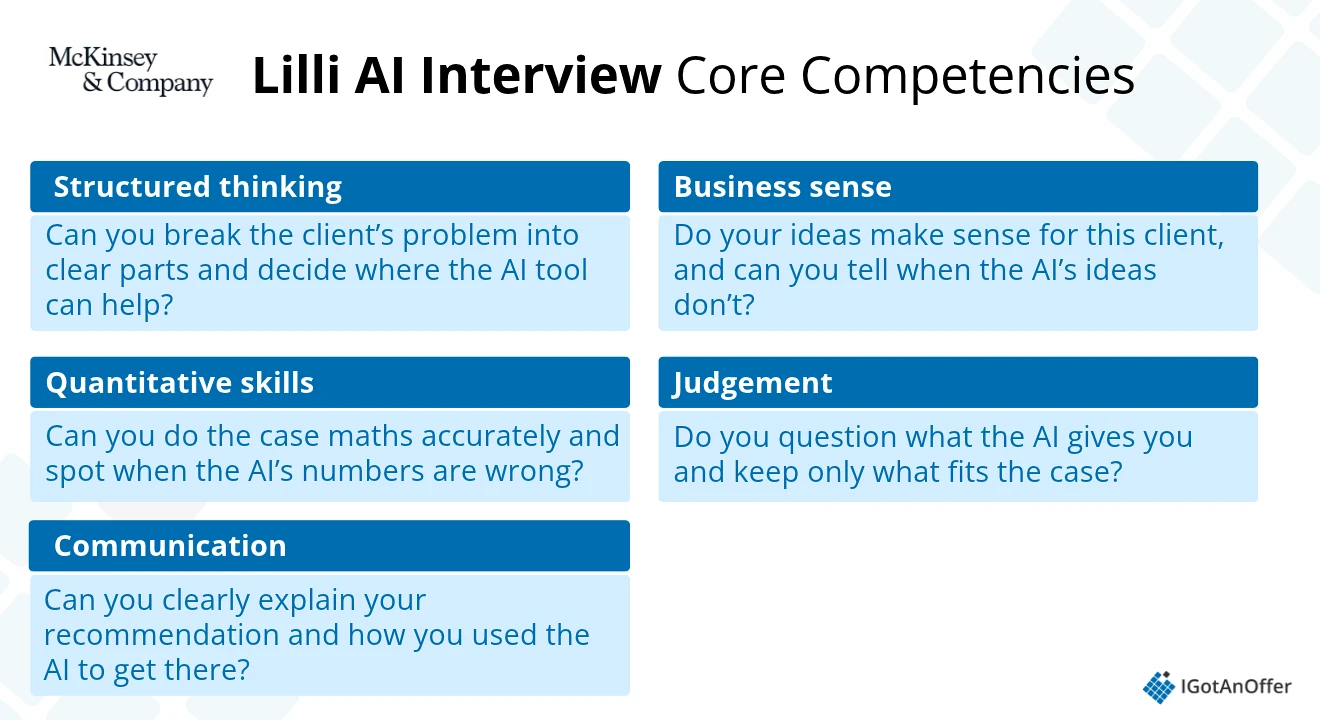
- Structured thinking: Break the client's problem into a clear, MECE structure and use it to drive the case forward. Decide which parts of your structure the AI tool should help with, so it supports your approach without setting it.
- Business sense: Come up with ideas that make sense for the client's business, and spot when the tool's suggestions don't fit their industry or situation.
- Quantitative skills: Work through the case maths accurately and sanity-check your results, including any figures the tool gives you.
- Judgement: Know when the tool's output is useful and how to apply it. Question everything it gives you, from figures that don't match the case data to generic recommendations that could apply to any company, and adjust your analysis when something doesn't add up.
- Communication: Explain how you're using the tool as you go, including what you're asking it and why. When you make your recommendation, show which parts come from your own analysis and which from the tool, and present it top-down, starting with your answer.
Even when Lilli does some of the work, such as listing possible cost drivers, you still need to decide which ones matter for your client and where they fit in your structure.
3. What is the McKinsey AI avatar interview? ↑
The McKinsey AI avatar interview simulates a 10-minute client meeting, in which an AI avatar plays the client and you act as the consultant. The Wall Street Journal first reported the pilot in October 2026.
McKinsey is testing the format this autumn with undergraduates applying for business analyst roles in some North American offices. If the pilot works, McKinsey plans to use it for other roles in 2027.
3.1 How does the AI avatar interview work?
You talk to the avatar on a laptop at a McKinsey office while partners or interview assessors watch from the room. For example, the avatar plays the mayor of a fictional city seeking advice on where to build a new stadium and questions the candidate about their thinking.
McKinsey says the avatar isn't designed to be combative or to trip candidates up with "gotcha" questions. Saleem Zafar, a Dallas partner who helped design the pilot, said that the scenarios reflect about 80% of what McKinsey consultants deal with day to day.
According to the WSJ, McKinsey believes using an avatar to play the client “makes the exercise fairer”. Some human interviewers may push candidates harder than others but the avatar gives everyone the same difficulty level.
3.2 What does the AI avatar interview evaluate?
The AI avatar interview evaluates how well you listen and adapt during a live conversation with a client. According to Zafar, he specifically looks out for whether candidates hear what matters and how they act on it.
For instance, in the WSJ’s stadium scenario, the mayor might tell you early on that the city can’t raise taxes. If you then propose funding the stadium through a tax increase, it shows you’re not listening properly or are only keen to push your own agenda. When the mayor rules out one of your sites, drop it and move on without defending your first plan.
The avatar responds to what you say. This means you won’t be able to script your answers in advance.
4. How to prepare for McKinsey's Lilli AI and AI avatar interviews ↑
Below, you'll find links to free resources and four steps to help you prepare for McKinsey's AI interviews.
4.1 Learn more about McKinsey
Before your interview, spend some time learning about McKinsey, including the types of clients it works with, the industries it serves, and the problems its consultants solve. It's also worth reading up on how McKinsey's consultants use Lilli in their day-to-day work.
Here are some resources to get you started:
- McKinsey interview process guide (by IGotAnOffer)
- McKinsey's interviewing guidelines (by McKinsey)
- Meet Lilli, McKinsey’s generative AI tool (by McKinsey)
- Rewiring the way McKinsey works with Lilli (by McKinsey)
4.2 Practice on your own
One of the best ways to prepare for a case interview is to review as many practice cases as you can. Here are some free practice cases from McKinsey's website to get you started:
Try to diversify the types of cases you practice with too.
For more practice cases, check out our complete list of case interview examples.
4.2.1 Practice with AI tools
You most likely will not be able to practice with Lilli before your interview. But you can still use a publicly available AI tool like ChatGPT or Claude.
The simplest approach is to follow the answer method in our case interview prep guide and bring the tool in where it helps:
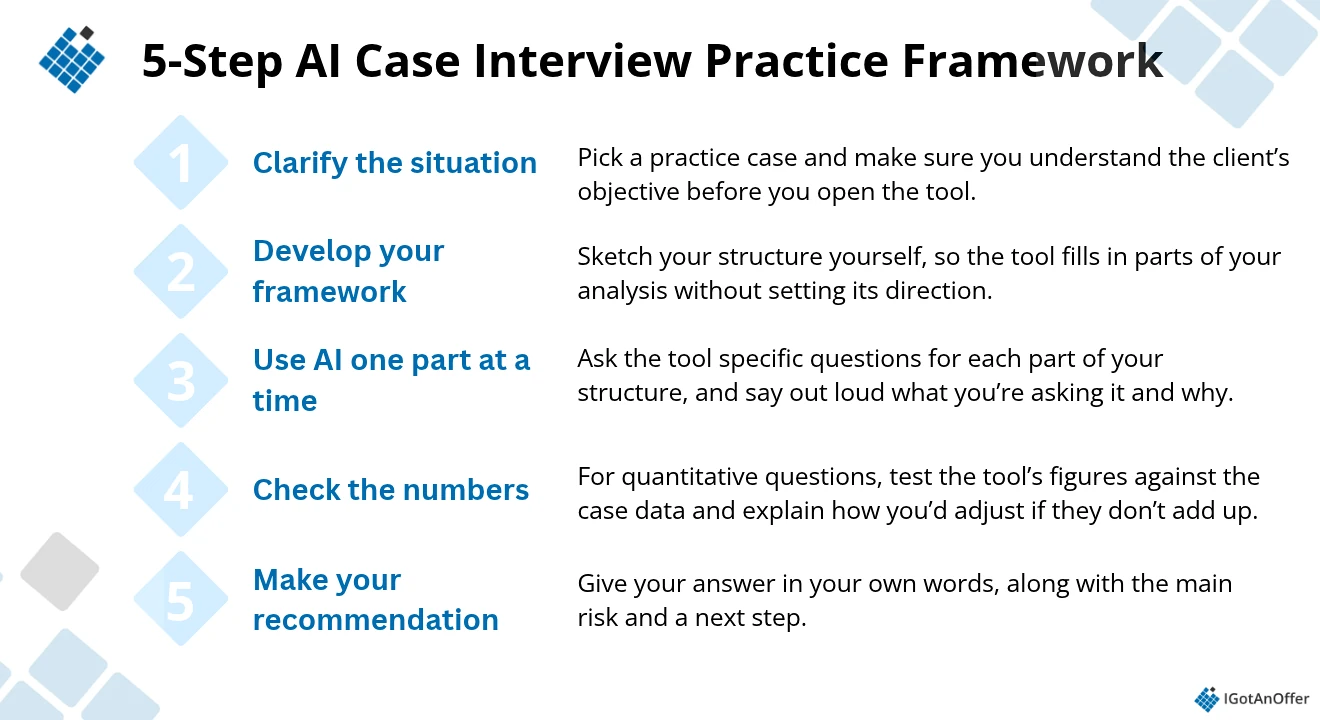
- Clarify the situation. Pick a practice case and make sure you understand the client's objective before you open the AI tool.
- Develop your framework. Sketch your structure yourself, so the tool fills in parts of your analysis without setting its direction.
- Use AI one part at a time. Ask the tool specific questions for each part of your structure, and say out loud what you're asking it and why.
- Check the numbers. For quantitative questions, test the tool's figures against the case data and explain how you'd adjust if they don't add up.
- Make your recommendation. Give your answer in your own words, along with the main risk and a next step.
For step 3, here’s the difference between a weak and a stronger prompt in a profitability case:
- Weak prompt: How can a grocery chain increase its profits?
- Stronger prompt: Our client is a UK grocery chain with 300 stores. Revenue has been flat for two years, but operating margin has fallen from 4% to 2%. Which cost categories most often drive margin decline in UK grocery retail, and roughly what share of total costs does each represent?
The stronger prompt gives the tool the client’s numbers, so you can check its answer against the case data in step 4.
4.2.2 Recommended consulting interview resources
Remember that the AI interviews are just one part of McKinsey's interview process. In addition to the practice cases above, we also recommend checking out our other resources:
- McKinsey interview process guide
- McKinsey case interview guide
- McKinsey PEI questions
- McKinsey Solve guide
- Common case interview frameworks
- Issue trees
- MECE framework
- Case interview maths
- "Why McKinsey?" interview question (with sample answer)
- Consulting interview questions (from McKinsey, BCG, etc.)
- 15 case interview tips for McKinsey, BCG, and Bain
Once you’re in command of the subject matter, you’ll want to practice under interview conditions. You can start by working through a case with an AI tool on your own. Just know you can’t simulate thinking on your feet or explaining your use of AI to an interviewer if you go this route. Plus, you won't get unexpected follow-up questions or feedback.
A practice partner can play the interviewer or the client. It’s a great way to prep for both the AI interviews and McKinsey’s live case interviews.
4.3 Practice with peers
If you have friends or peers who can do mock interviews with you, that's an option worth trying. It's free, but be warned, you may come up against the following problems:
- It's hard to know if the feedback you get is accurate
- They're unlikely to have insider knowledge of interviews at your target company
- On peer platforms, people often waste your time by not showing up
For those reasons, many candidates skip peer mock interviews and go straight to mock interviews with an expert.
4.4 Practice with experienced McKinsey interviewers
In our experience, practicing real interviews with experts who can give you company-specific feedback makes a huge difference.
Find a McKinsey interview coach so you can:
- Test yourself under real interview conditions
- Get accurate feedback from a real expert
- Build your confidence
- Get company-specific insights
- Learn how to tell the right stories, better.
- Save time by focusing your preparation
Landing a job at a big tech company often results in a $50,000 per year or more increase in total compensation. In our experience, three or four coaching sessions worth ~$500 make a significant difference in your ability to land the job. That’s an ROI of 100x!
Click here to book a mock case interview session with experienced McKinsey interviewers.



 Management consultant


 Behavioral