Back to other articles


 Last updated: November 10, 2026


 Interviews
 AI engineer
 AI system design
 Deeply researched
Google AI engineer interviews are challenging. You’ll need strong coding, system design, and AI skills, and you’ll have to demonstrate them under pressure as you solve problems and explain your decisions to interviewers.
This guide covers what you need to know to prepare for AI engineering interviews at Google, Google Cloud, Google DeepMind, and Gemini teams.
We've put together 25 practice questions, an overview of the process, and preparation tips from experienced coaches. The questions include Google candidate reports and supplementary AI engineering practice, with the sources identified in each list.
Practice with a Google AI engineer interview coach.
1. Google AI engineer role and salary ↑
Before getting into the interviews, let’s look at the work you could be doing and the experience you’ll need.
1.1 What does a Google AI engineer do?
AI engineers at Google build software that uses AI models. This can mean working on a product such as Gemini or helping a Google Cloud customer build an application. The responsibilities and job titles vary between those teams.
For instance, on the Gemini App Skills Platform, you’d build the systems that help Gemini find and use capabilities from Google and third-party services to complete tasks. This involves C++ serving code, Python evaluation pipelines, and testing how well the model selects and uses tools. You’d work with research, product, and engineering teams to bring those capabilities into the Gemini app.
As a Google Cloud AI engineer, your main goal would be to help customers build and deploy generative AI applications, including connecting the application securely to their data and services. You’ll do technical presentations, too, so you'll need to explain your recommendations to customers.
In an Applied AI Agents software engineering role at Google DeepMind, you could build agents that search company information and return answers with sources. You’d also work with subject matter experts to test factual accuracy and multi-step reasoning, then use the results to improve the system. The role calls for Python or TypeScript and experience shipping applications built with large language models (LLMs).
1.2 How much does a Google AI engineer make?
The median yearly total compensation for a Google AI engineer in the United States is about $240,000, according to Levels.fyi. This is based on 38 submissions in its AI engineer title filter, checked in October 2026.
Here are the average base pay and total compensation figures by level. All amounts are in US dollars per year.
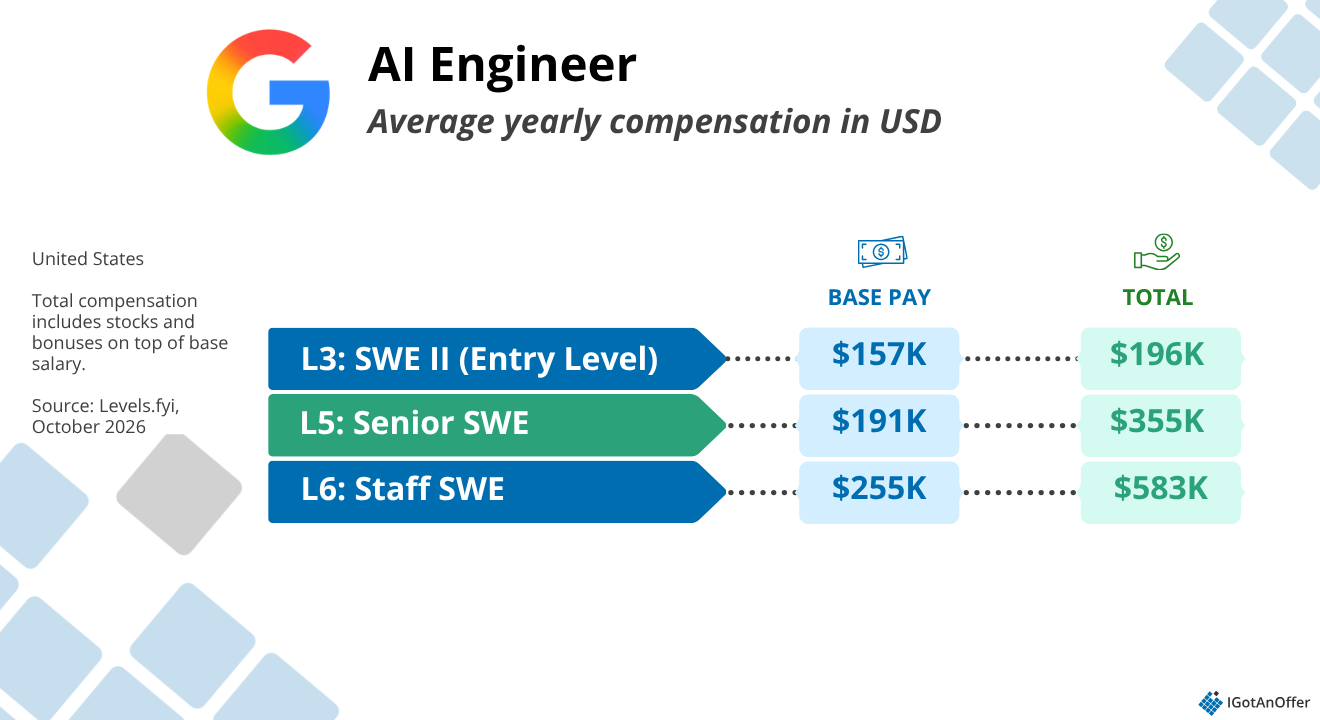
Total pay includes stock and bonuses, with sign-on payments included in the bonus figures.
Remember that these are self-reported figures from a small sample. Your location and level will affect what you're offered.
Ultimately, how you do in your interviews will help determine what you’ll be offered. That’s why hiring one of our ex-Google interview coaches can provide such a significant return on investment.
If you do get an offer, ask your recruiter whether any part of the package is open to discussion. Our Google salary negotiation guide can help you prepare, and you can book one of our salary negotiation coaches for personalized advice.
Coaches who contributed to this guide







2. Google AI engineer interview process ↑
The Google interview process for software engineers typically takes more than eight weeks. For an AI-focused software engineering role, use that as a rough planning estimate while you wait for your recruiter’s schedule.
The main stages to prepare for are:
- Resume screen
- Hiring assessments, if requested
- Recruiter / hiring manager screen
- Technical screen
- Onsite or virtual interviews
- Hiring decision and team matching
- Offer and negotiation
You'll find these stages in Google software engineer and Google machine learning engineer interviews, although the exact sequence varies. Google Cloud and Google DeepMind can arrange their AI interviews differently, including for Gemini roles. Confirm the rounds with your recruiter before planning your preparation.
2.1 Resume screen ↑
First, recruiters will look at your resume and assess if your experience matches the open position. This is a highly competitive step. To help you put together a targeted resume that stands out, follow the tips below:
Tips on crafting a resume
- Simplify. Avoid overly creative layouts. A simple resume passes through applicant tracking systems and reads quickly for recruiters and hiring managers.
- Verbalize. Start each bullet point under your previous roles with an action word.
- Quantify. Add numbers wherever you can, e.g., latency reductions, improvements in reliability, or the number of users your feature serves.
- Summarize. Include a skills section with keywords pulled directly from the job posting.
To keep your resume concise yet impactful, only include projects relevant to the role, and make it clear what you did yourself and what the results were.
For more guidance on how to craft your resume, check out our software engineer resume guide. If you’d like personalized feedback, you can also book a resume review session with an expert who can help you identify what to highlight and any areas for improvement.
If you know someone at Google, you could also ask them for a referral.
2.2 Hiring assessments ↑
You may be asked to complete a Google Hiring Assessment. This is a survey-style behavioral or workstyle assessment, rather than a coding test. You’ll receive a link with instructions and a deadline.
Engineering applicants may also receive a coding assessment. For this, you’ll need to brush up on your fundamentals and practice solving coding problems under time pressure.
The assessments and their order can vary by role. Check your invitation for what you need to complete, and use these Google online assessment examples to prepare for a coding test.
2.3 Recruiter / hiring manager screen ↑
In most cases, your first interview will be with an HR recruiter on the phone. The call may last for 30 minutes or so. They are looking to confirm that you've got a chance of getting the job at all, so be prepared to explain your background and why you’re a good fit at Google. You should expect typical behavioral and resume questions, like "Tell me about yourself," "Why Google?" or "Tell me about your current project."
In some cases, you’ll also have a hiring manager screen to discuss your experience and the team’s work. Google DeepMind includes this as a possible step in its initial interviews.
If you get past these initial interviews, the recruiter will schedule your technical screen(s). They will usually let you know who your interviewers are and what type of interviews you should expect and will share resources to help you prepare for them.
2.4 Technical screen ↑
Next, you'll have one or two problem-solving/coding screens, during which you'll be asked primarily data structure and algorithm questions. These typically last 45 to 60 minutes each.
Your interviewer, who may be a hiring manager or a peer, may start with a few behavioral questions, but most of the time will be spent on coding questions. You may write your solution in a shared Google Doc without syntax highlighting or auto-completion, so practice coding without those tools.
Ask which tools you'll be using before the interview. You'll want to practice in the same environment, including following any restrictions on AI assistants.
2.5 Onsite or virtual interviews ↑
Finally, if you pass your technical screens, you’ll be invited to the onsite interviews. For roles following Google's engineering process, the interview loop usually takes a full day. The SWE process has four to six interviews; the MLE process typically has five. Individual interviews generally last 45 to 60 minutes. Your team, role, and level determine the exact breakdown.
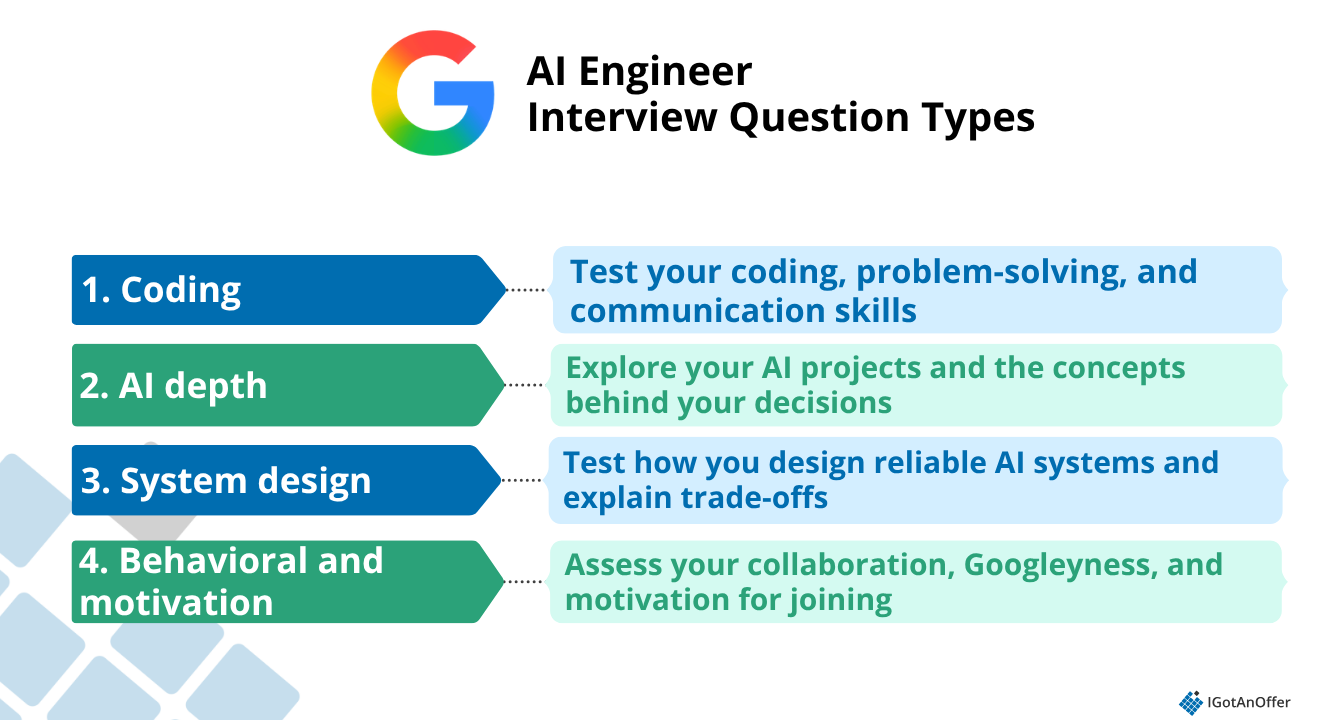
Prepare for questions in these four areas:
- Coding: where you'll solve algorithm and data structure questions.
- AI depth: where you’ll be asked about your machine learning (ML) and AI knowledge and practical experience.
- System design: where you'll need to design a system that solves a problem using AI or machine learning.
- Behavioral and motivation: where you can expect questions about your background, accomplishments, and motivation for applying to Google.
You may cover more than one of these topics in a single interview. A coding discussion, for instance, could include questions about the ML concepts behind your solution.
At Google DeepMind, the stated process is two or three skills interviews followed by final interviews with team leads or leadership. Ask your recruiter whether this applies to the Gemini role you've applied for.
2.6 Hiring decision and team matching ↑
At the end of each interview, your interviewer will grade your performance using a standardized feedback form. It records the questions, your responses, the interviewer’s assessment, and a final hiring recommendation.
In Google's broader engineering process, interviewers assess four main attributes:
- General cognitive ability. This is often referred to as "GCA" by Googlers. The company wants to hire smart engineers who can learn and adapt to new situations. Here, your interviewer will try to understand how you solve hard problems and how you learn. For more information, take a look at our guide to the Google GCA interview.
- Role-related knowledge and experience. This is often referred to as "RRK" or "RRKE" internally. The company wants to make sure that you have the right experience, domain expertise, and competencies for the position you're applying for. For more information, take a look at our guide to the Google RRK interview.
- Leadership. Google looks for a particular type of leadership called “emergent leadership.” You'll typically be working in cross-functional teams at Google, and different team members are expected to step up and lead at different times in the lifecycle of a project when their skills are needed.
- Googleyness (i.e. culture match). The company wants to make sure Google is the right environment for you. Your interviewer will check whether you naturally exhibit the company's values, including being comfortable with ambiguity, having a bias to action, and having a collaborative nature.
After your interviews, your interviewers will submit their feedback. In Google's broader engineering process, this feedback is reviewed by a hiring committee, along with your resume, internal referrals, and any past work you have submitted. The committee makes a recommendation on whether Google should hire you.
If you're going through Google team matching, you'll talk to hiring managers and one or several of them will need to be willing to take you on their team in order for you to get an offer from the company.
In parallel, a senior manager and compensation committee may review the hiring recommendation and proposed offer. Senior roles can also require a final executive review. These approvals and team matching can add time before an offer is sent.
2.7 Offer and negotiation ↑
If you receive an offer, take some time to review it before you respond.
Review the base salary, stock grant and vesting schedule, and any bonuses included. Compare the package with offers for similar jobs in the same location before asking your recruiter what can be negotiated.
Salary negotiation tips
- Be polite. Remember that the person you're negotiating with is just doing their job. You'll get much farther in your negotiations if you approach the conversation with grace.
- Don't give a number right away. Whenever possible, it's better to wait until you receive an offer to start negotiating. This reduces the risk of giving a number that is lower than what Google otherwise would have paid.
- Do your research. Have a number in mind before the conversation begins, and back it up with data. Research your position and level on Levels.fyi, ask around on professional networking sites like Blind, and factor in the cost of living where you are.
- Start high. If the offer is negotiable, ask for more than your target to leave room for discussion. Be prepared to explain how your experience and market data support the amount you’re asking for.
- Negotiate everything. Look at the complete offer, including base pay, stock grants, bonuses, where you’ll be working, and the work arrangements. If the salary is fixed, ask your recruiter if there is any room to negotiate some of those other terms.
If you'd like help reviewing your offer and planning your negotiation, you can book a session with one of our salary negotiation coaches. Our Google offer negotiation guide will help you prepare as well.
3. Google AI engineer example interview questions ↑
We've selected 25 questions for you to practice. Three are from Google AI engineer reports on Glassdoor. There were only a few specific technical questions in those reports, so we've added 18 general AI engineer interview questions and four from Google's MLE interviews. The sources are noted above or alongside the questions.
3.1 Coding ↑
Expect coding questions where you'll be tested on data structures and algorithms, as well as your programming language knowledge. Whatever format you get, you’ll be evaluated on your problem-solving skills, engineering judgment, and communication skills.
For an applied AI job, it's worth practicing how to build an application with a model. That's why we've included a Python retrieval-augmented generation (RAG) exercise below, where the application retrieves information for the model to use in its answer.
Example Google AI engineer interview questions: Coding
- What is a RAG pipeline and how to design it using Python code? (Python implementation example)
- Python: what is the difference between is and ==? (language reference)
- In a 2D array, find the shortest path from the top-left to the bottom-right cell of a maze. (worked variant)
- Given a string of parentheses, find the minimum number of insertions needed to make it valid. (solution)
- (Google MLE) Given an encoded string in the form k[encoded_string], including nested groups, return its decoded string. (solution)
- (Google MLE) Given a string S and a string T, find the minimum window in S which will contain all the characters in T in complexity O(n). (solution)
For more practice questions, solutions, and an answer framework, use our Google coding interview guide. For the RAG exercise, work through the Python implementation linked above and practice explaining how data retrieval connects to the model’s response.
3.2 AI depth ↑
An AI depth interview can start with your past projects, then explore the concepts and technologies behind your decisions. In one Google AI/ML interview discussion, a recent hire described questions about project decisions, alternatives, and trade-offs. In a Google Cloud AI discussion, another candidate reported questions about attention mechanisms and the loss function they had chosen for a past project.
Choose projects that show the experience the team needs, such as applying models in a product or building an AI application for a customer. Vivek K. (ex-Google ML software engineer) advises: “Prioritize showcasing projects where you've tackled real-world challenges over focusing solely on theoretical problems.”
For each project you choose, be ready to explain your contribution and the results. If it was a team effort, distinguish your work from your colleagues' work so the interviewer knows what to ask you about.
From there, prepare to explain the underlying ML concepts, including model selection, neural networks, bias-variance trade-offs, and handling overfitting. For LLM-focused jobs, review context limits, tokenization, hallucinations, and the trade-offs between response quality, cost, and latency. If you built a RAG application, explain how you retrieved information and evaluated the answers. Review frameworks such as LangChain if they’re relevant to your work or the role.
Use the questions below to practice explaining ML fundamentals and LLM/RAG concepts. The Google-reported question is identified in the list; the others provide general AI engineering practice.
Example Google AI engineer interview questions: AI depth
- Precision vs. recall: which matters more for fraud detection? (Reported by a Google AI engineer candidate.)
- What are underfitting and overfitting, and the tradeoff of each?
- Explain the significance of the ROC (Receiver Operating Characteristic) curve in machine learning.
- Explain gradient descent in machine learning.
- How do you deal with hallucination in LLMs?
- What is semantic searching?
- What are your metrics for evaluating RAG performance?
- Talk about prompt engineering principles.
- Explain LangGraph / LangChain.
- What is fine-tuning? How would you fine-tune a company’s model which uses hosted LLM models?
To review these topics, start with Google’s Machine Learning Crash Course, then work through the explanations of retrieval-augmented generation and prompt engineering. Use your own project to practice explaining why you chose a particular model or approach. For more sample questions, see our AI engineer interview questions guide.
3.3 System design ↑
System design interviews use an open-ended prompt asking you to build a system that solves a real-world problem.
Depending on your background and the team’s needs, you may get a standard system design interview or an AI/ML-focused one. A general system design question focuses on components such as databases, APIs, and how the system handles more users. An AI/ML-focused question also asks how you would choose, evaluate, and deploy the model.
To ace the interview (and get one step closer to an offer), you need to show you can build reliable AI systems. That includes knowing how a system might fail.
Viral G. (Meta engineering leader) emphasizes reliability: “If you can’t explain how your system breaks and how you’d fix it, you’re not ready.”
Example Google AI engineer interview questions: System design
- Design a chatbot. (General AI engineering practice.)
- Design the YouTube recommendation system. (Related Google MLE practice; sample answer.)
- How would you build, train, and deploy a system that detects if multimedia and/or ad content violates terms or contains offensive materials? (Related Google MLE practice.)
Practice structuring your answers with our machine learning system design interview and generative AI system design interview guides. They cover how to define the problem, choose an approach, and discuss how you would evaluate and run the system.
3.4 Behavioral and motivation ↑
Interviewers use behavioral questions to predict how you’ll perform and whether you'll fit well within a team. At Google, this includes Googleyness: being comfortable with ambiguity, taking initiative, and collaborating well with others. Prepare examples that show how you’ve handled those situations, including working with people outside your engineering team.
Google's company philosophy opens with “Focus on the user and all else will follow.” For an AI application, a useful question to ask is whether it helps the user finish their task. A technically impressive model won't necessarily do that.
The questions below cover the types of behavioral and motivation questions AI engineers have reported at Google and other companies on Glassdoor. Use them to practice introducing yourself, explaining your motivation, and discussing your past work and approach to responsible AI.
Example Google AI engineer interview questions: Behavioral and motivation
- Tell me about yourself.
- Why do you want to work here?
- Tell me about a time you used data or experimentation to drive a decision in a high-ambiguity environment.
- How would you explain a complex AI system to a non-technical stakeholder and get buy-in?
- Tell me about a time you dealt with conflict on a team. How did you solve it?
- How do you ensure responsible AI practices in your work?
For more examples, practice Googleyness and leadership interview questions and use the SPSIL method to structure your answers. For “Why Google?”, connect your interest in the company with the work you’d do on the team.
4. Google AI engineer interview tips ↑
You might be a fantastic AI engineer, but unfortunately, that won’t necessarily be enough to ace your interviews at Google. Interviewing is a skill in itself, that you need to learn.
Let’s look at some key tips to make sure you approach your interviews in the right way.
4.1 Ask clarifying questions
Often the questions you’ll be asked will be quite ambiguous, so make sure you ask questions that can help you clarify and understand the problem. Most of the questions will focus on testing your technical proficiency.
4.2 Think out loud
You need to walk your interviewer through your thought process before you actually start coding or designing a system. Google recommends that you talk even while coding as they want to know how you think. Your interviewer may give you hints about whether you’re on the right track or not.
During your technical interviews, you’ll also be assessed on your communication skills, or the way you talk through your problem-solving process. Use this as your opportunity to show how well you communicate and collaborate with colleagues by treating your technical interview like a conversation.
4.3 State and check assumptions
During your ML system design interview, you need to explicitly state assumptions and check with your interviewer to see if those assumptions are reasonable.
4.4 Brute force, then iterate
When coding, don’t necessarily go for the perfect solution straight away. Google recommends that you first try and find a solution that works as quickly as you can, then iterate to refine your answer.
4.5 Center on Google’s values/Googleyness
Never skip out on reviewing Google’s values and culture as you’ll be asked behavioral questions even during your technical interviews. In fact, it might be good to review them even before your recruiter screen, as you’ll most likely be asked behavioral/culture fit questions during this part of the interview process.
Prepare anecdotes/concrete examples from your professional experience corresponding to each Google core value. To be more efficient, adapt your stories so they can respond to different values.
4.6 Keep your code organized
Make sure to keep your code organized so your interviewer won’t have a hard time understanding what you’ve written. Google wants to see that your code has captured the right logical structure.
4.7 Get comfortable with coding on various mediums
You may be asked to code in a shared document, on a physical whiteboard, or on a device provided by your interviewers. Check with your recruiter what it will be and practice it a lot.
4.8 Brush up on Python
You’ll find that most machine learning-related roles at Google will require experience with Python, as it is Google’s programming language of choice for machine learning.
During your ML interview, Vivek (ex-Google MLE) says that you should “be prepared to implement fundamental ML techniques (e.g., Convolution, Batch Normalization, Logistic Regression) in pure Python.” This will show your interviewers that you can code ML solutions from the ground up.
That said you’ll still find machine learning roles that are open to candidates with experience in other coding languages.
5. How to prepare for Google AI engineer interviews ↑
Now that you know what questions to expect, let's focus on how to prepare. After all, the right preparation will make the difference between failing your Google interviews and getting an offer.
Here are the four most important things you can do to prepare for Google's AI engineer interviews.
5.1 Learn about Google's culture
Most candidates fail to do this. But before investing tens of hours preparing for an interview at Google, you should take some time to make sure it's actually the right company for you.
Google is prestigious and it's therefore tempting to assume that you should apply, without considering things more carefully. But, it's important to remember that the prestige of a job (by itself) won't make you happy in your day-to-day work. It's the type of work and the people you work with that will.
If you know engineers who work at Google or used to work there, it's a good idea to talk to them to understand what the culture is like. In addition, we would recommend reading the following resources:
- Google's mission statement (by Google)
- Google's values (by Google)
- Google strategy teardown (by CB Insights)
- Google’s (Alphabet’s) Organizational Culture & Its Traits (by Panmore Institute)
- Google Design’s People + AI Research section
5.2 Practice by yourself
As mentioned above, the four question categories to prepare for are Coding, AI depth, System design, and Behavioral and motivation. Build your foundations in each area, then practice answering questions independently.
For coding interviews:
Practice solving data structure and algorithm questions under time pressure. Explain your approach as you code, and test your solution before moving on. These resources include practice questions, solutions, and an answer framework:
- Google coding interview guide
- 73 data structure questions
- 71 algorithms questions
- Google’s interview tips video
For AI depth interviews:
Review the concepts behind your past projects and the technologies relevant to the job. Use these resources to fill any gaps:
- Google’s Machine Learning Crash Course
- Retrieval-augmented generation
- Prompt engineering
- LangChain and LangGraph (if relevant to your role)
For system design interviews:
Practice taking a problem from requirements through model selection, evaluation, and deployment. These guides explain how to structure your answer:
- Machine learning system design interview guide
- Generative AI system design interview guide
- Meta’s machine learning field guide
For behavioral and motivation interviews:
Choose stories that show your contribution, impact, and what you learned. Practice using a clear answer structure with these resources:
- Googleyness and leadership interview questions
- Google behavioral interview questions and the SPSIL method
- How to answer “Why Google?”
Finally, practice answering questions out loud. Play both the interviewer and the candidate so you get used to explaining your decisions without relying on written notes.
5.3 Practice with peers
If you have friends or peers who can do mock interviews with you, that's an option worth trying. It's free, but be warned, you may come up against the following problems:
- It's hard to know if the feedback you get is accurate
- They're unlikely to have insider knowledge of interviews at your target company
- On peer platforms, people often waste your time by not showing up
For those reasons, many candidates skip peer mock interviews and go straight to mock interviews with an expert.
5.4 Practice with experienced interviewers
In our experience, practicing real interviews with experts who can give you company-specific feedback makes a huge difference.
Find a Google AI engineer interview coach so you can:
- Test yourself under real interview conditions
- Get accurate feedback from a real expert
- Build your confidence
- Get company-specific insights
- Learn how to tell the right stories, better.
- Save time by focusing your preparation
Landing a job at a big tech company often results in a $50,000 per year or more increase in total compensation. In our experience, three or four coaching sessions worth ~$500 will make a significant difference in your ability to land the job. That's an ROI of 100x!
Book an AI engineer mock interview with an experienced interviewer.