

 Back to other articles
 Last updated: July 06, 2026

 Interviews
 Product designer
 Deeply researched
Product designer interviews at Google are quite daunting. You'll have to discuss multiple past projects in detail, showcase your design process by solving a problem on the spot, demonstrate deep familiarity with design accessibility, and know how to leverage AI in your workflow.
The good news is that the right preparation can help you highlight your strengths as a designer and maximize your chances of landing a job offer. We've put together the ultimate guide below to help you succeed.
Here’s an overview of what we’ll cover:
Click here to practice 1-on-1 with product designer interviewers
Let’s get started.
1. Google product designer role and salary
1.1 What does a Google product designer do?
As a Google product designer, you’ll play a central role in creating, enhancing, and maintaining the usability of Google’s products. These products include flagship apps like Gmail, Google Drive, Chrome, YouTube, and many others, which billions of people use every day.
In this position, you’re expected to take broad conceptual ideas and transform them into intuitive, useful experiences that meet the needs of users.
Your day-to-day work spans the full product design lifecycle: ideation, wireframing, prototyping, high-fidelity mockups, developer hand-off, and iteration based on user data and feedback.
As a Google product designer, your core responsibilities include:
- Designing experiences from end to end: Lead and take responsibility for every step of the product flow, from concept to rollout.
- Prototyping and iteration: Build prototypes to explore and validate concepts, then refine based on user feedback and data.
- Strategic thinking: Help define product goals, discover new opportunities, and drive innovation by coming up with new features and solutions that enhance user experience.
- Cross‑functional collaboration and leadership: Work with adjacent teams: product managers, engineers, researchers, and content strategists, communicating designs and priorities, and aligning stakeholders
- Mentorship and quality: Give and receive feedback, coach others, and elevate design standards across the team.
1.2 What is the difference between a Google product designer and a UX designer?
There’s a lot of overlap between the responsibilities and requirements of a product designer and a UX designer at Google and elsewhere. In practice, the two can be interchangeable.
The biggest difference is that a product designer is responsible for end-to-end design solutions, balancing user centricity and business goals. Meanwhile, a UX designer is primarily responsible for designing for ease of use, leveraging user pain points to improve a product’s usability.
According to Ex-Meta product designer Bona Kim, a product designer is a generalist with three key hard skills: UX, UI, and product thinking.
"Product thinking is the ability to think about what to make, and UX and UI is the ability to implement those ideas well," Kim says.
1.3 How much does a Google product designer make?
Google offers some of the most competitive salaries in the industry, which is a main attraction for most professionals who apply to the company.
Here’s a breakdown of the typical yearly salary and total compensation you can expect as a Google product designer, organized by level. This data is based on reported numbers at Levels.fyi.
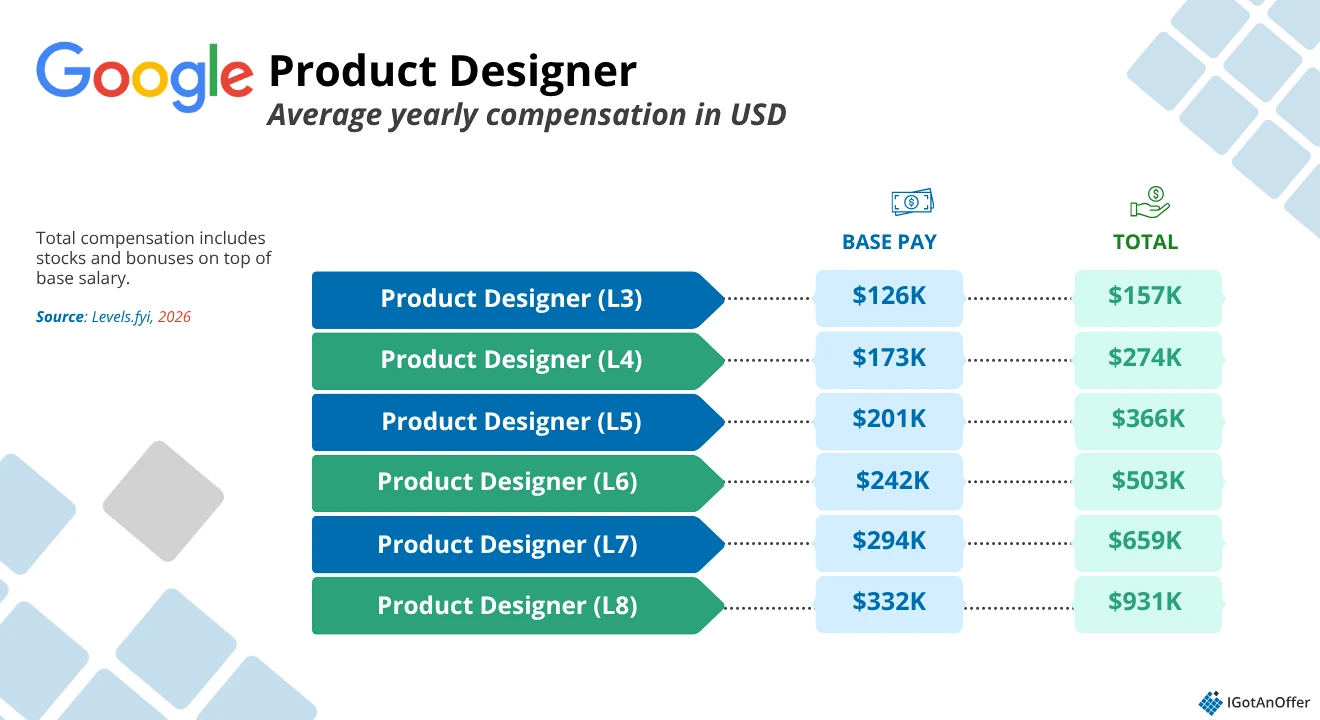
How you do in your interviews will help determine what you’ll be offered. That’s why hiring one of our ex-Google interview coaches can provide such a significant return on investment!
And remember, compensation packages are always negotiable, even at Google.
If you do get an offer, don’t be afraid to ask for more. If you need help negotiating, get practical tips from our guide to Google salary negotiations and consider booking one of our salary negotiation coaches to get expert advice.
Coaches who contributed to this guide


2. Google product designer interview process and timeline↑
2.1 What interviews to expect↑
What's the interview process and timeline at Meta for the product designer role? It typically takes around 4 weeks and follows these steps:
- Resume screening
- Recruiter screening
- Initial interview (portfolio screen)
- Take-home design challenge
- Onsite interviews
Let's look at each of these steps in more detail below.
2.1.1 Resume screen↑
First, recruiters will look at your resume and assess if your experience matches the open position.
This is the most competitive step in the process—we’ve found that ~90% of candidates don’t make it past this stage.
Tailor your resume to the position you’re targeting, then polish it further using successful resume examples in our Google resume guide.
For expert feedback, get input from our team of ex-Google recruiters, who will cover what achievements to focus on (or ignore), how to fine-tune your bullet points, and more.
2.1.2 Recruiter screening↑
Your first interview will be a phone screen with your recruiter. They want to check whether you meet the basic requirements for the position and stand a chance of getting hired.
Recruiters tend to ask more behavioral and resume questions, but also be prepared to talk about your technical skills, including the tools you use.
At this point, your recruiter should give you an outline of the rest of the recruitment process, along with interview prep resources. If they don’t, don’t be afraid to ask.
2.1.3 Initial interview (portfolio screen)↑
At the portfolio screen, you’ll either meet with a design lead or a panel of designers and you’ll be asked to present your portfolio.
At this stage, be prepared to talk about at least 2 projects you’re most proud of. Choose projects that will allow you to talk about your design process, technical skills, and UX and visual design knowledge.
Also, go back to the job description of the role you’ve applied for and highlight aspects of your experience that match the requirements.
2.1.4 Take-home design challenge↑
Some candidates report getting a take-home design challenge. You’ll be given a choice of three different projects. You only need to choose one.
The assignment will most likely involve three tasks, mainly:
- Creating sketches or wireframes
- A number of high-quality mock-ups
- Documentation of your solutions and design process
2.1.5 Onsite interviews↑
If you’ve successfully passed the initial screening and design challenge, you’ll advance to the onsite interviews.
The onsite interviews consist of multiple rounds, with each round lasting 45 to 60 minutes.
- Portfolio walkthrough (1 round). This is a panel interview, and you’ll be expected to do a deep dive into selected projects. They’ll be evaluating you on your clarity of thought, end-to-end ownership, ability to handle ambiguity and complexity, and how you make design decisions scale in a real-world scenario.
- Problem-solving/whiteboarding (1 round). Your interviewer will give you a couple of prompts. You choose one and whiteboard your solution. They want to see whether you can handle an ambiguous problem in a structured way, how you make decisions and think about trade-offs, and communicate your thought process.
- Design thinking (1 round). This may be a separate round or mixed in with the previous two. You’ll get “what are your thoughts on” type of questions around design, app critique prompts, or more questions about your creative process using one of your previous projects.
- Googleyness and behavioral (1-2 rounds). You’ll likely get multiple rounds of behavioral interviews testing your Googleyness, soft skills required for the role, and fit within a particular team. You could either get themed rounds (1 for Googleyness, 1 for XFN partnerships, etc.) or rounds with different sets of interviewers (1 with the hiring manager, 1 with cross-functional team members).
That being said, each of your interviewers will evaluate you on four main attributes (role-related knowledge, general cognitive ability, leadership, and Googleyness), take copious notes, and then file a detailed report.
2.2 What happens behind the scenes↑
If things go well at your on-site interviews, here is what the final steps of the process look like:
- Interviewers submit feedback. After your onsite interviews, your interviewers will all submit their feedback and grade your answers to their questions.
- Hiring committee recommendation. Their feedback will then be submitted to a hiring committee that will review the feedback along with your resume, internal referrals, and any past work you have submitted. Based on these, the committee should make a recommendation on whether Google should hire you or not.
- Senior leader review. The hiring committee's recommendation will then be reviewed and validated by a senior manager.
- Compensation committee recommendation. Once validated by a senior leader, your candidate packet will be sent to a compensation committee, which will decide how much money you’ll be offered. At this point, you may also go through a team match.
- Final executive review. Finally, a senior Google executive will review a summary of your candidacy and compensation before the offer is sent to you.
- You get an offer!
As you've probably gathered by now, Google goes to great lengths to avoid hiring the wrong candidates. This hiring process with multiple levels of validations helps them scale their teams while maintaining a high caliber of employees. But it also means that the typical process lasts four to eight weeks and sometimes much more.
3. Google product designer example interview questions↑
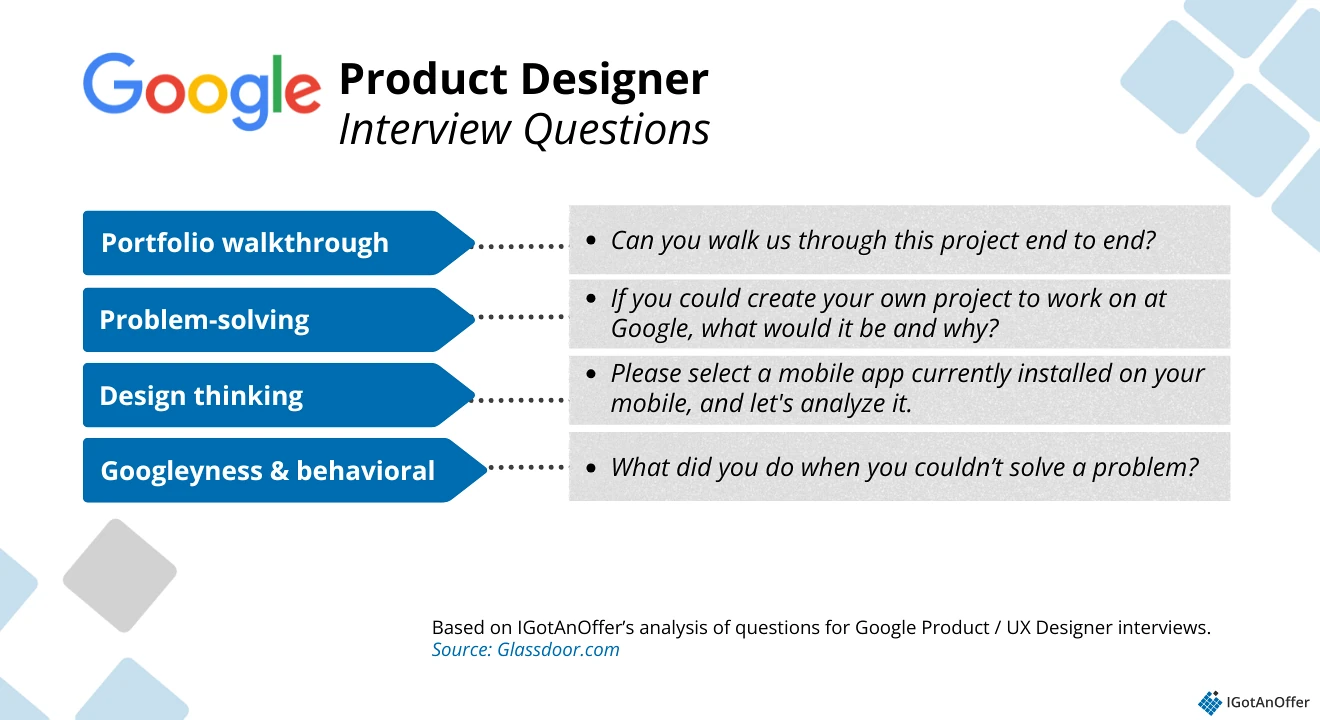
Let's dive into the four types of interviews you should be prepared for during your Google product designer interviews.
Below, we’ve curated some of the most common Google product designer / UX designer interview questions you may encounter, based on real candidate reports on Glassdoor. Slight edits have been made to improve clarity and grammar. In some underreported question categories, we’ve also included examples from Meta.
These sample questions are a great way to practice your answers, get comfortable with the relevant subject matters, and rehearse how you discuss your experiences and present your skills.
3.1 Portfolio walk-through↑
Google product designers are held to extremely high standards because they work on products that are used by billions of people every day. To maintain these standards, Google only hires candidates with a proven track record of high-quality, thoughtful design work.
According to Google, what they’re looking for in a product/UX designer is someone who can "defend the Google brand promise while exploring new design aesthetics and concepts to influence future product direction."
To show interviewers that you’re capable of what they’re looking for, you’ll need to present your design portfolio.
You’ll get two rounds of portfolio presentation/walkthrough in the entire hiring process. The first is in an initial screen with a design lead. The second is in the onsite interview with a panel.
According to this report, the difference between the first and second portfolio walkthroughs is that you’ll get questions as you go during the first one. In the second walkthrough, you’ll be presenting for the entire 45 minutes with no interruptions. You’ll likely get questions at the end of your presentation.
Either way, you should be prepared to talk about your design process, your skills and experience relevant to the role and team, and your passion for design. Structure your walk-through as a story to ensure that it’s easy to follow.
Here are some example questions you might encounter at your portfolio rounds, based on Glassdoor reports.
Google product designer example portfolio walkthrough questions
- Can you walk us through this project end to end?
- Explain the key decisions you made and why?
- What were the biggest constraints you faced, and how did they influence your design?
- If you were to do this project again, what would you change and why?
- What was your working hypothesis as you began designing?
- How did you incorporate accessibility into your design?
- How did you think through your web vs. mobile designs?
- Walk me through a product you designed that faced adoption issues.
- What did you learn?
- How did you approach the redesign?
- Walk me through one of your projects.
- Explain your design process.
- How did you define the problem?
- How did you work with stakeholders?
- How did you handle feedback and measure impact?
- Tell me about a design project where you faced a major challenge.
- How did you approach it?
- What was the outcome?
3.2 Problem-solving/whiteboarding ↑
At Google, designers solve user problems while also elevating their interaction with a product or feature. Therefore, the company needs to hire product designers who can take ambiguous problems, break them down, and create refined and intuitive solutions.
One way that Google evaluates this skill is through a dedicated problem-solving interview. This interview is also sometimes called a "whiteboarding interview" because you'll be using a virtual whiteboard to show your approach and organize solutions.
For this interview, Vasu suggests focusing on more than just UX — connect your designs to Google’s business goals.
"Highlight how your solution impacts engagement, retention, revenue, or competitive positioning to demonstrate genuine product thinking," Vasu says.
Below, we've listed several problem-solving interview questions you may encounter, according to real candidate data from Glassdoor.
Google product designer example problem-solving questions
- How would you design Google Pay if we changed the target audience group to people aged above 50?
- Create a prototype using your process and discuss it.
- If you could create your own project to work on at Google, what would it be and why?
- How would you pitch this project?
- What questions would you ask when doing UX research?
3.3 Design thinking ↑
To further test the depth of your design and product thinking skills, interviewers will likely ask technical design thinking questions.
This may come in the form of an app critique, hypothetical questions around design, or questions about your thoughts on design trends, etc.
You may get this as an entire separate round, or as part of your portfolio walk-through or problem-solving rounds.
If you’re doing an app critique, Vasu’s advice is to "look beyond UI polish." Pay attention to more than just aesthetics and assess the product design through a critical lens.
"Highlight whether the product aligns with the company's strategy and market fit. Call out risks or opportunities that others might overlook," Vasu says.
You may also want to brush up on design accessibility principles. Google Design has a section on it that’s a good place to get started.
Here are some example questions. We’ve also included a detailed question with follow-ups from Meta.
Google product designer example design thinking questions
- Please select a mobile app currently installed on your mobile, and let's analyze it.
- What design trend do you dislike?
- How do you communicate an idea with a programmer?
- How does AI fit into your workflow?
- Walk us through an app of your choice and critique it.
- Give us your impression of why you think the makers did this.
- What does the company want out of this app?
- Why do you think this feature was added and placed here?
- Example follow-up question: The bookmarking icon is the same as the collections icon. Why do you think they made them the same?
- What would you change about this app? What do you think the designers could have done better?
- What would be the next step in your strategy to improve this product from the user’s perspective?
3.4 Googleyness and behavioral↑
The last type of question you’ll get at your Google product designer interview is behavioral.
Interviewers use behavioral questions, i.e., "Tell me about a time when..." to learn more about you through your past experiences. The belief behind this is that past behavior is the best predictor of future performance. They reveal how you think, not just the skills you’ve mastered.
Google interviewers also use behavioral questions to assess your Googleyness. This nebulous set of values includes a bias for action, comfort with ambiguity, taking ownership, and having high standards.
For the product / UX designer in particular, job posts often highlight "Focus on the user and all else will follow" as an important value, so be sure to prepare stories that emphasize this.
According to multiple reports, Google product designer behavioral interviews are split into several rounds. Each round will focus on a particular soft skill: UX partnerships/collaboration, Googleyness and leadership, and navigating ambiguity.
Let’s look at some examples.
Google product designer example behavioral questions
Googleyness and leadership
- Why Google?
- Tell me about a challenge you faced at your past/current job. How did you handle it?
- Tell me about the last time you failed, and what happened
- Tell me about a time you demonstrated leadership even though you weren't the formal manager
- Tell me about a time you led a team through a difficult situation
- How would you deal with a team challenge in a balanced way?
UX partnerships/collaboration
- How do you handle feedback or design disagreements?
- How do you prioritize user feedback when designing a new feature, especially when there are conflicting opinions from different stakeholders?
- How do you communicate an idea with a programmer?
- Tell me about a time you had a conflict at work.
Navigating ambiguity
- How did you balance business and user goals?
- What is the biggest problem you've ever faced?
- What did you do when you couldn’t solve a problem?
Read our Google behavioral interview questions guide, where we show you how to use the IGotAnOffer SPSIL (Situation, Problem, Solution, Impact, Lesson) framework to properly structure your answers.
4. Interviewing tips ↑
You might be a fantastic product designer, but unfortunately, that’s not necessarily enough to ace your interviews at Google. Interviewing is a skill in itself, and luckily, it’s a skill you can improve with practice.
Let’s look at some recommended best practices for your Google product designer interviews:
4.1 Ask clarifying questions
Often, interviewers will ask you open-ended and ambiguous questions, especially at your whiteboard round. Before you jump to an answer, make sure to clarify and understand the problem by asking follow-up questions.
4.2 Think out loud
For the problem-solving interview, you need to walk your interviewer through your thought process before you start designing or suggesting solutions. Explain the rationale behind your decisions and why you’ve chosen a certain solution.
As mentioned, Google emphasizes "Focus on the user and all else will follow" in most, if not all, of their designer job posts. Interviewers will want to know that you can exercise this way of thinking in design decisions.
"Always explain the why behind your choices and weave in real user insights, behaviors, and psychology to demonstrate that you are addressing deeper human needs," says Vasu.
Your interviewer may give you hints about whether or not you’re on the right track. Pay attention to any additional details they may be giving to steer you in the right direction. This shows you’re eager to learn and attentive to feedback.
4.3 State and check assumptions
In your problem-solving interview, you need to explicitly state assumptions and check with your interviewer to see if those assumptions are reasonable.
Don’t hesitate to ask clarifying questions when you’re given a broad hypothetical situation to work through. This will show your interviewer that you’re engaged and thoughtful enough to consider multiple scenarios when making important design decisions.
4.4 Present multiple possible solutions
Google values product designers who do not work in a bubble. When designing a product or addressing a design issue, present multiple possible solutions if you can.
"As you present ideas, acknowledge technical trade-offs and describe how you would work with engineers to deliver something feasible and impactful," Vasu says
Your interviewer will want to know your reasoning for choosing certain solutions over others. This shows your ability to assess trade-offs, foresee potential risks, and respond thoughtfully when problems arise.
4.6 Adapt to follow-up questions
Interviewers will ask follow-up questions, whether it’s in your problem-solving or portfolio walkthrough. Listen carefully to the way your interviewer is asking these questions, as there will often be a subtle clue about what they’re looking to assess from the next part of your answer.
Sometimes, follow-up questions are a way for your interviewer to steer you in a particular direction, so don’t hesitate to follow them. In fact, listen actively for hints. Most interviewers have good intentions and are trying to help you think better.
4.7 Be honest and authentic
Be honest in your responses. Google interviewers appreciate authenticity and honesty. If you faced challenges or setbacks, discuss how you improved and learned from your mistakes.
5. Preparation plan ↑
Now that you know what questions to expect, here are the four preparation steps to help you get an offer as a Google product designer.
5.1 Learn about Google
Most candidates fail to do this. But before investing a ton of time preparing for an interview at Google, you should make sure it's actually the right company for you.
Google is prestigious, so it's tempting to ignore this step completely. But in our view, the prestige in itself won't make you happy day-to-day. It's the type of work and the people you work with that will.
If you know anyone who works at Google (or used to), it's a good idea to talk to them to understand what the culture is like.
In addition, we recommend doing your own research. You can start by reading the following resources:
- Google Design
- Google’s Commitments
- Google’s Philosophy
- Google UX Portfolio design tips
- The Evolution of Google’s Product Design Practices
5.2 Practice by yourself
As mentioned above, you'll have four main types of interviews at Google: portfolio walk-through, problem-solving, design thinking, and behavioral.
Aside from practicing with the example interview questions we mentioned in Section 3 here's how we'd recommend preparing for each interview type.
For the portfolio walk-through:
- Update and polish your portfolio. Check out this article that provides a step-by-step guide and examples of great portfolios.
- Translate your portfolio into a presentation, particularly for the onsite interviews. For this, we highly recommend Lily Konings' approach.
- Do a final check of your portfolio with Google’s UX Portfolio design tips
For the problem-solving round:
- Study the approach described in this article by Dan Shilov. It covers a systematic approach for tackling whiteboard interviews, highlights common mistakes, and provides a helpful strategy for allocating your whiteboard space.
- We recommend reading through our product design questions guide for more tips on how to answer product design questions.
For the design thinking round:
- Learn how to approach an app critique using a framework. To help with that, you can read Dan Shilov's guide, which covers several potential frameworks that you could use.
- Read the latest on Google Design to learn more about the company’s design principles.
- Brush up on designing for web accessibility.
For behavioral interviews:
- Learn our step-by-step method for answering Google behavioral interview questions.
- Deep dive into Googleyness to check whether your experiences align with the company’s culture.
To get the most out of your prep time, we recommend practicing out loud and setting a timer to simulate interview conditions. Play the role of both the candidate and the interviewer. This probably sounds strange, but trust us, it can significantly improve your communication, focus, and time management.
However, practicing on your own has its limitations. You can’t simulate thinking on your feet or the pressure of performing in front of a stranger. Plus, there are no unexpected follow-up questions and no feedback.
That’s why many candidates try to practice with friends or peers.
5.3 Practice with peers
If you have friends or peers who can do mock interviews with you, that's an option worth trying. It’s free, but be warned, you may come up against the following problems:
- It’s hard to know if the feedback you get is accurate
- They’re unlikely to have insider knowledge of interviews at your target company
- On peer platforms, people often waste your time by not showing up
For those reasons, many candidates skip peer mock interviews and go straight to mock interviews with an expert.
5.4 Practice with experienced product designer interviewers
In our experience, practicing real interviews with experts who can give you company-specific feedback makes a huge difference.
Find a Google product designer interview coach so you can:
- Test yourself under real interview conditions
- Get accurate feedback from a real expert
- Build your confidence
- Get company-specific insights
- Learn how to tell the right stories, better
- Save time by focusing your preparation
Landing a job at a big tech company often results in a $50,000 per year or more increase in total compensation. In our experience, three or four coaching sessions worth ~$500 make a significant difference in your ability to land the job. That’s an ROI of 100x!






 Coding, Technical