


 Back to other articles
 Last updated: April 01, 2026
 Interviews
 Behavioral
 Deeply researched
Bias for Action is one of Amazon's most frequently tested Leadership Principles (LP) and, based on our experience coaching Amazon candidates, one of the most commonly misunderstood.
Most candidates assume it means "move fast." But that’s not what Amazon is testing. The company is looking for a more specific behavior, and interviewers can quickly tell when a candidate understands the difference.
This guide covers what Bias for Action actually means, what interviewers are looking for in your answers, how to structure your stories using IGotAnOffer’s SPSIL framework, and a question bank mapped by role.
- What Amazon means by "Bias for Action"
- What Amazon interviewers are looking for
- How to answer Bias for Action questions: the SPSIL framework
- Amazon Bias for Action interview questions
- How to prepare
Practice Bias for Action questions 1-on-1 with ex-Amazon interviewers
1. What is the Bias for Action principle at Amazon? ↑
1.1 What Amazon means by "Bias for Action"
Amazon's official “Bias for Action” definition reads: "Speed matters in business. Many decisions and actions are reversible and do not need extensive study. We value calculated risk taking."
It's a short definition, but it contains three distinct ideas that most candidates collapse into one.
- Speed (sense of urgency) means acting without waiting for perfect information. Amazon operates in a competitive, fast-moving environment, and a decision made with 70% of the information (and made quickly) often beats a decision made with 90% of the information two weeks later.
- Reversibility. Amazon's internal framing distinguishes between what are often called "one-way door" and "two-way door" decisions. A one-way door decision is difficult or impossible to undo, and therefore warrants careful analysis. A two-way door decision can be reversed if it turns out to be wrong, so those can and should be made quickly. Understanding which type of decision you're dealing with is a core part of demonstrating this LP.
- Calculated risk is what separates Bias for Action from recklessness. Amazon doesn't want candidates who ship things without thinking. It wants candidates who can assess a situation, determine what they need to know to move forward, act on that, and course-correct when the outcome reveals new information.
The common misconception is that this principle is simply about moving fast. In practice, interviewers are evaluating whether you can think clearly under uncertainty. A story that demonstrates urgency without judgment won't land the way you hope.
It's also worth noting that Bias for Action sits at the intersection of several other Leadership Principles. Strong answers often touch on Ownership, Deliver Results, and Invent and Simplify, which is part of why it comes up so frequently across roles and interview stages.
In fact, LP questions appear at every stage of the Amazon interview process. Every interviewer is assigned at least one LP to assess, so you may be asked about Bias for Action in a technical screen, a hiring manager conversation, or a Bar Raiser session. For a full picture of what to expect, see our Amazon interview process guide.
1.2 Example Amazon Bias for Action interview questions
Bias for Action interview questions appear frequently across all roles (including product managers, software development engineers, software development managers, and technical program managers) and seniority levels.
Some ask directly about speed and risk; others approach the LP through pressure, incomplete information, or missed deadlines.
The framing varies, but the underlying test is the same: can you make sound decisions when the path isn't fully clear? The questions below are sourced from real candidate reports on Glassdoor and our own research across Amazon interview roles. Use them as a starting point when building your story bank.
Example Amazon Bias for Action interview questions
- Tell me about a time you had to make an urgent decision without data
- Tell me about a time you launched a feature or project with known risks
- Tell me about a time you had to change your approach to avoid missing a deadline
- Tell me about a time you found an opportunity no one else had seen
- Tell me about a time when speed was more important than thoroughness. How did you decide when you had enough information?
- Tell me about a time you had to work with incomplete information
- Tell me about a time you saw an issue your team could face and proactively took steps to address it before it became a problem
- Tell me about a time you took a calculated risk. What was your reasoning, and how did it turn out?
- Tell me about a time you made a hard decision quickly. What was the outcome?
For role-specific questions, skip ahead to section 4.
2. What Amazon interviewers are looking for ↑
Knowing the “Bias for Action” definition isn't enough. Before you start preparing stories, it's worth understanding what a strong answer looks like to an Amazon interviewer and what a weak one is.
What a strong answer looks like:
- You recognized that you were facing a two-way door decision and acted accordingly
- You identified the minimum information needed to move forward and stopped gathering once you had it
- You accepted the uncertainty, acted, and were prepared to course-correct
- You can articulate what you learned, even if the outcome wasn't perfect
What a weak answer looks like:
- Choosing a trivial example where the stakes were low and speed didn't genuinely matter
- Describing a situation where they waited for full consensus or escalated unnecessarily, which signals the opposite of Bias for Action
- Confusing urgency with carelessness, i.e., ("I just shipped it") without explaining the reasoning behind the decision
- Spending too long setting up the situation at the expense of the solution and impact
A quick way to determine what kinds of stories fit the bill? "Provide examples of how you've taken calculated risks to achieve desired outcomes, demonstrating your ability to navigate ambiguity and drive results in a fast-paced environment," Bilwasiva (Amazon Applied Scientist and interviewer) says.
That's the bar. The question is whether your story clears it.
One thing our coaches consistently flag is the fact that interviewers will always probe. If you say "I made the call quickly," expect a follow-up like "How did you know you had enough information?" or "What would you have done differently if the outcome had been worse?"
Preparing your story means preparing for those follow-ups, too.
Coaches who contributed to this guide


3. How to answer Bias for Action questions: IGotAnOffer’s SPSIL framework ↑
The most common framework candidates use for Amazon LP questions is STAR (Situation, Task, Action, Result). You’ll see many online articles recommend it, similar to this one (they tend to copy each other!).
However, the STAR method has two problems:
- We’ve found that candidates often find it difficult to distinguish the difference between steps two and three, or task and action.
- It ignores the importance of talking about WHAT YOU LEARNED, which is often the most important part of your answer.
That last piece is often what separates a strong hire signal from a borderline pass.
To correct those two faults, IGotAnOffer developed our own (very slightly different) framework that many of our candidates have used successfully over the years: the SPSIL method (Situation, Problem, Solution, Impact, Lesson).
Here’s how this five-step approach works:
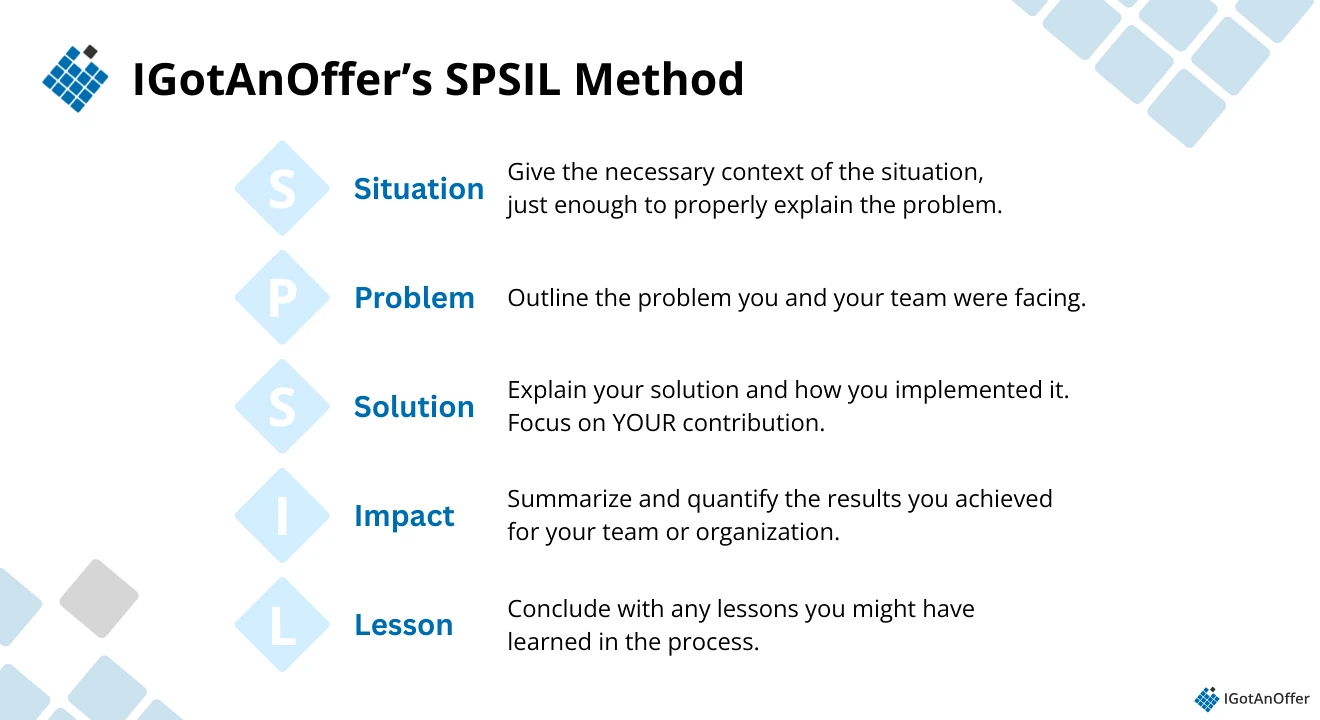
The five steps don't overlap, and the Lesson step is non-optional, especially for Bias for Action, where showing that you can act quickly and reflect honestly on the outcome is the full picture.
Recommended time allocation per step:
- Situation (30 secs max): give only the context needed to understand the problem.
- Problem + Solution (60–90 secs): this will be the core of your answer. Focus on your reasoning and your actions, not the team's.
- Impact (30–45 secs): quantify wherever possible. Numbers make your answer concrete and memorable.
- Lesson (20–30 secs): don't skip it. This step signals self-awareness and growth, both of which Amazon values highly.
It's also worth noting that not every Bias for Action story needs to end in a clear win. Some of the most compelling answers are ones where a candidate reflects on a time they didn't act with enough urgency.
In cases like that, it’s best to acknowledge what held you back, what the cost of that delay was, and what you'd do differently. That kind of accountability and self-awareness signals both Ownership and genuine alignment with the LP, and interviewers notice it.
For a full breakdown of the SPSIL method and how it applies across all 16 Leadership Principles with examples, see our Amazon Leadership Principles guide.
Example answers to Bias for Action interview questions using the SPSIL method
Below are two worked examples using real Bias for Action questions. The first is a PM-focused scenario; the second applies across roles. After each answer, we break down what makes it effective.
3.1 Example answer: "Tell me about a time you had to make an urgent decision without data"
(Situation)
"I was a senior PM at a mid-size SaaS company, leading a team responsible for our core onboarding flow. We were three weeks from a major product launch when our lead engineer flagged a serious issue: a third-party API we depended on had announced it was deprecating a key endpoint in 14 days, before our launch date."
(Problem)
"We had no fallback. The API handled about 40% of our user verification flow. I had two options: delay the launch by at least three weeks while we built a proper replacement, or ship a workaround using a secondary vendor whose service I'd only briefly evaluated. I had 24 hours to decide, because both options required immediate resourcing commitment."
(Solution)
"I didn't have time for a full vendor evaluation. Instead, I focused on the one question that mattered most: could this vendor's service fail in a way that was visible to the end user, or would failures be silent and recoverable? I spent two hours reviewing their documentation and speaking with their support team. The answer was that failures would surface as a 'retry later' prompt — not ideal, but recoverable and reversible. I also scoped out what a rollback would take if things went wrong. Once I was confident the downside was manageable, I made the call to proceed with the workaround and flagged the risk clearly to leadership."
(Impact)
"We launched on schedule. The workaround resulted in a 4% increase in verification retries during the first two weeks, which we addressed in a follow-up sprint. The launch itself met all its core success metrics."
(Lesson)
"I learned to focus on the shape of the downside, not just the probability. I used to delay decisions because I was trying to reduce the chance of a bad outcome. Now I first ask whether the bad outcome would be recoverable because if it is, the cost of delay is usually higher than the cost of being wrong."
What makes this answer effective:
This answer demonstrates the speed and reasoning behind the decision. The candidate identifies the decision as reversible, establishes a clear information threshold, acts, and articulates a genuine lesson. That's exactly what interviewers are listening for.
3.2 Example answer: "Tell me about a time you launched a product or feature with known risks"
(Situation)
“I was a PM on a payments team at a mid-size fintech. We had a merchant onboarding flow that was causing a significant drop-off, about 35% of merchants weren't completing registration. We'd identified a redesigned flow that we believed would fix it, but our QA cycle wasn't complete, and we had flagged two minor edge cases in the error-handling logic.”
(Problem)
“Our peak merchant acquisition season was three weeks away. Waiting for a full QA cycle would mean missing it entirely and the business case for the season was significant. But shipping with known gaps carried real risk of a poor experience for a small subset of users.”
(Solution)
“I mapped out which merchants would actually hit the edge cases. It turned out to be a narrow segment of merchants registering with certain non-US tax ID formats, which represented under 3% of the expected volume during the season. I worked with engineering to add a fallback that routed those merchants to a manual review queue rather than failing silently. We shipped the redesign, monitored closely for the first 48 hours, and had a hotfix ready to deploy if needed.”
(Impact)
“Drop-off during onboarding fell from 35% to 18% over the season. The edge case affected 47 merchants, all of whom were successfully handled through the manual queue with no churn. We didn't need the hotfix.”
(Lesson)
“The key decision was whether I understood the risk well enough to contain it. I learned to always ask: "What's the worst-case scenario, how many users does it actually affect, and do I have a mitigation?" That framing has made me much more comfortable making launch calls under uncertainty, because it forces the question to become concrete rather than abstract.”
What makes this answer effective:
This answer shows you took a risk and the reasoning process behind it, too. It shows you can scope the impact, build a containment plan, and ship with your eyes open. That's what "calculated" in "calculated risk-taking" looks like to an Amazon interviewer.
4. Amazon Bias for Action interview questions by role ↑
The general questions above are a good foundation, but Bias for Action can look different depending on the role you're interviewing for.
Before diving in, one framing note: Bias for Action questions don't always sound like Bias for Action questions. Prompts about missed deadlines, incomplete information, or launching under pressure are all testing this LP, even if the interviewer doesn't name it explicitly.
The questions below are sourced from real candidate reports on Glassdoor and our own research across Amazon interview roles. They're organized by role so you can focus your prep on what's most relevant to your interview.
4.1 SDE: Bias for Action interview questions
For SDEs, Bias for Action tends to show up in moments where a technical decision had to be made without full requirements, a deadline forced a tradeoff, or a risk had to be accepted to keep things moving.
Interviewers want to see that you can navigate those moments without waiting to be told what to do.
Example Amazon Bias for Action interview questions for software development engineers
- Tell me about a time you shipped something with known gaps or technical debt. How did you decide the risk was acceptable?
- Tell me about a time when you had to deliver under a tight deadline. What tradeoffs did you make, and what was the result?
- Tell me about a time you broke a complex problem into simpler parts to move faster. How did you decide where to cut scope?
- Tell me about a time you had to make a technical decision without full requirements. What was your approach, and how did you validate it?
- Tell me about a time you saw a technical issue before it escalated and took action without being asked
- Tell me about a time you disagreed with your team's approach but still moved forward. How did you balance speed with your concerns?
Learn more about the Amazon SDE interview process.
4.2 SDM: Bias for Action interview questions
If you're applying for the SDM role, you can choose stories where a program was at risk, a team was blocked, or a resourcing call had to be made without complete information.
Interviewers want to see that you can unblock your team and move things forward without waiting for perfect clarity or approval from above.
Example Amazon Bias for Action interview questions for software development managers
- Tell me about a time you had to make a resourcing or prioritization call quickly, with limited information. What was your process?
- Tell me about a time you removed a blocker for your team without waiting for approval from above
- Tell me about a time you pushed your team to ship earlier than they were comfortable with. How did you manage the tension?
- Tell me about a time you had to make a program-level decision with incomplete data. What did you do, and what happened?
- Tell me about a time your team was at risk of missing a critical deadline. What actions did you take, and how quickly?
Learn more about the Amazon SDM interview process.
4.3 PM: Bias for Action interview questions
Product manager interviews are where Bias for Action comes up most frequently, often alongside Ownership and Customer Obsession. Call up instances where a product decision had to be made without full data, an MVP had to be scoped under pressure, or a market window was closing.
Interviewers want to see that you can make a well-reasoned call and commit to it, rather than waiting for validation that may never fully arrive.
Amazon Bias for Action interview questions for product managers
- Tell me about a time you launched an MVP despite pressure to add more features first. How did you decide what was sufficient?
- Tell me about a time you had to make a product prioritization decision with incomplete user data. What was your reasoning?
- Tell me about a time you moved forward on a product bet that wasn't fully validated. What happened?
- Tell me about a time you had to pivot mid-project. What triggered the change, and how quickly did you act?
- Tell me about a time you had to decide between shipping something imperfect now vs. something better later. What did you choose and why?
- Tell me about a time you saw a market opportunity and drove your team to act on it before the window closed
Learn more about the Amazon PM interview process.
4.4 TPM: Bias for Action interview questions
If you're going for a TPM role, you can show Bias for Action by recalling moments where a large program hit ambiguity, dependencies got blocked, or a deadline forced a change in approach.
Interviewers want to see that you can keep cross-functional programs moving even when the path forward isn't fully clear.
Amazon Bias for Action interview questions for technical program managers
- Tell me about a time you had to change your approach mid-program because you were going to miss a critical deadline
- Tell me about a time you had to make a key decision with incomplete information. How did you decide when you had enough?
- Tell me about a time you broke a large, complex program into phases to maintain momentum. How did you decide on the phasing?
- Tell me about a time you escalated, or deliberately chose not to escalate, a risk to senior leadership. How did you make that call?
- Tell me about a time you had to align multiple stakeholders quickly and move forward without full consensus
- Tell me about the most challenging program you've delivered and the moment when moving fast mattered most
Learn more about the Amazon TPM interview process.
4.5 Data engineer: Bias for Action interview questions
As a data engineer, you can demonstrate Bias for Action in moments where a pipeline decision had to be made under pressure, a data quality issue required immediate action, or a tradeoff had to be made between speed and completeness.
Interviewers want to see that you can make pragmatic calls on data infrastructure without waiting for perfect conditions.
Example Amazon Bias for Action interview questions for data engineers
- Tell me about a time you had to make a quick decision about a data pipeline that was failing or at risk. What did you do?
- Tell me about a time you shipped a data solution with known limitations. How did you decide it was good enough to move forward?
- Tell me about a time you had to balance data quality against a tight delivery deadline. What tradeoff did you make?
- Tell me about a time you identified a data issue before it escalated and took action without being asked
- Tell me about a time you had to work with incomplete or unreliable data to deliver something on time
Learn more about the Amazon data engineer interview process.
4.6 Machine learning engineer: Bias for Action interview questions
Stories where ML engineers can showcase Bias for Action include moments when a model had to be shipped before it was fully optimized, an experiment had to be scoped down to move faster, or a technical call had to be made without complete validation.
Interviewers want to see that you can move ML work forward under real-world constraints without waiting for perfect results.
Example Amazon Bias for Action interview questions for machine learning engineers
- Tell me about a time you shipped a model or ML feature before it was fully optimized. How did you decide it was ready?
- Tell me about a time you had to scope down an experiment or model to meet a deadline. What did you cut and why?
- Tell me about a time you had to make a modeling decision without sufficient data. What was your approach?
- Tell me about a time you identified a risk in an ML system and took action before it became a larger problem
- Tell me about a time you had to move forward on an ML project despite uncertainty about whether the approach would work
Learn more about the Amazon machine learning engineer interview process.
5. How to prepare for Amazon’s Bias for Action interview questions ↑
Working through the question bank above is a useful starting point, but the candidates who perform best in Amazon LP interviews do more than memorize stories. Here are the steps our coaches recommend for Bias for Action prep specifically.
5.1 Familiarize yourself with Amazon and the Leadership Principles
Before investing hours in story prep, make sure you have a solid grounding in how Amazon thinks. The Leadership Principles are the framework Amazonians use to make decisions day-to-day. The more fluent you are with them, the more naturally your answers will land.
Start with our Amazon Leadership Principles guide, which covers all 16 principles with example questions, sample answers, and tips from our coaches. For broader interview context, our Amazon behavioral interview guide and Amazon bar raiser interview guide are also worth reading before your first session.
It's also worth noting that Bias for Action (like all LP questions) can come up at any point during the hiring process, not just in a dedicated behavioral round. You may face it in a recruiter screen, a hiring manager conversation, or a bar raiser session. Preparing early and across all stages is the right approach.
For role-specific interview process guides, see the links below:
- Amazon product manager interview
- Amazon software development engineer interview
- Amazon software development manager interview
- Amazon technical program manager interview
- Amazon data engineer interview
- Amazon machine learning engineer interview
- Amazon data scientist interview
- Amazon program manager interview
5.2 Build and pressure-test your stories
5.2.1 Prepare your story bank
For Bias for Action specifically, you need at least two examples:
- An example where acting quickly led to a clearly positive outcome
- An example where you acted quickly, encountered friction or failure, and adjusted.
The second type is often more persuasive because it shows you can operate under uncertainty without being paralyzed by the possibility of being wrong.
One thing candidates often overlook: your stories don't need to demonstrate only one LP. The strongest answers typically touch on multiple principles at once.
A Bias for Action story that also shows Ownership, or Deliver Results, or Invent and Simplify, gives interviewers multiple positive signals from a single narrative. As you build your bank, note which other LPs each story could support.
5.2.2 Rehearse the probe questions
After you've drafted each story, sit with these follow-up questions:
- Why didn't you wait for more information?
- How did you know the decision was reversible?
- What would you have done differently if the outcome had been worse?
If you can answer these fluently without rewriting your story, you're in good shape. If the answers reveal gaps like thin reasoning, a decision that wasn't actually yours, or an outcome that wasn't really influenced by speed, go back and find a stronger example.
5.2.3 Use the SPSIL framework as a self-check
After drafting a story, run through the five steps. If your Situation runs longer than 30 seconds, cut it. If your Lesson is vague ("I learned to communicate better"), make it specific. If your Impact has no numbers, find one. A story that passes those three checks is usually ready to practice out loud.
5.3 Practice by yourself
Start by writing your stories down. For Bias for Action specifically, the act of writing forces you to be precise about the part that trips most candidates up: your reasoning.
It's easy to tell yourself you "made a quick call". It's harder to write down why you decided you had enough information to act. That precision is exactly what interviewers will probe.
Once your stories are written, practice out loud. A story that reads well on paper can still fall apart when you're telling it live, particularly if you've over-indexed on the Situation and left too little time for the Solution and Lesson.
Time yourself: situation should be under 30 seconds. The full answer should sit between two and three minutes.
5.4 Practice with peers
If you have colleagues or friends you can run mock interviews with, it's worth doing, especially if they've been through an Amazon interview themselves.
The most useful thing a peer can do is ask the follow-up questions: "How did you know you had enough information?" or "What was the downside you were accepting?" Those are the questions that reveal whether your story holds up.
It’s free, but be warned, you may come up against the following problems:
- It’s hard to know if the feedback you get is accurate
- They’re unlikely to have insider knowledge of interviews at your target company
- On peer platforms, people often waste your time by not showing up
For those reasons, many candidates skip peer mock interviews and go straight to mock interviews with an expert.
5.5 Practice with experienced interviewers
In our experience, practicing real interviews with experts who can give you company-specific feedback makes a huge difference.
Find an Amazon interview coach so you can:
- Test yourself under real interview conditions
- Get accurate feedback from a real expert
- Build your confidence
- Get company-specific insights
- Learn how to tell the right stories, better.
- Save time by focusing your preparation
Landing a job at a big tech company often results in a $50,000 per year or more increase in total compensation. In our experience, three or four coaching sessions worth ~$500 make a significant difference in your ability to land the job. That’s an ROI of 100x!
Book a mock interview with an ex-Amazon interviewer.







 Account manager