


 Back to other articles
  Last updated: December 17, 2025

 Interviews
 Deeply researched
There's a bit of mystery about how Boston Consulting Group (BCG) hires. The process looks straightforward on the surface, but there are critical differences between offices, roles, and candidate types that can catch even strong applicants off guard.
In this guide, we'll break down exactly what happens during the BCG hiring process and how you can prepare for each stage. You'll learn about BCG's unique approach to consulting, the typical 5-step interview process, and proven strategies to stand out as a candidate.
Here's an overview of each step of the BCG interview process:
Click here to book 1-on-1 interview coaching with an ex-BCG interviewer.
1. About BCG ↑
When Bruce Henderson founded Boston Consulting Group in 1963, he started with a simple idea: bring rigorous analysis and strategic thinking to business problems. Today, BCG is one of the world's leading management consulting firms, serving clients across 50+ countries with over 32,000 employees worldwide.
BCG pioneered business strategy frameworks like the Growth-Share Matrix and continues to lead in strategic innovation. The firm reported a revenue of $12.5 billion in 2024, marking its 21st consecutive year of growth. BCG now operates through specialized divisions, including:
- BCG X (tech and digital solutions)
- BCG Platinion (technology consulting)
- BCG Digital Ventures (venture building)
This focus on innovation, creativity, and transformational impact is baked into everything BCG does, including how they hire.
While BCG is often grouped with McKinsey and Bain as "MBB" (the big three management consulting firms), each has distinct characteristics. BCG emphasizes creativity, original thinking, and what they call "blue ocean" strategies that create new market spaces rather than competing in existing ones.
2. Working at BCG ↑
We've helped thousands of candidates ace their BCG interviews. A common theme they’ve noticed is how BCG balances intellectual rigor with a collaborative, people-first culture.
If you want to know what life at BCG looks like, here's a peek:
2.1 Values-driven culture
BCG operates on a foundation of core values that shape everything from client work to internal collaboration. The firm looks for candidates who demonstrate:
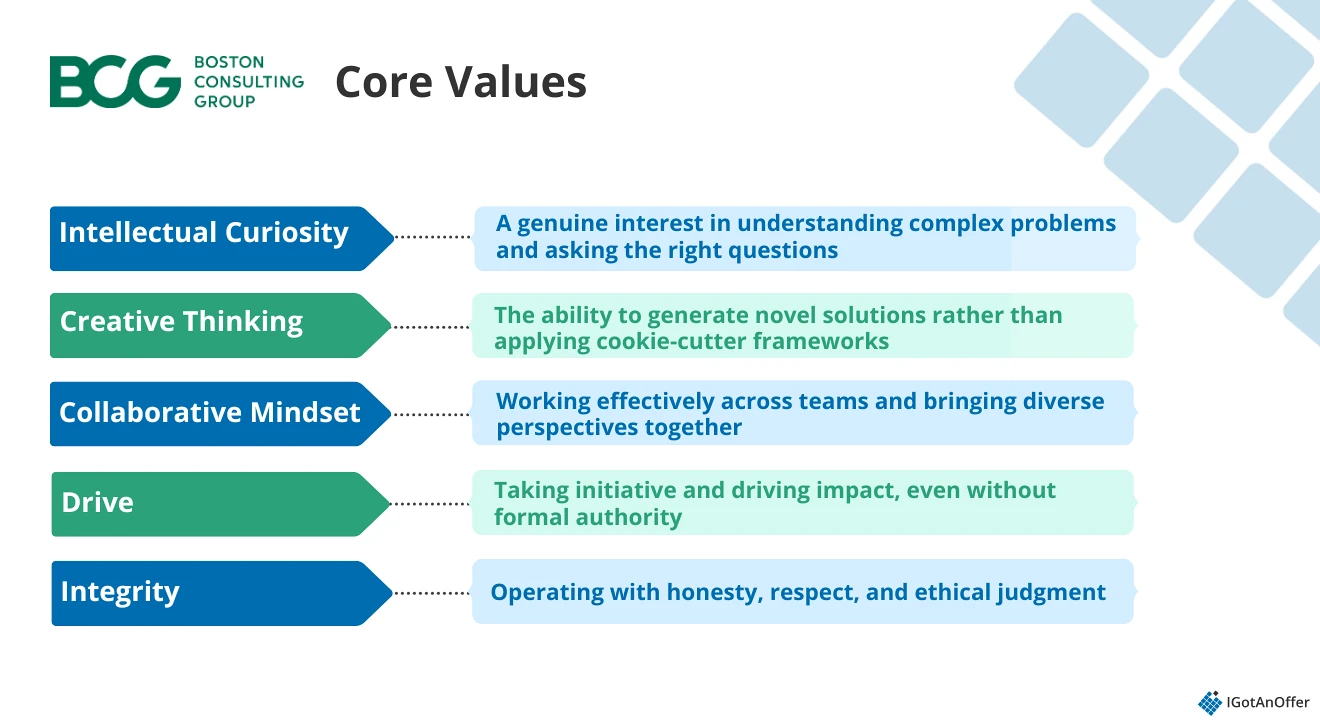
We've found that BCG interviews consistently evaluate these values through both behavioral questions and case interviews. Your responses are measured not just against technical competencies, but against these core attributes.
2.2 Emphasis on creativity and bespoke thinking
Unlike some consulting firms that rely heavily on standardized frameworks, BCG is known for encouraging creative, customized approaches to problems. The firm values consultants who can develop original frameworks tailored to specific client situations rather than forcing every problem into a predetermined structure.
This philosophy extends to case interviews. BCG interviewers actively look for candidates who can think creatively, challenge assumptions, and develop unique insights rather than reciting memorized frameworks.
2.3 Competitive compensation
BCG offers competitive compensation packages that place it among the top consulting firms globally. To give you a sense of compensation structure, here's what management consultants typically earn at each level, according to Levels.fyi data:
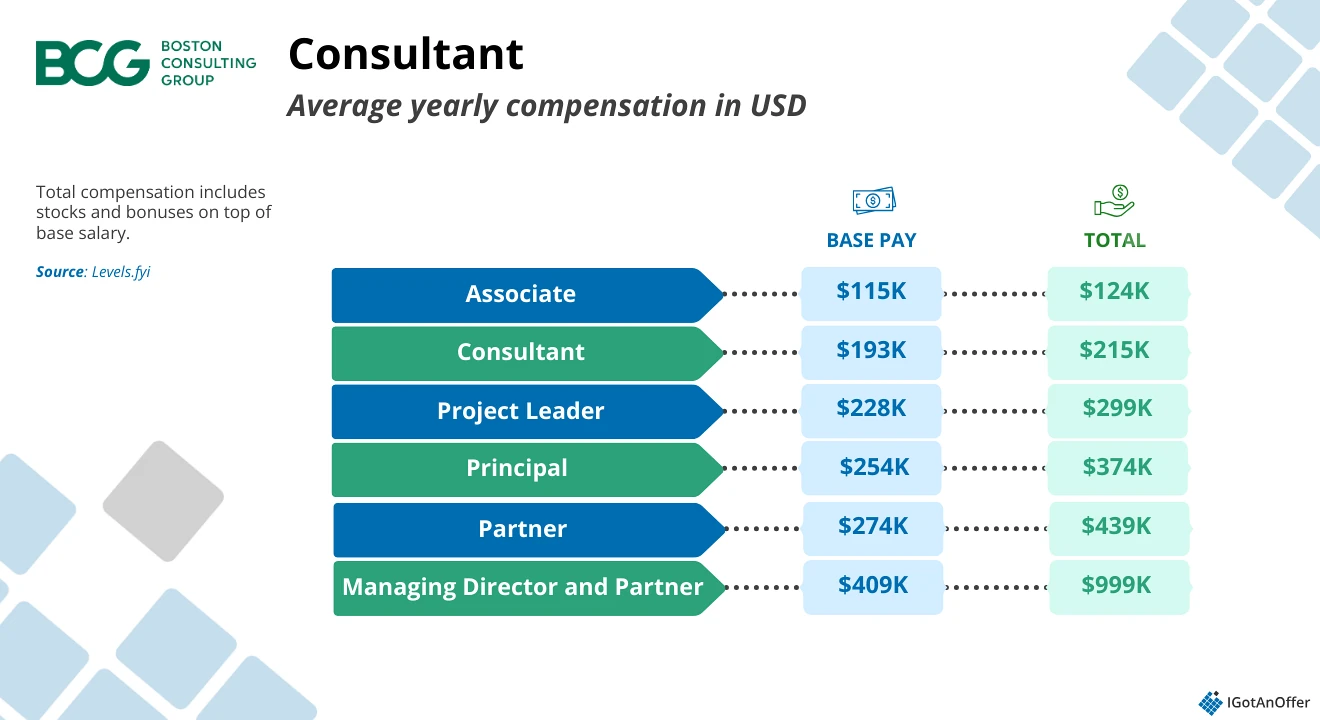
Note that compensation varies by role, office location, and performance. Beyond base compensation, BCG invests significantly in professional development, offering extensive training programs, mentorship from experienced consultants, and clear paths to partnership for high performers.
2.4 Interview as mutual evaluation
BCG views the interview process as a two-way conversation. As the firm states on its careers page, "You are interviewing us as much as we are interviewing you." This philosophy reflects BCG's belief that finding the right mutual fit matters more than simply filling positions.
During your interviews, you'll have opportunities to ask questions and evaluate whether BCG's culture, work style, and values align with your career goals. BCG interviewers expect you to showcase curiosity about the firm and the role, not just answer questions.
3. BCG interview process and timeline (4 steps to an offer) ↑

The BCG hiring process typically takes four to eight weeks from application to offer decision, based on data from thousands of candidate experiences. The steps can vary by role, but most candidates go through these main stages:
Between each stage, expect to wait approximately two weeks for feedback. Some offices move faster. Others, particularly during busy recruiting seasons, may take longer.
If you haven't heard back within the expected timeframe, follow up with your recruiter. They can provide updates on where you stand.
Step 1: Resume Screen
The first step of BCG's interview process is submitting your application through BCG's careers portal. Your application will include your resume, cover letter, personal details, and office preferences.
This is a highly competitive step—about 90% of applicants don't advance past resume screening. To help you put together a targeted application that stands out, follow the tips below:
Tips on crafting a resume
- Quantify your impact: Use specific metrics to demonstrate your achievements. Instead of "managed projects," write "led cross-functional team of 12 to deliver $2M cost reduction." BCG values measurable outcomes.
- Emphasize problem-solving: Highlight experiences where you tackled ambiguous challenges, analyzed complex situations, or developed creative solutions. These directly align with consulting work.
- Show leadership: Include examples of taking initiative, influencing others, and driving results, even if you weren't in formal leadership roles. BCG looks for emergent leaders.
- Keep it concise: Limit your resume to one page. Every bullet should demonstrate impact and relevance to consulting.
- Target school advantage: Candidates from target schools (top undergraduate or MBA programs) have structured recruiting timelines and higher pass-through rates. Non-target candidates should leverage networking and referrals.
For more guidance on how to craft your resume, check out our consulting resume guide.
However, if you want personalized feedback and tips from those who know BCG’s hiring process firsthand, you can get input from our ex-BCG resume coaches themselves. They will cover what achievements to focus on (or ignore), how to fine-tune your bullet points, and more.
Cover letter essentials
Your cover letter should be tailored specifically to BCG, demonstrating a genuine understanding of the firm's values and culture. Explain why consulting, why BCG specifically, and what unique perspective you bring.
Strong cover letters connect personal experiences to BCG's values (curiosity, creativity, collaboration, leadership) and demonstrate research into the firm's work and approach.
For detailed cover letter guidance, see our consulting cover letter guide.
Step 2: Online assessments
After passing the resume screen, you'll be invited to complete one or more online assessments. The specific assessment varies by office location, role, and candidate background. These assessments help BCG efficiently evaluate candidates before moving them on to resource-intensive interview rounds.
BCG uses several different assessment types, each designed to test different skills relevant to consulting work. Below, we'll walk through each assessment you might encounter and what to expect from them.
2.1 BCG online case (Casey chatbot)
The BCG Online Case, featuring the "Casey" chatbot, is the most common screening assessment used in US offices and increasingly worldwide.
This assessment typically takes 25-35 minutes and consists of two components:
1. Chatbot case interview:
You'll work through a business case by answering 8-12 questions presented by the Casey chatbot. Questions include multiple-choice selections, numerical calculations, and data interpretation from charts and graphs. Cases typically cover profitability analysis, market sizing, or strategic decisions.
The chatbot case is interviewer-led, meaning the chatbot guides you through specific questions. You cannot skip questions or return to previous ones, so time management is essential.
2. Video recommendation:
After completing the chatbot questions, you'll record a one-minute video presenting your recommendation to the client. This tests your ability to synthesize findings and communicate clearly under pressure. Structure your response clearly: state your recommendation, provide 2-3 supporting reasons, and suggest next steps.
2.2 BCG Potential Test
Some offices may still use the BCG Potential Test, though it's increasingly being replaced by the online case we mentioned above. The Potential Test is a 45-minute assessment with 23 multiple-choice questions based on a single business case.
Questions test data interpretation, numerical reasoning, and logical thinking. The test includes math word problems, data interpretation questions, and logic questions.
2.3 BCG Pymetrics Test
Not all BCG locations use the Pymetrics Test. It's more common in certain offices and for specific candidate types, most commonly for undergraduate candidates and applicants from schools where BCG doesn't recruit heavily on campus.
This 20-30 minute assessment consists of 12 mini-games measuring cognitive, emotional, and social traits across nine categories:
- Attention
- Decision-making
- Effort
- Emotion
- Fairness
- Focus
- Generosity
- Learning
- Risk tolerance
The games assess 91+ traits without requiring business knowledge. Examples include attention games where you tap when seeing specific shapes, emotion recognition games using facial expressions, and fairness games involving money distribution decisions.
You cannot retake the Pymetrics test for 330 days, so approach it authentically rather than trying to game the system. BCG uses your results alongside other application factors, not as a standalone decision tool.
2.4 One-way video interview
If you get a one-way video interview, expect to record responses to three pre-set questions using a video interview platform. BCG will send you a custom link to access the platform when it's time to complete your interview.
Questions typically focus on your motivation for consulting, why BCG specifically, and ask about behavioral scenarios that demonstrate your skills.
You'll have 2-3 minutes to respond to each question, and most platforms don't allow re-recording. The format tests your ability to communicate clearly and demonstrate presence without live interaction.
You'll receive a notification from your recruiter about which assessment to expect, with time to prepare. Results typically arrive within two weeks of completion.
Step 3: Final round interviews
After successfully completing online assessments, you'll move to BCG's interview rounds. This is the most critical stage of the hiring process, where BCG evaluates whether you have the problem-solving abilities, behavioral competencies, and cultural fit to succeed as a consultant.
BCG typically conducts two rounds of interviews before making a final hiring decision. Each round includes both case interviews and behavioral questions, allowing interviewers to assess your technical consulting skills alongside your leadership potential and alignment with BCG's values.
Interviews may be conducted virtually or in-person, depending on your location, the office you're applying to, and current circumstances. First-round interviews often take place virtually or on campus for university recruiting, while final rounds typically occur in-person at a BCG office when possible.
3.1 First-round interviews
Your first-round interview typically consists of two back-to-back interviews, each lasting approximately 45 minutes. You'll meet with mid-level consultants, project leaders, or principals who evaluate your fundamental consulting potential.
Each interview follows a similar structure:
- Fit/behavioral questions (10 minutes): Your interviewer will ask about your background, motivations, and past experiences
- Case interview (30-35 minutes): You'll work through a business problem, demonstrating your analytical and problem-solving abilities
- Your questions (5 minutes): You'll have time to ask questions about BCG, the role, or your interviewer's experience
The first round focuses heavily on technical ability, case structuring, and analytical rigor. Interviewers will closely scrutinize your frameworks, quantitative skills, and structured thinking.
While you need to demonstrate strong fundamentals, interviewers understand you're still developing your consulting skills and may be more lenient with minor mistakes if they see potential.
3.2 Second-round interviews
If you pass the first round, you'll advance to the second round. This typically consists of two back-to-back interviews with more senior consultants—usually principals, partners, or managing directors.
The structure mirrors the first round, with each interview including both behavioral questions and a case. However, several key differences make the final round more challenging:
- Higher standards: At this stage, you're competing against candidates who already passed the first round. The bar is significantly higher, and mistakes that might have been acceptable earlier could now cost you an offer. You need to nail every case interview.
- Less structured cases: Final round cases can feel more conversational and less formulaic. Partners often use cases they've conducted for years and may not follow a strict script. They might challenge your assumptions, introduce unexpected information, or test how you adapt when your initial approach doesn't work.
- Deeper behavioral assessment: While first-round behavioral questions focus on basic competencies, final rounds probe deeper into your motivations, leadership style, and cultural fit. Partners want to determine not just whether you can solve cases, but whether you're someone they'd want on their client teams.
- More complex problems: The quantitative analysis may be more difficult, qualitative questions more challenging, and reaching a clear recommendation may require synthesizing more ambiguous information.
3.3 Interview question types
BCG uses four main tools to assess candidates during these rounds:
Let’s take a look at them.
Case interviews simulate real consulting work. You'll receive a business problem and need to structure your approach, analyze data, and develop recommendations.
A typical BCG case interview includes:
- Framework development: Structuring the problem by identifying key areas to investigate
- Quantitative analysis: Performing calculations with and without provided data
- Qualitative reasoning: Answering questions about strategy, implementation, or market dynamics
- Recommendation: Synthesizing your analysis into clear, actionable recommendations
BCG cases are candidate-led, meaning you drive the conversation and decide which areas to explore rather than being guided through specific questions by the interviewer. For more guidance on case interviews, read our guide to BCG case questions.
Fit questions assess whether you're a good match for BCG specifically and consulting in general. These questions help interviewers understand your motivations and evaluate whether you've thoroughly researched BCG and the consulting industry.
Let's take a look at some common fit questions below.
Fit interview questions asked at BCG
- Why consulting?
- Why BCG?
- Walk me through your resume.
- Tell me something that's not on your resume.
- What's your career plan / 5-year plan?
3. Personal Experience Interview (PEI) questions
PEI questions ask you to share specific examples from your past that demonstrate key consulting competencies. These questions typically begin with "Tell me about a time when..." and assess skills like leadership, teamwork, problem-solving, and resilience.
The most common PEI topics at BCG include:
- Managing a personal conflict or team situation
- Leading others
- Overcoming challenges
- Influencing others
BCG also asks some questions that appear less frequently at other consulting firms:
- Handling failure.
- Dealing with ambiguity.
PEI interview questions asked at BCG
- Tell me about a time you had to work in a team with complex dynamics and how you handled the situation.
- Tell me about a time you had to work with a difficult team member.
- Tell me about a time you disagreed with someone and had to convince them you were right.
- Tell me about a time you had to manage multiple tasks at once.
- Tell me about a time a project did not go according to plan. How did you adapt?
- Describe a challenging situation when you had to work hard to achieve something in a limited time, outside your comfort zone.
For PEI questions, use the IGotAnOffer SPSIL method (Situation, Problem, Solution, Impact, Lessons) to structure your responses. Be specific about your role, the actions you took, and the measurable outcomes you achieved.
Read more about fit and PEI questions here.
4. Written case (select offices)
BCG sometimes uses a written case in second-round interviews, though this is primarily used in US offices.
If you receive a written case, you'll be given a set of documents to analyze and will have approximately 2 hours to develop your analysis and create a 3- to 5-slide presentation. You'll then present your findings and recommendations to your interviewer in a 15-minute presentation.
The written case tests your ability to synthesize large amounts of information, identify key insights, structure a compelling narrative, and present professionally under time pressure. For more information, read our guide to written case interviews.
3.5 What BCG is really evaluating
Understanding BCG's hiring numbers helps contextualize the competitive nature of these interviews. In 2024, BCG added approximately 1,000 net new employees, bringing total global headcount to 33,000.
The firm is highly selective, making its hiring extremely competitive. While specific acceptance rates aren't published, the intensity of competition is similar to other MBB firms, where acceptance rates typically range around 1-2%.
The good news is that with proper preparation, you can significantly improve your performance across all these dimensions. Section 4 below provides detailed guidance on how to prepare effectively for your BCG interviews, so that you can advance to the next step.
Step 4: Offer
After completing your interviews, you can expect a decision from BCG in one to two weeks. However, some candidates report receiving decisions within 24 to 48 hours.
BCG partners and principals review all candidate evaluations together to make final decisions. They consider your performance across all interview rounds, including case interview skills, behavioral responses, and overall cultural fit.
Whether you receive an offer or not, BCG provides feedback on your interview performance. If you're not selected, you'll learn about your strengths and development areas. BCG values candidate development even for those who don't receive offers.
If you receive an offer, a partner will congratulate you, and a recruiter will walk you through the next steps, including compensation, start dates, and onboarding information.
While BCG typically presents strong initial offers, there may be room for negotiation, particularly if you have competing offers from peer firms or unique circumstances.
When negotiating:
- Research compensation benchmarks using Levels.fyi and other sources
- Emphasize competing offers if you have them
- Focus on total compensation, including base salary, performance bonus, and benefits
- Approach negotiations collaboratively rather than adversarially
If you're not selected, BCG typically imposes a waiting period before you can reapply. This period often ranges from one to two years. Use this time to gain additional experience, strengthen your skills, and address the development areas identified in your interview feedback.
4. How to prepare for your BCG interviews ↑
So what's the best way to prepare for your BCG case interviews? Let's go through some additional tips to make sure you're fully prepared.
4.1 Perfect your case interview maths
You don't have to have a perfect GPA or GMAT score to succeed at case interview maths. However, during your BCG interviews, you will be expected to quickly perform accurate mental maths.
In order to do this, it’s essential to know the formulas for common metrics, like return on investment or breakeven point. And it’s also helpful to know a few maths shortcuts to help you solve problems more quickly. To learn more about these topics, check out our free guide to case interview math.
In our experience, the most successful applicants start their interview preparation by practising maths skills, so make sure you prioritise this step.
4.2 Develop a consistent method to crack cases
One of the biggest challenges of interviewing with BCG is solving cases that you’ve never seen before. Each case can be difficult, and you’ll have to perform well across multiple case interviews to get an offer.
As a result, it’s good to have a consistent approach for solving cases. BCG uses candidate-led case interviews, which can be broken down into the following types of questions:
- Situation
- Framework development
- Framework exploration
- Quant question – Data provided
- Quant question – No data provided
- Creativity question
- Recommendation
If you can crack each type of question (within a case), then you can crack the overall case.
For more self-study resources, check out our BCG-specific guides:
- BCG Case Interview - How to Prepare (2025)
- BCG Online Case Assessment/Casey Chatbot Guide
- “Why BCG?” interview question (with sample answer)
- 31 consulting interview questions (from McKinsey, BCG, etc.)
- Phone and video case interviews at McKinsey, BCG, and Bain
- 15 case interview tips for McKinsey, BCG, and Bain
- Dress Code for Interviews at McKinsey, BCG, Bain, etc.
- Big 3 consulting firms: McKinsey, BCG, and Bain (MBB)
If you're also applying to other consulting firms, you may also want to check out the Consulting section of our blog.
4.3 Practice with peers
Once you've done enough self-prep, you'll want to start practicing cases. You can start practicing on your own, but by yourself, you can’t simulate thinking on your feet or the pressure of performing in front of a stranger. Plus, there are no unexpected follow-up questions and no feedback.
If you have friends or peers who can do mock interviews with you, that's an option worth trying. It’s free, but be warned, you may come up against the following problems:
- It’s hard to know if the feedback you get is accurate
- They’re unlikely to have insider knowledge of interviews at your target company
- On peer platforms, people often waste your time by not showing up
For those reasons, many candidates skip peer mock interviews and go straight to mock interviews with an expert.
4.4 Practice with experienced case interviewers
In our experience, practicing real interviews with experts who can give you company-specific feedback makes a huge difference.
Find a BCG interview coach so you can:
- Test yourself under real interview conditions
- Get accurate feedback from a real expert
- Build your confidence
- Get company-specific insights
- Learn how to tell the right stories better
- Save time by focusing your preparation
Landing a job at a top consulting company often results in a $50,000 per year or more increase in total compensation. In our experience, three or four coaching sessions worth ~$500 make a significant difference in your ability to land the job. That’s an ROI of 100x!
Click here to book 1-on-1 mock interview sessions with ex-BCG interviewers.
5. Frequently asked questions about the BCG interview process and timeline ↑
How difficult are BCG interviews?
BCG interviews are challenging and competitive. The firm emphasizes creativity, bespoke thinking, and cultural fit alongside technical problem-solving skills.
The difficulty comes from the expectation to develop original frameworks, think through ambiguous problems, and demonstrate BCG's core values throughout the process. With proper preparation, particularly practicing case interviews and preparing strong behavioral examples, you can successfully navigate the process.
What is BCG looking for in candidates?
BCG looks for candidates who demonstrate
- Intellectual curiosity
- Creative thinking
- Collaborative mindset
- Drive
- Integrity.
The firm values people who can develop creative solutions rather than applying cookie-cutter frameworks, work effectively in teams, and make sound judgments under pressure. BCG assesses these qualities through both case interviews and behavioral/fit/PEI questions.
Does BCG sponsor visas for international candidates?
BCG does sponsor work visas for international candidates, though the approach varies by office and country. Visa sponsorship is typically reserved for candidates who meet BCG's high hiring bar and possess skills that are in demand. International candidates should be prepared to demonstrate significant expertise and cultural fit to receive sponsorship support.
What's the difference between BCG, McKinsey, and Bain interviews?
While all three MBB firms use case interviews and behavioral questions, BCG's approach differs in key ways.
- BCG cases are candidate-led. You drive the conversation and decide which areas to explore. McKinsey uses interviewer-led cases where they direct you through specific questions. Bain is shifting toward the McKinsey approach in many offices.
- BCG particularly emphasizes creativity and bespoke thinking. The firm wants original frameworks tailored to each problem, not standard cookie-cutter structures. McKinsey rewards more structured, hypothesis-driven approaches, while Bain focuses on practical implementation.
- BCG's behavioral interviews are conversational, emphasizing cultural fit and your motivations for consulting. McKinsey's Personal Experience Interview goes much deeper, drilling into single stories for 10-15 minutes. Bain now uses dedicated 45-minute behavioral interviews with heavy emphasis on teamwork.
If you're preparing for BCG specifically, focus on demonstrating creative problem-solving and being comfortable driving the case independently.





 Management consultant
 Case
Case